Virginia: Speed and space — Part 3 Practice Test
Questions in this part include: “The hand and foot response times do not take into account a delay in what?” · “What does searching mean?”
Independent educational site · not affiliated with any government agency or DMV
Ready? Test yourself
- Instant feedback with an explanation
- Every answer cites its source in the manual
- Your best score is saved on this device
- Keyboard: press 1 to 4 to answer and Enter for the next question
Questions are original and based on the official manual "Virginia Driver's Manual" (DMV 39 (April 27, 2026)), Virginia Department of Motor Vehicles (DMV).
All 18 questions in this practice test
Take the test above first, then use this list to study. Tap “Show answer” to see the correct answer and explanation.
Show the questions and answersHide the questions
-
The hand and foot response times do not take into account a delay in what?
- Braking distance on wet or icy pavement, which is longer than on dry pavement
- Reaction distance at speeds over 70 MPH
- Stopping time of a heavy vehicle
- Perception time, such as when the driver is tired, on medication or distracted
Show answer
Correct answer: Perception time, such as when the driver is tired, on medication or distracted
The response times leave out any extra perception delay caused by a tired, medicated or distracted driver.
Source: Virginia Driver's Manual (DMV 39 (April 27, 2026)), page 19 · Open this page in the manual (Manual page 19)
-
Which of the following changes your ability to stop?
- The weight of the vehicle you are driving
- The color of the vehicle you are driving
- The number of lanes on the road
- The number of passengers wearing seat belts
Show answer
Correct answer: The weight of the vehicle you are driving
Road conditions, speed, driver alertness and the weight of the vehicle all change how well you can stop.
Source: Virginia Driver's Manual (DMV 39 (April 27, 2026)), page 19 · Open this page in the manual (Manual page 19)
-
When should you increase your following distance?
- When following a vehicle at the same speed on a dry road
- When driving under 35 MPH on a quiet street
- When exiting an expressway
- When the vehicle ahead is a small car
Show answer
Correct answer: When exiting an expressway
Exiting an expressway is one of the times the manual lists for adding following distance.
Source: Virginia Driver's Manual (DMV 39 (April 27, 2026)), page 19 · Open this page in the manual (Manual page 19)
-
You are driving behind a large vehicle that blocks your vision. What should you do with your following distance?
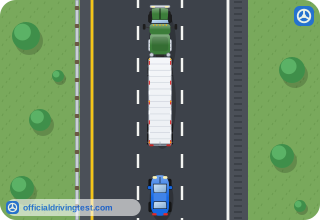
- Decrease it to see around the vehicle
- Increase it
- Keep it the same as usual
- Decrease it so others cannot pull in
Show answer
Correct answer: Increase it
The manual says to increase your following distance behind a large vehicle that blocks your vision.
Source: Virginia Driver's Manual (DMV 39 (April 27, 2026)), page 19 · Open this page in the manual (Manual page 19)
-
What is tailgating?
- When a driver stays in the left lane without passing
- When a driver passes another vehicle too closely
- When a driver follows a truck at a long distance
- When one driver follows another too closely
Show answer
Correct answer: When one driver follows another too closely
Tailgating is following another vehicle too closely.
Source: Virginia Driver's Manual (DMV 39 (April 27, 2026)), page 19 · Open this page in the manual (Manual page 19)
-
What should you do if you are being tailgated?
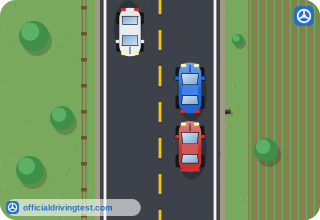
- If possible, move to another lane, or gently tap your brakes to flash your brake lights and slow down
- Brake suddenly and firmly so that the tailgater is forced to drop back and leave more room
- Speed up quickly to open a gap behind you
- Stop on the shoulder and wait for the driver to leave
Show answer
Correct answer: If possible, move to another lane, or gently tap your brakes to flash your brake lights and slow down
Do not brake suddenly; change lanes if you can, or gently tap the brakes to encourage the tailgater to pass or slow down.
Source: Virginia Driver's Manual (DMV 39 (April 27, 2026)), page 19 · Open this page in the manual (Manual page 19)
-
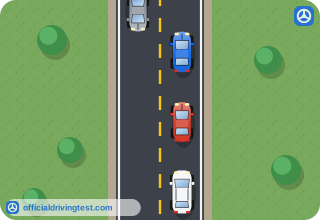
How can you warn the driver behind you that you plan to slow down or stop?
- Flash your headlights
- Move toward the edge of your lane
- Tap your brakes
- Sound your horn twice
Show answer
Correct answer: Tap your brakes
Tapping your brakes warns the driver behind you before you slow or stop.
Source: Virginia Driver's Manual (DMV 39 (April 27, 2026)), page 19 · Open this page in the manual (Manual page 19)
-
How can you help the driver behind you?
- By driving a few miles per hour below the speed limit
- By maintaining a safe following distance and a steady speed
- By staying in the left lane at all times
- By braking lightly every few seconds
Show answer
Correct answer: By maintaining a safe following distance and a steady speed
A safe following distance and steady speed make your driving predictable for the driver behind.
Source: Virginia Driver's Manual (DMV 39 (April 27, 2026)), page 19 · Open this page in the manual (Manual page 19)
-
What does searching mean?
- Looking only at the road directly in front of your vehicle
- Looking for a parking space before you reach your destination
- Looking at the mirrors every few seconds and nowhere else
- Looking at the entire scene for anything that might come into your path
Show answer
Correct answer: Looking at the entire scene for anything that might come into your path
Searching means scanning the whole scene for anything that might enter your path.
Source: Virginia Driver's Manual (DMV 39 (April 27, 2026)), page 19 · Open this page in the manual (Manual page 19)
-
As you search the road, what should you avoid?
- Staring at one thing
- Scanning from side to side
- Checking for traffic signs and signals
- Keeping your eyes moving
Show answer
Correct answer: Staring at one thing
Keep your eyes moving instead of staring at one thing or the middle of the road.
Source: Virginia Driver's Manual (DMV 39 (April 27, 2026)), page 19 · Open this page in the manual (Manual page 19)
-
How far ahead do expert drivers try to focus their eyes?
- 2 to 4 seconds ahead
- 5 to 10 seconds ahead
- 20 to 30 seconds ahead
- 40 to 50 seconds ahead
Show answer
Correct answer: 20 to 30 seconds ahead
Expert drivers try to focus their eyes 20 to 30 seconds ahead.
Source: Virginia Driver's Manual (DMV 39 (April 27, 2026)), page 19 · Open this page in the manual (Manual page 19)
-
In the city, about how far ahead is 20 to 30 seconds?
- About one car length
- About one block
- About three blocks
- About half a mile
Show answer
Correct answer: About one block
In the city, looking 20 to 30 seconds ahead equals approximately one block.
Source: Virginia Driver's Manual (DMV 39 (April 27, 2026)), page 19 · Open this page in the manual (Manual page 19)
-
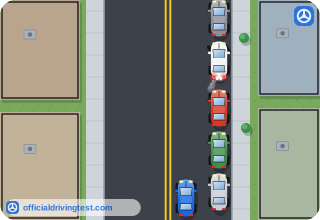
Exhaust smoke, brake lights, back-up lights and turned wheels on a vehicle are clues that:
- The vehicle is about to stop and wait for you
- The driver has seen you and will yield
- The vehicle is about to run out of fuel
- The vehicle may pull into your path
Show answer
Correct answer: The vehicle may pull into your path
These clues warn that the vehicle may pull into your path.
Source: Virginia Driver's Manual (DMV 39 (April 27, 2026)), page 19 · Open this page in the manual (Manual page 19)
-
When driving in rural areas, what should you watch for?
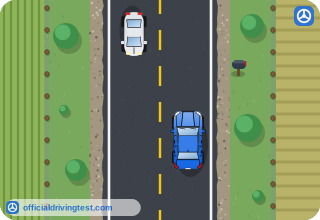
- Hidden intersections and driveways, curves, hills and different road conditions
- Parking meters, crosswalks and bus-only lanes
- Reversible lanes, parking meters, and electronic speed limit signs
- Bicycle boxes and pedestrian crossing beacons
Show answer
Correct answer: Hidden intersections and driveways, curves, hills and different road conditions
In rural areas, watch for hidden intersections and driveways, curves, hills and changing road conditions.
Source: Virginia Driver's Manual (DMV 39 (April 27, 2026)), page 19 · Open this page in the manual (Manual page 19)
-
About how often should you use your rearview mirror to check the traffic behind you?
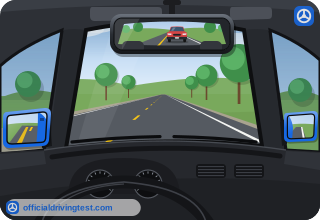
- About every 2 seconds
- About every 30 seconds
- About every 60 seconds
- About every 10 seconds
Show answer
Correct answer: About every 10 seconds
The manual says to check the traffic behind you frequently, about every 10 seconds.
Source: Virginia Driver's Manual (DMV 39 (April 27, 2026)), page 19 · Open this page in the manual (Manual page 19)
-
In addition to checking behind you frequently, when should you check the traffic behind you?
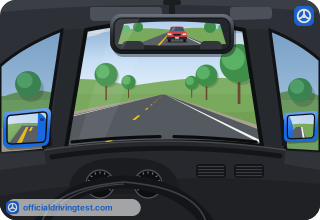
- When driving down a long, steep hill
- Only when another driver honks at you
- Only after you have stopped completely
- Only when you are about to park
Show answer
Correct answer: When driving down a long, steep hill
Check behind you when changing lanes, backing up, slowing down quickly or going down a long, steep hill.
Source: Virginia Driver's Manual (DMV 39 (April 27, 2026)), page 19 · Open this page in the manual (Manual page 19)
-
According to the manual, what is the single biggest contributor to crashes?
- Failing to identify a risk
- Bad weather
- Driving too slowly
- Looking too far down the road
Show answer
Correct answer: Failing to identify a risk
The manual says failing to identify a risk is the single biggest contributor to crashes.
Source: Virginia Driver's Manual (DMV 39 (April 27, 2026)), page 22 · Open this page in the manual (Manual page 22)
-
Where must you look while you are driving?
- Only at the vehicle directly ahead of you and at signs
- Mainly at the road surface just ahead of your hood
- Down the road only, so you can see far ahead
- Down the road, to the sides, and behind your vehicle
Show answer
Correct answer: Down the road, to the sides, and behind your vehicle
The manual says you must look down the road, to the sides, and behind your vehicle.
Source: Virginia Driver's Manual (DMV 39 (April 27, 2026)), page 22 · Open this page in the manual (Manual page 22)