Virginia: Speed and space
Virginia speed limits, reckless driving by speed, stopping distance, following distance and the space cushion. Split into 4 shorter tests so you're not stuck in one long quiz.
Independent educational site · not affiliated with any government agency or DMV
Choose a part
Speed and space — Part 1
Questions in this part include: “During rain, snow or ice, you are driving at or below the posted speed limit. Can you still be ticketed for speed?”
StartSpeed and space — Part 2
Questions in this part include: “Perception time, reaction distance and braking distance are all affected by which of these?”
StartSpeed and space — Part 3
Questions in this part include: “The hand and foot response times do not take into account a delay in what?”
StartSpeed and space — Part 4
Questions in this part include: “What should be your first response to decreased visibility and dangerous road conditions?”
StartAll 74 Speed and space questions with answers
Choose a part above to take a practice test, or study every question and answer here.
Show the questions and answersHide the questions
-
During rain, snow or ice, you are driving at or below the posted speed limit. Can you still be ticketed for speed?
- Yes, for driving too fast for the conditions
- No, because you are within the posted limit
- No, unless you are driving more than 10 MPH under the limit
- Yes, but only if you are in a school zone
Show answer
Correct answer: Yes, for driving too fast for the conditions
You may be ticketed for driving too fast for the conditions even at or below the posted limit.
Source: Virginia Driver's Manual (DMV 39 (April 27, 2026)), page 7 · Open this page in the manual (Manual page 7)
-
How does the manual define a speed limit?
- The average speed of traffic on a road when conditions are ideal
- The maximum legal speed you can travel on a road under ideal conditions
- The speed you should drive in every kind of weather and traffic
- The lowest speed you may travel on a road under ideal conditions
Show answer
Correct answer: The maximum legal speed you can travel on a road under ideal conditions
A speed limit is the highest legal speed on a road when conditions are ideal.
Source: Virginia Driver's Manual (DMV 39 (April 27, 2026)), page 14 · Open this page in the manual (Manual page 14)
-
You may drive slower than the speed limit as long as you:
- Stay in the left lane of the highway
- Turn on your hazard flashers while driving
- Keep your headlights on at all times
- Don’t impede the normal movement of traffic
Show answer
Correct answer: Don’t impede the normal movement of traffic
Driving slower than the limit is allowed only if it does not impede the normal movement of traffic.
Source: Virginia Driver's Manual (DMV 39 (April 27, 2026)), page 14 · Open this page in the manual (Manual page 14)
-
By law, when must you drive slower than the posted speed limit?
- When another driver is following you closely behind
- When you are driving on a highway with more than two lanes
- When road construction or bad weather make the posted speed unsafe
- When your vehicle is equipped with antilock brakes
Show answer
Correct answer: When road construction or bad weather make the posted speed unsafe
Conditions such as road construction or bad weather that make the posted speed unsafe require you to drive slower.
Source: Virginia Driver's Manual (DMV 39 (April 27, 2026)), page 14 · Open this page in the manual (Manual page 14)
-
Driving how many miles per hour (MPH) or more above the speed limit can lead a law enforcement officer to charge you with reckless driving?
- 20
- 5
- 10
- 15
Show answer
Correct answer: 20
Virginia law lets an officer charge reckless driving for driving 20 or more MPH above the limit.
Source: Virginia Driver's Manual (DMV 39 (April 27, 2026)), page 14 · Open this page in the manual (Manual page 14)
-
Regardless of the speed limit, driving over what speed can lead an officer to charge you with reckless driving?
- 65 MPH
- 70 MPH
- 75 MPH
- 85 MPH
Show answer
Correct answer: 85 MPH
Driving over 85 MPH can be charged as reckless driving no matter what the posted limit is.
Source: Virginia Driver's Manual (DMV 39 (April 27, 2026)), page 14 · Open this page in the manual (Manual page 14)
-
How is a conviction for reckless driving classified?
- As a civil offense that never goes to court
- As a misdemeanor criminal offense
- As a minor equipment violation
- As a non-criminal traffic infraction with no court date
Show answer
Correct answer: As a misdemeanor criminal offense
The manual says reckless driving is considered a misdemeanor criminal offense if you are convicted.
Source: Virginia Driver's Manual (DMV 39 (April 27, 2026)), page 14 · Open this page in the manual (Manual page 14)
-
Which of these may a court require or impose on a driver convicted of reckless driving?
- Loss of your vehicle to the state and a written warning
- A fine, a suspended driving privilege and/or a jail sentence
- Community service and an emissions inspection
- Only a written warning and a vehicle inspection
Show answer
Correct answer: A fine, a suspended driving privilege and/or a jail sentence
A conviction can bring a fine, a suspended driving privilege and/or jail time.
Source: Virginia Driver's Manual (DMV 39 (April 27, 2026)), page 14 · Open this page in the manual (Manual page 14)
-
A reckless driving violation may be considered a felony if:
- You drive more than 85 MPH on a highway and cause a crash
- It is your second reckless driving charge within one year
- It takes place in a school zone or a highway work zone
- It results in death while your license is suspended or revoked
Show answer
Correct answer: It results in death while your license is suspended or revoked
A reckless driving violation that causes a death while the license is suspended or revoked may be a felony.
Source: Virginia Driver's Manual (DMV 39 (April 27, 2026)), page 14 · Open this page in the manual (Manual page 14)
-
What additional fine applies if you are convicted of driving between 81 and 85 MPH in a 65-MPH zone?
- $100
- $50
- $150
- $250
Show answer
Correct answer: $100
The manual states an additional $100 fine for that conviction.
Source: Virginia Driver's Manual (DMV 39 (April 27, 2026)), page 14 · Open this page in the manual (Manual page 14)
-
What does Virginia law say about using radar detectors?
- They are legal for drivers age 21 or older
- They are legal only on interstate highways
- It is illegal to use them
- They are legal if mounted behind the rearview mirror
Show answer
Correct answer: It is illegal to use them
Using a radar detector is illegal in Virginia.
Source: Virginia Driver's Manual (DMV 39 (April 27, 2026)), page 14 · Open this page in the manual (Manual page 14)
-
Unless a sign says otherwise, what is the maximum speed limit for passenger vehicles and motorcycles in school, business and residential areas?
- 15 MPH
- 20 MPH
- 35 MPH
- 25 MPH
Show answer
Correct answer: 25 MPH
The default limit in school, business and residential areas is 25 MPH.
Source: Virginia Driver's Manual (DMV 39 (April 27, 2026)), page 15 · Open this page in the manual (Manual page 15)
-
Unless a sign says otherwise, what is the maximum speed limit for passenger vehicles and motorcycles on unpaved roads?
- 25 MPH
- 35 MPH
- 45 MPH
- 55 MPH
Show answer
Correct answer: 35 MPH
The default maximum on unpaved roads is 35 MPH.
Source: Virginia Driver's Manual (DMV 39 (April 27, 2026)), page 15 · Open this page in the manual (Manual page 15)
-
Unless a sign says otherwise, what is the maximum speed limit for passenger vehicles and motorcycles on roads other than school, business and residential areas and unpaved roads?
- 45 MPH
- 60 MPH
- 55 MPH
- 65 MPH
Show answer
Correct answer: 55 MPH
The default maximum for all other roads is 55 MPH.
Source: Virginia Driver's Manual (DMV 39 (April 27, 2026)), page 15 · Open this page in the manual (Manual page 15)
-
A school zone sign shows a camera symbol and the message “Speed Photo Enforced.” What does it indicate?
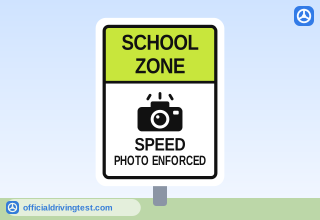
- The school zone may have automated photo enforcement
- The speed limit applies only on school days
- A crossing guard is always on duty at that spot
- You must stop completely before entering the zone
Show answer
Correct answer: The school zone may have automated photo enforcement
Signs with that message show that a school zone may use automated photo enforcement.
Source: Virginia Driver's Manual (DMV 39 (April 27, 2026)), page 15 · Open this page in the manual (Manual page 15)
-
Which three factors determine the distance it takes to stop your vehicle?
- Perception time, reaction distance and braking distance
- Reaction time, tire pressure and braking force
- Perception time, vehicle weight and braking distance
- Perception distance, road width and reaction time
Show answer
Correct answer: Perception time, reaction distance and braking distance
Stopping distance is made up of perception time, reaction distance and braking distance.
Source: Virginia Driver's Manual (DMV 39 (April 27, 2026)), page 15 · Open this page in the manual (Manual page 15)
-
What is perception time?
- The time it takes you to move your foot to the brake pedal
- The time your vehicle takes to stop after the brakes are applied
- The time it takes you to recognize a hazard
- The time between seeing a hazard and sounding your horn
Show answer
Correct answer: The time it takes you to recognize a hazard
Perception time is how long it takes you to recognize a hazard.
Source: Virginia Driver's Manual (DMV 39 (April 27, 2026)), page 15 · Open this page in the manual (Manual page 15)
-
What is reaction distance?
- The distance your vehicle travels between the time you apply the brakes and the time it stops
- The distance between your vehicle and the hazard at the moment you first recognize the problem
- The distance your vehicle travels from the time you start the engine until you apply the brakes
- The distance your vehicle travels between the time you recognize a problem and the time you apply the brakes
Show answer
Correct answer: The distance your vehicle travels between the time you recognize a problem and the time you apply the brakes
Reaction distance is how far the vehicle travels from the moment you recognize a problem until you apply the brakes.
Source: Virginia Driver's Manual (DMV 39 (April 27, 2026)), page 15 · Open this page in the manual (Manual page 15)
-
What is braking distance?
- The distance your car travels before you recognize a hazard
- The distance your car travels after you apply the brakes
- The distance your car travels while you decide whether to brake
- The distance your car travels between a hazard appearing and your foot touching the pedal
Show answer
Correct answer: The distance your car travels after you apply the brakes
Braking distance is how far the car goes after the brakes are applied.
Source: Virginia Driver's Manual (DMV 39 (April 27, 2026)), page 15 · Open this page in the manual (Manual page 15)
-
Perception time, reaction distance and braking distance are all affected by which of these?
- The color of your vehicle
- The width of the road
- Weather and visibility
- The number of passengers in your vehicle
Show answer
Correct answer: Weather and visibility
All three parts of stopping distance are affected by weather, visibility, and your mental and physical condition.
Source: Virginia Driver's Manual (DMV 39 (April 27, 2026)), page 15 · Open this page in the manual (Manual page 15)
-
Besides weather, visibility, and your mental and physical condition, which of these also affects braking distance?
- The condition of your brakes and tires
- The number of lanes on the road
- The color of your vehicle
- The type of fuel in your vehicle
Show answer
Correct answer: The condition of your brakes and tires
Braking distance is also affected by the condition of your brakes and tires.
Source: Virginia Driver's Manual (DMV 39 (April 27, 2026)), page 15 · Open this page in the manual (Manual page 15)
-
Apart from the condition of your brakes and tires, what else affects braking distance?
- How fast your vehicle is traveling
- How long you have held your license
- The size of the road signs nearby
- The number of vehicles behind you
Show answer
Correct answer: How fast your vehicle is traveling
Braking distance is also affected by how fast your vehicle is traveling.
Source: Virginia Driver's Manual (DMV 39 (April 27, 2026)), page 15 · Open this page in the manual (Manual page 15)
-
What can wet pavement do to your braking distance?
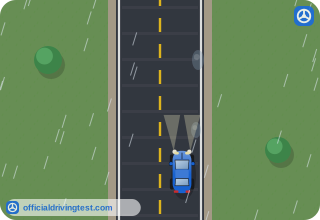
- Cut it in half
- Have no effect on it
- Double it
- Add only a few feet to it
Show answer
Correct answer: Double it
The manual says wet pavement can double your braking distance.
Source: Virginia Driver's Manual (DMV 39 (April 27, 2026)), page 15 · Open this page in the manual (Manual page 15)
-
What is the average stopping distance on dry, level pavement for a vehicle traveling 25 MPH?
- 65 feet
- 85 feet
- 105 feet
- 120 feet
Show answer
Correct answer: 85 feet
For 25 MPH the average stopping distance on dry, level pavement is 85 feet.
Source: Virginia Driver's Manual (DMV 39 (April 27, 2026)), page 15 · Open this page in the manual (Manual page 15)
-
What is the average stopping distance on dry, level pavement for a vehicle traveling 35 MPH?
- 115 feet
- 155 feet
- 175 feet
- 135 feet
Show answer
Correct answer: 135 feet
For 35 MPH the average stopping distance on dry, level pavement is 135 feet.
Source: Virginia Driver's Manual (DMV 39 (April 27, 2026)), page 15 · Open this page in the manual (Manual page 15)
-
What is the average stopping distance on dry, level pavement for a vehicle traveling 45 MPH?
- 165 feet
- 225 feet
- 195 feet
- 255 feet
Show answer
Correct answer: 195 feet
For 45 MPH the average stopping distance on dry, level pavement is 195 feet.
Source: Virginia Driver's Manual (DMV 39 (April 27, 2026)), page 15 · Open this page in the manual (Manual page 15)
-
What is the average stopping distance on dry, level pavement for a vehicle traveling 55 MPH?
- 265 feet
- 235 feet
- 295 feet
- 325 feet
Show answer
Correct answer: 265 feet
For 55 MPH the average stopping distance on dry, level pavement is 265 feet.
Source: Virginia Driver's Manual (DMV 39 (April 27, 2026)), page 15 · Open this page in the manual (Manual page 15)
-
What is the average stopping distance on dry, level pavement for a vehicle traveling 65 MPH?
- 304 feet
- 374 feet
- 404 feet
- 344 feet
Show answer
Correct answer: 344 feet
For 65 MPH the average stopping distance on dry, level pavement is 344 feet.
Source: Virginia Driver's Manual (DMV 39 (April 27, 2026)), page 15 · Open this page in the manual (Manual page 15)
-
How can you create a space cushion around your vehicle?
- By driving close to the right edge of your lane
- By driving on the line between two lanes
- By staying in the middle of your lane
- By staying close to the vehicle ahead of you
Show answer
Correct answer: By staying in the middle of your lane
Staying in the middle of your lane leaves room around your vehicle, and enough room ahead and behind for others to pass or stop safely.
Source: Virginia Driver's Manual (DMV 39 (April 27, 2026)), page 19 · Open this page in the manual (Manual page 19)
-
On a dry road at under 35 MPH, how many seconds of following distance does the manual give?
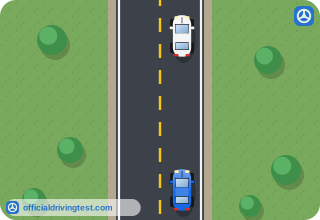
- 1 second
- 2 seconds
- 5 seconds
- 6 seconds
Show answer
Correct answer: 2 seconds
Under 35 MPH the following distance is 2 seconds.
Source: Virginia Driver's Manual (DMV 39 (April 27, 2026)), page 19 · Open this page in the manual (Manual page 19)
-
On a dry road at 35 to 45 MPH, how many seconds of following distance does the manual give?
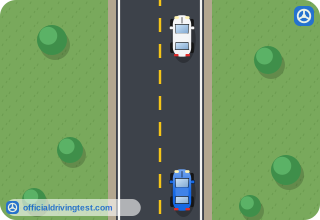
- 1 second
- 5 seconds
- 6 seconds
- 3 seconds
Show answer
Correct answer: 3 seconds
At 35 to 45 MPH the following distance is 3 seconds.
Source: Virginia Driver's Manual (DMV 39 (April 27, 2026)), page 19 · Open this page in the manual (Manual page 19)
-
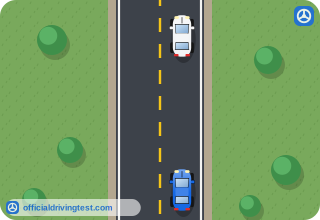
On a dry road at 46 to 70 MPH, how many seconds of following distance does the manual give?
- 4 seconds
- 1 second
- 2 seconds
- 6 seconds
Show answer
Correct answer: 4 seconds
At 46 to 70 MPH the following distance is 4 seconds.
Source: Virginia Driver's Manual (DMV 39 (April 27, 2026)), page 19 · Open this page in the manual (Manual page 19)
-
What does the manual say about the two-, three- and four-second following distances if you are speeding over 70 MPH?
- They still work as long as the road is dry
- They still work if you add one second
- The space cushions do not work
- They still work for passenger vehicles
Show answer
Correct answer: The space cushions do not work
The following distances only work up to 70 MPH; they do not work if you are speeding over 70.
Source: Virginia Driver's Manual (DMV 39 (April 27, 2026)), page 19 · Open this page in the manual (Manual page 19)
-
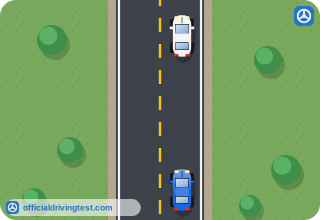
How do you use the following distance rule to check your distance behind the vehicle ahead?
- Count the seconds between your brake lights and the brake lights of the vehicle ahead
- Note when the vehicle ahead passes a fixed object, then count the seconds until you reach the same place
- Count the seconds you need to bring your vehicle to a full stop from your current speed
- Count the car lengths between your front bumper and the rear bumper ahead
Show answer
Correct answer: Note when the vehicle ahead passes a fixed object, then count the seconds until you reach the same place
You pick a fixed mark, watch the vehicle ahead pass it, and count the seconds until you reach the same spot.
Source: Virginia Driver's Manual (DMV 39 (April 27, 2026)), page 19 · Open this page in the manual (Manual page 19)
-
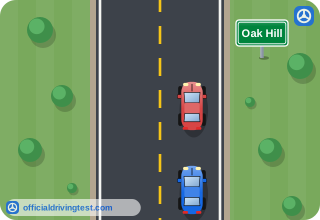
You reach the fixed mark before counting off two, three or four seconds, depending on your speed. What does this mean?
- You are following at a safe distance and can keep your current speed and position
- You are following too far behind and should move up
- You should speed up to pass the vehicle ahead
- You are following too closely and should slow down and increase your following distance
Show answer
Correct answer: You are following too closely and should slow down and increase your following distance
Reaching the mark too soon means you are following too closely, so you slow down and open up the gap.
Source: Virginia Driver's Manual (DMV 39 (April 27, 2026)), page 19 · Open this page in the manual (Manual page 19)
-
In which situation should you add extra seconds to your following distance?
- When your vehicle is in poor condition
- When the road is dry and the pavement is smooth
- When you are driving alone in your vehicle
- When you are driving during daylight hours
Show answer
Correct answer: When your vehicle is in poor condition
Bad weather, heavy traffic, poor pavement or a vehicle in poor condition all call for extra seconds of following distance.
Source: Virginia Driver's Manual (DMV 39 (April 27, 2026)), page 19 · Open this page in the manual (Manual page 19)
-
According to the manual, hand response time is close to how long?
- One second
- A quarter of a second
- A half second
- One and a half seconds
Show answer
Correct answer: A half second
Hand response time is close to a half second.
Source: Virginia Driver's Manual (DMV 39 (April 27, 2026)), page 19 · Open this page in the manual (Manual page 19)
-
According to the manual, foot response time is normally how long?
- A quarter of a second
- Three-quarters of a second
- One and a half seconds
- Two seconds
Show answer
Correct answer: Three-quarters of a second
Foot response time is normally three-quarters of a second.
Source: Virginia Driver's Manual (DMV 39 (April 27, 2026)), page 19 · Open this page in the manual (Manual page 19)
-
The hand and foot response times do not take into account a delay in what?
- Braking distance on wet or icy pavement, which is longer than on dry pavement
- Reaction distance at speeds over 70 MPH
- Stopping time of a heavy vehicle
- Perception time, such as when the driver is tired, on medication or distracted
Show answer
Correct answer: Perception time, such as when the driver is tired, on medication or distracted
The response times leave out any extra perception delay caused by a tired, medicated or distracted driver.
Source: Virginia Driver's Manual (DMV 39 (April 27, 2026)), page 19 · Open this page in the manual (Manual page 19)
-
Which of the following changes your ability to stop?
- The weight of the vehicle you are driving
- The color of the vehicle you are driving
- The number of lanes on the road
- The number of passengers wearing seat belts
Show answer
Correct answer: The weight of the vehicle you are driving
Road conditions, speed, driver alertness and the weight of the vehicle all change how well you can stop.
Source: Virginia Driver's Manual (DMV 39 (April 27, 2026)), page 19 · Open this page in the manual (Manual page 19)
-
When should you increase your following distance?
- When following a vehicle at the same speed on a dry road
- When driving under 35 MPH on a quiet street
- When exiting an expressway
- When the vehicle ahead is a small car
Show answer
Correct answer: When exiting an expressway
Exiting an expressway is one of the times the manual lists for adding following distance.
Source: Virginia Driver's Manual (DMV 39 (April 27, 2026)), page 19 · Open this page in the manual (Manual page 19)
-
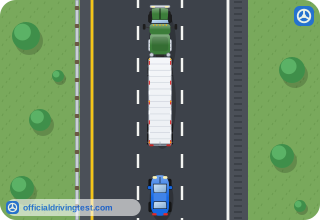
You are driving behind a large vehicle that blocks your vision. What should you do with your following distance?
- Decrease it to see around the vehicle
- Increase it
- Keep it the same as usual
- Decrease it so others cannot pull in
Show answer
Correct answer: Increase it
The manual says to increase your following distance behind a large vehicle that blocks your vision.
Source: Virginia Driver's Manual (DMV 39 (April 27, 2026)), page 19 · Open this page in the manual (Manual page 19)
-
What is tailgating?
- When a driver stays in the left lane without passing
- When a driver passes another vehicle too closely
- When a driver follows a truck at a long distance
- When one driver follows another too closely
Show answer
Correct answer: When one driver follows another too closely
Tailgating is following another vehicle too closely.
Source: Virginia Driver's Manual (DMV 39 (April 27, 2026)), page 19 · Open this page in the manual (Manual page 19)
-
What should you do if you are being tailgated?
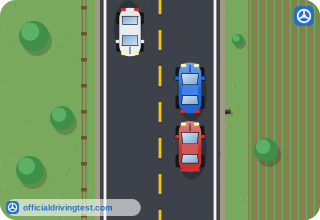
- If possible, move to another lane, or gently tap your brakes to flash your brake lights and slow down
- Brake suddenly and firmly so that the tailgater is forced to drop back and leave more room
- Speed up quickly to open a gap behind you
- Stop on the shoulder and wait for the driver to leave
Show answer
Correct answer: If possible, move to another lane, or gently tap your brakes to flash your brake lights and slow down
Do not brake suddenly; change lanes if you can, or gently tap the brakes to encourage the tailgater to pass or slow down.
Source: Virginia Driver's Manual (DMV 39 (April 27, 2026)), page 19 · Open this page in the manual (Manual page 19)
-
How can you warn the driver behind you that you plan to slow down or stop?
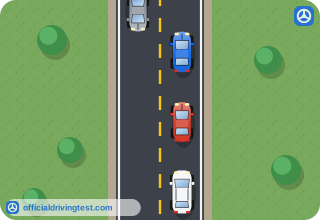
- Flash your headlights
- Move toward the edge of your lane
- Tap your brakes
- Sound your horn twice
Show answer
Correct answer: Tap your brakes
Tapping your brakes warns the driver behind you before you slow or stop.
Source: Virginia Driver's Manual (DMV 39 (April 27, 2026)), page 19 · Open this page in the manual (Manual page 19)
-
How can you help the driver behind you?
- By driving a few miles per hour below the speed limit
- By maintaining a safe following distance and a steady speed
- By staying in the left lane at all times
- By braking lightly every few seconds
Show answer
Correct answer: By maintaining a safe following distance and a steady speed
A safe following distance and steady speed make your driving predictable for the driver behind.
Source: Virginia Driver's Manual (DMV 39 (April 27, 2026)), page 19 · Open this page in the manual (Manual page 19)
-
What does searching mean?
- Looking only at the road directly in front of your vehicle
- Looking for a parking space before you reach your destination
- Looking at the mirrors every few seconds and nowhere else
- Looking at the entire scene for anything that might come into your path
Show answer
Correct answer: Looking at the entire scene for anything that might come into your path
Searching means scanning the whole scene for anything that might enter your path.
Source: Virginia Driver's Manual (DMV 39 (April 27, 2026)), page 19 · Open this page in the manual (Manual page 19)
-
As you search the road, what should you avoid?
- Staring at one thing
- Scanning from side to side
- Checking for traffic signs and signals
- Keeping your eyes moving
Show answer
Correct answer: Staring at one thing
Keep your eyes moving instead of staring at one thing or the middle of the road.
Source: Virginia Driver's Manual (DMV 39 (April 27, 2026)), page 19 · Open this page in the manual (Manual page 19)
-
How far ahead do expert drivers try to focus their eyes?
- 2 to 4 seconds ahead
- 5 to 10 seconds ahead
- 20 to 30 seconds ahead
- 40 to 50 seconds ahead
Show answer
Correct answer: 20 to 30 seconds ahead
Expert drivers try to focus their eyes 20 to 30 seconds ahead.
Source: Virginia Driver's Manual (DMV 39 (April 27, 2026)), page 19 · Open this page in the manual (Manual page 19)
-
In the city, about how far ahead is 20 to 30 seconds?
- About one car length
- About one block
- About three blocks
- About half a mile
Show answer
Correct answer: About one block
In the city, looking 20 to 30 seconds ahead equals approximately one block.
Source: Virginia Driver's Manual (DMV 39 (April 27, 2026)), page 19 · Open this page in the manual (Manual page 19)
-
Exhaust smoke, brake lights, back-up lights and turned wheels on a vehicle are clues that:
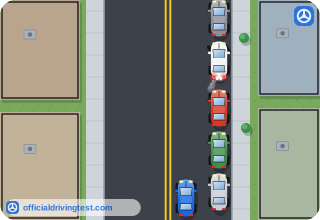
- The vehicle is about to stop and wait for you
- The driver has seen you and will yield
- The vehicle is about to run out of fuel
- The vehicle may pull into your path
Show answer
Correct answer: The vehicle may pull into your path
These clues warn that the vehicle may pull into your path.
Source: Virginia Driver's Manual (DMV 39 (April 27, 2026)), page 19 · Open this page in the manual (Manual page 19)
-
When driving in rural areas, what should you watch for?
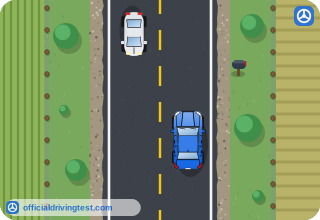
- Hidden intersections and driveways, curves, hills and different road conditions
- Parking meters, crosswalks and bus-only lanes
- Reversible lanes, parking meters, and electronic speed limit signs
- Bicycle boxes and pedestrian crossing beacons
Show answer
Correct answer: Hidden intersections and driveways, curves, hills and different road conditions
In rural areas, watch for hidden intersections and driveways, curves, hills and changing road conditions.
Source: Virginia Driver's Manual (DMV 39 (April 27, 2026)), page 19 · Open this page in the manual (Manual page 19)
-
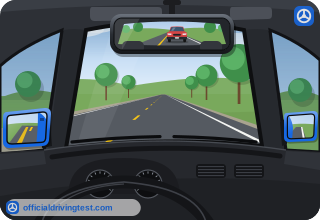
About how often should you use your rearview mirror to check the traffic behind you?
- About every 2 seconds
- About every 30 seconds
- About every 60 seconds
- About every 10 seconds
Show answer
Correct answer: About every 10 seconds
The manual says to check the traffic behind you frequently, about every 10 seconds.
Source: Virginia Driver's Manual (DMV 39 (April 27, 2026)), page 19 · Open this page in the manual (Manual page 19)
-
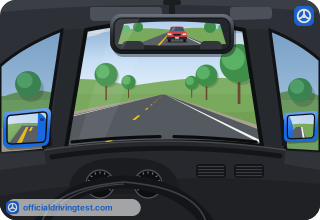
In addition to checking behind you frequently, when should you check the traffic behind you?
- When driving down a long, steep hill
- Only when another driver honks at you
- Only after you have stopped completely
- Only when you are about to park
Show answer
Correct answer: When driving down a long, steep hill
Check behind you when changing lanes, backing up, slowing down quickly or going down a long, steep hill.
Source: Virginia Driver's Manual (DMV 39 (April 27, 2026)), page 19 · Open this page in the manual (Manual page 19)
-
According to the manual, what is the single biggest contributor to crashes?
- Failing to identify a risk
- Bad weather
- Driving too slowly
- Looking too far down the road
Show answer
Correct answer: Failing to identify a risk
The manual says failing to identify a risk is the single biggest contributor to crashes.
Source: Virginia Driver's Manual (DMV 39 (April 27, 2026)), page 22 · Open this page in the manual (Manual page 22)
-
Where must you look while you are driving?
- Only at the vehicle directly ahead of you and at signs
- Mainly at the road surface just ahead of your hood
- Down the road only, so you can see far ahead
- Down the road, to the sides, and behind your vehicle
Show answer
Correct answer: Down the road, to the sides, and behind your vehicle
The manual says you must look down the road, to the sides, and behind your vehicle.
Source: Virginia Driver's Manual (DMV 39 (April 27, 2026)), page 22 · Open this page in the manual (Manual page 22)
-
What should be your first response to decreased visibility and dangerous road conditions?
- Turn on your hazard lights
- Move to the left lane
- Pull onto the shoulder and stop
- Reduce your speed
Show answer
Correct answer: Reduce your speed
Reducing speed is the first response to poor visibility or a slick road.
Source: Virginia Driver's Manual (DMV 39 (April 27, 2026)), page 23 · Open this page in the manual (Manual page 23)
-
How should you increase your space cushion when driving becomes hazardous?
- By keeping your normal following distance and braking earlier
- By increasing your following distance by about one-half
- By staying in the lane next to the shoulder
- By doubling your normal following distance
Show answer
Correct answer: By doubling your normal following distance
The manual says to increase the space cushion by doubling your normal following distance.
Source: Virginia Driver's Manual (DMV 39 (April 27, 2026)), page 23 · Open this page in the manual (Manual page 23)
-
In heavy fog, what can you look for to guide you?
- Road edge markings
- The glare of your own high beams
- The horns of other vehicles
- The headlights of oncoming vehicles
Show answer
Correct answer: Road edge markings
In heavy fog the road edge markings help you stay on the road.
Source: Virginia Driver's Manual (DMV 39 (April 27, 2026)), page 23 · Open this page in the manual (Manual page 23)
-
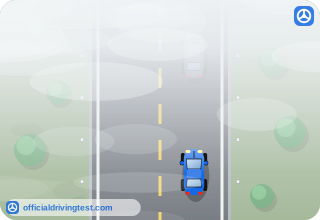
What can fog do to your own headlights?
- Make them shine farther down the road
- Dim them so they burn out
- Bend them toward the edge of the road
- Reflect them back into your eyes
Show answer
Correct answer: Reflect them back into your eyes
Fog reflects light, including your own headlights, back toward your eyes.
Source: Virginia Driver's Manual (DMV 39 (April 27, 2026)), page 23 · Open this page in the manual (Manual page 23)
-
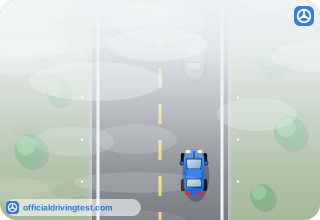
Even light fog reduces visibility and your ability to judge distances. What should you do?
- Speed up to leave the fog sooner
- Slow down
- Follow the vehicle ahead more closely
- Turn off your headlights
Show answer
Correct answer: Slow down
Because even light fog hurts visibility and distance judgment, you should slow down.
Source: Virginia Driver's Manual (DMV 39 (April 27, 2026)), page 23 · Open this page in the manual (Manual page 23)
-
Driving in heavy rain can be as hazardous as driving in what, especially if the wind is blowing?
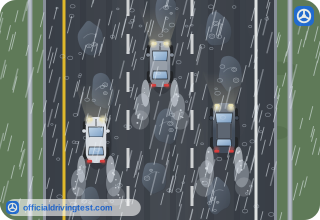
- Fog
- Snow
- Sleet
- Darkness
Show answer
Correct answer: Fog
The manual compares heavy rain, especially with wind, to the hazard of driving in fog.
Source: Virginia Driver's Manual (DMV 39 (April 27, 2026)), page 23 · Open this page in the manual (Manual page 23)
-
In the rain, which other vehicles are especially difficult to see?
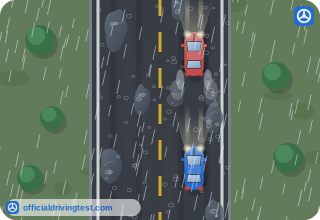
- Those directly ahead of you in your own lane
- Those parked on the shoulder
- Those to the rear and in blind spot areas
- Those that are coming toward you
Show answer
Correct answer: Those to the rear and in blind spot areas
Vehicles behind you and in your blind spots are the hardest to see in the rain.
Source: Virginia Driver's Manual (DMV 39 (April 27, 2026)), page 23 · Open this page in the manual (Manual page 23)
-
When rain begins, during which period are roads more likely to be slippery?
- The first two hours
- The first half-hour
- Only after the rain stops
- Only when the road is completely covered with water
Show answer
Correct answer: The first half-hour
Roads are more likely to be slippery during the first half-hour of rain.
Source: Virginia Driver's Manual (DMV 39 (April 27, 2026)), page 23 · Open this page in the manual (Manual page 23)
-
What makes roads slippery during the first half-hour of rain?
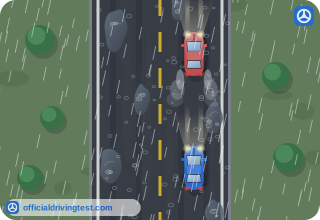
- Leaves and gravel washed into the lane
- Ice forming under the water
- Oil on the road surface mixing with water
- Water freezing on bridges
Show answer
Correct answer: Oil on the road surface mixing with water
Oil on the road surface mixes with the rain and makes the surface slippery.
Source: Virginia Driver's Manual (DMV 39 (April 27, 2026)), page 23 · Open this page in the manual (Manual page 23)
-
What should you do when you come to ponded water on the road?
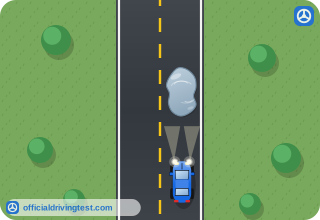
- Use caution and avoid it if possible
- Drive through it quickly to clear your tires
- Follow the tracks of the vehicle ahead through it
- Drive through it with your high beams on
Show answer
Correct answer: Use caution and avoid it if possible
Ponded water can make a vehicle lose control, so avoid it if you can.
Source: Virginia Driver's Manual (DMV 39 (April 27, 2026)), page 23 · Open this page in the manual (Manual page 23)
-
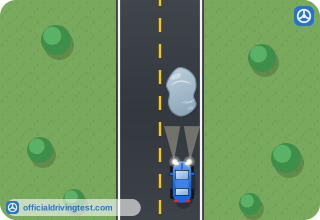
What can ponded water cause vehicles to do?
- Pull toward the shoulder of the road
- Hydroplane or otherwise lose control
- Stop in a much shorter distance
- Slow down on their own
Show answer
Correct answer: Hydroplane or otherwise lose control
Ponded water can make a vehicle hydroplane or lose control.
Source: Virginia Driver's Manual (DMV 39 (April 27, 2026)), page 23 · Open this page in the manual (Manual page 23)
-
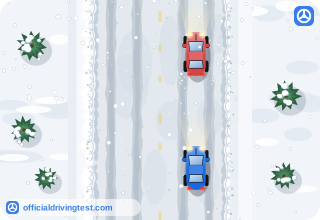
Driving on packed snow is similar to driving on what?
- Ice
- Wet pavement
- Loose gravel
- Dry pavement
Show answer
Correct answer: Ice
The manual says packed snow is similar to ice.
Source: Virginia Driver's Manual (DMV 39 (April 27, 2026)), page 23 · Open this page in the manual (Manual page 23)
-
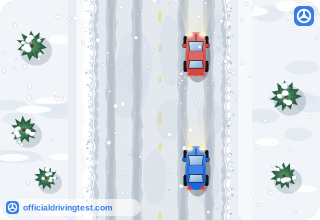
When you brake on packed snow, how should you apply the brakes?
- Hard
- In short, hard pumps
- Only at the last moment
- Gently
Show answer
Correct answer: Gently
On packed snow you brake gently.
Source: Virginia Driver's Manual (DMV 39 (April 27, 2026)), page 23 · Open this page in the manual (Manual page 23)
-
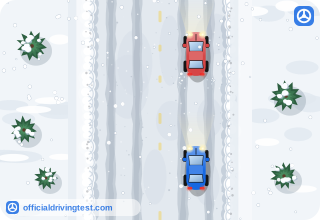
On packed snow, when should you slow down?
- After you start the turn
- Before stopping or turning
- Only after the car begins to skid
- Only while you are braking
Show answer
Correct answer: Before stopping or turning
You slow down before stopping or turning on packed snow.
Source: Virginia Driver's Manual (DMV 39 (April 27, 2026)), page 23 · Open this page in the manual (Manual page 23)
-
On a slippery surface, what should you do when you need to stop?
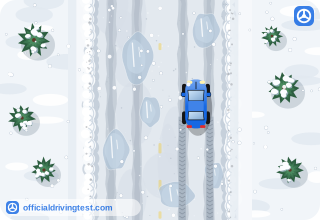
- Release the accelerator and apply the brakes gently
- Brake as hard as you can until the car stops
- Shift to neutral and let the car coast to a stop
- Pump the accelerator, then brake as hard as needed
Show answer
Correct answer: Release the accelerator and apply the brakes gently
You ease off the accelerator and brake gently when stopping on a slippery surface.
Source: Virginia Driver's Manual (DMV 39 (April 27, 2026)), page 23 · Open this page in the manual (Manual page 23)
-
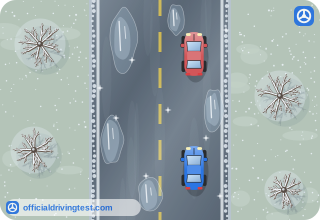
On slippery surfaces, when do you have the most traction and control?
- When the front wheels are locked
- When all four tires are skidding
- When the front tires are rolling
- When you are braking hard
Show answer
Correct answer: When the front tires are rolling
Front tires that are rolling give you the most traction and control.
Source: Virginia Driver's Manual (DMV 39 (April 27, 2026)), page 23 · Open this page in the manual (Manual page 23)
-
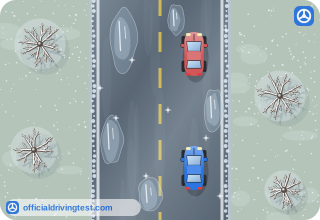
What will allow you to control your vehicle on a slippery surface?
- Braking hard and early
- Keeping a slow, steady speed rather than hard braking
- Speeding up slightly before every curve you reach
- Shifting into a lower gear and coasting
Show answer
Correct answer: Keeping a slow, steady speed rather than hard braking
A slow, steady speed rather than hard braking lets you control the vehicle.
Source: Virginia Driver's Manual (DMV 39 (April 27, 2026)), page 23 · Open this page in the manual (Manual page 23)
-
Which of these freezes before other road surfaces?
- Tunnels
- Hill crests
- Road shoulders
- Bridges
Show answer
Correct answer: Bridges
The manual says bridges freeze before other road surfaces.
Source: Virginia Driver's Manual (DMV 39 (April 27, 2026)), page 23 · Open this page in the manual (Manual page 23)