Virginia: Speed and space — Part 2 Practice Test
Questions in this part include: “Perception time, reaction distance and braking distance are all affected by which of these?” · “What is the average stopping distance on dry, level pavement for a vehicle traveling 55 MPH?”
Independent educational site · not affiliated with any government agency or DMV
Ready? Test yourself
- Instant feedback with an explanation
- Every answer cites its source in the manual
- Your best score is saved on this device
- Keyboard: press 1 to 4 to answer and Enter for the next question
Questions are original and based on the official manual "Virginia Driver's Manual" (DMV 39 (April 27, 2026)), Virginia Department of Motor Vehicles (DMV).
All 19 questions in this practice test
Take the test above first, then use this list to study. Tap “Show answer” to see the correct answer and explanation.
Show the questions and answersHide the questions
-
Perception time, reaction distance and braking distance are all affected by which of these?
- The color of your vehicle
- The width of the road
- Weather and visibility
- The number of passengers in your vehicle
Show answer
Correct answer: Weather and visibility
All three parts of stopping distance are affected by weather, visibility, and your mental and physical condition.
Source: Virginia Driver's Manual (DMV 39 (April 27, 2026)), page 15 · Open this page in the manual (Manual page 15)
-
Besides weather, visibility, and your mental and physical condition, which of these also affects braking distance?
- The condition of your brakes and tires
- The number of lanes on the road
- The color of your vehicle
- The type of fuel in your vehicle
Show answer
Correct answer: The condition of your brakes and tires
Braking distance is also affected by the condition of your brakes and tires.
Source: Virginia Driver's Manual (DMV 39 (April 27, 2026)), page 15 · Open this page in the manual (Manual page 15)
-
Apart from the condition of your brakes and tires, what else affects braking distance?
- How fast your vehicle is traveling
- How long you have held your license
- The size of the road signs nearby
- The number of vehicles behind you
Show answer
Correct answer: How fast your vehicle is traveling
Braking distance is also affected by how fast your vehicle is traveling.
Source: Virginia Driver's Manual (DMV 39 (April 27, 2026)), page 15 · Open this page in the manual (Manual page 15)
-
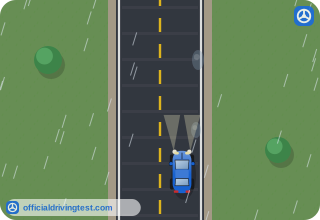
What can wet pavement do to your braking distance?
- Cut it in half
- Have no effect on it
- Double it
- Add only a few feet to it
Show answer
Correct answer: Double it
The manual says wet pavement can double your braking distance.
Source: Virginia Driver's Manual (DMV 39 (April 27, 2026)), page 15 · Open this page in the manual (Manual page 15)
-
What is the average stopping distance on dry, level pavement for a vehicle traveling 25 MPH?
- 65 feet
- 85 feet
- 105 feet
- 120 feet
Show answer
Correct answer: 85 feet
For 25 MPH the average stopping distance on dry, level pavement is 85 feet.
Source: Virginia Driver's Manual (DMV 39 (April 27, 2026)), page 15 · Open this page in the manual (Manual page 15)
-
What is the average stopping distance on dry, level pavement for a vehicle traveling 35 MPH?
- 115 feet
- 155 feet
- 175 feet
- 135 feet
Show answer
Correct answer: 135 feet
For 35 MPH the average stopping distance on dry, level pavement is 135 feet.
Source: Virginia Driver's Manual (DMV 39 (April 27, 2026)), page 15 · Open this page in the manual (Manual page 15)
-
What is the average stopping distance on dry, level pavement for a vehicle traveling 45 MPH?
- 165 feet
- 225 feet
- 195 feet
- 255 feet
Show answer
Correct answer: 195 feet
For 45 MPH the average stopping distance on dry, level pavement is 195 feet.
Source: Virginia Driver's Manual (DMV 39 (April 27, 2026)), page 15 · Open this page in the manual (Manual page 15)
-
What is the average stopping distance on dry, level pavement for a vehicle traveling 55 MPH?
- 265 feet
- 235 feet
- 295 feet
- 325 feet
Show answer
Correct answer: 265 feet
For 55 MPH the average stopping distance on dry, level pavement is 265 feet.
Source: Virginia Driver's Manual (DMV 39 (April 27, 2026)), page 15 · Open this page in the manual (Manual page 15)
-
What is the average stopping distance on dry, level pavement for a vehicle traveling 65 MPH?
- 304 feet
- 374 feet
- 404 feet
- 344 feet
Show answer
Correct answer: 344 feet
For 65 MPH the average stopping distance on dry, level pavement is 344 feet.
Source: Virginia Driver's Manual (DMV 39 (April 27, 2026)), page 15 · Open this page in the manual (Manual page 15)
-
How can you create a space cushion around your vehicle?
- By driving close to the right edge of your lane
- By driving on the line between two lanes
- By staying in the middle of your lane
- By staying close to the vehicle ahead of you
Show answer
Correct answer: By staying in the middle of your lane
Staying in the middle of your lane leaves room around your vehicle, and enough room ahead and behind for others to pass or stop safely.
Source: Virginia Driver's Manual (DMV 39 (April 27, 2026)), page 19 · Open this page in the manual (Manual page 19)
-
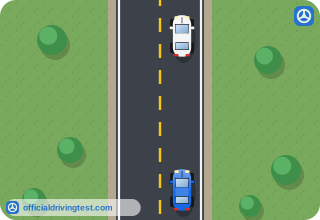
On a dry road at under 35 MPH, how many seconds of following distance does the manual give?
- 1 second
- 2 seconds
- 5 seconds
- 6 seconds
Show answer
Correct answer: 2 seconds
Under 35 MPH the following distance is 2 seconds.
Source: Virginia Driver's Manual (DMV 39 (April 27, 2026)), page 19 · Open this page in the manual (Manual page 19)
-
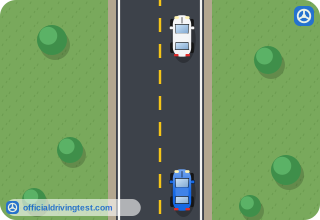
On a dry road at 35 to 45 MPH, how many seconds of following distance does the manual give?
- 1 second
- 5 seconds
- 6 seconds
- 3 seconds
Show answer
Correct answer: 3 seconds
At 35 to 45 MPH the following distance is 3 seconds.
Source: Virginia Driver's Manual (DMV 39 (April 27, 2026)), page 19 · Open this page in the manual (Manual page 19)
-
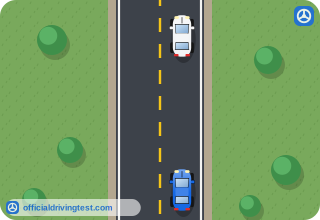
On a dry road at 46 to 70 MPH, how many seconds of following distance does the manual give?
- 4 seconds
- 1 second
- 2 seconds
- 6 seconds
Show answer
Correct answer: 4 seconds
At 46 to 70 MPH the following distance is 4 seconds.
Source: Virginia Driver's Manual (DMV 39 (April 27, 2026)), page 19 · Open this page in the manual (Manual page 19)
-
What does the manual say about the two-, three- and four-second following distances if you are speeding over 70 MPH?
- They still work as long as the road is dry
- They still work if you add one second
- The space cushions do not work
- They still work for passenger vehicles
Show answer
Correct answer: The space cushions do not work
The following distances only work up to 70 MPH; they do not work if you are speeding over 70.
Source: Virginia Driver's Manual (DMV 39 (April 27, 2026)), page 19 · Open this page in the manual (Manual page 19)
-
How do you use the following distance rule to check your distance behind the vehicle ahead?
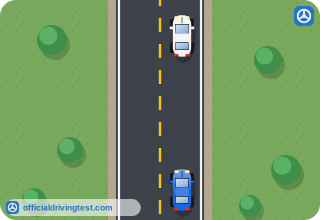
- Count the seconds between your brake lights and the brake lights of the vehicle ahead
- Note when the vehicle ahead passes a fixed object, then count the seconds until you reach the same place
- Count the seconds you need to bring your vehicle to a full stop from your current speed
- Count the car lengths between your front bumper and the rear bumper ahead
Show answer
Correct answer: Note when the vehicle ahead passes a fixed object, then count the seconds until you reach the same place
You pick a fixed mark, watch the vehicle ahead pass it, and count the seconds until you reach the same spot.
Source: Virginia Driver's Manual (DMV 39 (April 27, 2026)), page 19 · Open this page in the manual (Manual page 19)
-
You reach the fixed mark before counting off two, three or four seconds, depending on your speed. What does this mean?
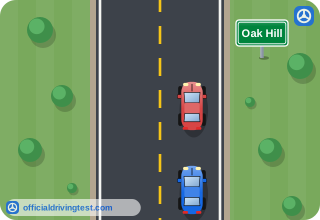
- You are following at a safe distance and can keep your current speed and position
- You are following too far behind and should move up
- You should speed up to pass the vehicle ahead
- You are following too closely and should slow down and increase your following distance
Show answer
Correct answer: You are following too closely and should slow down and increase your following distance
Reaching the mark too soon means you are following too closely, so you slow down and open up the gap.
Source: Virginia Driver's Manual (DMV 39 (April 27, 2026)), page 19 · Open this page in the manual (Manual page 19)
-
In which situation should you add extra seconds to your following distance?
- When your vehicle is in poor condition
- When the road is dry and the pavement is smooth
- When you are driving alone in your vehicle
- When you are driving during daylight hours
Show answer
Correct answer: When your vehicle is in poor condition
Bad weather, heavy traffic, poor pavement or a vehicle in poor condition all call for extra seconds of following distance.
Source: Virginia Driver's Manual (DMV 39 (April 27, 2026)), page 19 · Open this page in the manual (Manual page 19)
-
According to the manual, hand response time is close to how long?
- One second
- A quarter of a second
- A half second
- One and a half seconds
Show answer
Correct answer: A half second
Hand response time is close to a half second.
Source: Virginia Driver's Manual (DMV 39 (April 27, 2026)), page 19 · Open this page in the manual (Manual page 19)
-
According to the manual, foot response time is normally how long?
- A quarter of a second
- Three-quarters of a second
- One and a half seconds
- Two seconds
Show answer
Correct answer: Three-quarters of a second
Foot response time is normally three-quarters of a second.
Source: Virginia Driver's Manual (DMV 39 (April 27, 2026)), page 19 · Open this page in the manual (Manual page 19)