Virginia: Speed and space — Part 1 Practice Test
Questions in this part include: “During rain, snow or ice, you are driving at or below the posted speed limit. Can you still be ticketed for speed?” · “What additional fine applies if you are convicted of driving between 81 and 85 MPH in a 65-MPH zone?”
Independent educational site · not affiliated with any government agency or DMV
Ready? Test yourself
- Instant feedback with an explanation
- Every answer cites its source in the manual
- Your best score is saved on this device
- Keyboard: press 1 to 4 to answer and Enter for the next question
Questions are original and based on the official manual "Virginia Driver's Manual" (DMV 39 (April 27, 2026)), Virginia Department of Motor Vehicles (DMV).
All 19 questions in this practice test
Take the test above first, then use this list to study. Tap “Show answer” to see the correct answer and explanation.
Show the questions and answersHide the questions
-
During rain, snow or ice, you are driving at or below the posted speed limit. Can you still be ticketed for speed?
- Yes, for driving too fast for the conditions
- No, because you are within the posted limit
- No, unless you are driving more than 10 MPH under the limit
- Yes, but only if you are in a school zone
Show answer
Correct answer: Yes, for driving too fast for the conditions
You may be ticketed for driving too fast for the conditions even at or below the posted limit.
Source: Virginia Driver's Manual (DMV 39 (April 27, 2026)), page 7 · Open this page in the manual (Manual page 7)
-
How does the manual define a speed limit?
- The average speed of traffic on a road when conditions are ideal
- The maximum legal speed you can travel on a road under ideal conditions
- The speed you should drive in every kind of weather and traffic
- The lowest speed you may travel on a road under ideal conditions
Show answer
Correct answer: The maximum legal speed you can travel on a road under ideal conditions
A speed limit is the highest legal speed on a road when conditions are ideal.
Source: Virginia Driver's Manual (DMV 39 (April 27, 2026)), page 14 · Open this page in the manual (Manual page 14)
-
You may drive slower than the speed limit as long as you:
- Stay in the left lane of the highway
- Turn on your hazard flashers while driving
- Keep your headlights on at all times
- Don’t impede the normal movement of traffic
Show answer
Correct answer: Don’t impede the normal movement of traffic
Driving slower than the limit is allowed only if it does not impede the normal movement of traffic.
Source: Virginia Driver's Manual (DMV 39 (April 27, 2026)), page 14 · Open this page in the manual (Manual page 14)
-
By law, when must you drive slower than the posted speed limit?
- When another driver is following you closely behind
- When you are driving on a highway with more than two lanes
- When road construction or bad weather make the posted speed unsafe
- When your vehicle is equipped with antilock brakes
Show answer
Correct answer: When road construction or bad weather make the posted speed unsafe
Conditions such as road construction or bad weather that make the posted speed unsafe require you to drive slower.
Source: Virginia Driver's Manual (DMV 39 (April 27, 2026)), page 14 · Open this page in the manual (Manual page 14)
-
Driving how many miles per hour (MPH) or more above the speed limit can lead a law enforcement officer to charge you with reckless driving?
- 20
- 5
- 10
- 15
Show answer
Correct answer: 20
Virginia law lets an officer charge reckless driving for driving 20 or more MPH above the limit.
Source: Virginia Driver's Manual (DMV 39 (April 27, 2026)), page 14 · Open this page in the manual (Manual page 14)
-
Regardless of the speed limit, driving over what speed can lead an officer to charge you with reckless driving?
- 65 MPH
- 70 MPH
- 75 MPH
- 85 MPH
Show answer
Correct answer: 85 MPH
Driving over 85 MPH can be charged as reckless driving no matter what the posted limit is.
Source: Virginia Driver's Manual (DMV 39 (April 27, 2026)), page 14 · Open this page in the manual (Manual page 14)
-
How is a conviction for reckless driving classified?
- As a civil offense that never goes to court
- As a misdemeanor criminal offense
- As a minor equipment violation
- As a non-criminal traffic infraction with no court date
Show answer
Correct answer: As a misdemeanor criminal offense
The manual says reckless driving is considered a misdemeanor criminal offense if you are convicted.
Source: Virginia Driver's Manual (DMV 39 (April 27, 2026)), page 14 · Open this page in the manual (Manual page 14)
-
Which of these may a court require or impose on a driver convicted of reckless driving?
- Loss of your vehicle to the state and a written warning
- A fine, a suspended driving privilege and/or a jail sentence
- Community service and an emissions inspection
- Only a written warning and a vehicle inspection
Show answer
Correct answer: A fine, a suspended driving privilege and/or a jail sentence
A conviction can bring a fine, a suspended driving privilege and/or jail time.
Source: Virginia Driver's Manual (DMV 39 (April 27, 2026)), page 14 · Open this page in the manual (Manual page 14)
-
A reckless driving violation may be considered a felony if:
- You drive more than 85 MPH on a highway and cause a crash
- It is your second reckless driving charge within one year
- It takes place in a school zone or a highway work zone
- It results in death while your license is suspended or revoked
Show answer
Correct answer: It results in death while your license is suspended or revoked
A reckless driving violation that causes a death while the license is suspended or revoked may be a felony.
Source: Virginia Driver's Manual (DMV 39 (April 27, 2026)), page 14 · Open this page in the manual (Manual page 14)
-
What additional fine applies if you are convicted of driving between 81 and 85 MPH in a 65-MPH zone?
- $100
- $50
- $150
- $250
Show answer
Correct answer: $100
The manual states an additional $100 fine for that conviction.
Source: Virginia Driver's Manual (DMV 39 (April 27, 2026)), page 14 · Open this page in the manual (Manual page 14)
-
What does Virginia law say about using radar detectors?
- They are legal for drivers age 21 or older
- They are legal only on interstate highways
- It is illegal to use them
- They are legal if mounted behind the rearview mirror
Show answer
Correct answer: It is illegal to use them
Using a radar detector is illegal in Virginia.
Source: Virginia Driver's Manual (DMV 39 (April 27, 2026)), page 14 · Open this page in the manual (Manual page 14)
-
Unless a sign says otherwise, what is the maximum speed limit for passenger vehicles and motorcycles in school, business and residential areas?
- 15 MPH
- 20 MPH
- 35 MPH
- 25 MPH
Show answer
Correct answer: 25 MPH
The default limit in school, business and residential areas is 25 MPH.
Source: Virginia Driver's Manual (DMV 39 (April 27, 2026)), page 15 · Open this page in the manual (Manual page 15)
-
Unless a sign says otherwise, what is the maximum speed limit for passenger vehicles and motorcycles on unpaved roads?
- 25 MPH
- 35 MPH
- 45 MPH
- 55 MPH
Show answer
Correct answer: 35 MPH
The default maximum on unpaved roads is 35 MPH.
Source: Virginia Driver's Manual (DMV 39 (April 27, 2026)), page 15 · Open this page in the manual (Manual page 15)
-
Unless a sign says otherwise, what is the maximum speed limit for passenger vehicles and motorcycles on roads other than school, business and residential areas and unpaved roads?
- 45 MPH
- 60 MPH
- 55 MPH
- 65 MPH
Show answer
Correct answer: 55 MPH
The default maximum for all other roads is 55 MPH.
Source: Virginia Driver's Manual (DMV 39 (April 27, 2026)), page 15 · Open this page in the manual (Manual page 15)
-
A school zone sign shows a camera symbol and the message “Speed Photo Enforced.” What does it indicate?
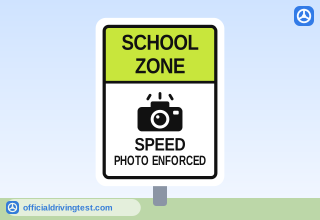
- The school zone may have automated photo enforcement
- The speed limit applies only on school days
- A crossing guard is always on duty at that spot
- You must stop completely before entering the zone
Show answer
Correct answer: The school zone may have automated photo enforcement
Signs with that message show that a school zone may use automated photo enforcement.
Source: Virginia Driver's Manual (DMV 39 (April 27, 2026)), page 15 · Open this page in the manual (Manual page 15)
-
Which three factors determine the distance it takes to stop your vehicle?
- Perception time, reaction distance and braking distance
- Reaction time, tire pressure and braking force
- Perception time, vehicle weight and braking distance
- Perception distance, road width and reaction time
Show answer
Correct answer: Perception time, reaction distance and braking distance
Stopping distance is made up of perception time, reaction distance and braking distance.
Source: Virginia Driver's Manual (DMV 39 (April 27, 2026)), page 15 · Open this page in the manual (Manual page 15)
-
What is perception time?
- The time it takes you to move your foot to the brake pedal
- The time your vehicle takes to stop after the brakes are applied
- The time it takes you to recognize a hazard
- The time between seeing a hazard and sounding your horn
Show answer
Correct answer: The time it takes you to recognize a hazard
Perception time is how long it takes you to recognize a hazard.
Source: Virginia Driver's Manual (DMV 39 (April 27, 2026)), page 15 · Open this page in the manual (Manual page 15)
-
What is reaction distance?
- The distance your vehicle travels between the time you apply the brakes and the time it stops
- The distance between your vehicle and the hazard at the moment you first recognize the problem
- The distance your vehicle travels from the time you start the engine until you apply the brakes
- The distance your vehicle travels between the time you recognize a problem and the time you apply the brakes
Show answer
Correct answer: The distance your vehicle travels between the time you recognize a problem and the time you apply the brakes
Reaction distance is how far the vehicle travels from the moment you recognize a problem until you apply the brakes.
Source: Virginia Driver's Manual (DMV 39 (April 27, 2026)), page 15 · Open this page in the manual (Manual page 15)
-
What is braking distance?
- The distance your car travels before you recognize a hazard
- The distance your car travels after you apply the brakes
- The distance your car travels while you decide whether to brake
- The distance your car travels between a hazard appearing and your foot touching the pedal
Show answer
Correct answer: The distance your car travels after you apply the brakes
Braking distance is how far the car goes after the brakes are applied.
Source: Virginia Driver's Manual (DMV 39 (April 27, 2026)), page 15 · Open this page in the manual (Manual page 15)