Virginia: Right-of-way, turning and passing — Part 3 Practice Test
Questions in this part include: “In which of these situations is passing unlawful and unsafe?” · “In business districts, cities and towns, where are U-turns allowed?”
Independent educational site · not affiliated with any government agency or DMV
Ready? Test yourself
- Instant feedback with an explanation
- Every answer cites its source in the manual
- Your best score is saved on this device
- Keyboard: press 1 to 4 to answer and Enter for the next question
Questions are original and based on the official manual "Virginia Driver's Manual" (DMV 39 (April 27, 2026)), Virginia Department of Motor Vehicles (DMV).
All 16 questions in this practice test
Take the test above first, then use this list to study. Tap “Show answer” to see the correct answer and explanation.
Show the questions and answersHide the questions
-
You are making a right turn and there is a red traffic light or a stop sign at the intersection. What must you do?
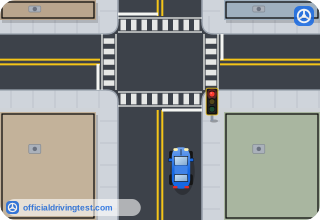
- Slow down and turn if no pedestrians are close
- Turn without stopping if no traffic is coming
- Come to a complete stop before you make the turn
- Stop only if another vehicle is waiting behind you
Show answer
Correct answer: Come to a complete stop before you make the turn
With a red light or a stop sign, you come to a complete stop before the right turn.
Source: Virginia Driver's Manual (DMV 39 (April 27, 2026)), page 18 · Open this page in the manual (Manual page 18)
-
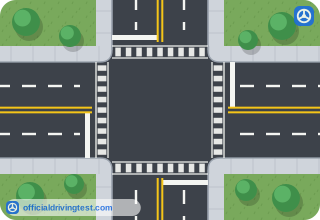
Into which lane should you turn when making a right turn, unless pavement markings lead you otherwise?
- The center lane of the road
- The lane closest to the curb
- The lane furthest from the curb
- Whichever lane is clearest
Show answer
Correct answer: The lane closest to the curb
You turn into the lane closest to the curb and change lanes afterward if needed.
Source: Virginia Driver's Manual (DMV 39 (April 27, 2026)), page 18 · Open this page in the manual (Manual page 18)
-
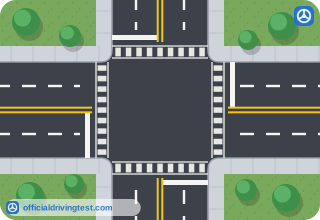
When making a left turn, which lane on the intersecting road should you generally turn into, unless pavement markings lead you otherwise or multiple left turn lanes are provided?
- The rightmost lane
- The lane closest to the curb
- The center lane
- The leftmost lane
Show answer
Correct answer: The leftmost lane
A left turn should go into the leftmost lane of the intersecting road, unless markings or multiple turn lanes say otherwise.
Source: Virginia Driver's Manual (DMV 39 (April 27, 2026)), page 18 · Open this page in the manual (Manual page 18)
-
If multiple left turn lanes are provided, which lane should you choose?
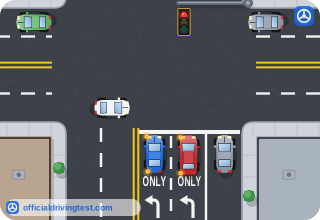
- The lane that will best serve your need once you enter the intersecting road
- The lane closest to the center line of the road
- The lane that is the least crowded at the time
- The lane that is furthest to the right of all the left turn lanes provided
Show answer
Correct answer: The lane that will best serve your need once you enter the intersecting road
With several left turn lanes, choose the one that best suits where you need to be after entering the intersecting road.
Source: Virginia Driver's Manual (DMV 39 (April 27, 2026)), page 18 · Open this page in the manual (Manual page 18)
-
Why should you keep your front wheels pointed straight ahead until you are actually going to make a left turn?
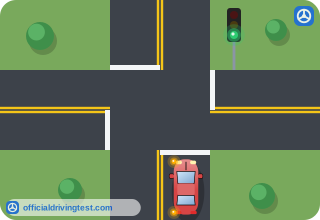
- So your vehicle stays centered in the lane while you wait for the oncoming traffic to clear
- So the turn signal keeps flashing while you wait
- So you are not pushed into oncoming traffic if another vehicle crashes into you from behind
- So you can see oncoming traffic more clearly
Show answer
Correct answer: So you are not pushed into oncoming traffic if another vehicle crashes into you from behind
If you are hit from behind while the wheels are turned left, you could be pushed into oncoming traffic; straight wheels prevent that.
Source: Virginia Driver's Manual (DMV 39 (April 27, 2026)), page 18 · Open this page in the manual (Manual page 18)
-
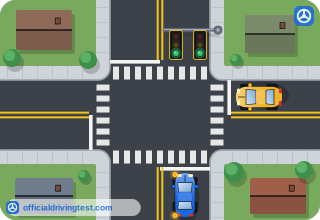
When making a left turn, which of the following must you yield to when the way is clear?
- Only motor vehicles approaching from behind you
- Vehicles, including bicycles and pedestrians, approaching from the opposite direction
- Only vehicles that are larger than your vehicle
- Only pedestrians who are already in the crosswalk beside your vehicle or ahead of it
Show answer
Correct answer: Vehicles, including bicycles and pedestrians, approaching from the opposite direction
A left-turning driver yields to anything approaching from the opposite direction, including bicycles and pedestrians.
Source: Virginia Driver's Manual (DMV 39 (April 27, 2026)), page 18 · Open this page in the manual (Manual page 18)
-
Two vehicles approach each other at an intersection, and both are signaling to turn left. How should they turn?
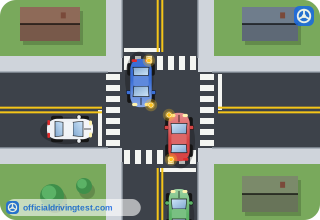
- Both turn behind each other so the driver sides of the vehicles are beside each other
- The vehicle on the right turns first while the other waits until the intersection is clear
- Both stop and wait until one of the drivers waves the other through the intersection
- Both turn in front of each other so the passenger sides of the vehicles are beside each other
Show answer
Correct answer: Both turn in front of each other so the passenger sides of the vehicles are beside each other
Two vehicles turning left toward each other pass in front of each other, keeping the passenger sides beside each other.
Source: Virginia Driver's Manual (DMV 39 (April 27, 2026)), page 18 · Open this page in the manual (Manual page 18)
-
In which of these situations is passing unlawful and unsafe?
- When a solid line marks the left side of your lane
- When the vehicle ahead is traveling below the speed limit
- When the vehicle ahead is a bicycle, moped or power-assisted bicycle
- When it is daytime and the road is dry
Show answer
Correct answer: When a solid line marks the left side of your lane
Passing is unlawful and unsafe when a solid line marks the left side of your lane.
Source: Virginia Driver's Manual (DMV 39 (April 27, 2026)), page 18 · Open this page in the manual (Manual page 18)
-
In business districts, cities and towns, where are U-turns allowed?
- Anywhere the road is clear of traffic
- Only at the end of a block
- Only at intersections
- Only on streets with a center turn lane
Show answer
Correct answer: Only at intersections
In business districts, cities and towns, U-turns are allowed only at intersections.
Source: Virginia Driver's Manual (DMV 39 (April 27, 2026)), page 18 · Open this page in the manual (Manual page 18)
-
Which statement about U-turns is correct?
- U-turns are legal everywhere unless a sign says otherwise
- Never make a U-turn on a highway
- A U-turn does not require a turn signal
- U-turns are allowed on a highway if no traffic is coming
Show answer
Correct answer: Never make a U-turn on a highway
U-turns are not legal everywhere, and the manual says never to make one on a highway.
Source: Virginia Driver's Manual (DMV 39 (April 27, 2026)), page 18 · Open this page in the manual (Manual page 18)
-
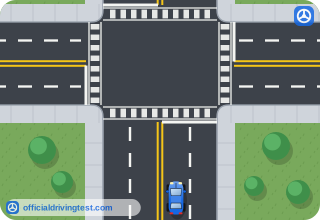
Before you make a U-turn, which signs should you look for?
- No Right Turn or No Turn on Red signs
- Do Not Pass or Keep Right signs
- Speed Limit or Yield signs
- No U-Turn or No Left Turn signs
Show answer
Correct answer: No U-Turn or No Left Turn signs
U-turns are not legal everywhere, so you check for No U-Turn or No Left Turn signs first.
Source: Virginia Driver's Manual (DMV 39 (April 27, 2026)), page 18 · Open this page in the manual (Manual page 18)
-
How should you begin a U-turn?
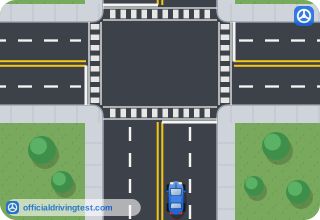
- Turn on your left-turn signal, stop, and yield for approaching traffic
- Turn on your right-turn signal, slow down, and swing wide into the far lane
- Turn on your left-turn signal and turn without stopping
- Sound your horn, stop, and wait for traffic to pass you
Show answer
Correct answer: Turn on your left-turn signal, stop, and yield for approaching traffic
For a U-turn you signal left, stop and yield to approaching traffic before proceeding.
Source: Virginia Driver's Manual (DMV 39 (April 27, 2026)), page 18 · Open this page in the manual (Manual page 18)
-
When the way is clear during a U-turn, which lane do you proceed into?
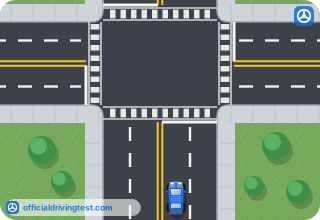
- The inside or left hand lane traveling in the opposite direction
- The center turn lane of the road
- The outside or right hand lane traveling in the opposite direction
- Whichever lane is empty in the opposite direction
Show answer
Correct answer: The outside or right hand lane traveling in the opposite direction
After a U-turn you end up in the outside, right-hand lane of the opposite direction.
Source: Virginia Driver's Manual (DMV 39 (April 27, 2026)), page 18 · Open this page in the manual (Manual page 18)
-
Why should you stay alert after you signal a turn?
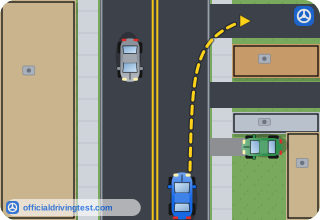
- Drivers turning into your lane may not know where you will turn and may pull out in front of you
- Other drivers will always yield to you as soon as they see your turn signal flashing
- Your signal tells pedestrians to cross behind you
- Drivers behind you are required to stop for your signal
Show answer
Correct answer: Drivers turning into your lane may not know where you will turn and may pull out in front of you
Other drivers cannot tell exactly where you will turn, so some may pull out in front of you.
Source: Virginia Driver's Manual (DMV 39 (April 27, 2026)), page 18 · Open this page in the manual (Manual page 18)
-
In what order should you look before entering an intersection?
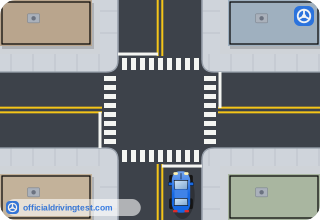
- Right, then left, then right again
- Left, then right, then straight ahead
- Left, then right, then left again
- Straight ahead, then right, then left
Show answer
Correct answer: Left, then right, then left again
Check left, right, and then left again, since cars from the left will be closer to you.
Source: Virginia Driver's Manual (DMV 39 (April 27, 2026)), page 19 · Open this page in the manual (Manual page 19)
-
At an intersection, why should you look to the left first?
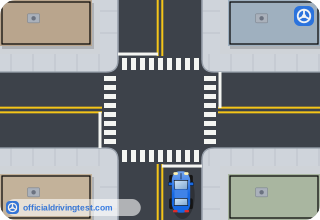
- Cars coming from the left always have the right-of-way
- Cars coming from the left will be closer to you
- Cars coming from the right are never a danger
- Cars coming from the left are traveling faster
Show answer
Correct answer: Cars coming from the left will be closer to you
Traffic from the left is closer to you than traffic from the right, so look left first.
Source: Virginia Driver's Manual (DMV 39 (April 27, 2026)), page 19 · Open this page in the manual (Manual page 19)