Virginia: Railroad crossings Practice Test
Crossbucks, flashing lights and gates, school buses at crossings, light rail, and a car stalled on the tracks.
Independent educational site · not affiliated with any government agency or DMV
Ready? Test yourself
- Instant feedback with an explanation
- Every answer cites its source in the manual
- Your best score is saved on this device
- Keyboard: press 1 to 4 to answer and Enter for the next question
Questions are original and based on the official manual "Virginia Driver's Manual" (DMV 39 (April 27, 2026)), Virginia Department of Motor Vehicles (DMV).
All 20 questions in this practice test
Take the test above first, then use this list to study. Tap “Show answer” to see the correct answer and explanation.
Show the questions and answersHide the questions
-
You are at a railroad crossing with a flashing red light and you do not see a train. What must you do?
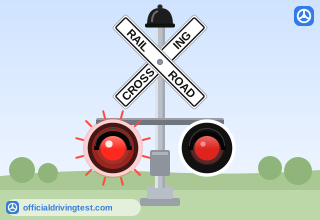
- Slow down and cross if no train is visible
- Come to a complete stop
- Stop only if you hear a train horn
- Yield to oncoming vehicles, then cross without stopping
Show answer
Correct answer: Come to a complete stop
At a railroad crossing you must come to a complete stop even if you do not see a train.
Source: Virginia Driver's Manual (DMV 39 (April 27, 2026)), page 5 · Open this page in the manual (Manual page 5)
-
What may happen at a low ground railroad crossing, where a steep slope meets the tracks?
- The wheels of a low vehicle may slip on the wet steel rails
- The exhaust system of a low vehicle may be damaged by heat
- The bottom of a low vehicle may get caught or drag on the tracks
- The engine of a low vehicle may stall in the dip of the road
Show answer
Correct answer: The bottom of a low vehicle may get caught or drag on the tracks
The low ground crossing sign warns that the steep slope can make low vehicles drag or get caught on the tracks.
Source: Virginia Driver's Manual (DMV 39 (April 27, 2026)), page 9 · Open this page in the manual (Manual page 9)
-
A round yellow sign with an X and the letters RR is placed before a railroad crossing. What does it warn you to do?
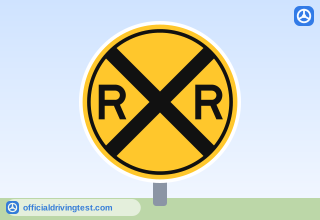
- Look, listen, slow down and be prepared to stop
- Stop, sound your horn and then proceed with care
- Speed up so that you clear the tracks quickly
- Yield only to trains coming from your left side
Show answer
Correct answer: Look, listen, slow down and be prepared to stop
Advance warning signs before a crossing warn you to look, listen, slow down and be ready to stop for trains or other vehicles on the rails.
Source: Virginia Driver's Manual (DMV 39 (April 27, 2026)), page 9 · Open this page in the manual (Manual page 9)
-
At a railroad crossing with more than one track, from where may trains be approaching?
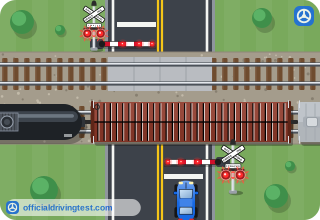
- Only from the direction of the nearest track
- Only from the direction the crossbuck faces
- Only from the right on the first track
- From either direction on either track
Show answer
Correct answer: From either direction on either track
The crossbuck warns that trains may come from either direction, and with several tracks, from either direction on any track.
Source: Virginia Driver's Manual (DMV 39 (April 27, 2026)), page 9 · Open this page in the manual (Manual page 9)
-
Flashing lights are used with a crossbuck sign. When may you proceed?
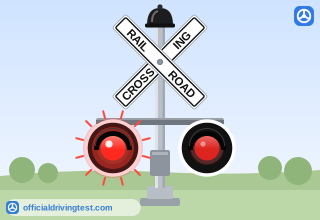
- When the first train has passed, even if the lights are still flashing
- When all trains have passed, the tracks are clear and the lights are no longer flashing
- When you see no train in either direction, even if the lights are flashing
- When you have waited ten seconds and no train is in sight
Show answer
Correct answer: When all trains have passed, the tracks are clear and the lights are no longer flashing
You must stay stopped until every train or other rail vehicle has passed, the tracks are clear and the lights have stopped flashing.
Source: Virginia Driver's Manual (DMV 39 (April 27, 2026)), page 9 · Open this page in the manual (Manual page 9)
-
Why should you be especially alert at a multitrack railroad crossing?
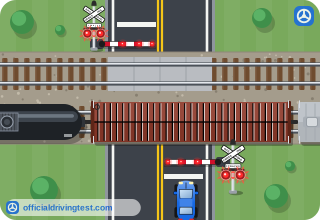
- A second train could be approaching from the opposite direction
- Trains on the second track always travel more slowly than the first
- The lights flash only for the track nearest to your vehicle
- The gate stays down only for the first train that passes
Show answer
Correct answer: A second train could be approaching from the opposite direction
At crossings with several tracks, a second train may be coming from the other direction while the first one passes.
Source: Virginia Driver's Manual (DMV 39 (April 27, 2026)), page 9 · Open this page in the manual (Manual page 9)
-
At a railroad crossing with flashing lights and a gate, when must you stop?
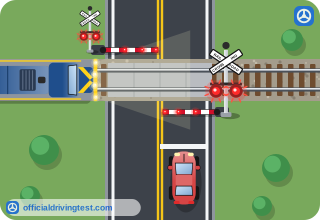
- Only after the gate has lowered across your lane
- Only when you can see a train approaching
- When the lights begin to flash and before the gate lowers
- Only when the gate is down and the bell stops
Show answer
Correct answer: When the lights begin to flash and before the gate lowers
The manual says to stop when the lights begin to flash, before the gate comes down.
Source: Virginia Driver's Manual (DMV 39 (April 27, 2026)), page 9 · Open this page in the manual (Manual page 9)
-
At a railroad crossing with a gate, how long must you remain stopped?
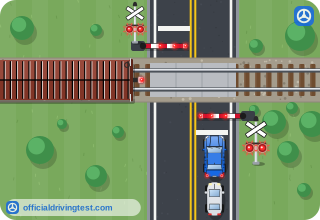
- Until the train horn can no longer be heard
- Until the gates are raised and the lights stop flashing
- Until you can see down the tracks in both directions
- Until the gate has risen at least halfway
Show answer
Correct answer: Until the gates are raised and the lights stop flashing
You must stay stopped until the gates are raised and the lights stop flashing, and you must never drive around a lowered gate.
Source: Virginia Driver's Manual (DMV 39 (April 27, 2026)), page 9 · Open this page in the manual (Manual page 9)
-
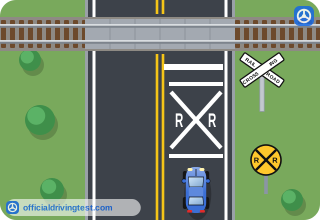
Where may pavement markings consisting of an X and RR be painted?
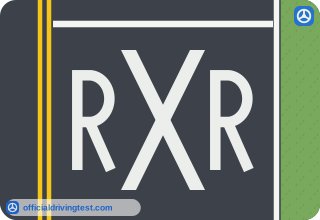
- On the pavement at the entrance to some work zones
- On the pavement at the start of some toll plazas
- On the pavement beside some school bus stops
- On the pavement at the approach to some railroad crossings
Show answer
Correct answer: On the pavement at the approach to some railroad crossings
The X and RR pavement markings may be painted at the approach to some railroad crossings.
Source: Virginia Driver's Manual (DMV 39 (April 27, 2026)), page 10 · Open this page in the manual (Manual page 10)
-
When may you start across railroad tracks?
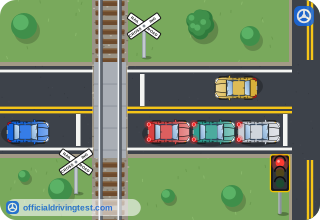
- Whenever you can see no train in either direction, even if there is little room on the other side
- As soon as the traffic ahead of you begins to move
- Whenever the crossing has no gate or flashing lights
- Only if you can clear the tracks completely, with room for your vehicle on the other side
Show answer
Correct answer: Only if you can clear the tracks completely, with room for your vehicle on the other side
Trains may come at any time from either direction, so you should not start across unless you can clear the tracks and have room on the other side.
Source: Virginia Driver's Manual (DMV 39 (April 27, 2026)), page 10 · Open this page in the manual (Manual page 10)
-
When must school buses stop at railroad crossings?
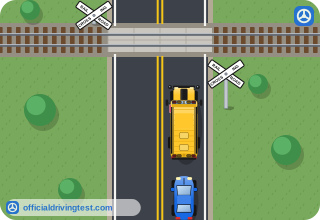
- Only when the lights are flashing and the gate is lowered
- Always, even when the lights are not flashing
- Only when students are on board
- Only when no gate is present
Show answer
Correct answer: Always, even when the lights are not flashing
The manual notes that school buses must always stop at railroad crossings, even if the lights are not flashing.
Source: Virginia Driver's Manual (DMV 39 (April 27, 2026)), page 10 · Open this page in the manual (Manual page 10)
-
What does calling the number listed on a railroad crossing emergency sign allow the rail company to do?
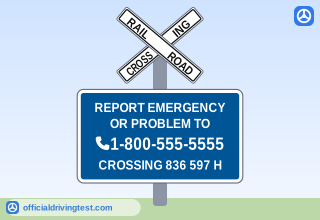
- Close the road to all car traffic until the hazard is removed
- Send a repair crew to the crossing within one hour
- Stop or reroute approaching rail traffic until the hazard is removed
- Turn off the flashing lights until the hazard is removed
Show answer
Correct answer: Stop or reroute approaching rail traffic until the hazard is removed
When there is a dangerous condition at a crossing, calling the emergency number lets the rail company stop or reroute trains.
Source: Virginia Driver's Manual (DMV 39 (April 27, 2026)), page 10 · Open this page in the manual (Manual page 10)
-
When you call the number on a railroad emergency sign about a dangerous condition, what must you be sure to give?
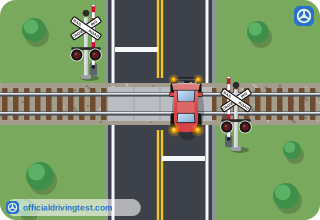
- The posted crossing number
- Your driver’s license number
- The license plate number of your vehicle
- The time of the next scheduled train
Show answer
Correct answer: The posted crossing number
The posted crossing number lets the rail company identify the hazard correctly.
Source: Virginia Driver's Manual (DMV 39 (April 27, 2026)), page 10 · Open this page in the manual (Manual page 10)
-
What should you do if your car stalls on the railroad tracks?
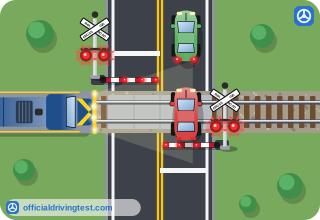
- Stay inside with your seat belt fastened and call for help right away
- Get out right away and run diagonally away from the tracks in the direction of the oncoming train
- Get out and push the vehicle off the tracks before the train arrives
- Get out right away and run diagonally away from the tracks, away from the oncoming train’s direction
Show answer
Correct answer: Get out right away and run diagonally away from the tracks in the direction of the oncoming train
You should not hesitate: leave the car immediately and run diagonally away from the tracks in the direction the train is coming from.
Source: Virginia Driver's Manual (DMV 39 (April 27, 2026)), page 10 · Open this page in the manual (Manual page 10)
-
What must you always do at a railroad crossing with flashing signals?
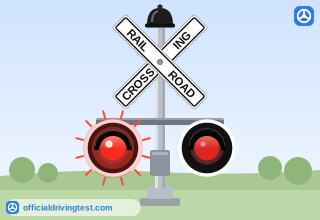
- Slow down and cross if no train is visible
- Stop your vehicle
- Stop only if you see a train
- Sound your horn and cross carefully
Show answer
Correct answer: Stop your vehicle
The manual lists railroad crossings with flashing signals among the places you must always stop.
Source: Virginia Driver's Manual (DMV 39 (April 27, 2026)), page 15 · Open this page in the manual (Manual page 15)
-
What should you never do around light rail when the crossing gates are lowered?
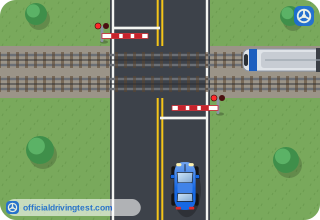
- Drive around them
- Wait for the train to pass
- Stop behind the crossing
- Look both ways before the gates rise
Show answer
Correct answer: Drive around them
The light rail tips say never to drive around lowered crossing gates.
Source: Virginia Driver's Manual (DMV 39 (April 27, 2026)), page 21 · Open this page in the manual (Manual page 21)
-
What should you do before turning across light rail train tracks?
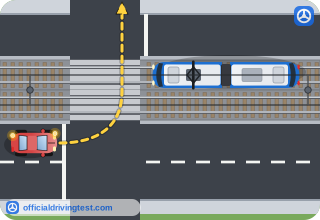
- Shift into a lower gear
- Speed up to clear the tracks quickly
- Look both ways
- Turn on your hazard flashers
Show answer
Correct answer: Look both ways
Always look both ways before turning across train tracks.
Source: Virginia Driver's Manual (DMV 39 (April 27, 2026)), page 21 · Open this page in the manual (Manual page 21)
-
Near light rail, on which track should you expect trains?
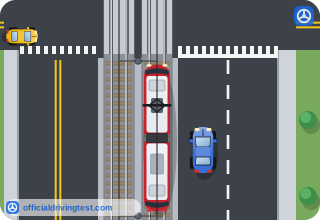
- Only the track nearest the curb
- Any track, at any time
- Only the track in the direction of traffic
- Only the tracks marked with signals
Show answer
Correct answer: Any track, at any time
The light rail tips say to expect trains on any track at any time.
Source: Virginia Driver's Manual (DMV 39 (April 27, 2026)), page 21 · Open this page in the manual (Manual page 21)
-
Which of these should you never do on train tracks?
- Signal a turn
- Check your mirrors
- Look both ways
- Stop, pass or shift
Show answer
Correct answer: Stop, pass or shift
Never stop, pass or shift on train tracks.
Source: Virginia Driver's Manual (DMV 39 (April 27, 2026)), page 21 · Open this page in the manual (Manual page 21)
-
When may you cross light rail train tracks?
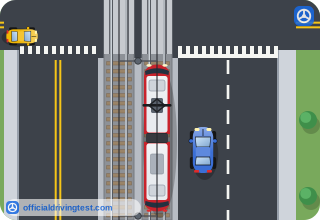
- Only when you have room to cross without stopping and can clear the tracks to a safe distance
- Whenever the crossing gates are raised
- Whenever no train is in sight
- Whenever the vehicle ahead of you is already crossing the tracks in front of you
Show answer
Correct answer: Only when you have room to cross without stopping and can clear the tracks to a safe distance
Cross only if you can get all the way across and clear the tracks without stopping.
Source: Virginia Driver's Manual (DMV 39 (April 27, 2026)), page 21 · Open this page in the manual (Manual page 21)