Virginia: Right-of-way, turning and passing
Who yields at intersections and roundabouts, turns and U-turns, changing lanes, and when passing is unlawful. Split into 3 shorter tests so you're not stuck in one long quiz.
Independent educational site · not affiliated with any government agency or DMV
Choose a part
Right-of-way, turning and passing — Part 1
Questions in this part include: “Vehicles from different directions arrive at an intersection at different times. Which vehicle goes first?”
StartRight-of-way, turning and passing — Part 2
Questions in this part include: “When may you pass on the right?”
StartRight-of-way, turning and passing — Part 3
Questions in this part include: “In which of these situations is passing unlawful and unsafe?”
StartAll 50 Right-of-way, turning and passing questions with answers
Choose a part above to take a practice test, or study every question and answer here.
Show the questions and answersHide the questions
-
At an all-way stop, you arrive at the same time as other vehicles. Who must yield?
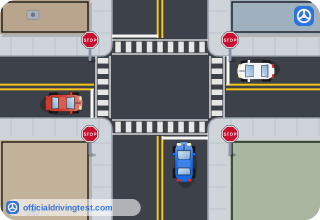
- The driver on the left must yield to the driver on the right
- The driver on the right must yield to the driver on the left
- The driver going straight must yield to the driver turning
- The driver in the larger vehicle must yield to the smaller one
Show answer
Correct answer: The driver on the left must yield to the driver on the right
When arriving together, the driver on the left yields to the driver on the right.
Source: Virginia Driver's Manual (DMV 39 (April 27, 2026)), page 6 · Open this page in the manual (Manual page 6)
-
You are approaching a stop sign and the car in front of you proceeds through it. What should you do?
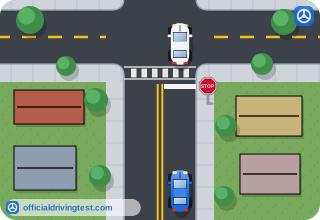
- Stop at the sign and proceed when the way is clear
- Follow the car through without stopping
- Slow down and proceed if no other traffic is visible
- Stop only if a pedestrian is nearby
Show answer
Correct answer: Stop at the sign and proceed when the way is clear
You must still stop at the sign yourself, even if the car ahead went on.
Source: Virginia Driver's Manual (DMV 39 (April 27, 2026)), page 15 · Open this page in the manual (Manual page 15)
-
What does yielding also mean if you cannot merge safely into the flow of traffic?
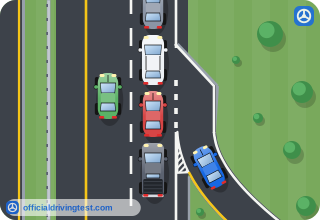
- To speed up and merge
- To sound your horn and merge
- To pull onto the shoulder
- To stop
Show answer
Correct answer: To stop
The manual says yield also means to stop if you cannot merge safely.
Source: Virginia Driver's Manual (DMV 39 (April 27, 2026)), page 16 · Open this page in the manual (Manual page 16)
-
Vehicles from different directions arrive at an intersection at different times. Which vehicle goes first?
- The one that arrives first
- The larger vehicle
- The faster vehicle
- The one traveling straight ahead
Show answer
Correct answer: The one that arrives first
When vehicles arrive at different times, the vehicle that arrives first goes first.
Source: Virginia Driver's Manual (DMV 39 (April 27, 2026)), page 16 · Open this page in the manual (Manual page 16)
-
Vehicles from different directions arrive at the same time at an intersection with no signs or signals. Who must go first?
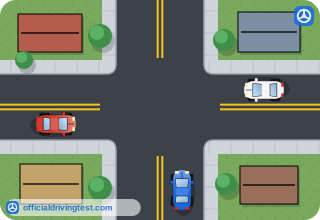
- The driver on the left
- The driver in the larger vehicle
- The driver on the right
- The driver going straight ahead
Show answer
Correct answer: The driver on the right
The driver on the left must let the driver on the right go first.
Source: Virginia Driver's Manual (DMV 39 (April 27, 2026)), page 16 · Open this page in the manual (Manual page 16)
-
The traffic lights at an intersection are not working. What must all vehicles coming to the intersection do?
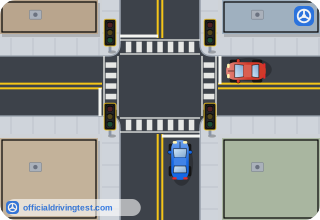
- Slow down and go through if no other vehicle is in sight
- Let the driver on the right wait while the driver on the left goes first
- Treat the intersection as having yield signs and proceed
- Stop, with the driver on the left yielding to the driver on the right
Show answer
Correct answer: Stop, with the driver on the left yielding to the driver on the right
With dead lights, all vehicles must stop, and the driver on the left yields to the driver on the right.
Source: Virginia Driver's Manual (DMV 39 (April 27, 2026)), page 16 · Open this page in the manual (Manual page 16)
-
What must you do when entering a roadway from a private road or driveway?
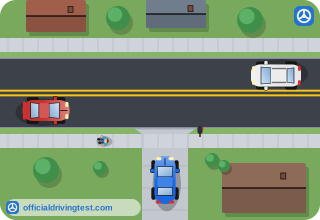
- Yield only to traffic already in your lane
- Slow down and yield only to pedestrians
- Stop and yield to all traffic and pedestrians
- Stop only if other traffic is approaching
Show answer
Correct answer: Stop and yield to all traffic and pedestrians
You must stop and yield to all traffic and pedestrians.
Source: Virginia Driver's Manual (DMV 39 (April 27, 2026)), page 16 · Open this page in the manual (Manual page 16)
-
What must you not do around a funeral procession?
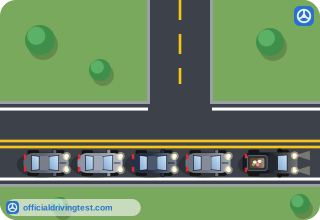
- Yield the right-of-way to it
- Wait for it to pass an intersection
- Cut through, join or interfere with it
- Slow down as it goes by
Show answer
Correct answer: Cut through, join or interfere with it
You must yield to funeral processions and never cut through, join or interfere with one.
Source: Virginia Driver's Manual (DMV 39 (April 27, 2026)), page 16 · Open this page in the manual (Manual page 16)
-
Unless led by a police escort, what must the lead vehicle in a funeral procession do?
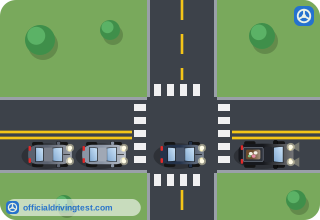
- Proceed through red lights if the others follow
- Obey all traffic signs and signals
- Stop only at red lights
- Use its hazard lights instead of stopping
Show answer
Correct answer: Obey all traffic signs and signals
Without a police escort, the lead vehicle must obey all traffic signs and signals.
Source: Virginia Driver's Manual (DMV 39 (April 27, 2026)), page 16 · Open this page in the manual (Manual page 16)
-
How may other drivers in a funeral procession show that they are part of it?
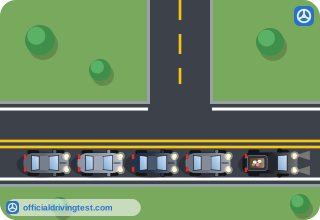
- By sounding their horns continuously
- By turning on their high-beam headlights
- By driving with their left turn signal on
- By using their hazard lights (flashers)
Show answer
Correct answer: By using their hazard lights (flashers)
Other drivers in the procession may use their hazard lights (flashers) to indicate they are in it.
Source: Virginia Driver's Manual (DMV 39 (April 27, 2026)), page 16 · Open this page in the manual (Manual page 16)
-
How must you treat a military convoy?
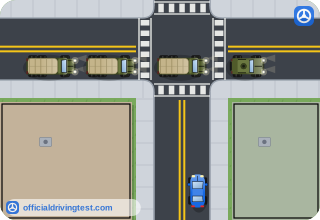
- Treat it like ordinary traffic and merge into it
- Yield only if it is led by a police escort
- Yield to it and never cut through or join it
- Yield only if its vehicles use flashing lights
Show answer
Correct answer: Yield to it and never cut through or join it
You must yield to all military convoys and never cut through or join one.
Source: Virginia Driver's Manual (DMV 39 (April 27, 2026)), page 16 · Open this page in the manual (Manual page 16)
-
After entering a roundabout, in which direction must drivers travel?
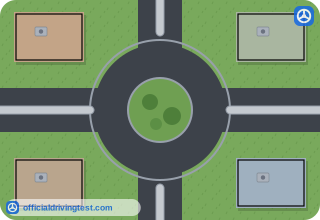
- Clockwise
- Whichever direction is shorter to the exit
- Toward the right edge only
- Counter-clockwise
Show answer
Correct answer: Counter-clockwise
Drivers must travel in a counter-clockwise direction after entering a roundabout.
Source: Virginia Driver's Manual (DMV 39 (April 27, 2026)), page 16 · Open this page in the manual (Manual page 16)
-
What should you do when approaching a roundabout?
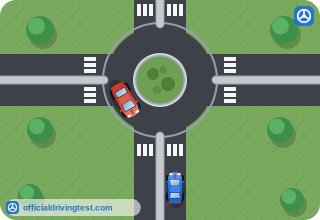
- Keep your speed and signal only at the moment you exit
- Move into the left lane whatever exit you plan to take
- Slow down and use your turn signals to show where you want to go
- Speed up to merge and use your horn
Show answer
Correct answer: Slow down and use your turn signals to show where you want to go
Slow down and use your turn signals to show where you want to go.
Source: Virginia Driver's Manual (DMV 39 (April 27, 2026)), page 16 · Open this page in the manual (Manual page 16)
-
If you plan to turn right at a roundabout, where should you stay as you enter?
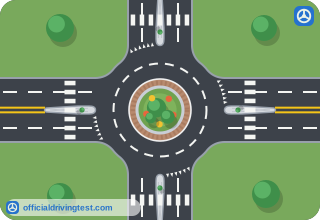
- To the right
- To the left
- In either lane
- Next to the center island
Show answer
Correct answer: To the right
To turn right, stay to the right as you enter the roundabout.
Source: Virginia Driver's Manual (DMV 39 (April 27, 2026)), page 16 · Open this page in the manual (Manual page 16)
-
If you plan to go straight at a dual lane roundabout, which lane may you use?
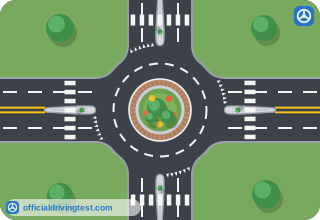
- Only the right lane
- Only the left lane
- The lane closest to the island
- Either lane
Show answer
Correct answer: Either lane
To go straight in a dual lane roundabout, you may stay in either lane.
Source: Virginia Driver's Manual (DMV 39 (April 27, 2026)), page 16 · Open this page in the manual (Manual page 16)
-
If you plan to turn left at a roundabout, where should you stay as you enter?
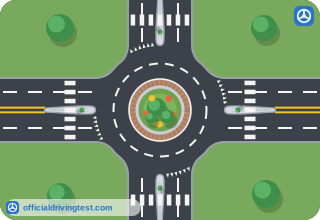
- To the right
- To the left
- In either lane
- On the outside edge
Show answer
Correct answer: To the left
To turn left, stay to the left as you enter the roundabout.
Source: Virginia Driver's Manual (DMV 39 (April 27, 2026)), page 16 · Open this page in the manual (Manual page 16)
-
As you approach a roundabout, what should you look for to know which exit to take?
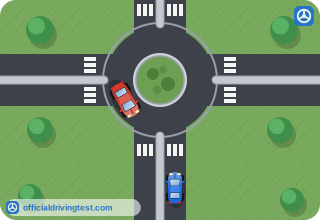
- Lane arrows painted on the island
- Street and direction signs
- Brake lights on the vehicles ahead
- Pedestrian crossing signals
Show answer
Correct answer: Street and direction signs
Street and direction signs posted before the roundabout help you know which exit to take.
Source: Virginia Driver's Manual (DMV 39 (April 27, 2026)), page 17 · Open this page in the manual (Manual page 17)
-
When you arrive at a roundabout, who must you yield the right-of-way to?
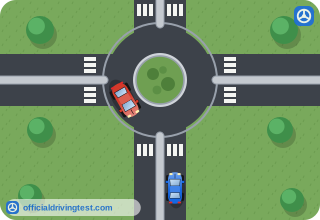
- Only the vehicles that are already in the roundabout circle
- Only vehicles entering from your right
- Only pedestrians in the crosswalk
- Pedestrians and bicyclists, and any vehicles already in the roundabout
Show answer
Correct answer: Pedestrians and bicyclists, and any vehicles already in the roundabout
You must yield to pedestrians and bicyclists, and to any vehicles already in the roundabout.
Source: Virginia Driver's Manual (DMV 39 (April 27, 2026)), page 17 · Open this page in the manual (Manual page 17)
-
While inside a roundabout, what should you do until you are ready to exit?
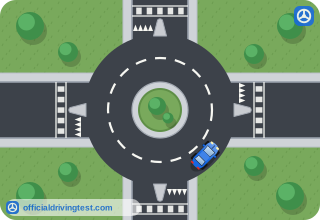
- Stay in your lane
- Move to the inside lane
- Move to the outside lane
- Stop and wait for pedestrians
Show answer
Correct answer: Stay in your lane
You should stay in your lane until you are ready to exit.
Source: Virginia Driver's Manual (DMV 39 (April 27, 2026)), page 17 · Open this page in the manual (Manual page 17)
-
While inside a roundabout, which signal should you use to let drivers around you know what you want to do?
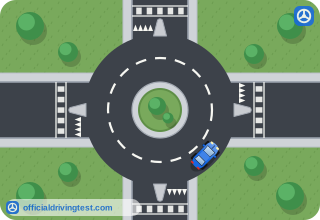
- Your vehicle’s left turn signal
- Your hazard flashers
- Your vehicle’s right turn signal
- Your high-beam headlights
Show answer
Correct answer: Your vehicle’s right turn signal
The manual says to use the vehicle’s right turn signal inside the roundabout.
Source: Virginia Driver's Manual (DMV 39 (April 27, 2026)), page 17 · Open this page in the manual (Manual page 17)
-
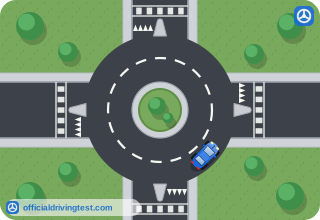
Before changing lanes or taking an exit in a roundabout, what should you check for?
- Vehicles waiting to enter the roundabout from the road you are leaving
- Whether the next exit road has a yield sign or a signal
- Whether the island has a pedestrian crossing
- Vehicles continuing through the roundabout next to you or behind you
Show answer
Correct answer: Vehicles continuing through the roundabout next to you or behind you
Check for vehicles continuing through in the lane next to you or behind you, including those in blind spots.
Source: Virginia Driver's Manual (DMV 39 (April 27, 2026)), page 17 · Open this page in the manual (Manual page 17)
-
What should you do first before changing lanes?
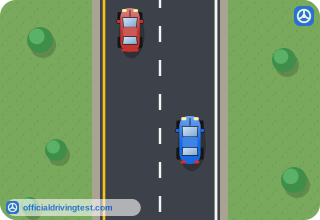
- Turn on your turn signal and start moving over
- Check your mirrors for traffic approaching from behind
- Look over your shoulder to check your blind spot
- Move partly into the other lane
Show answer
Correct answer: Check your mirrors for traffic approaching from behind
The first step is checking the side and rearview mirrors for traffic coming from behind; then you signal.
Source: Virginia Driver's Manual (DMV 39 (April 27, 2026)), page 17 · Open this page in the manual (Manual page 17)
-
After you signal that you plan to change lanes, what should you check for?
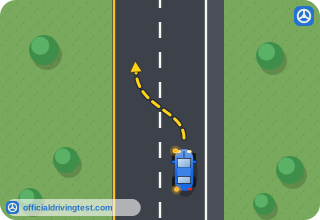
- Whether the lane ahead has a higher speed limit than yours
- Whether a bicycle lane is nearby
- Other drivers who also may be moving into the same lane
- Whether the vehicle ahead is turning
Show answer
Correct answer: Other drivers who also may be moving into the same lane
After signaling, check for other drivers who may also be moving into the same lane.
Source: Virginia Driver's Manual (DMV 39 (April 27, 2026)), page 17 · Open this page in the manual (Manual page 17)
-
Just before you begin moving into the other lane, what should you do?
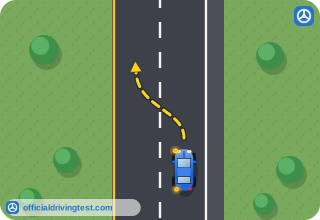
- Quickly glance over your shoulder to check your blind spot
- Tap your horn to warn the drivers in the next lane
- Brake lightly to slow down
- Flash your headlights at the vehicle behind
Show answer
Correct answer: Quickly glance over your shoulder to check your blind spot
Just before you move over, glance over your shoulder to check your blind spot.
Source: Virginia Driver's Manual (DMV 39 (April 27, 2026)), page 17 · Open this page in the manual (Manual page 17)
-
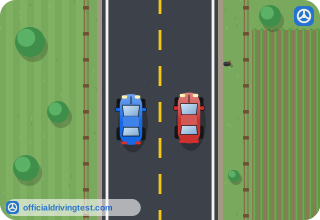
When may you return to the right lane after passing another vehicle?
- Only after you have passed the next intersection ahead of you
- Once you are at least 500 feet ahead of the passed vehicle
- As soon as the passed vehicle signals
- When you can see the passed vehicle’s front in your rearview mirror
Show answer
Correct answer: When you can see the passed vehicle’s front in your rearview mirror
Return to the right lane once the front of the passed vehicle is visible in your rearview mirror.
Source: Virginia Driver's Manual (DMV 39 (April 27, 2026)), page 17 · Open this page in the manual (Manual page 17)
-
May you exceed the speed limit while passing another vehicle?
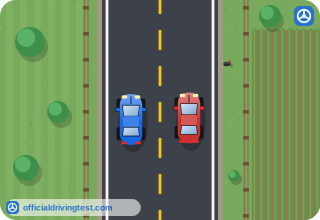
- Yes, by up to 5 MPH when the road ahead is clear
- Yes, if you complete the pass quickly
- No, it is against the law to exceed the speed limit
- Yes, on multi-lane highways only
Show answer
Correct answer: No, it is against the law to exceed the speed limit
It is against the law to exceed the speed limit when passing.
Source: Virginia Driver's Manual (DMV 39 (April 27, 2026)), page 17 · Open this page in the manual (Manual page 17)
-
When must you complete a pass in relation to a No Passing zone?
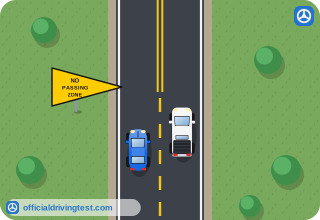
- Before you reach the zone
- Before you leave the zone
- Before the passed vehicle signals
- Within five seconds of starting to pass
Show answer
Correct answer: Before you reach the zone
You must finish passing before the No Passing zone; being in the left lane when you reach it breaks the law.
Source: Virginia Driver's Manual (DMV 39 (April 27, 2026)), page 17 · Open this page in the manual (Manual page 17)
-
When may you pass on the right?
- If the vehicle you are passing is driving below the speed limit
- If there is a wide paved shoulder beside the road
- If the vehicle ahead has signaled a right turn
- If the vehicle you are passing has signaled and is making a left turn
Show answer
Correct answer: If the vehicle you are passing has signaled and is making a left turn
You may pass on the right if the vehicle ahead has signaled and is making a left turn.
Source: Virginia Driver's Manual (DMV 39 (April 27, 2026)), page 17 · Open this page in the manual (Manual page 17)
-
When may you not pass on the right?
- If the vehicle you are passing is a large truck or a bus
- If you must drive off the pavement or main portion of the roadway
- If the vehicle you are passing is signaling a left turn
- If the road has two lanes in your direction of travel
Show answer
Correct answer: If you must drive off the pavement or main portion of the roadway
Passing on the right is not allowed when you would have to leave the pavement or the main portion of the roadway.
Source: Virginia Driver's Manual (DMV 39 (April 27, 2026)), page 17 · Open this page in the manual (Manual page 17)
-
What should you do when you are being passed?
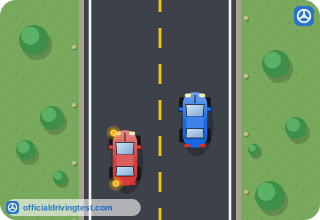
- Speed up to stay ahead of the other driver
- Move onto the shoulder
- Flash your headlights
- Maintain a steady speed or slow down
Show answer
Correct answer: Maintain a steady speed or slow down
When being passed, don’t speed up; keep a steady speed or slow down.
Source: Virginia Driver's Manual (DMV 39 (April 27, 2026)), page 17 · Open this page in the manual (Manual page 17)
-
Passing is unlawful and unsafe on hills, curves, at intersections or at railroad crossings, except on roads that have what?
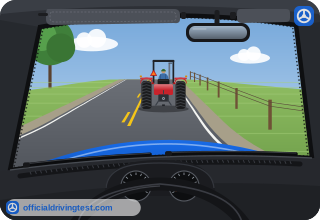
- Two or more lanes of traffic moving in the same direction
- A wide paved shoulder that vehicles may drive on safely
- A posted speed limit of 35 MPH or less on the road
- A center turn lane
Show answer
Correct answer: Two or more lanes of traffic moving in the same direction
Passing at these places is allowed only on roads with two or more lanes moving in the same direction.
Source: Virginia Driver's Manual (DMV 39 (April 27, 2026)), page 17 · Open this page in the manual (Manual page 17)
-
Which of these is unlawful and unsafe when passing?
- Passing in the left lane of a multi-lane highway
- Passing after you signal and check your blind spot
- Passing off the pavement or on the shoulder of the road
- Passing a slower vehicle on a road with two lanes in your direction
Show answer
Correct answer: Passing off the pavement or on the shoulder of the road
Passing off the pavement or on the shoulder is unlawful and unsafe.
Source: Virginia Driver's Manual (DMV 39 (April 27, 2026)), page 17 · Open this page in the manual (Manual page 17)
-
In which lane should you be to make a right turn?
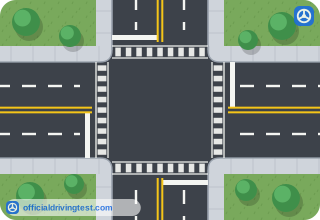
- The lane furthest to the left
- The center lane of the road
- Any lane that is clear
- The lane furthest to the right
Show answer
Correct answer: The lane furthest to the right
To make a right turn, you should be in the lane furthest to the right.
Source: Virginia Driver's Manual (DMV 39 (April 27, 2026)), page 18 · Open this page in the manual (Manual page 18)
-
How far ahead of a turn should you signal your intent to turn?
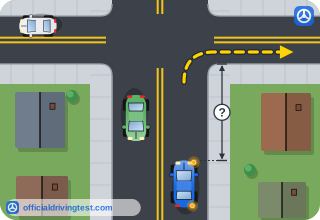
- At least three or four seconds (100 feet)
- At least one or two seconds (25 feet)
- At least five or six seconds (250 feet)
- Only at the moment you begin to turn
Show answer
Correct answer: At least three or four seconds (100 feet)
You should signal at least three or four seconds, 100 feet, before the turn.
Source: Virginia Driver's Manual (DMV 39 (April 27, 2026)), page 18 · Open this page in the manual (Manual page 18)
-
You are making a right turn and there is a red traffic light or a stop sign at the intersection. What must you do?
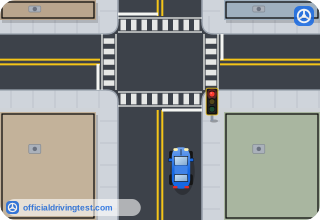
- Slow down and turn if no pedestrians are close
- Turn without stopping if no traffic is coming
- Come to a complete stop before you make the turn
- Stop only if another vehicle is waiting behind you
Show answer
Correct answer: Come to a complete stop before you make the turn
With a red light or a stop sign, you come to a complete stop before the right turn.
Source: Virginia Driver's Manual (DMV 39 (April 27, 2026)), page 18 · Open this page in the manual (Manual page 18)
-
Into which lane should you turn when making a right turn, unless pavement markings lead you otherwise?
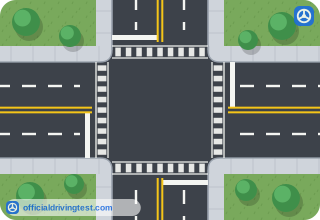
- The center lane of the road
- The lane closest to the curb
- The lane furthest from the curb
- Whichever lane is clearest
Show answer
Correct answer: The lane closest to the curb
You turn into the lane closest to the curb and change lanes afterward if needed.
Source: Virginia Driver's Manual (DMV 39 (April 27, 2026)), page 18 · Open this page in the manual (Manual page 18)
-
When making a left turn, which lane on the intersecting road should you generally turn into, unless pavement markings lead you otherwise or multiple left turn lanes are provided?
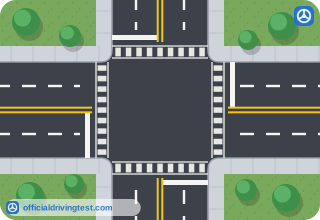
- The rightmost lane
- The lane closest to the curb
- The center lane
- The leftmost lane
Show answer
Correct answer: The leftmost lane
A left turn should go into the leftmost lane of the intersecting road, unless markings or multiple turn lanes say otherwise.
Source: Virginia Driver's Manual (DMV 39 (April 27, 2026)), page 18 · Open this page in the manual (Manual page 18)
-
If multiple left turn lanes are provided, which lane should you choose?
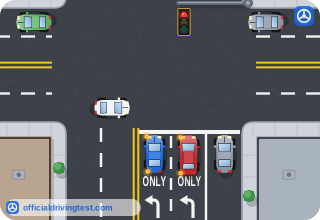
- The lane that will best serve your need once you enter the intersecting road
- The lane closest to the center line of the road
- The lane that is the least crowded at the time
- The lane that is furthest to the right of all the left turn lanes provided
Show answer
Correct answer: The lane that will best serve your need once you enter the intersecting road
With several left turn lanes, choose the one that best suits where you need to be after entering the intersecting road.
Source: Virginia Driver's Manual (DMV 39 (April 27, 2026)), page 18 · Open this page in the manual (Manual page 18)
-
Why should you keep your front wheels pointed straight ahead until you are actually going to make a left turn?
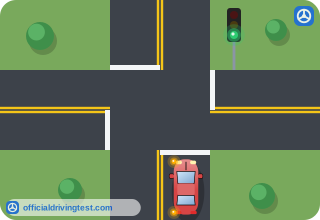
- So your vehicle stays centered in the lane while you wait for the oncoming traffic to clear
- So the turn signal keeps flashing while you wait
- So you are not pushed into oncoming traffic if another vehicle crashes into you from behind
- So you can see oncoming traffic more clearly
Show answer
Correct answer: So you are not pushed into oncoming traffic if another vehicle crashes into you from behind
If you are hit from behind while the wheels are turned left, you could be pushed into oncoming traffic; straight wheels prevent that.
Source: Virginia Driver's Manual (DMV 39 (April 27, 2026)), page 18 · Open this page in the manual (Manual page 18)
-
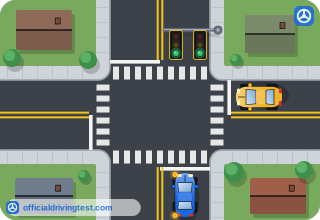
When making a left turn, which of the following must you yield to when the way is clear?
- Only motor vehicles approaching from behind you
- Vehicles, including bicycles and pedestrians, approaching from the opposite direction
- Only vehicles that are larger than your vehicle
- Only pedestrians who are already in the crosswalk beside your vehicle or ahead of it
Show answer
Correct answer: Vehicles, including bicycles and pedestrians, approaching from the opposite direction
A left-turning driver yields to anything approaching from the opposite direction, including bicycles and pedestrians.
Source: Virginia Driver's Manual (DMV 39 (April 27, 2026)), page 18 · Open this page in the manual (Manual page 18)
-
Two vehicles approach each other at an intersection, and both are signaling to turn left. How should they turn?
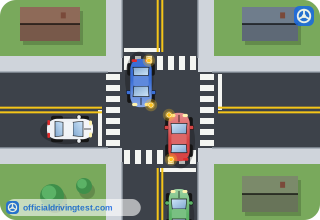
- Both turn behind each other so the driver sides of the vehicles are beside each other
- The vehicle on the right turns first while the other waits until the intersection is clear
- Both stop and wait until one of the drivers waves the other through the intersection
- Both turn in front of each other so the passenger sides of the vehicles are beside each other
Show answer
Correct answer: Both turn in front of each other so the passenger sides of the vehicles are beside each other
Two vehicles turning left toward each other pass in front of each other, keeping the passenger sides beside each other.
Source: Virginia Driver's Manual (DMV 39 (April 27, 2026)), page 18 · Open this page in the manual (Manual page 18)
-
In which of these situations is passing unlawful and unsafe?
- When a solid line marks the left side of your lane
- When the vehicle ahead is traveling below the speed limit
- When the vehicle ahead is a bicycle, moped or power-assisted bicycle
- When it is daytime and the road is dry
Show answer
Correct answer: When a solid line marks the left side of your lane
Passing is unlawful and unsafe when a solid line marks the left side of your lane.
Source: Virginia Driver's Manual (DMV 39 (April 27, 2026)), page 18 · Open this page in the manual (Manual page 18)
-
In business districts, cities and towns, where are U-turns allowed?
- Anywhere the road is clear of traffic
- Only at the end of a block
- Only at intersections
- Only on streets with a center turn lane
Show answer
Correct answer: Only at intersections
In business districts, cities and towns, U-turns are allowed only at intersections.
Source: Virginia Driver's Manual (DMV 39 (April 27, 2026)), page 18 · Open this page in the manual (Manual page 18)
-
Which statement about U-turns is correct?
- U-turns are legal everywhere unless a sign says otherwise
- Never make a U-turn on a highway
- A U-turn does not require a turn signal
- U-turns are allowed on a highway if no traffic is coming
Show answer
Correct answer: Never make a U-turn on a highway
U-turns are not legal everywhere, and the manual says never to make one on a highway.
Source: Virginia Driver's Manual (DMV 39 (April 27, 2026)), page 18 · Open this page in the manual (Manual page 18)
-
Before you make a U-turn, which signs should you look for?
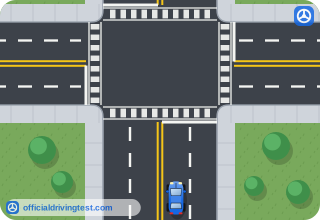
- No Right Turn or No Turn on Red signs
- Do Not Pass or Keep Right signs
- Speed Limit or Yield signs
- No U-Turn or No Left Turn signs
Show answer
Correct answer: No U-Turn or No Left Turn signs
U-turns are not legal everywhere, so you check for No U-Turn or No Left Turn signs first.
Source: Virginia Driver's Manual (DMV 39 (April 27, 2026)), page 18 · Open this page in the manual (Manual page 18)
-
How should you begin a U-turn?
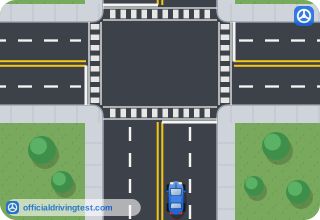
- Turn on your left-turn signal, stop, and yield for approaching traffic
- Turn on your right-turn signal, slow down, and swing wide into the far lane
- Turn on your left-turn signal and turn without stopping
- Sound your horn, stop, and wait for traffic to pass you
Show answer
Correct answer: Turn on your left-turn signal, stop, and yield for approaching traffic
For a U-turn you signal left, stop and yield to approaching traffic before proceeding.
Source: Virginia Driver's Manual (DMV 39 (April 27, 2026)), page 18 · Open this page in the manual (Manual page 18)
-
When the way is clear during a U-turn, which lane do you proceed into?
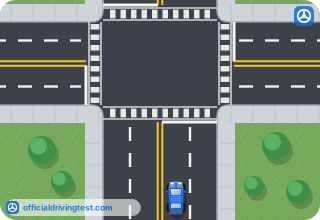
- The inside or left hand lane traveling in the opposite direction
- The center turn lane of the road
- The outside or right hand lane traveling in the opposite direction
- Whichever lane is empty in the opposite direction
Show answer
Correct answer: The outside or right hand lane traveling in the opposite direction
After a U-turn you end up in the outside, right-hand lane of the opposite direction.
Source: Virginia Driver's Manual (DMV 39 (April 27, 2026)), page 18 · Open this page in the manual (Manual page 18)
-
Why should you stay alert after you signal a turn?
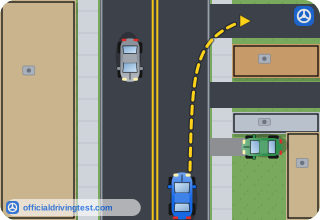
- Drivers turning into your lane may not know where you will turn and may pull out in front of you
- Other drivers will always yield to you as soon as they see your turn signal flashing
- Your signal tells pedestrians to cross behind you
- Drivers behind you are required to stop for your signal
Show answer
Correct answer: Drivers turning into your lane may not know where you will turn and may pull out in front of you
Other drivers cannot tell exactly where you will turn, so some may pull out in front of you.
Source: Virginia Driver's Manual (DMV 39 (April 27, 2026)), page 18 · Open this page in the manual (Manual page 18)
-
In what order should you look before entering an intersection?
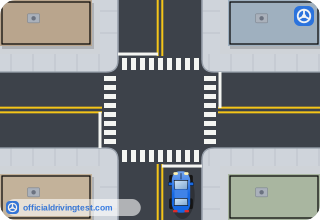
- Right, then left, then right again
- Left, then right, then straight ahead
- Left, then right, then left again
- Straight ahead, then right, then left
Show answer
Correct answer: Left, then right, then left again
Check left, right, and then left again, since cars from the left will be closer to you.
Source: Virginia Driver's Manual (DMV 39 (April 27, 2026)), page 19 · Open this page in the manual (Manual page 19)
-
At an intersection, why should you look to the left first?
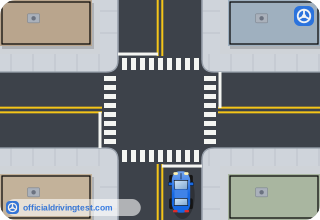
- Cars coming from the left always have the right-of-way
- Cars coming from the left will be closer to you
- Cars coming from the right are never a danger
- Cars coming from the left are traveling faster
Show answer
Correct answer: Cars coming from the left will be closer to you
Traffic from the left is closer to you than traffic from the right, so look left first.
Source: Virginia Driver's Manual (DMV 39 (April 27, 2026)), page 19 · Open this page in the manual (Manual page 19)