Virginia: Right-of-way, turning and passing — Part 2 Practice Test
Questions in this part include: “When may you pass on the right?” · “When may you not pass on the right?”
Independent educational site · not affiliated with any government agency or DMV
Ready? Test yourself
- Instant feedback with an explanation
- Every answer cites its source in the manual
- Your best score is saved on this device
- Keyboard: press 1 to 4 to answer and Enter for the next question
Questions are original and based on the official manual "Virginia Driver's Manual" (DMV 39 (April 27, 2026)), Virginia Department of Motor Vehicles (DMV).
All 17 questions in this practice test
Take the test above first, then use this list to study. Tap “Show answer” to see the correct answer and explanation.
Show the questions and answersHide the questions
-
When you arrive at a roundabout, who must you yield the right-of-way to?
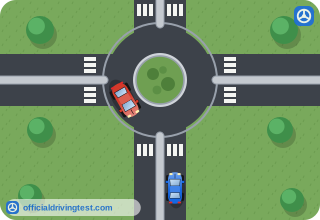
- Only the vehicles that are already in the roundabout circle
- Only vehicles entering from your right
- Only pedestrians in the crosswalk
- Pedestrians and bicyclists, and any vehicles already in the roundabout
Show answer
Correct answer: Pedestrians and bicyclists, and any vehicles already in the roundabout
You must yield to pedestrians and bicyclists, and to any vehicles already in the roundabout.
Source: Virginia Driver's Manual (DMV 39 (April 27, 2026)), page 17 · Open this page in the manual (Manual page 17)
-
While inside a roundabout, what should you do until you are ready to exit?
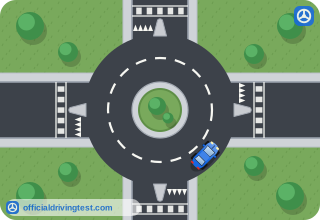
- Stay in your lane
- Move to the inside lane
- Move to the outside lane
- Stop and wait for pedestrians
Show answer
Correct answer: Stay in your lane
You should stay in your lane until you are ready to exit.
Source: Virginia Driver's Manual (DMV 39 (April 27, 2026)), page 17 · Open this page in the manual (Manual page 17)
-
While inside a roundabout, which signal should you use to let drivers around you know what you want to do?
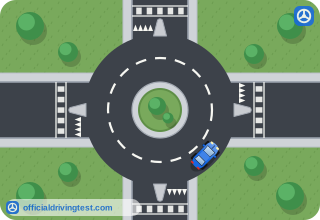
- Your vehicle’s left turn signal
- Your hazard flashers
- Your vehicle’s right turn signal
- Your high-beam headlights
Show answer
Correct answer: Your vehicle’s right turn signal
The manual says to use the vehicle’s right turn signal inside the roundabout.
Source: Virginia Driver's Manual (DMV 39 (April 27, 2026)), page 17 · Open this page in the manual (Manual page 17)
-
Before changing lanes or taking an exit in a roundabout, what should you check for?
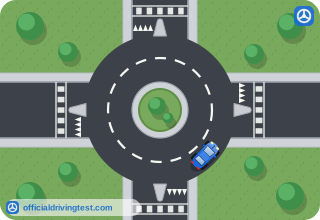
- Vehicles waiting to enter the roundabout from the road you are leaving
- Whether the next exit road has a yield sign or a signal
- Whether the island has a pedestrian crossing
- Vehicles continuing through the roundabout next to you or behind you
Show answer
Correct answer: Vehicles continuing through the roundabout next to you or behind you
Check for vehicles continuing through in the lane next to you or behind you, including those in blind spots.
Source: Virginia Driver's Manual (DMV 39 (April 27, 2026)), page 17 · Open this page in the manual (Manual page 17)
-
What should you do first before changing lanes?
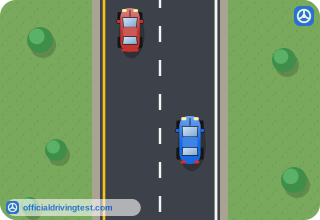
- Turn on your turn signal and start moving over
- Check your mirrors for traffic approaching from behind
- Look over your shoulder to check your blind spot
- Move partly into the other lane
Show answer
Correct answer: Check your mirrors for traffic approaching from behind
The first step is checking the side and rearview mirrors for traffic coming from behind; then you signal.
Source: Virginia Driver's Manual (DMV 39 (April 27, 2026)), page 17 · Open this page in the manual (Manual page 17)
-
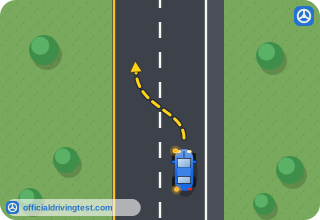
After you signal that you plan to change lanes, what should you check for?
- Whether the lane ahead has a higher speed limit than yours
- Whether a bicycle lane is nearby
- Other drivers who also may be moving into the same lane
- Whether the vehicle ahead is turning
Show answer
Correct answer: Other drivers who also may be moving into the same lane
After signaling, check for other drivers who may also be moving into the same lane.
Source: Virginia Driver's Manual (DMV 39 (April 27, 2026)), page 17 · Open this page in the manual (Manual page 17)
-
Just before you begin moving into the other lane, what should you do?
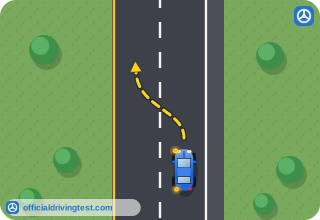
- Quickly glance over your shoulder to check your blind spot
- Tap your horn to warn the drivers in the next lane
- Brake lightly to slow down
- Flash your headlights at the vehicle behind
Show answer
Correct answer: Quickly glance over your shoulder to check your blind spot
Just before you move over, glance over your shoulder to check your blind spot.
Source: Virginia Driver's Manual (DMV 39 (April 27, 2026)), page 17 · Open this page in the manual (Manual page 17)
-
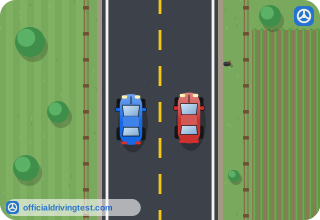
When may you return to the right lane after passing another vehicle?
- Only after you have passed the next intersection ahead of you
- Once you are at least 500 feet ahead of the passed vehicle
- As soon as the passed vehicle signals
- When you can see the passed vehicle’s front in your rearview mirror
Show answer
Correct answer: When you can see the passed vehicle’s front in your rearview mirror
Return to the right lane once the front of the passed vehicle is visible in your rearview mirror.
Source: Virginia Driver's Manual (DMV 39 (April 27, 2026)), page 17 · Open this page in the manual (Manual page 17)
-
May you exceed the speed limit while passing another vehicle?
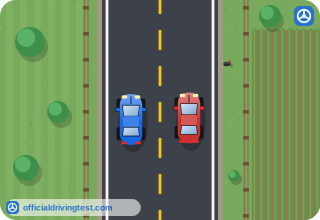
- Yes, by up to 5 MPH when the road ahead is clear
- Yes, if you complete the pass quickly
- No, it is against the law to exceed the speed limit
- Yes, on multi-lane highways only
Show answer
Correct answer: No, it is against the law to exceed the speed limit
It is against the law to exceed the speed limit when passing.
Source: Virginia Driver's Manual (DMV 39 (April 27, 2026)), page 17 · Open this page in the manual (Manual page 17)
-
When must you complete a pass in relation to a No Passing zone?
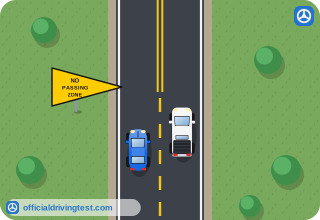
- Before you reach the zone
- Before you leave the zone
- Before the passed vehicle signals
- Within five seconds of starting to pass
Show answer
Correct answer: Before you reach the zone
You must finish passing before the No Passing zone; being in the left lane when you reach it breaks the law.
Source: Virginia Driver's Manual (DMV 39 (April 27, 2026)), page 17 · Open this page in the manual (Manual page 17)
-
When may you pass on the right?
- If the vehicle you are passing is driving below the speed limit
- If there is a wide paved shoulder beside the road
- If the vehicle ahead has signaled a right turn
- If the vehicle you are passing has signaled and is making a left turn
Show answer
Correct answer: If the vehicle you are passing has signaled and is making a left turn
You may pass on the right if the vehicle ahead has signaled and is making a left turn.
Source: Virginia Driver's Manual (DMV 39 (April 27, 2026)), page 17 · Open this page in the manual (Manual page 17)
-
When may you not pass on the right?
- If the vehicle you are passing is a large truck or a bus
- If you must drive off the pavement or main portion of the roadway
- If the vehicle you are passing is signaling a left turn
- If the road has two lanes in your direction of travel
Show answer
Correct answer: If you must drive off the pavement or main portion of the roadway
Passing on the right is not allowed when you would have to leave the pavement or the main portion of the roadway.
Source: Virginia Driver's Manual (DMV 39 (April 27, 2026)), page 17 · Open this page in the manual (Manual page 17)
-
What should you do when you are being passed?
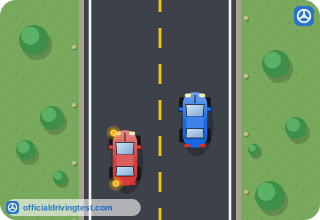
- Speed up to stay ahead of the other driver
- Move onto the shoulder
- Flash your headlights
- Maintain a steady speed or slow down
Show answer
Correct answer: Maintain a steady speed or slow down
When being passed, don’t speed up; keep a steady speed or slow down.
Source: Virginia Driver's Manual (DMV 39 (April 27, 2026)), page 17 · Open this page in the manual (Manual page 17)
-
Passing is unlawful and unsafe on hills, curves, at intersections or at railroad crossings, except on roads that have what?
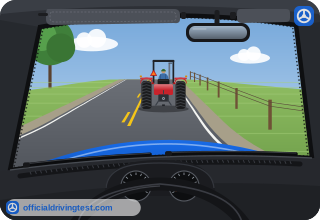
- Two or more lanes of traffic moving in the same direction
- A wide paved shoulder that vehicles may drive on safely
- A posted speed limit of 35 MPH or less on the road
- A center turn lane
Show answer
Correct answer: Two or more lanes of traffic moving in the same direction
Passing at these places is allowed only on roads with two or more lanes moving in the same direction.
Source: Virginia Driver's Manual (DMV 39 (April 27, 2026)), page 17 · Open this page in the manual (Manual page 17)
-
Which of these is unlawful and unsafe when passing?
- Passing in the left lane of a multi-lane highway
- Passing after you signal and check your blind spot
- Passing off the pavement or on the shoulder of the road
- Passing a slower vehicle on a road with two lanes in your direction
Show answer
Correct answer: Passing off the pavement or on the shoulder of the road
Passing off the pavement or on the shoulder is unlawful and unsafe.
Source: Virginia Driver's Manual (DMV 39 (April 27, 2026)), page 17 · Open this page in the manual (Manual page 17)
-
In which lane should you be to make a right turn?
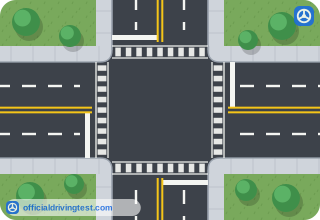
- The lane furthest to the left
- The center lane of the road
- Any lane that is clear
- The lane furthest to the right
Show answer
Correct answer: The lane furthest to the right
To make a right turn, you should be in the lane furthest to the right.
Source: Virginia Driver's Manual (DMV 39 (April 27, 2026)), page 18 · Open this page in the manual (Manual page 18)
-
How far ahead of a turn should you signal your intent to turn?
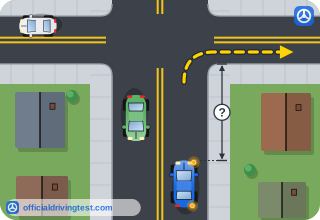
- At least three or four seconds (100 feet)
- At least one or two seconds (25 feet)
- At least five or six seconds (250 feet)
- Only at the moment you begin to turn
Show answer
Correct answer: At least three or four seconds (100 feet)
You should signal at least three or four seconds, 100 feet, before the turn.
Source: Virginia Driver's Manual (DMV 39 (April 27, 2026)), page 18 · Open this page in the manual (Manual page 18)