Virginia: Right-of-way, turning and passing — Part 1 Practice Test
Questions in this part include: “Vehicles from different directions arrive at an intersection at different times. Which vehicle goes first?”
Independent educational site · not affiliated with any government agency or DMV
Ready? Test yourself
- Instant feedback with an explanation
- Every answer cites its source in the manual
- Your best score is saved on this device
- Keyboard: press 1 to 4 to answer and Enter for the next question
Questions are original and based on the official manual "Virginia Driver's Manual" (DMV 39 (April 27, 2026)), Virginia Department of Motor Vehicles (DMV).
All 17 questions in this practice test
Take the test above first, then use this list to study. Tap “Show answer” to see the correct answer and explanation.
Show the questions and answersHide the questions
-
At an all-way stop, you arrive at the same time as other vehicles. Who must yield?
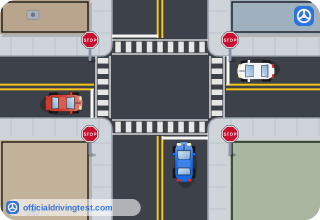
- The driver on the left must yield to the driver on the right
- The driver on the right must yield to the driver on the left
- The driver going straight must yield to the driver turning
- The driver in the larger vehicle must yield to the smaller one
Show answer
Correct answer: The driver on the left must yield to the driver on the right
When arriving together, the driver on the left yields to the driver on the right.
Source: Virginia Driver's Manual (DMV 39 (April 27, 2026)), page 6 · Open this page in the manual (Manual page 6)
-
You are approaching a stop sign and the car in front of you proceeds through it. What should you do?
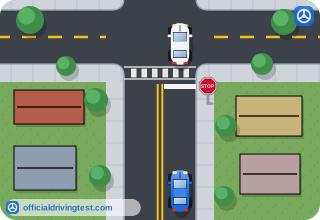
- Stop at the sign and proceed when the way is clear
- Follow the car through without stopping
- Slow down and proceed if no other traffic is visible
- Stop only if a pedestrian is nearby
Show answer
Correct answer: Stop at the sign and proceed when the way is clear
You must still stop at the sign yourself, even if the car ahead went on.
Source: Virginia Driver's Manual (DMV 39 (April 27, 2026)), page 15 · Open this page in the manual (Manual page 15)
-
What does yielding also mean if you cannot merge safely into the flow of traffic?
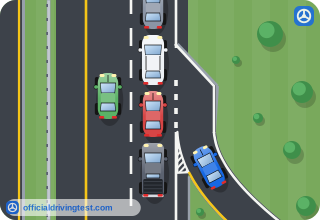
- To speed up and merge
- To sound your horn and merge
- To pull onto the shoulder
- To stop
Show answer
Correct answer: To stop
The manual says yield also means to stop if you cannot merge safely.
Source: Virginia Driver's Manual (DMV 39 (April 27, 2026)), page 16 · Open this page in the manual (Manual page 16)
-
Vehicles from different directions arrive at an intersection at different times. Which vehicle goes first?
- The one that arrives first
- The larger vehicle
- The faster vehicle
- The one traveling straight ahead
Show answer
Correct answer: The one that arrives first
When vehicles arrive at different times, the vehicle that arrives first goes first.
Source: Virginia Driver's Manual (DMV 39 (April 27, 2026)), page 16 · Open this page in the manual (Manual page 16)
-
Vehicles from different directions arrive at the same time at an intersection with no signs or signals. Who must go first?
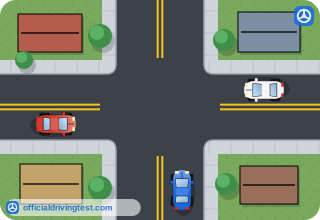
- The driver on the left
- The driver in the larger vehicle
- The driver on the right
- The driver going straight ahead
Show answer
Correct answer: The driver on the right
The driver on the left must let the driver on the right go first.
Source: Virginia Driver's Manual (DMV 39 (April 27, 2026)), page 16 · Open this page in the manual (Manual page 16)
-
The traffic lights at an intersection are not working. What must all vehicles coming to the intersection do?
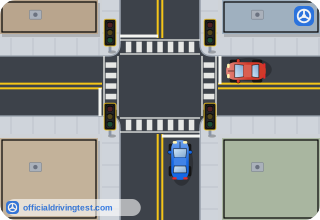
- Slow down and go through if no other vehicle is in sight
- Let the driver on the right wait while the driver on the left goes first
- Treat the intersection as having yield signs and proceed
- Stop, with the driver on the left yielding to the driver on the right
Show answer
Correct answer: Stop, with the driver on the left yielding to the driver on the right
With dead lights, all vehicles must stop, and the driver on the left yields to the driver on the right.
Source: Virginia Driver's Manual (DMV 39 (April 27, 2026)), page 16 · Open this page in the manual (Manual page 16)
-
What must you do when entering a roadway from a private road or driveway?
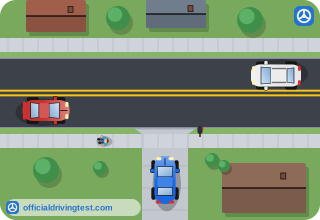
- Yield only to traffic already in your lane
- Slow down and yield only to pedestrians
- Stop and yield to all traffic and pedestrians
- Stop only if other traffic is approaching
Show answer
Correct answer: Stop and yield to all traffic and pedestrians
You must stop and yield to all traffic and pedestrians.
Source: Virginia Driver's Manual (DMV 39 (April 27, 2026)), page 16 · Open this page in the manual (Manual page 16)
-
What must you not do around a funeral procession?
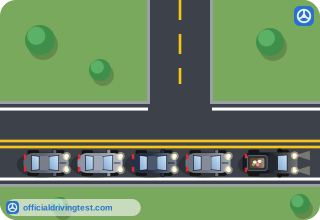
- Yield the right-of-way to it
- Wait for it to pass an intersection
- Cut through, join or interfere with it
- Slow down as it goes by
Show answer
Correct answer: Cut through, join or interfere with it
You must yield to funeral processions and never cut through, join or interfere with one.
Source: Virginia Driver's Manual (DMV 39 (April 27, 2026)), page 16 · Open this page in the manual (Manual page 16)
-
Unless led by a police escort, what must the lead vehicle in a funeral procession do?
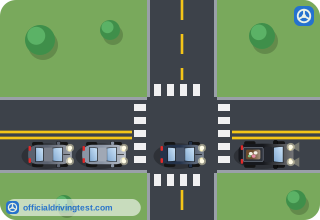
- Proceed through red lights if the others follow
- Obey all traffic signs and signals
- Stop only at red lights
- Use its hazard lights instead of stopping
Show answer
Correct answer: Obey all traffic signs and signals
Without a police escort, the lead vehicle must obey all traffic signs and signals.
Source: Virginia Driver's Manual (DMV 39 (April 27, 2026)), page 16 · Open this page in the manual (Manual page 16)
-
How may other drivers in a funeral procession show that they are part of it?
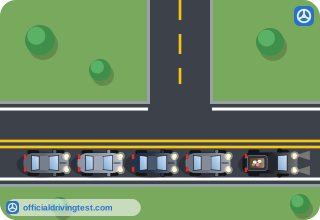
- By sounding their horns continuously
- By turning on their high-beam headlights
- By driving with their left turn signal on
- By using their hazard lights (flashers)
Show answer
Correct answer: By using their hazard lights (flashers)
Other drivers in the procession may use their hazard lights (flashers) to indicate they are in it.
Source: Virginia Driver's Manual (DMV 39 (April 27, 2026)), page 16 · Open this page in the manual (Manual page 16)
-
How must you treat a military convoy?
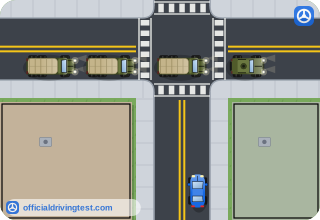
- Treat it like ordinary traffic and merge into it
- Yield only if it is led by a police escort
- Yield to it and never cut through or join it
- Yield only if its vehicles use flashing lights
Show answer
Correct answer: Yield to it and never cut through or join it
You must yield to all military convoys and never cut through or join one.
Source: Virginia Driver's Manual (DMV 39 (April 27, 2026)), page 16 · Open this page in the manual (Manual page 16)
-
After entering a roundabout, in which direction must drivers travel?
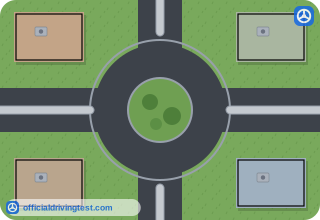
- Clockwise
- Whichever direction is shorter to the exit
- Toward the right edge only
- Counter-clockwise
Show answer
Correct answer: Counter-clockwise
Drivers must travel in a counter-clockwise direction after entering a roundabout.
Source: Virginia Driver's Manual (DMV 39 (April 27, 2026)), page 16 · Open this page in the manual (Manual page 16)
-
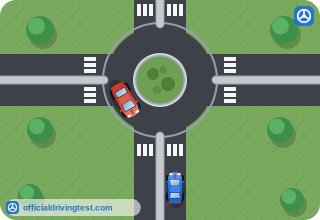
What should you do when approaching a roundabout?
- Keep your speed and signal only at the moment you exit
- Move into the left lane whatever exit you plan to take
- Slow down and use your turn signals to show where you want to go
- Speed up to merge and use your horn
Show answer
Correct answer: Slow down and use your turn signals to show where you want to go
Slow down and use your turn signals to show where you want to go.
Source: Virginia Driver's Manual (DMV 39 (April 27, 2026)), page 16 · Open this page in the manual (Manual page 16)
-
If you plan to turn right at a roundabout, where should you stay as you enter?
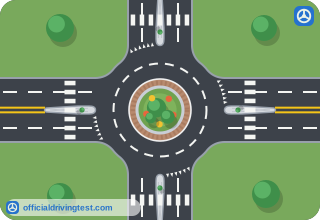
- To the right
- To the left
- In either lane
- Next to the center island
Show answer
Correct answer: To the right
To turn right, stay to the right as you enter the roundabout.
Source: Virginia Driver's Manual (DMV 39 (April 27, 2026)), page 16 · Open this page in the manual (Manual page 16)
-
If you plan to go straight at a dual lane roundabout, which lane may you use?
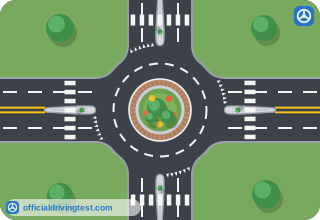
- Only the right lane
- Only the left lane
- The lane closest to the island
- Either lane
Show answer
Correct answer: Either lane
To go straight in a dual lane roundabout, you may stay in either lane.
Source: Virginia Driver's Manual (DMV 39 (April 27, 2026)), page 16 · Open this page in the manual (Manual page 16)
-
If you plan to turn left at a roundabout, where should you stay as you enter?
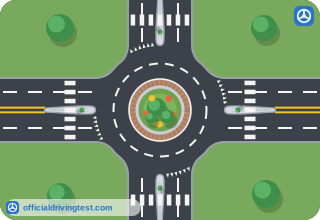
- To the right
- To the left
- In either lane
- On the outside edge
Show answer
Correct answer: To the left
To turn left, stay to the left as you enter the roundabout.
Source: Virginia Driver's Manual (DMV 39 (April 27, 2026)), page 16 · Open this page in the manual (Manual page 16)
-
As you approach a roundabout, what should you look for to know which exit to take?
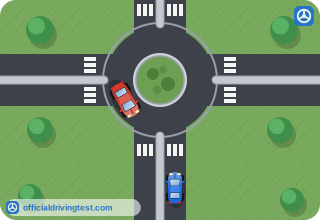
- Lane arrows painted on the island
- Street and direction signs
- Brake lights on the vehicles ahead
- Pedestrian crossing signals
Show answer
Correct answer: Street and direction signs
Street and direction signs posted before the roundabout help you know which exit to take.
Source: Virginia Driver's Manual (DMV 39 (April 27, 2026)), page 17 · Open this page in the manual (Manual page 17)