Vermont: Interstate driving Practice Test
Entering and leaving the interstate, merging, lane use, ramps and exits, and safe driving at highway speeds.
Independent educational site · not affiliated with any government agency or DMV
Ready? Test yourself
- Instant feedback with an explanation
- Every answer cites its source in the manual
- Your best score is saved on this device
- Keyboard: press 1 to 4 to answer and Enter for the next question
Questions are original and based on the official manual "Vermont Driver's Manual" (2025 edition (VN-007 07/2024)), Vermont Department of Motor Vehicles.
All 21 questions in this practice test
Take the test above first, then use this list to study. Tap “Show answer” to see the correct answer and explanation.
Show the questions and answersHide the questions
-
How does the manual describe interstates?
- Two-lane roads with intersections every few miles
- One-way roads designed for slow local travel
- Multiple-lane, divided roads designed for high-speed travel
- Undivided roads with the same speed limit everywhere
Show answer
Correct answer: Multiple-lane, divided roads designed for high-speed travel
Interstates are multiple-lane, divided roads built for high-speed travel.
Source: Vermont Driver's Manual (2025 edition (VN-007 07/2024)), page 50 · Open this page in the manual (Manual page 50)
-
What are speed-change lanes next to the interstate for?
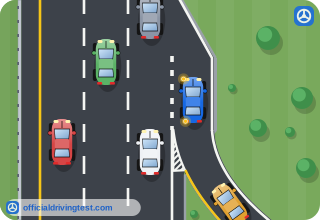
- Speeding up or slowing down to enter or exit traffic
- Passing slower vehicles at a high rate of speed
- Stopping to wait for a gap in the traffic
- Parking when you need to rest for a while
Show answer
Correct answer: Speeding up or slowing down to enter or exit traffic
Speed-change lanes connect ramps to the interstate so vehicles can speed up or slow down as they enter or exit the traffic lanes.
Source: Vermont Driver's Manual (2025 edition (VN-007 07/2024)), page 50 · Open this page in the manual (Manual page 50)
-
Where does an interstate entrance ramp take you?
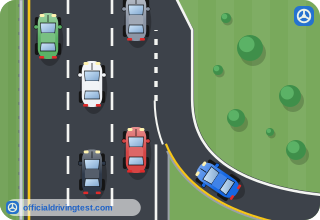
- To the acceleration lane
- To the deceleration lane
- To the breakdown lane
- To the left travel lane
Show answer
Correct answer: To the acceleration lane
The entrance ramp leads to the acceleration lane, where vehicles speed up to interstate speeds.
Source: Vermont Driver's Manual (2025 edition (VN-007 07/2024)), page 50 · Open this page in the manual (Manual page 50)
-
You are on the acceleration lane about to merge onto the interstate. Which signal do you give and where do you check your blind spot?
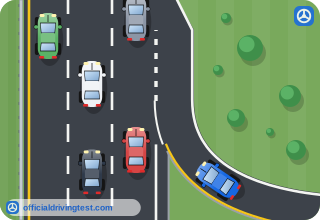
- Signal right and check over your right shoulder
- Signal left and check over your right shoulder
- Signal left and check over your left shoulder
- Signal right and check over your left shoulder
Show answer
Correct answer: Signal left and check over your left shoulder
The manual says to signal left and check the blind spot over your left shoulder before changing lanes when the travel lane is safe.
Source: Vermont Driver's Manual (2025 edition (VN-007 07/2024)), page 50 · Open this page in the manual (Manual page 50)
-
Who must yield when a driver enters an interstate from an entrance ramp?
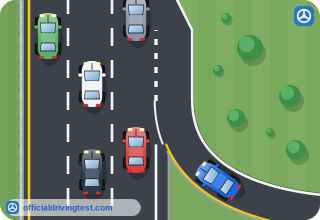
- Drivers already on the interstate yield to the entering driver
- The entering driver yields to drivers already on the interstate
- The driver in the right lane yields to the entering driver
- Whoever reaches the merge point last
Show answer
Correct answer: The entering driver yields to drivers already on the interstate
The entering driver must yield to the drivers already on the interstate.
Source: Vermont Driver's Manual (2025 edition (VN-007 07/2024)), page 50 · Open this page in the manual (Manual page 50)
-
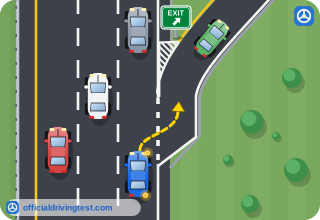
When leaving an interstate, to what speed should you slow down?
- The speed of the traffic in the left lane
- The speed limit of the interstate itself
- The speed of the vehicle behind you
- The posted exit speed
Show answer
Correct answer: The posted exit speed
After signaling and moving to the deceleration lane, slow down to the posted exit speed.
Source: Vermont Driver's Manual (2025 edition (VN-007 07/2024)), page 50 · Open this page in the manual (Manual page 50)
-
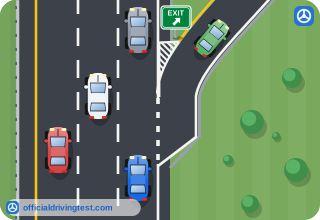
When leaving an interstate, which lane should you move to before slowing down?
- The acceleration lane
- The breakdown lane
- The far left lane
- The deceleration lane
Show answer
Correct answer: The deceleration lane
To leave the interstate you signal, move to the deceleration lane closest to the exit, then slow to the posted exit speed.
Source: Vermont Driver's Manual (2025 edition (VN-007 07/2024)), page 50 · Open this page in the manual (Manual page 50)
-
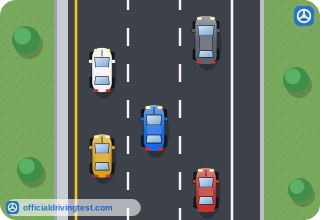
What does the manual say about frequent lane changes on the interstate?
- They are unsafe
- They help traffic move faster
- They are needed to stay safe
- They reduce the risk of tailgating
Show answer
Correct answer: They are unsafe
The manual says never to slow down or change lanes suddenly and that frequent lane changes are unsafe.
Source: Vermont Driver's Manual (2025 edition (VN-007 07/2024)), page 50 · Open this page in the manual (Manual page 50)
-
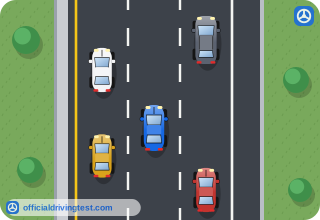
On the interstate, when should you let other drivers know what you are going to do?
- Before you do it
- While you are doing it
- After you have done it
- Only when you change lanes
Show answer
Correct answer: Before you do it
You should let other drivers know your intentions before you act, so they have time to respond.
Source: Vermont Driver's Manual (2025 edition (VN-007 07/2024)), page 50 · Open this page in the manual (Manual page 50)
-
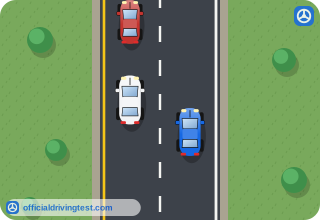
Before changing lanes or passing on the interstate, which blind spots should you check?
- Those on the right side only
- Those behind your vehicle only
- Those in the direction you plan to move
- None, if you have checked your mirrors
Show answer
Correct answer: Those in the direction you plan to move
Check your mirrors, signal, and check the blind spots in the direction you plan to move.
Source: Vermont Driver's Manual (2025 edition (VN-007 07/2024)), page 50 · Open this page in the manual (Manual page 50)
-
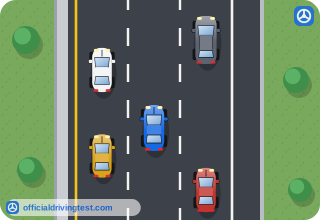
What should you do to know what is going on around you on the interstate?
- Keep your eyes fixed on the vehicle ahead of you
- Keep your eyes moving and check your mirrors often
- Check your mirrors only before changing lanes
- Watch only for exit signs and ramps
Show answer
Correct answer: Keep your eyes moving and check your mirrors often
The first rule for safe interstate driving is to keep your eyes moving and check your mirrors often.
Source: Vermont Driver's Manual (2025 edition (VN-007 07/2024)), page 50 · Open this page in the manual (Manual page 50)
-
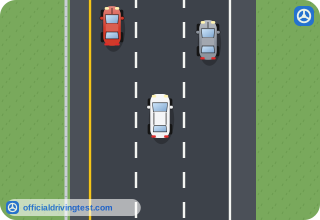
When is it legal to stop on an interstate?
- When you miss your exit
- When you need to check a map
- When traffic ahead is moving slowly
- Only in an emergency
Show answer
Correct answer: Only in an emergency
It is illegal to stop on an interstate unless it is an emergency.
Source: Vermont Driver's Manual (2025 edition (VN-007 07/2024)), page 51 · Open this page in the manual (Manual page 51)
-
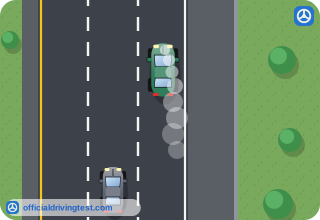
If you must stop on an interstate for an emergency, where should you stop?
- In the left lane next to the median
- In the right travel lane near the next exit
- On the acceleration lane beside the ramp
- In the breakdown lane, as far right as possible
Show answer
Correct answer: In the breakdown lane, as far right as possible
For an emergency stop, move into the breakdown lane and as far to the right as you can.
Source: Vermont Driver's Manual (2025 edition (VN-007 07/2024)), page 51 · Open this page in the manual (Manual page 51)
-
You have stopped on an interstate and need help. What does the manual say to do?
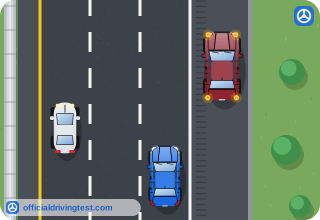
- Walk along the shoulder toward the nearest exit for help
- Raise the hood, tie a white cloth on the vehicle, and stay in it
- Stand behind your vehicle and wave to passing drivers
- Wait outside the vehicle, well away from the traffic lanes
Show answer
Correct answer: Raise the hood, tie a white cloth on the vehicle, and stay in it
To signal for help, raise the hood, tie a white cloth on the vehicle, and stay in your vehicle.
Source: Vermont Driver's Manual (2025 edition (VN-007 07/2024)), page 51 · Open this page in the manual (Manual page 51)
-
Which lane should you drive in on an interstate unless you are passing another vehicle or a sign indicates otherwise?
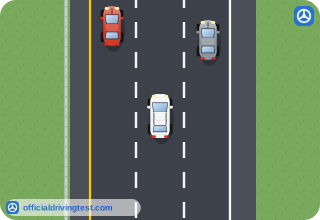
- The left lane
- The middle lane
- The right lane
- Any lane you choose
Show answer
Correct answer: The right lane
The manual says to drive in the right lane unless you are passing or a sign says otherwise.
Source: Vermont Driver's Manual (2025 edition (VN-007 07/2024)), page 51 · Open this page in the manual (Manual page 51)
-
Which of these is a major cause of crashes on interstates, according to the manual?
- Driving when tired
- Driving in the right lane
- Using the deceleration lane
- Checking your mirrors often
Show answer
Correct answer: Driving when tired
The manual states that driving when tired is a major cause of crashes on interstates.
Source: Vermont Driver's Manual (2025 edition (VN-007 07/2024)), page 51 · Open this page in the manual (Manual page 51)
-
If you become tired while driving on an interstate, what is important?
- To stop and rest in a safe area as soon as possible
- To keep driving until you reach your destination
- To switch to your high beam headlights
- To drive faster to finish the trip sooner
Show answer
Correct answer: To stop and rest in a safe area as soon as possible
A tired driver should stop and rest in a safe area as soon as possible.
Source: Vermont Driver's Manual (2025 edition (VN-007 07/2024)), page 51 · Open this page in the manual (Manual page 51)
-
On icy and snow-covered interstates, which parts may be more slippery than the main road?
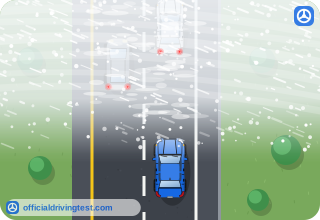
- The breakdown lane
- The left lane
- Bridges and overpasses
- Sections near exit signs
Show answer
Correct answer: Bridges and overpasses
Bridges and overpasses may be more slippery than the main road.
Source: Vermont Driver's Manual (2025 edition (VN-007 07/2024)), page 51 · Open this page in the manual (Manual page 51)
-
What should you do if you miss your exit ramp on an interstate?
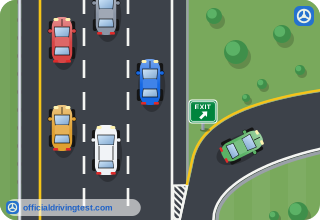
- Stop and back up to the exit
- Go on to the next exit
- Use the nearest emergency turnaround
- Slow down and cross the median
Show answer
Correct answer: Go on to the next exit
Never stop and back up or use the emergency turnaround; go on to the next exit.
Source: Vermont Driver's Manual (2025 edition (VN-007 07/2024)), page 51 · Open this page in the manual (Manual page 51)
-
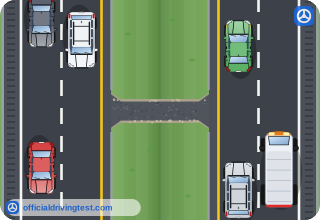
Who may use the emergency turnarounds (crossovers) on an interstate?
- Any vehicle that has missed its exit
- Passenger vehicles in light traffic
- Vehicles that have broken down
- Emergency and maintenance vehicles only
Show answer
Correct answer: Emergency and maintenance vehicles only
The crossovers are for emergency and maintenance vehicles only.
Source: Vermont Driver's Manual (2025 edition (VN-007 07/2024)), page 51 · Open this page in the manual (Manual page 51)
-
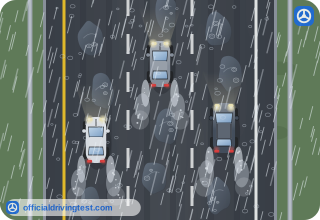
What does the manual say about using cruise control in rain, fog, snow, or ice?
- Use it only at low speeds
- Use it only on interstates
- Use it only in daylight
- Never use it
Show answer
Correct answer: Never use it
In driving conditions such as rain, fog, snow, and ice, cruise control must never be used.
Source: Vermont Driver's Manual (2025 edition (VN-007 07/2024)), page 51 · Open this page in the manual (Manual page 51)