Vermont: Parking rules — Part 1 Practice Test
Questions in this part include: “When you park on a 2-lane road in Vermont, how close must the right wheels be to the right side of the road or curb?” · “You may not park within how many feet of the nearest rail of a railroad crossing?”
Independent educational site · not affiliated with any government agency or DMV
Ready? Test yourself
- Instant feedback with an explanation
- Every answer cites its source in the manual
- Your best score is saved on this device
- Keyboard: press 1 to 4 to answer and Enter for the next question
Questions are original and based on the official manual "Vermont Driver's Manual" (2025 edition (VN-007 07/2024)), Vermont Department of Motor Vehicles.
All 20 questions in this practice test
Take the test above first, then use this list to study. Tap “Show answer” to see the correct answer and explanation.
Show the questions and answersHide the questions
-
When you park on a 2-lane road in Vermont, how close must the right wheels be to the right side of the road or curb?
- Within 12 inches
- Within 6 inches
- Within 18 inches
- Within 24 inches
Show answer
Correct answer: Within 12 inches
A vehicle parked on a 2-lane road must have its right wheels within 12 inches of the right side of the road or the curb.
Source: Vermont Driver's Manual (2025 edition (VN-007 07/2024)), page 29 · Open this page in the manual (Manual page 29)
-
On a one-way road, how close to the side of the road must a parked vehicle be positioned?
- Within 6 inches
- Within 24 inches
- Within 12 inches
- Within 3 feet
Show answer
Correct answer: Within 12 inches
On a one-way road the parked vehicle must be positioned within 12 inches of the side of the road.
Source: Vermont Driver's Manual (2025 edition (VN-007 07/2024)), page 29 · Open this page in the manual (Manual page 29)
-
In which direction must your parked vehicle face?
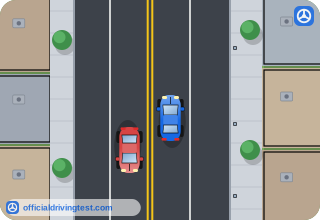
- Toward oncoming traffic
- The same direction as traffic flow
- Either direction, whichever is easier
- Whichever way leaves the most room to pull out
Show answer
Correct answer: The same direction as traffic flow
The manual says a vehicle must be parked in the same direction as traffic flow.
Source: Vermont Driver's Manual (2025 edition (VN-007 07/2024)), page 29 · Open this page in the manual (Manual page 29)
-
Parking can be parallel, angle or perpendicular. Which of these must you NOT do in order to park?
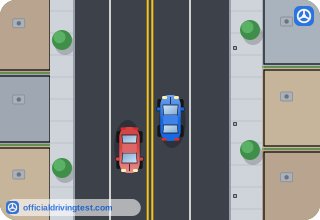
- Park at an angle to the curb
- Park perpendicular to the curb
- Park parallel to the curb
- Cross the center line
Show answer
Correct answer: Cross the center line
The manual lists several parking options but says not to cross the center line to park.
Source: Vermont Driver's Manual (2025 edition (VN-007 07/2024)), page 29 · Open this page in the manual (Manual page 29)
-
If you must park on a highway in a rural area, where must your wheels be?
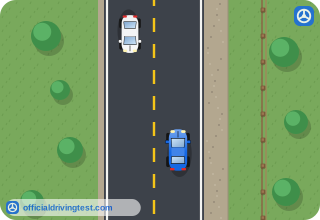
- All wheels off the traveled portion of the road
- Two wheels on the traveled portion, near the edge
- All wheels in the left lane of the road
- Straddling the edge line of the road
Show answer
Correct answer: All wheels off the traveled portion of the road
On a rural highway you must have all wheels off the traveled portion of the road.
Source: Vermont Driver's Manual (2025 edition (VN-007 07/2024)), page 29 · Open this page in the manual (Manual page 29)
-
Be careful not to stop where your vehicle cannot be seen for at least how far in either direction?
- 100 feet
- 200 feet
- 150 feet
- 300 feet
Show answer
Correct answer: 150 feet
The manual warns against stopping where your vehicle cannot be seen for at least 150 feet in either direction.
Source: Vermont Driver's Manual (2025 edition (VN-007 07/2024)), page 29 · Open this page in the manual (Manual page 29)
-
When parking on a hill, what must you always do to keep the vehicle from rolling into traffic?
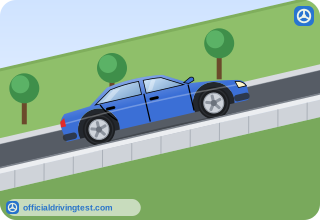
- Shift to neutral and turn off the engine
- Turn the front wheels and set the parking brake
- Leave the engine running with the vehicle in neutral
- Turn on the hazard lights and leave the brake off
Show answer
Correct answer: Turn the front wheels and set the parking brake
Always turn the front wheels and set the parking brake so the vehicle cannot roll into traffic.
Source: Vermont Driver's Manual (2025 edition (VN-007 07/2024)), page 29 · Open this page in the manual (Manual page 29)
-
You park downhill on the right side of the street. Which way should you turn the front wheels?
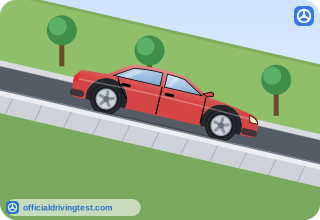
- To the left
- Straight ahead
- It does not matter if the parking brake is set
- To the right
Show answer
Correct answer: To the right
When parking downhill on the right side of the street, turn the front wheels to the right.
Source: Vermont Driver's Manual (2025 edition (VN-007 07/2024)), page 29 · Open this page in the manual (Manual page 29)
-
You park uphill on the right side of the street, and there is a curb. Which way should you turn the front wheels?
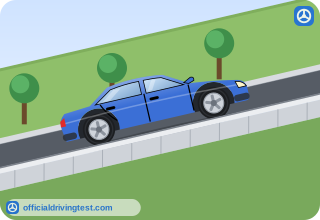
- To the left
- To the right
- Straight ahead
- It does not matter if the parking brake is set
Show answer
Correct answer: To the left
When parking uphill on the right side of the street with a curb, turn the front wheels to the left.
Source: Vermont Driver's Manual (2025 edition (VN-007 07/2024)), page 29 · Open this page in the manual (Manual page 29)
-
You park uphill on the right side of the road, and there is no curb. Which way should you turn the front wheels?
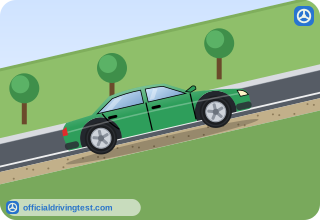
- To the left
- Straight ahead
- To the right
- It does not matter if the parking brake is set
Show answer
Correct answer: To the right
When parking uphill on the right side of the road with no curb, turn the front wheels to the right.
Source: Vermont Driver's Manual (2025 edition (VN-007 07/2024)), page 29 · Open this page in the manual (Manual page 29)
-
How close to a fire hydrant may you park?
- Not within 3 feet
- Not within 6 feet
- Not within 10 feet
- Not within 15 feet
Show answer
Correct answer: Not within 6 feet
The manual says you may not park within 6 feet of a fire hydrant.
Source: Vermont Driver's Manual (2025 edition (VN-007 07/2024)), page 29 · Open this page in the manual (Manual page 29)
-
You may not park within how many feet of a crosswalk at an intersection?
- 6 feet
- 10 feet
- 50 feet
- 20 feet
Show answer
Correct answer: 20 feet
Parking within 20 feet of a crosswalk at an intersection is not allowed.
Source: Vermont Driver's Manual (2025 edition (VN-007 07/2024)), page 29 · Open this page in the manual (Manual page 29)
-
You may not park within how many feet of a flashing red or yellow light, a stop sign or a traffic light?
- 30 feet
- 6 feet
- 20 feet
- 75 feet
Show answer
Correct answer: 30 feet
Parking within 30 feet of a flashing red or yellow light, stop sign or traffic light is not allowed.
Source: Vermont Driver's Manual (2025 edition (VN-007 07/2024)), page 29 · Open this page in the manual (Manual page 29)
-
You may not park within how many feet of the nearest rail of a railroad crossing?
- 20 feet
- 30 feet
- 50 feet
- 75 feet
Show answer
Correct answer: 50 feet
The manual lists parking on railroad tracks or within 50 feet of the nearest rail of a crossing as not allowed.
Source: Vermont Driver's Manual (2025 edition (VN-007 07/2024)), page 29 · Open this page in the manual (Manual page 29)
-
You may not park within how many feet of the driveway of a fire station?
- 6 feet
- 20 feet
- 30 feet
- 50 feet
Show answer
Correct answer: 20 feet
The manual says not to park within 20 feet of a fire station driveway.
Source: Vermont Driver's Manual (2025 edition (VN-007 07/2024)), page 29 · Open this page in the manual (Manual page 29)
-
When there are signs, you may not park across the street from a fire station driveway within how many feet of the driveway?
- 20 feet
- 30 feet
- 50 feet
- 75 feet
Show answer
Correct answer: 75 feet
When signs are posted, parking is not allowed across the street within 75 feet of a fire station driveway.
Source: Vermont Driver's Manual (2025 edition (VN-007 07/2024)), page 29 · Open this page in the manual (Manual page 29)
-
Which of these is a place where you may not park?
- On a bridge or in a tunnel
- On a one-way road, within 12 inches of the side of the road
- On a 2-lane road, with the right wheels within 12 inches of the curb
- Facing the same direction as traffic flow
Show answer
Correct answer: On a bridge or in a tunnel
Parking on a bridge or in a tunnel is on the list of places where you may not park.
Source: Vermont Driver's Manual (2025 edition (VN-007 07/2024)), page 29 · Open this page in the manual (Manual page 29)
-
Which of these is NOT a legal place to park?
- On a one-way road, within 12 inches of the side of the road
- On a 2-lane road, with the right wheels within 12 inches of the curb
- In front of any driveway
- On a rural highway, with all wheels off the traveled portion
Show answer
Correct answer: In front of any driveway
Parking in front of any driveway is on the list of places where you may not park.
Source: Vermont Driver's Manual (2025 edition (VN-007 07/2024)), page 29 · Open this page in the manual (Manual page 29)
-
Where is parking prohibited?
- Facing the same direction as traffic flow
- On a marked bicycle lane
- On a 2-lane road, with the right wheels within 12 inches of the curb
- On a rural highway, with all wheels off the traveled portion
Show answer
Correct answer: On a marked bicycle lane
A marked bicycle lane is on the list of places where you may not park.
Source: Vermont Driver's Manual (2025 edition (VN-007 07/2024)), page 29 · Open this page in the manual (Manual page 29)
-
Which of these may you NOT do?
- Park facing the same direction as traffic flow
- Park on a one-way road, within 12 inches of the side of the road
- Turn the front wheels and set the parking brake on a hill
- Park beside a vehicle stopped or parked at the side of a street
Show answer
Correct answer: Park beside a vehicle stopped or parked at the side of a street
Parking beside a vehicle that is stopped or parked at the side of a street is not allowed.
Source: Vermont Driver's Manual (2025 edition (VN-007 07/2024)), page 29 · Open this page in the manual (Manual page 29)