Vermont: Emergency vehicles and work zones — Part 2 Practice Test
Questions in this part include: “When do work zone rules apply?” · “What may flashing arrow panels be used for in a work zone?”
Independent educational site · not affiliated with any government agency or DMV
Ready? Test yourself
- Instant feedback with an explanation
- Every answer cites its source in the manual
- Your best score is saved on this device
- Keyboard: press 1 to 4 to answer and Enter for the next question
Questions are original and based on the official manual "Vermont Driver's Manual" (2025 edition (VN-007 07/2024)), Vermont Department of Motor Vehicles.
All 22 questions in this practice test
Take the test above first, then use this list to study. Tap “Show answer” to see the correct answer and explanation.
Show the questions and answersHide the questions
-
What should you remember about stopped traffic when you approach a work zone?
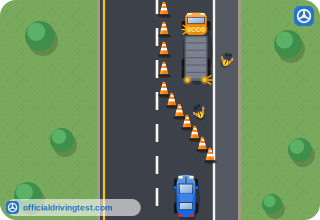
- It may be hidden around a curve or over a hill
- It is always easy to see from a long way off
- It never forms before the work area begins
- It is found only at the places where flaggers are posted
Show answer
Correct answer: It may be hidden around a curve or over a hill
Stopped traffic can be hidden around a curve or over a hill, so drivers must be ready to stop.
Source: Vermont Driver's Manual (2025 edition (VN-007 07/2024)), page 35 · Open this page in the manual (Manual page 35)
-
When do work zone rules apply?
- Only when workers are visible in the work zone
- Only during daylight hours when crews are working
- At all times, not just during daylight hours
- Only on weekdays when road crews are on the job
Show answer
Correct answer: At all times, not just during daylight hours
Work zone rules apply 24 hours a day, 7 days a week, not only in daylight.
Source: Vermont Driver's Manual (2025 edition (VN-007 07/2024)), page 35 · Open this page in the manual (Manual page 35)
-
How should you drive through a work zone?
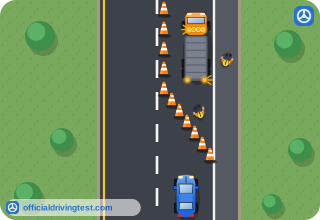
- At the normal highway speed if no workers are visible
- Slow down to the posted speed limit and adjust for weather
- At whatever speed matches the vehicles around you
- At a little below the speed limit set before the work zone
Show answer
Correct answer: Slow down to the posted speed limit and adjust for weather
Drivers slow down to the posted work zone speed limit and adjust for weather, because speeds are reduced to protect motorists and workers.
Source: Vermont Driver's Manual (2025 edition (VN-007 07/2024)), page 35 · Open this page in the manual (Manual page 35)
-
Which road users can you encounter in a work zone, according to the manual?
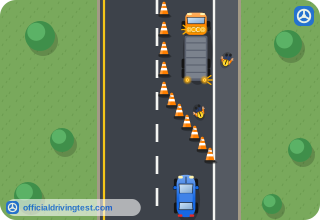
- Only motor vehicles and the flaggers who direct them
- Only vehicles that are used by the road crews
- Only trucks and construction equipment working there
- All modes of travel, including pedestrians and bicyclists
Show answer
Correct answer: All modes of travel, including pedestrians and bicyclists
All modes of travel, including pedestrians and bicyclists, can appear in a work zone.
Source: Vermont Driver's Manual (2025 edition (VN-007 07/2024)), page 35 · Open this page in the manual (Manual page 35)
-
Which of these does the manual tell drivers NOT to do in a work zone?
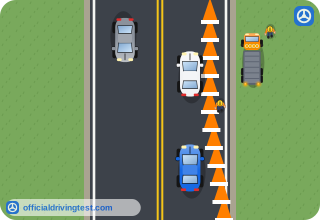
- Change lanes in the work zone
- Follow the signs
- Slow down to the posted speed limit
- Seek an alternate route when delays are expected
Show answer
Correct answer: Change lanes in the work zone
The work zone tips say not to change lanes in the work zone, tailgate, or engage in other aggressive behavior.
Source: Vermont Driver's Manual (2025 edition (VN-007 07/2024)), page 35 · Open this page in the manual (Manual page 35)
-
How much space should you give roadway workers and their equipment?
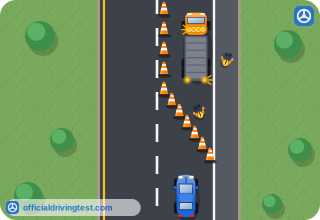
- At least 100 feet at all times
- Only enough to avoid touching them
- As much space as possible
- About one car length
Show answer
Correct answer: As much space as possible
Drivers should not overcrowd roadway workers or equipment and should give them as much space as possible.
Source: Vermont Driver's Manual (2025 edition (VN-007 07/2024)), page 35 · Open this page in the manual (Manual page 35)
-
What does the manual advise drivers to do about delays in a work zone?
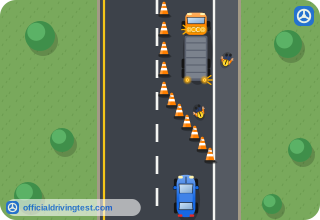
- Speed up to clear the work zone as quickly as you can
- Drive on the shoulder to avoid the delay in traffic
- Be patient, expect delays, or seek an alternate route
- Pass slower vehicles as soon as another lane opens up
Show answer
Correct answer: Be patient, expect delays, or seek an alternate route
The work zone tips tell drivers to be patient, expect delays, or take an alternate route.
Source: Vermont Driver's Manual (2025 edition (VN-007 07/2024)), page 35 · Open this page in the manual (Manual page 35)
-
What happens to fines for speeding in a work zone?
- They are waived for a first offense
- They are doubled
- They are raised only for a second offense
- They stay the same as elsewhere
Show answer
Correct answer: They are doubled
Fines for speeding in a work zone are doubled.
Source: Vermont Driver's Manual (2025 edition (VN-007 07/2024)), page 35 · Open this page in the manual (Manual page 35)
-
What color and shapes are work zone signs?
- Yellow, diamond or round
- Orange, octagonal or round
- White, rectangular or triangular
- Orange, diamond or rectangular
Show answer
Correct answer: Orange, diamond or rectangular
Work zone signs are orange and are diamond or rectangular in shape.
Source: Vermont Driver's Manual (2025 edition (VN-007 07/2024)), page 36 · Open this page in the manual (Manual page 36)
-
What do work zone signs warn the driver of?
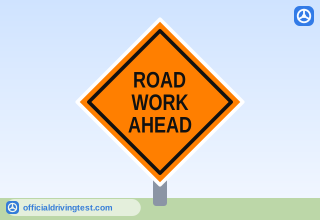
- Hazards ahead, such as closed lanes, detours, rough pavement, or flaggers
- Only the speed limit that applies after the work zone ends and normal traffic resumes
- Only where traffic must stop for railroad trains ahead
- Only the places where workers are on foot beside the road
Show answer
Correct answer: Hazards ahead, such as closed lanes, detours, rough pavement, or flaggers
Work zone signs warn of hazards ahead, including closed lanes, detours, rough pavement, and flaggers.
Source: Vermont Driver's Manual (2025 edition (VN-007 07/2024)), page 36 · Open this page in the manual (Manual page 36)
-
Why is traffic often required to stop in a work zone?
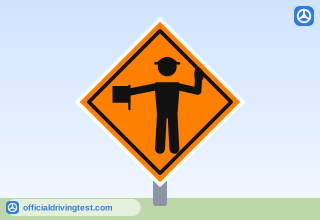
- To let workers inspect each vehicle that passes through it
- Because all work zones are closed to traffic during all of the daylight hours
- To let construction equipment move, or because one lane serves both directions
- To give drivers enough time to read each sign posted ahead
Show answer
Correct answer: To let construction equipment move, or because one lane serves both directions
Traffic stops so equipment can move or because only one lane is open for traffic in both directions.
Source: Vermont Driver's Manual (2025 edition (VN-007 07/2024)), page 36 · Open this page in the manual (Manual page 36)
-
What do flaggers use to guide traffic through a work zone?
- Red lanterns, or sometimes white flags
- Stop/slow paddles, or sometimes orange flags
- Flashing batons, or sometimes green flags
- Whistles and hand-held spotlights to signal each driver
Show answer
Correct answer: Stop/slow paddles, or sometimes orange flags
Flaggers use stop/slow paddles or sometimes orange flags to guide traffic.
Source: Vermont Driver's Manual (2025 edition (VN-007 07/2024)), page 36 · Open this page in the manual (Manual page 36)
-
What authority does a flagger have in a work zone?
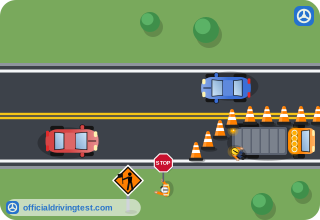
- No legal authority, since flaggers only advise drivers
- Authority only on roads where no signs are posted
- Authority to issue citations to drivers who disobey them
- The legal authority to control traffic, and must be obeyed
Show answer
Correct answer: The legal authority to control traffic, and must be obeyed
A flagger has the legal authority to control traffic, so drivers must obey.
Source: Vermont Driver's Manual (2025 edition (VN-007 07/2024)), page 36 · Open this page in the manual (Manual page 36)
-
What are cones, drums, and barricades often used for in work zones?
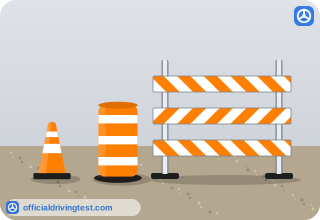
- To keep traffic out of hazardous roadwork areas and guide it through safely
- To mark where workers may park their vehicles during the day
- To show every change of the speed limit inside the work zone area
- To warn drivers that no flagger is present ahead of them
Show answer
Correct answer: To keep traffic out of hazardous roadwork areas and guide it through safely
These channeling devices keep traffic out of hazardous roadwork areas and guide it safely through the work zone.
Source: Vermont Driver's Manual (2025 edition (VN-007 07/2024)), page 36 · Open this page in the manual (Manual page 36)
-
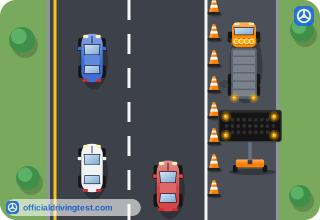
What may flashing arrow panels be used for in a work zone?
- To show drivers the posted speed limit
- To tell drivers where a detour ends
- To guide drivers into the correct lane
- To signal that a flagger is ahead
Show answer
Correct answer: To guide drivers into the correct lane
Flashing arrow panels may be used to guide drivers into the correct lane.
Source: Vermont Driver's Manual (2025 edition (VN-007 07/2024)), page 36 · Open this page in the manual (Manual page 36)
-
What should drivers do when they see a flashing arrow panel in "caution" mode?
- Move to the left lane at once
- Slow down
- Stop and wait for a flagger
- Speed up to clear the zone
Show answer
Correct answer: Slow down
A panel in caution mode is a signal for drivers to slow down.
Source: Vermont Driver's Manual (2025 edition (VN-007 07/2024)), page 36 · Open this page in the manual (Manual page 36)
-
What does a flashing arrow panel show when it is in "caution" mode?
- A solid arrow pointing toward the open lane ahead
- A steady red light on each corner of the sign
- Blinking lights shaped like a cross in the middle of the sign panel
- A straight line of blinking lights, or blinking lights on its 4 corners
Show answer
Correct answer: A straight line of blinking lights, or blinking lights on its 4 corners
When the arrows are not in use, the panel shows a straight line of blinking lights or blinking lights on its 4 corners.
Source: Vermont Driver's Manual (2025 edition (VN-007 07/2024)), page 36 · Open this page in the manual (Manual page 36)
-
In a work zone with temporary pavement markings, what do white markers or lines separate?
- Lanes going in the same direction
- Lanes going in opposite directions
- The travel lanes from the shoulder
- Open lanes from closed lanes
Show answer
Correct answer: Lanes going in the same direction
Temporary white markers or lines separate lanes going in the same direction.
Source: Vermont Driver's Manual (2025 edition (VN-007 07/2024)), page 36 · Open this page in the manual (Manual page 36)
-
Temporary yellow markers or lines in a work zone separate which lanes?
- Lanes going in the same direction
- The shoulder from the travel lanes
- Lanes going in opposite directions
- Lanes for cars from lanes for trucks
Show answer
Correct answer: Lanes going in opposite directions
Yellow markers or lines separate lanes going in opposite directions.
Source: Vermont Driver's Manual (2025 edition (VN-007 07/2024)), page 36 · Open this page in the manual (Manual page 36)
-
In a work zone, on which side of you should the yellow markings be?
- On your right
- On your left
- Directly under your vehicle
- Behind your vehicle at all times
Show answer
Correct answer: On your left
The yellow markings should be on your left; if they are not, you are in the wrong lane.
Source: Vermont Driver's Manual (2025 edition (VN-007 07/2024)), page 36 · Open this page in the manual (Manual page 36)
-
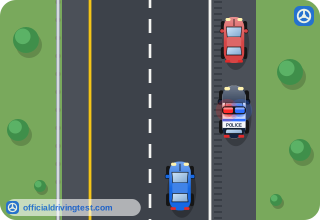
On an interstate, you approach a law enforcement, emergency, or repair vehicle with a flashing light stopped at the side of the road. What does the law say you must do?
- Stop behind it until the flashing light is turned off
- Proceed with caution and change lanes when it is safe
- Keep your speed and stay in your lane
- Pull onto the shoulder ahead of it and stop
Show answer
Correct answer: Proceed with caution and change lanes when it is safe
The law says to slow down, proceed with caution, and move away from the stopped vehicle by changing lanes as soon as it is safe.
Source: Vermont Driver's Manual (2025 edition (VN-007 07/2024)), page 51 · Open this page in the manual (Manual page 51)
-
On an interstate, you are unable to change lanes when approaching a stopped law enforcement, emergency, or repair vehicle with a flashing light. How fast may you go by it?
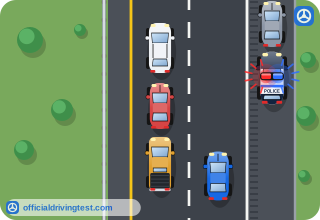
- 10 mph below the speed limit
- 5 mph below the speed limit
- 20 mph below the speed limit
- At the speed limit
Show answer
Correct answer: 20 mph below the speed limit
If you cannot change lanes, you must slow down to 20 mph below the speed limit to go by the stopped vehicles.
Source: Vermont Driver's Manual (2025 edition (VN-007 07/2024)), page 51 · Open this page in the manual (Manual page 51)