Vermont: Emergency vehicles and work zones
Pulling over for emergency vehicles, Vermont’s Move Over Law, police stops, flaggers and work zones with doubled fines. Split into 2 shorter tests so you're not stuck in one long quiz.
Independent educational site · not affiliated with any government agency or DMV
All 44 Emergency vehicles and work zones questions with answers
Choose a part above to take a practice test, or study every question and answer here.
Show the questions and answersHide the questions
-
You are not yet in the roundabout when an emergency vehicle approaches. What should you do?
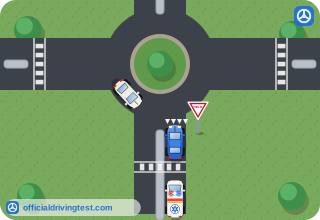
- Enter and drive through to the next exit
- Stop inside the roundabout
- Pull over and let the emergency vehicle pass
- Speed up and enter before it arrives
Show answer
Correct answer: Pull over and let the emergency vehicle pass
If you are not already in the roundabout, you pull over and let the emergency vehicle pass.
Source: Vermont Driver's Manual (2025 edition (VN-007 07/2024)), page 30 · Open this page in the manual (Manual page 30)
-
You are already in the roundabout when an emergency vehicle approaches. When should you pull over?
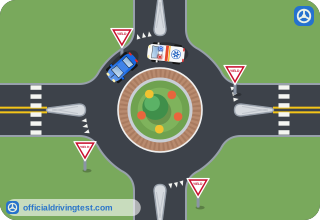
- Right away, where you are in the circle
- After you have safely exited the roundabout
- Only after the vehicle passes you in the circle
- At the next entrance after the circle
Show answer
Correct answer: After you have safely exited the roundabout
If you are already in the roundabout, you pull over once you have safely exited it.
Source: Vermont Driver's Manual (2025 edition (VN-007 07/2024)), page 30 · Open this page in the manual (Manual page 30)
-
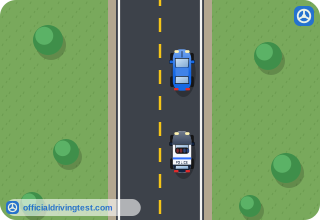
How will police vehicles attempting to stop drivers signal them?
- By sounding the horn and flashing the headlights only
- By using a loudspeaker or a spotlight only
- By flashing the brake lights several times
- By turning on flashing lights, or flashing lights and a siren
Show answer
Correct answer: By turning on flashing lights, or flashing lights and a siren
Police vehicles stop drivers by turning on flashing lights, or flashing lights and a siren.
Source: Vermont Driver's Manual (2025 edition (VN-007 07/2024)), page 30 · Open this page in the manual (Manual page 30)
-
When a police vehicle signals you to stop, where should you stop?
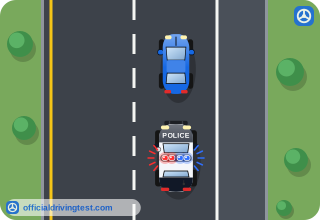
- As close as you safely can to the right side of the road
- In the center median of the divided highway ahead
- In the middle of the next intersection
- In the lane you are in, wherever you are
Show answer
Correct answer: As close as you safely can to the right side of the road
You drive as close as you safely can to the right side of the road.
Source: Vermont Driver's Manual (2025 edition (VN-007 07/2024)), page 30 · Open this page in the manual (Manual page 30)
-
When signaled to stop by police, where must you NOT stop?
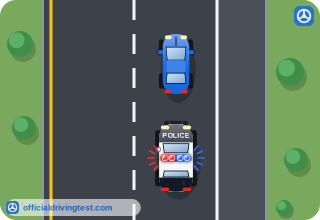
- On the right side of the road
- Safely at the right edge of the road
- In an intersection
- Right where the officer can see the car
Show answer
Correct answer: In an intersection
You must not stop in an intersection or pull into the center median of a divided highway.
Source: Vermont Driver's Manual (2025 edition (VN-007 07/2024)), page 30 · Open this page in the manual (Manual page 30)
-
During a police stop, what should you do with your safety belt?
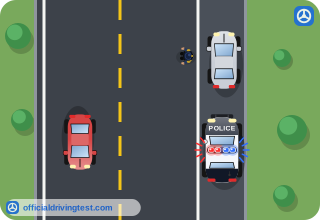
- Unfasten it as soon as you stop
- Keep it fastened until the officer has seen you wearing it
- Unfasten it when the officer walks up to the car
- Keep it unfastened so you can step out of the car quickly
Show answer
Correct answer: Keep it fastened until the officer has seen you wearing it
Keep your safety belt fastened until the officer has seen you wearing it.
Source: Vermont Driver's Manual (2025 edition (VN-007 07/2024)), page 30 · Open this page in the manual (Manual page 30)
-
During a police stop, what should you do about your movements and those of your passengers?
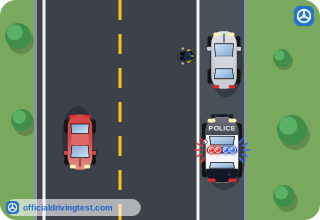
- Move around to find your documents quickly
- Reach toward the glove box right away
- Have passengers get out of the vehicle
- Limit them
Show answer
Correct answer: Limit them
The manual tells you to limit your movements and those of any passengers.
Source: Vermont Driver's Manual (2025 edition (VN-007 07/2024)), page 30 · Open this page in the manual (Manual page 30)
-
What does the manual say to show the officer when requested during a police stop?
- Your license, vehicle registration and proof of insurance
- Your license, vehicle registration and a second photo ID
- Your license, proof of insurance and the vehicle title
- Only your license and your vehicle registration
Show answer
Correct answer: Your license, vehicle registration and proof of insurance
You show your license, vehicle registration and proof of insurance when the officer requests them.
Source: Vermont Driver's Manual (2025 edition (VN-007 07/2024)), page 30 · Open this page in the manual (Manual page 30)
-
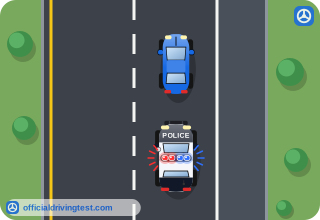
During a police stop, what should you do unless the officer asks otherwise?
- Get out and walk to the police vehicle
- Get out and stand at the back of your vehicle
- Stay in your vehicle
- Get out and open the hood
Show answer
Correct answer: Stay in your vehicle
You stay in your vehicle and do not get out unless requested, for your safety and the officer’s.
Source: Vermont Driver's Manual (2025 edition (VN-007 07/2024)), page 30 · Open this page in the manual (Manual page 30)
-
If you are stopped by police in a dimly lit area, what should you do after stopping and before the officer approaches?
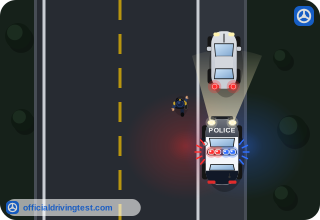
- Turn off all the lights
- Turn on the vehicle’s interior lights
- Flash your high beams
- Get out and wave to the officer
Show answer
Correct answer: Turn on the vehicle’s interior lights
In a dimly lit area, turn on the interior lights after stopping and before the officer approaches.
Source: Vermont Driver's Manual (2025 edition (VN-007 07/2024)), page 30 · Open this page in the manual (Manual page 30)
-
According to the manual, where should a traffic offense be addressed instead of at the roadside?
- At the scene, with the officer
- On the way to the police station
- Before the officer reaches your window
- In court
Show answer
Correct answer: In court
The roadside is not the place to argue a traffic offense; there is time to address it in court.
Source: Vermont Driver's Manual (2025 edition (VN-007 07/2024)), page 30 · Open this page in the manual (Manual page 30)
-
You see or hear a vehicle with flashing blue or red lights and/or a siren approaching from any direction. What does the law say you must do?
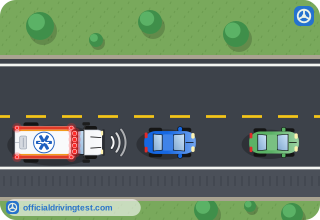
- Pull over to the right side of the road and stop
- Slow down and keep driving in your lane
- Pull over to the left side of the road and stop
- Speed up to get out of its way
Show answer
Correct answer: Pull over to the right side of the road and stop
The law says you must pull over to the right side of the road and stop.
Source: Vermont Driver's Manual (2025 edition (VN-007 07/2024)), page 31 · Open this page in the manual (Manual page 31)
-
How long must you remain stopped after pulling over for an emergency or law enforcement vehicle with flashing lights or a siren?
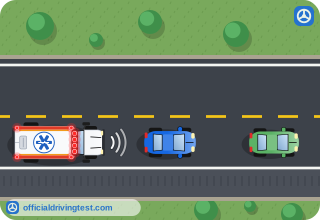
- Until its siren stops
- For at least one minute
- Until the vehicle has gone by
- Until you can no longer see its lights
Show answer
Correct answer: Until the vehicle has gone by
You must remain stopped until the emergency or law enforcement vehicle has gone by.
Source: Vermont Driver's Manual (2025 edition (VN-007 07/2024)), page 31 · Open this page in the manual (Manual page 31)
-
You see a stopped police vehicle with flashing blue lights, or a stopped emergency vehicle with flashing red lights. What must you always do?
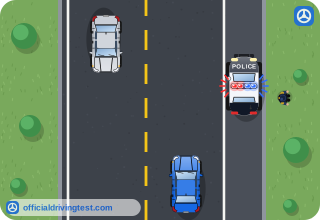
- Stop behind it until it leaves
- Proceed with caution (slow down)
- Drive past it at your normal speed
- Sound your horn as you pass
Show answer
Correct answer: Proceed with caution (slow down)
You must always proceed with caution and slow down when you approach these stopped vehicles.
Source: Vermont Driver's Manual (2025 edition (VN-007 07/2024)), page 31 · Open this page in the manual (Manual page 31)
-
On a four-lane highway such as an Interstate, what does the law require when you approach a stopped police or emergency vehicle with flashing lights?
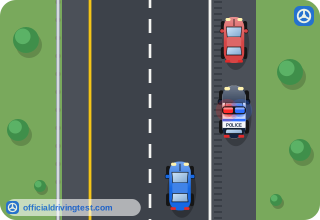
- A full stop behind the vehicle
- Driving on the shoulder
- An increase in speed to pass it quickly
- A lane change, if you can do so safely
Show answer
Correct answer: A lane change, if you can do so safely
On a four-lane highway the law also requires you to make a lane change if you can do so safely.
Source: Vermont Driver's Manual (2025 edition (VN-007 07/2024)), page 31 · Open this page in the manual (Manual page 31)
-
What does the law require when you approach a state, city or town maintenance vehicle working on a highway, such as a snowplow with flashing lights?
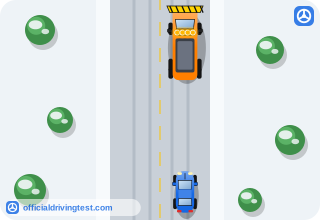
- Yield the right of way and proceed with caution
- Pass it as quickly as possible
- Stop until it leaves the highway
- Follow it closely until it turns off the road
Show answer
Correct answer: Yield the right of way and proceed with caution
Drivers must yield the right of way to maintenance vehicles working on a highway and proceed with caution.
Source: Vermont Driver's Manual (2025 edition (VN-007 07/2024)), page 31 · Open this page in the manual (Manual page 31)
-
What color flashing lights do towing and repair vehicles usually have?
- Blue
- Red
- Amber
- White
Show answer
Correct answer: Amber
Towing and repair vehicles usually have amber-colored flashing lights, and you use the same caution as for other stopped emergency vehicles.
Source: Vermont Driver's Manual (2025 edition (VN-007 07/2024)), page 31 · Open this page in the manual (Manual page 31)
-
What is a work zone?
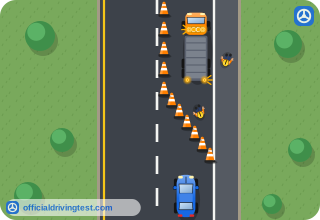
- Any road where the speed limit has been lowered
- A stretch of road that is closed to every kind of vehicle until crews finish
- A lane reserved only for road crews and their equipment
- An area along a highway with construction, maintenance, or utility work
Show answer
Correct answer: An area along a highway with construction, maintenance, or utility work
A work zone is an area along a highway where construction, maintenance, or utility work takes place.
Source: Vermont Driver's Manual (2025 edition (VN-007 07/2024)), page 35 · Open this page in the manual (Manual page 35)
-
A work zone may be stationary, or it may be what?
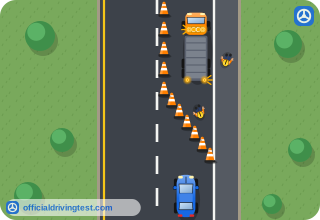
- A mobile operation that moves down the road slowly
- A lane that is closed only at night for utility crews
- A fixed area that is marked only by flashing lights
- A permanent lane reserved for road crews and equipment
Show answer
Correct answer: A mobile operation that moves down the road slowly
Work such as line striping, mowing, and snow removal can move slowly down the road as a mobile work zone.
Source: Vermont Driver's Manual (2025 edition (VN-007 07/2024)), page 35 · Open this page in the manual (Manual page 35)
-
Where do many work zone crashes occur, according to the manual?
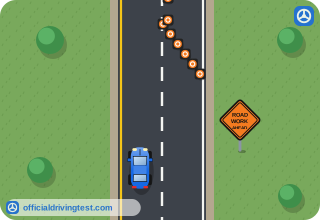
- Inside the work area, right beside the workers
- After the work area, where drivers speed up again once they are past it
- Before the actual work area, where drivers are slowing down or merging
- At the spot where the flaggers are posted
Show answer
Correct answer: Before the actual work area, where drivers are slowing down or merging
Many crashes happen before the work area itself, where drivers slow down or merge.
Source: Vermont Driver's Manual (2025 edition (VN-007 07/2024)), page 35 · Open this page in the manual (Manual page 35)
-
When approaching a work zone, when should you merge into the appropriate lane?
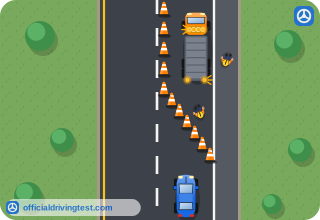
- At the last moment, right at the lane closure
- As soon as it is safe to do so
- Only when all traffic has come to a stop
- After you have passed the first work zone sign
Show answer
Correct answer: As soon as it is safe to do so
Merge into the appropriate lane as soon as it is safe, which is the courteous thing to do.
Source: Vermont Driver's Manual (2025 edition (VN-007 07/2024)), page 35 · Open this page in the manual (Manual page 35)
-
What type of crash is most common in work zones?
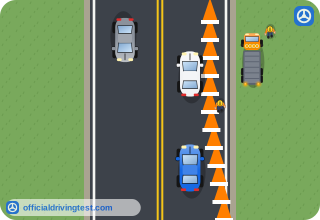
- Head-on crashes
- Crashes with workers on foot
- Side-impact crashes at intersections
- Rear end crashes
Show answer
Correct answer: Rear end crashes
Most work zone crashes are rear end crashes caused by driving too fast and following too closely.
Source: Vermont Driver's Manual (2025 edition (VN-007 07/2024)), page 35 · Open this page in the manual (Manual page 35)
-
What should you remember about stopped traffic when you approach a work zone?
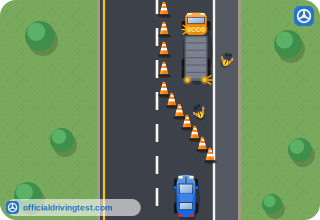
- It may be hidden around a curve or over a hill
- It is always easy to see from a long way off
- It never forms before the work area begins
- It is found only at the places where flaggers are posted
Show answer
Correct answer: It may be hidden around a curve or over a hill
Stopped traffic can be hidden around a curve or over a hill, so drivers must be ready to stop.
Source: Vermont Driver's Manual (2025 edition (VN-007 07/2024)), page 35 · Open this page in the manual (Manual page 35)
-
When do work zone rules apply?
- Only when workers are visible in the work zone
- Only during daylight hours when crews are working
- At all times, not just during daylight hours
- Only on weekdays when road crews are on the job
Show answer
Correct answer: At all times, not just during daylight hours
Work zone rules apply 24 hours a day, 7 days a week, not only in daylight.
Source: Vermont Driver's Manual (2025 edition (VN-007 07/2024)), page 35 · Open this page in the manual (Manual page 35)
-
How should you drive through a work zone?
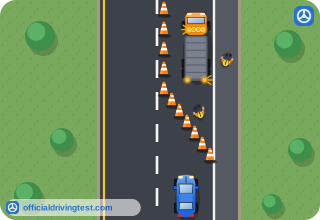
- At the normal highway speed if no workers are visible
- Slow down to the posted speed limit and adjust for weather
- At whatever speed matches the vehicles around you
- At a little below the speed limit set before the work zone
Show answer
Correct answer: Slow down to the posted speed limit and adjust for weather
Drivers slow down to the posted work zone speed limit and adjust for weather, because speeds are reduced to protect motorists and workers.
Source: Vermont Driver's Manual (2025 edition (VN-007 07/2024)), page 35 · Open this page in the manual (Manual page 35)
-
Which road users can you encounter in a work zone, according to the manual?
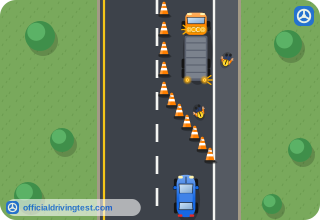
- Only motor vehicles and the flaggers who direct them
- Only vehicles that are used by the road crews
- Only trucks and construction equipment working there
- All modes of travel, including pedestrians and bicyclists
Show answer
Correct answer: All modes of travel, including pedestrians and bicyclists
All modes of travel, including pedestrians and bicyclists, can appear in a work zone.
Source: Vermont Driver's Manual (2025 edition (VN-007 07/2024)), page 35 · Open this page in the manual (Manual page 35)
-
Which of these does the manual tell drivers NOT to do in a work zone?
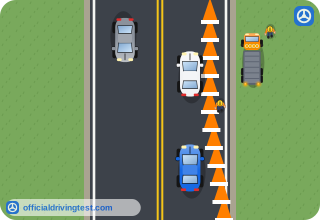
- Change lanes in the work zone
- Follow the signs
- Slow down to the posted speed limit
- Seek an alternate route when delays are expected
Show answer
Correct answer: Change lanes in the work zone
The work zone tips say not to change lanes in the work zone, tailgate, or engage in other aggressive behavior.
Source: Vermont Driver's Manual (2025 edition (VN-007 07/2024)), page 35 · Open this page in the manual (Manual page 35)
-
How much space should you give roadway workers and their equipment?
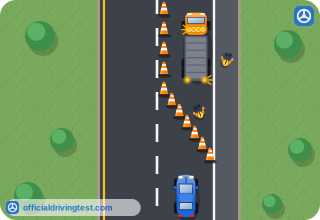
- At least 100 feet at all times
- Only enough to avoid touching them
- As much space as possible
- About one car length
Show answer
Correct answer: As much space as possible
Drivers should not overcrowd roadway workers or equipment and should give them as much space as possible.
Source: Vermont Driver's Manual (2025 edition (VN-007 07/2024)), page 35 · Open this page in the manual (Manual page 35)
-
What does the manual advise drivers to do about delays in a work zone?
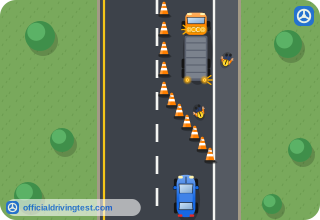
- Speed up to clear the work zone as quickly as you can
- Drive on the shoulder to avoid the delay in traffic
- Be patient, expect delays, or seek an alternate route
- Pass slower vehicles as soon as another lane opens up
Show answer
Correct answer: Be patient, expect delays, or seek an alternate route
The work zone tips tell drivers to be patient, expect delays, or take an alternate route.
Source: Vermont Driver's Manual (2025 edition (VN-007 07/2024)), page 35 · Open this page in the manual (Manual page 35)
-
What happens to fines for speeding in a work zone?
- They are waived for a first offense
- They are doubled
- They are raised only for a second offense
- They stay the same as elsewhere
Show answer
Correct answer: They are doubled
Fines for speeding in a work zone are doubled.
Source: Vermont Driver's Manual (2025 edition (VN-007 07/2024)), page 35 · Open this page in the manual (Manual page 35)
-
What color and shapes are work zone signs?
- Yellow, diamond or round
- Orange, octagonal or round
- White, rectangular or triangular
- Orange, diamond or rectangular
Show answer
Correct answer: Orange, diamond or rectangular
Work zone signs are orange and are diamond or rectangular in shape.
Source: Vermont Driver's Manual (2025 edition (VN-007 07/2024)), page 36 · Open this page in the manual (Manual page 36)
-
What do work zone signs warn the driver of?
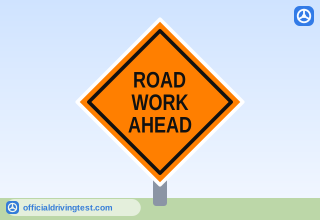
- Hazards ahead, such as closed lanes, detours, rough pavement, or flaggers
- Only the speed limit that applies after the work zone ends and normal traffic resumes
- Only where traffic must stop for railroad trains ahead
- Only the places where workers are on foot beside the road
Show answer
Correct answer: Hazards ahead, such as closed lanes, detours, rough pavement, or flaggers
Work zone signs warn of hazards ahead, including closed lanes, detours, rough pavement, and flaggers.
Source: Vermont Driver's Manual (2025 edition (VN-007 07/2024)), page 36 · Open this page in the manual (Manual page 36)
-
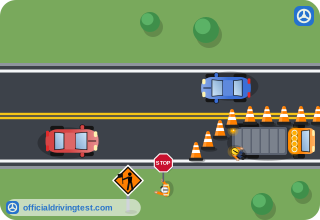
Why is traffic often required to stop in a work zone?
- To let workers inspect each vehicle that passes through it
- Because all work zones are closed to traffic during all of the daylight hours
- To let construction equipment move, or because one lane serves both directions
- To give drivers enough time to read each sign posted ahead
Show answer
Correct answer: To let construction equipment move, or because one lane serves both directions
Traffic stops so equipment can move or because only one lane is open for traffic in both directions.
Source: Vermont Driver's Manual (2025 edition (VN-007 07/2024)), page 36 · Open this page in the manual (Manual page 36)
-
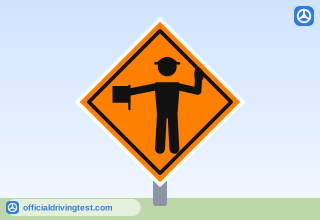
What do flaggers use to guide traffic through a work zone?
- Red lanterns, or sometimes white flags
- Stop/slow paddles, or sometimes orange flags
- Flashing batons, or sometimes green flags
- Whistles and hand-held spotlights to signal each driver
Show answer
Correct answer: Stop/slow paddles, or sometimes orange flags
Flaggers use stop/slow paddles or sometimes orange flags to guide traffic.
Source: Vermont Driver's Manual (2025 edition (VN-007 07/2024)), page 36 · Open this page in the manual (Manual page 36)
-
What authority does a flagger have in a work zone?
- No legal authority, since flaggers only advise drivers
- Authority only on roads where no signs are posted
- Authority to issue citations to drivers who disobey them
- The legal authority to control traffic, and must be obeyed
Show answer
Correct answer: The legal authority to control traffic, and must be obeyed
A flagger has the legal authority to control traffic, so drivers must obey.
Source: Vermont Driver's Manual (2025 edition (VN-007 07/2024)), page 36 · Open this page in the manual (Manual page 36)
-
What are cones, drums, and barricades often used for in work zones?
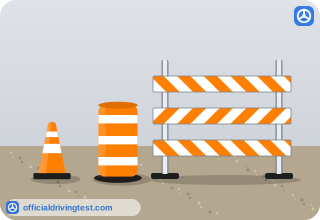
- To keep traffic out of hazardous roadwork areas and guide it through safely
- To mark where workers may park their vehicles during the day
- To show every change of the speed limit inside the work zone area
- To warn drivers that no flagger is present ahead of them
Show answer
Correct answer: To keep traffic out of hazardous roadwork areas and guide it through safely
These channeling devices keep traffic out of hazardous roadwork areas and guide it safely through the work zone.
Source: Vermont Driver's Manual (2025 edition (VN-007 07/2024)), page 36 · Open this page in the manual (Manual page 36)
-
What may flashing arrow panels be used for in a work zone?
- To show drivers the posted speed limit
- To tell drivers where a detour ends
- To guide drivers into the correct lane
- To signal that a flagger is ahead
Show answer
Correct answer: To guide drivers into the correct lane
Flashing arrow panels may be used to guide drivers into the correct lane.
Source: Vermont Driver's Manual (2025 edition (VN-007 07/2024)), page 36 · Open this page in the manual (Manual page 36)
-
What should drivers do when they see a flashing arrow panel in "caution" mode?
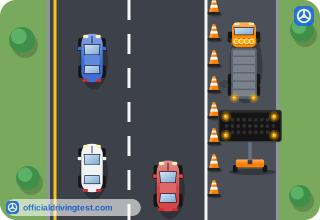
- Move to the left lane at once
- Slow down
- Stop and wait for a flagger
- Speed up to clear the zone
Show answer
Correct answer: Slow down
A panel in caution mode is a signal for drivers to slow down.
Source: Vermont Driver's Manual (2025 edition (VN-007 07/2024)), page 36 · Open this page in the manual (Manual page 36)
-
What does a flashing arrow panel show when it is in "caution" mode?
- A solid arrow pointing toward the open lane ahead
- A steady red light on each corner of the sign
- Blinking lights shaped like a cross in the middle of the sign panel
- A straight line of blinking lights, or blinking lights on its 4 corners
Show answer
Correct answer: A straight line of blinking lights, or blinking lights on its 4 corners
When the arrows are not in use, the panel shows a straight line of blinking lights or blinking lights on its 4 corners.
Source: Vermont Driver's Manual (2025 edition (VN-007 07/2024)), page 36 · Open this page in the manual (Manual page 36)
-
In a work zone with temporary pavement markings, what do white markers or lines separate?
- Lanes going in the same direction
- Lanes going in opposite directions
- The travel lanes from the shoulder
- Open lanes from closed lanes
Show answer
Correct answer: Lanes going in the same direction
Temporary white markers or lines separate lanes going in the same direction.
Source: Vermont Driver's Manual (2025 edition (VN-007 07/2024)), page 36 · Open this page in the manual (Manual page 36)
-
Temporary yellow markers or lines in a work zone separate which lanes?
- Lanes going in the same direction
- The shoulder from the travel lanes
- Lanes going in opposite directions
- Lanes for cars from lanes for trucks
Show answer
Correct answer: Lanes going in opposite directions
Yellow markers or lines separate lanes going in opposite directions.
Source: Vermont Driver's Manual (2025 edition (VN-007 07/2024)), page 36 · Open this page in the manual (Manual page 36)
-
In a work zone, on which side of you should the yellow markings be?
- On your right
- On your left
- Directly under your vehicle
- Behind your vehicle at all times
Show answer
Correct answer: On your left
The yellow markings should be on your left; if they are not, you are in the wrong lane.
Source: Vermont Driver's Manual (2025 edition (VN-007 07/2024)), page 36 · Open this page in the manual (Manual page 36)
-
On an interstate, you approach a law enforcement, emergency, or repair vehicle with a flashing light stopped at the side of the road. What does the law say you must do?
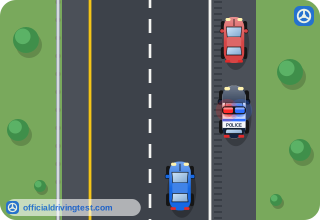
- Stop behind it until the flashing light is turned off
- Proceed with caution and change lanes when it is safe
- Keep your speed and stay in your lane
- Pull onto the shoulder ahead of it and stop
Show answer
Correct answer: Proceed with caution and change lanes when it is safe
The law says to slow down, proceed with caution, and move away from the stopped vehicle by changing lanes as soon as it is safe.
Source: Vermont Driver's Manual (2025 edition (VN-007 07/2024)), page 51 · Open this page in the manual (Manual page 51)
-
On an interstate, you are unable to change lanes when approaching a stopped law enforcement, emergency, or repair vehicle with a flashing light. How fast may you go by it?
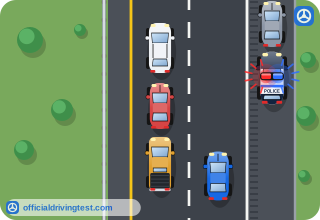
- 10 mph below the speed limit
- 5 mph below the speed limit
- 20 mph below the speed limit
- At the speed limit
Show answer
Correct answer: 20 mph below the speed limit
If you cannot change lanes, you must slow down to 20 mph below the speed limit to go by the stopped vehicles.
Source: Vermont Driver's Manual (2025 edition (VN-007 07/2024)), page 51 · Open this page in the manual (Manual page 51)