Utah: Vehicle controls and equipment — Vehicle Equipment: Brakes, Lights and Loads Practice Test
Questions in this part include: “In which conditions may a vehicle’s safety features not work correctly?” · “How far must lights on an extending load be visible at night?”
Independent educational site · not affiliated with any government agency or DMV
Ready? Test yourself
- Instant feedback with an explanation
- Every answer cites its source in the manual
- Your best score is saved on this device
- Keyboard: press 1 to 4 to answer and Enter for the next question
Questions are original and based on the official manual "Utah Driver Handbook" (2026 edition (new 2026 laws effective May 6, 2026)), Utah Department of Public Safety, Driver License Division.
All 23 questions in this practice test
Take the test above first, then use this list to study. Tap “Show answer” to see the correct answer and explanation.
Show the questions and answersHide the questions
-
In which conditions may a vehicle’s safety features not work correctly?
- Only on dry, straight, level roads
- Only at night
- Rain, snow, ice, fog, hills, and curves
- Only above 65 miles per hour
Show answer
Correct answer: Rain, snow, ice, fog, hills, and curves
Weather such as rain, snow, ice, and fog, and terrain such as hills and curves, can keep safety features from working correctly.
Source: Utah Driver Handbook (2026 edition (new 2026 laws effective May 6, 2026)), page 90 · Open this page in the manual (Manual page 90)
-
What should you do with the sensors of your vehicle’s safety features?
- Cover them in cold weather
- Always keep them clean and damage-free
- Recalibrate them yourself every month
- Switch them off in rain
Show answer
Correct answer: Always keep them clean and damage-free
Dirty or damaged sensors can keep safety features from working, so keep them clean and undamaged.
Source: Utah Driver Handbook (2026 edition (new 2026 laws effective May 6, 2026)), page 90 · Open this page in the manual (Manual page 90)
-
How does the handbook say to learn how your vehicle’s safety features operate?
- Test them on a busy road
- Ask a passenger to demonstrate
- Assume they work like those of other vehicles
- Read your vehicle owner’s manual
Show answer
Correct answer: Read your vehicle owner’s manual
The owner’s manual explains how your own vehicle’s safety features work.
Source: Utah Driver Handbook (2026 edition (new 2026 laws effective May 6, 2026)), page 90 · Open this page in the manual (Manual page 90)
-
Apart from certain trucks with three or more axles, on which wheels must all motor vehicles have brakes that meet federal standards?
- The rear wheels only
- The front wheels only
- One front and one rear wheel
- All wheels
Show answer
Correct answer: All wheels
Motor vehicles must have brakes meeting federal standards on all wheels, with an exception for certain trucks.
Source: Utah Driver Handbook (2026 edition (new 2026 laws effective May 6, 2026)), page 90 · Open this page in the manual (Manual page 90)
-
In a slippery situation, how should you brake if your vehicle has ABS brakes?
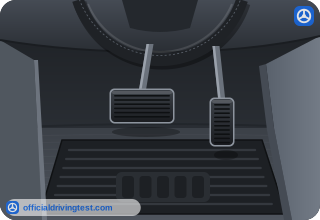
- Pump the pedal rapidly
- Apply constant and firm pressure without pumping
- Tap the pedal lightly several times
- Alternate the brake with the parking brake
Show answer
Correct answer: Apply constant and firm pressure without pumping
ABS brakes do not need to be pumped; firm, constant pressure gives a smooth, safe stop.
Source: Utah Driver Handbook (2026 edition (new 2026 laws effective May 6, 2026)), page 90 · Open this page in the manual (Manual page 90)
-
Buses, RVs, and trailers that are what width or more must have clearance lights?
- 60 inches
- 72 inches
- 80 inches
- 96 inches
Show answer
Correct answer: 80 inches
Clearance lights are required on buses, RVs, and trailers 80 inches or more in width.
Source: Utah Driver Handbook (2026 edition (new 2026 laws effective May 6, 2026)), page 91 · Open this page in the manual (Manual page 91)
-
From what distance at night must required clearance lights be visible?
- 500 feet
- 100 feet
- 250 feet
- 1,000 feet
Show answer
Correct answer: 500 feet
Clearance lights must be visible from 500 feet at night.
Source: Utah Driver Handbook (2026 edition (new 2026 laws effective May 6, 2026)), page 91 · Open this page in the manual (Manual page 91)
-
What does the handbook recommend about fire extinguishers?
- That all drivers carry at least one
- That only truck drivers carry one
- That none be carried in passenger vehicles
- That every vehicle carry two
Show answer
Correct answer: That all drivers carry at least one
Fire extinguishers are not required for all vehicles, but carrying at least one is recommended for all drivers.
Source: Utah Driver Handbook (2026 edition (new 2026 laws effective May 6, 2026)), page 91 · Open this page in the manual (Manual page 91)
-
A load extending how far beyond the bed or body of a vehicle must display two flags or lights on the rear of the load?
- One foot or more
- Two feet or more
- Four feet or more
- Six feet or more
Show answer
Correct answer: Four feet or more
A load that sticks out four feet or more must show two flags or lights at its rear.
Source: Utah Driver Handbook (2026 edition (new 2026 laws effective May 6, 2026)), page 91 · Open this page in the manual (Manual page 91)
-
Which marking for an extending load may be used only during the daytime?
- Lights
- Flags
- Red reflectors
- Flares
Show answer
Correct answer: Flags
Flags are for daytime use only, while lights are for nighttime.
Source: Utah Driver Handbook (2026 edition (new 2026 laws effective May 6, 2026)), page 91 · Open this page in the manual (Manual page 91)
-
How large must the flags on an extending load be?
- At least 6 inches square
- At least 18 inches square
- At least 24 inches square
- At least 12 inches square
Show answer
Correct answer: At least 12 inches square
Flags on an extending load must be at least 12 inches square.
Source: Utah Driver Handbook (2026 edition (new 2026 laws effective May 6, 2026)), page 91 · Open this page in the manual (Manual page 91)
-
How far must lights on an extending load be visible at night?
- At least 100 feet
- At least 250 feet
- At least 1,000 feet
- At least 500 feet
Show answer
Correct answer: At least 500 feet
Nighttime lights on an extending load must be visible for at least 500 feet.
Source: Utah Driver Handbook (2026 edition (new 2026 laws effective May 6, 2026)), page 91 · Open this page in the manual (Manual page 91)
-
What color must the headlights of vehicles other than motorcycles be?
- Amber
- White
- Blue
- Yellow
Show answer
Correct answer: White
Required headlights must be white.
Source: Utah Driver Handbook (2026 edition (new 2026 laws effective May 6, 2026)), page 91 · Open this page in the manual (Manual page 91)
-
How far must required headlights be able to shine on high beams?
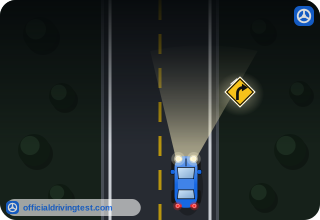
- 100 feet
- 200 feet
- 350 feet
- 500 feet
Show answer
Correct answer: 350 feet
Headlights must be able to shine 350 feet on high beams.
Source: Utah Driver Handbook (2026 edition (new 2026 laws effective May 6, 2026)), page 91 · Open this page in the manual (Manual page 91)
-
How far must required headlights be able to shine on low beams?
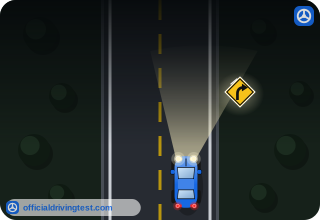
- 100 feet
- 50 feet
- 200 feet
- 350 feet
Show answer
Correct answer: 100 feet
Headlights must be able to shine 100 feet on low beams.
Source: Utah Driver Handbook (2026 edition (new 2026 laws effective May 6, 2026)), page 91 · Open this page in the manual (Manual page 91)
-
How many operational headlights must all vehicles except motorcycles have?
- At least two, one on each side
- One, in the center
- Three, including one fog light
- Four, two on each side
Show answer
Correct answer: At least two, one on each side
At least two operational headlights, one on each side, are required on vehicles other than motorcycles.
Source: Utah Driver Handbook (2026 edition (new 2026 laws effective May 6, 2026)), page 91 · Open this page in the manual (Manual page 91)
-
What indicator light must all vehicles have for their headlights?
- A low-beam warning buzzer
- A fog light indicator
- A high-beam indicator light
- A parking light timer
Show answer
Correct answer: A high-beam indicator light
Every vehicle must have a high-beam indicator light.
Source: Utah Driver Handbook (2026 edition (new 2026 laws effective May 6, 2026)), page 91 · Open this page in the manual (Manual page 91)
-
From what distance, under normal conditions, must the horn of a motor vehicle be heard?
- No less than 50 feet
- No less than 200 feet
- No less than 100 feet
- No less than 500 feet
Show answer
Correct answer: No less than 200 feet
The one required horn must be audible from no less than 200 feet under normal conditions.
Source: Utah Driver Handbook (2026 edition (new 2026 laws effective May 6, 2026)), page 91 · Open this page in the manual (Manual page 91)
-
At what distance must the license plate light let the license number be read?
- At least 25 feet
- At least 100 feet
- At least 200 feet
- At least 50 feet
Show answer
Correct answer: At least 50 feet
The white rear light must let the license number be read from at least 50 feet.
Source: Utah Driver Handbook (2026 edition (new 2026 laws effective May 6, 2026)), page 91 · Open this page in the manual (Manual page 91)
-
Which vehicle must be equipped with wheel covers, mudguards, flaps, or splash aprons behind the rearmost wheels?
- Any vehicle driven regularly on gravel roads
- Any vehicle with a rear spoiler or body kit
- Any vehicle with more than four doors
- Any vehicle with altered suspension or tire size
Show answer
Correct answer: Any vehicle with altered suspension or tire size
Altered suspension or tire size triggers the requirement for mudguards or flaps behind the rearmost wheels.
Source: Utah Driver Handbook (2026 edition (new 2026 laws effective May 6, 2026)), page 91 · Open this page in the manual (Manual page 91)
-
A trailer with an unladed weight of at least how many pounds must have mudguards or flaps behind the rearmost wheels?
- 500 pounds
- 750 pounds
- 1,000 pounds
- 2,000 pounds
Show answer
Correct answer: 750 pounds
A trailer with an unladed weight of 750 pounds or more needs mudguards, flaps, or splash aprons.
Source: Utah Driver Handbook (2026 edition (new 2026 laws effective May 6, 2026)), page 91 · Open this page in the manual (Manual page 91)
-
A vehicle with a gross vehicle weight rating of at least how many pounds must have mudguards or flaps behind the rearmost wheels?
- 6,000 pounds
- 8,500 pounds
- 10,500 pounds
- 14,000 pounds
Show answer
Correct answer: 10,500 pounds
A gross vehicle weight rating of 10,500 pounds or more triggers the mudguard or flap requirement.
Source: Utah Driver Handbook (2026 edition (new 2026 laws effective May 6, 2026)), page 91 · Open this page in the manual (Manual page 91)
-
How wide must mud flaps or guards be?
- At least as wide as the tires
- Half as wide as the tires
- Wide enough to cover the whole bumper
- Two inches narrower than the tires
Show answer
Correct answer: At least as wide as the tires
The flaps or guards must be at least as wide as the tires.
Source: Utah Driver Handbook (2026 edition (new 2026 laws effective May 6, 2026)), page 91 · Open this page in the manual (Manual page 91)