Utah: Vehicle controls and equipment — Preparing Your Vehicle, Backing and Lane Changes Practice Test
Questions in this part include: “In the handbook’s definitions, what are blind spots?” · “Before starting a vehicle, what should be true of the gear or clutch?”
Independent educational site · not affiliated with any government agency or DMV
Ready? Test yourself
- Instant feedback with an explanation
- Every answer cites its source in the manual
- Your best score is saved on this device
- Keyboard: press 1 to 4 to answer and Enter for the next question
Questions are original and based on the official manual "Utah Driver Handbook" (2026 edition (new 2026 laws effective May 6, 2026)), Utah Department of Public Safety, Driver License Division.
All 21 questions in this practice test
Take the test above first, then use this list to study. Tap “Show answer” to see the correct answer and explanation.
Show the questions and answersHide the questions
-
In the handbook’s definitions, what are blind spots?
- The part of the road beyond the reach of your own headlights at night
- The area of roadway hidden from view by fog, rain, or heavy smoke
- The area of roadway that can’t be seen with mirrors while operating a vehicle
- The stretch of road hidden behind a hill crest or a sharp bend ahead
Show answer
Correct answer: The area of roadway that can’t be seen with mirrors while operating a vehicle
Blind spots are the parts of the roadway you cannot see with your mirrors while driving.
Source: Utah Driver Handbook (2026 edition (new 2026 laws effective May 6, 2026)), page 1 · Open this page in the manual (Manual page 1)
-
What does the handbook mean by a head check?
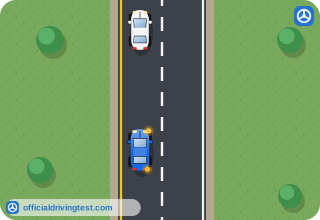
- Glancing at the side mirrors and the rearview mirror before every lane change or turn you make
- Checking your blind spot by turning your head and looking over your shoulder in the direction you plan on moving
- Looking far ahead to scan for traffic, signals, and hazards at the next intersection you reach
- Tilting your head back to adjust the rearview mirror before you start driving the vehicle
Show answer
Correct answer: Checking your blind spot by turning your head and looking over your shoulder in the direction you plan on moving
A head check means turning your head to look over your shoulder into the blind spot on the side you plan to move toward.
Source: Utah Driver Handbook (2026 edition (new 2026 laws effective May 6, 2026)), page 2 · Open this page in the manual (Manual page 2)
-
What does the handbook mean by a traffic check?
- A stop made at a police checkpoint where you must show your license and registration
- Counting the vehicles ahead of you to estimate how heavy the traffic is on that road
- Checking the fuel gauge and warning lights before starting the engine
- A defensive driving scan for other traffic, pedestrians, or other obstacles while driving
Show answer
Correct answer: A defensive driving scan for other traffic, pedestrians, or other obstacles while driving
A traffic check is a defensive scan for other traffic, pedestrians, and obstacles.
Source: Utah Driver Handbook (2026 edition (new 2026 laws effective May 6, 2026)), page 3 · Open this page in the manual (Manual page 3)
-
When your seat is adjusted correctly, how much space should you leave between your chest and the steering wheel?
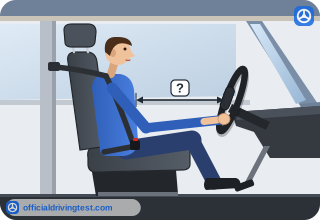
- 10 inches
- 4 inches
- 18 inches
- 24 inches
Show answer
Correct answer: 10 inches
The handbook says to leave 10 inches between your chest and the steering wheel, and not to lean the seat back.
Source: Utah Driver Handbook (2026 edition (new 2026 laws effective May 6, 2026)), page 27 · Open this page in the manual (Manual page 27)
-
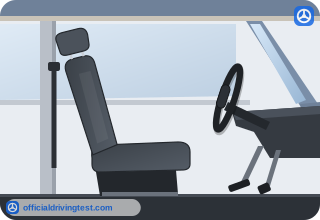
Where should the top of the steering wheel be in relation to your body?
- Level with the top of your head
- Just above your shoulders but below your ears
- No higher than your shoulders and below chin level
- Higher than your shoulders so you can see over it
Show answer
Correct answer: No higher than your shoulders and below chin level
The top of the steering wheel should be no higher than your shoulders and below chin level.
Source: Utah Driver Handbook (2026 edition (new 2026 laws effective May 6, 2026)), page 27 · Open this page in the manual (Manual page 27)
-
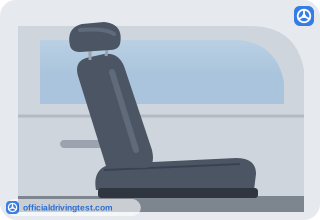
Where should the headrest contact the back of your head?
- At the base of your neck
- Above the level of your ears
- At the level of your shoulders
- Below the level of your ears
Show answer
Correct answer: Above the level of your ears
The headrest should touch the back of your head above ear level.
Source: Utah Driver Handbook (2026 edition (new 2026 laws effective May 6, 2026)), page 27 · Open this page in the manual (Manual page 27)
-
When your seat is adjusted correctly, how should you be able to move your foot?
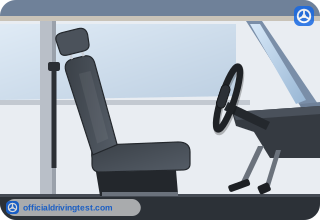
- Between the pedals only by lifting your whole leg off the floor
- Between the pedals only after sliding the seat back until your leg is straight
- From the brake to the gas pedal with your heel raised off the floor
- Easily from the brake to the gas pedal, with your heel on the floor
Show answer
Correct answer: Easily from the brake to the gas pedal, with your heel on the floor
With the seat set right, your foot moves easily from brake to gas pedal while the heel stays on the floor.
Source: Utah Driver Handbook (2026 edition (new 2026 laws effective May 6, 2026)), page 27 · Open this page in the manual (Manual page 27)
-
How should the inside mirror be adjusted?
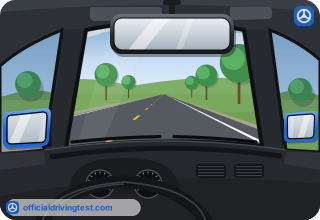
- So that it frames the rear window
- So that it shows mostly the back seat
- So that it shows the left side of your vehicle
- So that it points at the road just behind the bumper
Show answer
Correct answer: So that it frames the rear window
The inside mirror is set so that it frames the rear window.
Source: Utah Driver Handbook (2026 edition (new 2026 laws effective May 6, 2026)), page 27 · Open this page in the manual (Manual page 27)
-
If your vehicle has a day/night mirror, how should it be set?
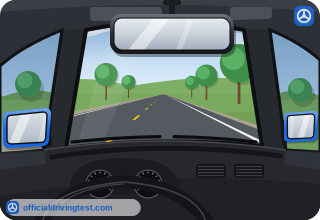
- To the night setting at all times
- To the day setting unless it is raining
- For the time of day you drive
- To the night setting whenever you drive on a highway
Show answer
Correct answer: For the time of day you drive
A day/night mirror should be set for the time of day you are driving.
Source: Utah Driver Handbook (2026 edition (new 2026 laws effective May 6, 2026)), page 27 · Open this page in the manual (Manual page 27)
-
How should you set your outside mirrors to minimize blind spots?
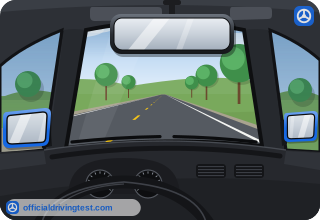
- So you can see as much of your own vehicle as possible
- So you can barely see the left and right sides of your vehicle
- So the mirrors point down at the road right beside the car
- So the mirrors show only the lane directly behind you
Show answer
Correct answer: So you can barely see the left and right sides of your vehicle
Setting the outside mirrors so you can barely see your vehicle's sides gives a wide view of the adjacent lanes.
Source: Utah Driver Handbook (2026 edition (new 2026 laws effective May 6, 2026)), page 27 · Open this page in the manual (Manual page 27)
-
Before starting a vehicle, what should be true of the gear or clutch?
- The vehicle is in neutral, with the clutch released
- The vehicle is in reverse, with the brake released
- The vehicle is in park, or the clutch is engaged on a manual
- The vehicle is in first gear, with the parking brake off
Show answer
Correct answer: The vehicle is in park, or the clutch is engaged on a manual
The vehicle must be in P (park) or the clutch engaged if it has manual gears.
Source: Utah Driver Handbook (2026 edition (new 2026 laws effective May 6, 2026)), page 30 · Open this page in the manual (Manual page 30)
-
After you turn on the engine, which of these should you check?
- Only the fuel level and the speedometer, before you move
- The lights and gauges, such as fuel level, ABS and air bags
- The tire pressure, the oil level and the coolant level
- The windshield wipers, the horn and the radio volume
Show answer
Correct answer: The lights and gauges, such as fuel level, ABS and air bags
After starting you check the lights and gauges, including fuel level, ABS and air bags.
Source: Utah Driver Handbook (2026 edition (new 2026 laws effective May 6, 2026)), page 30 · Open this page in the manual (Manual page 30)
-
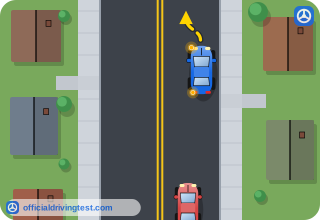
When moving forward, what should you do after putting the vehicle in gear and before you accelerate?
- Honk your horn to warn nearby traffic
- Turn on your high beams for visibility
- Turn on your hazard lights first
- Perform a traffic check and head check
Show answer
Correct answer: Perform a traffic check and head check
The steps are: brake, gear, traffic check and head check, signal if needed, then accelerate smoothly.
Source: Utah Driver Handbook (2026 edition (new 2026 laws effective May 6, 2026)), page 30 · Open this page in the manual (Manual page 30)
-
Why should you check behind the vehicle before you get in to back up?
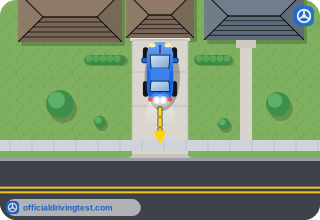
- You cannot see children or small objects from the driver's seat
- Your mirrors are always set too high for a clear view
- The rear window is usually too dirty to see through clearly
- Backing lights do not show what is behind the vehicle
Show answer
Correct answer: You cannot see children or small objects from the driver's seat
From the driver's seat you cannot see children or small objects behind the vehicle.
Source: Utah Driver Handbook (2026 edition (new 2026 laws effective May 6, 2026)), page 30 · Open this page in the manual (Manual page 30)
-
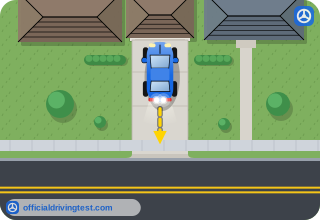
When backing, how should you hold the steering wheel and position your arm?
- Right hand on the wheel and left arm on the back of the driver's seat
- Both hands on the wheel and your arm on the door
- Left hand on the wheel and right arm on the back of the passenger seat
- Left hand on the wheel and left arm on the window
Show answer
Correct answer: Left hand on the wheel and right arm on the back of the passenger seat
You grasp the wheel with your left hand and put your right arm on the back of the passenger seat to look through the rear window.
Source: Utah Driver Handbook (2026 edition (new 2026 laws effective May 6, 2026)), page 30 · Open this page in the manual (Manual page 30)
-
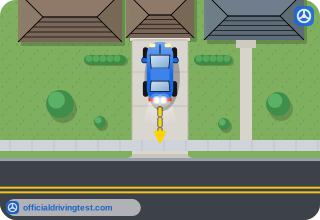
Why must you look through the rear window when backing?
- The rear window shows the road more brightly
- Your mirrors do not show the area right behind your vehicle
- Your mirrors work only when moving forward
- The rear window shows how far you are from the curb
Show answer
Correct answer: Your mirrors do not show the area right behind your vehicle
Mirrors do not show the area right behind the vehicle, so you look through the rear window.
Source: Utah Driver Handbook (2026 edition (new 2026 laws effective May 6, 2026)), page 30 · Open this page in the manual (Manual page 30)
-
When backing, in which direction should you steer?
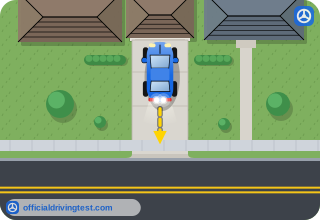
- In the direction you want the front of the vehicle to move
- Opposite to the direction you want the rear to move
- Straight until you are stopped
- In the direction you want the rear of the vehicle to move
Show answer
Correct answer: In the direction you want the rear of the vehicle to move
You steer toward the direction you want the rear of the vehicle to go.
Source: Utah Driver Handbook (2026 edition (new 2026 laws effective May 6, 2026)), page 30 · Open this page in the manual (Manual page 30)
-
How long should you keep looking to the rear when backing?
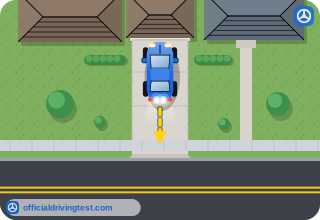
- Until you are stopped
- Only for the first few feet
- Until the vehicle is halfway to its destination
- Until you have checked the mirrors once
Show answer
Correct answer: Until you are stopped
You keep looking to the rear until you have come to a stop.
Source: Utah Driver Handbook (2026 edition (new 2026 laws effective May 6, 2026)), page 30 · Open this page in the manual (Manual page 30)
-
When backing, which side of the road should you keep your vehicle on?
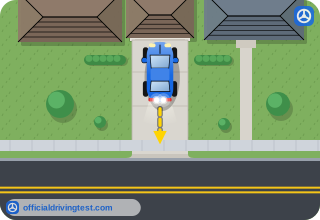
- The left-hand side
- The right-hand side
- The center of the road
- Whichever side has less traffic
Show answer
Correct answer: The right-hand side
Keep the vehicle on the right-hand side of the road and avoid backing unnecessarily long distances.
Source: Utah Driver Handbook (2026 edition (new 2026 laws effective May 6, 2026)), page 30 · Open this page in the manual (Manual page 30)
-
For how long should you signal before a lane change, according to the lane change steps?
- At least two seconds
- At least one second
- At least four seconds
- At least five seconds
Show answer
Correct answer: At least two seconds
The lane change steps say to signal for at least two seconds in the direction you intend to move.
Source: Utah Driver Handbook (2026 edition (new 2026 laws effective May 6, 2026)), page 30 · Open this page in the manual (Manual page 30)
-
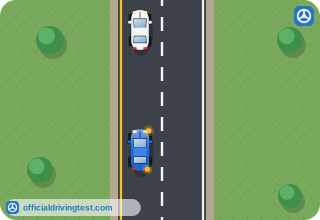
How do you check your blind spot before changing lanes?
- Look only in your inside mirror and then move over when the lane seems clear
- Look over your shoulder in the opposite direction from your lane change
- Turn your head and look over your shoulder in the same direction you intend to move
- Look in your outside mirror for two full seconds before moving over
Show answer
Correct answer: Turn your head and look over your shoulder in the same direction you intend to move
A blind spot check means turning your head to look over your shoulder in the direction of the lane change.
Source: Utah Driver Handbook (2026 edition (new 2026 laws effective May 6, 2026)), page 30 · Open this page in the manual (Manual page 30)