Utah: Vehicle controls and equipment
Seat and mirrors, starting, backing, steering and braking, turn and hand signals, headlights, and the lights, brakes and other equipment Utah requires. Split into 7 shorter tests so you're not stuck in one long quiz.
Independent educational site · not affiliated with any government agency or DMV
Choose a part
Vehicle controls and equipment — Test Vehicle and Safe Driving Tips
Questions in this part include: “Which lights must your vehicle have working for the driving skills test?”
StartVehicle controls and equipment — Preparing Your Vehicle, Backing and Lane Changes
Questions in this part include: “In the handbook’s definitions, what are blind spots?”
StartVehicle controls and equipment — Signaling, Steering and Stopping
Questions in this part include: “When should you check traffic by looking over your shoulder (a head check)?”
StartVehicle controls and equipment — Night and Mountain Driving, Street Legal ATVs
Questions in this part include: “At night, which lights should you ensure are illuminated?”
StartVehicle controls and equipment — Vehicle Equipment: Brakes, Lights and Loads
Questions in this part include: “In which conditions may a vehicle’s safety features not work correctly?”
StartVehicle controls and equipment — Equipment: Reflectors, Signals, Wipers, Towing
Questions in this part include: “Which vehicles are exempt from the requirement for one functional parking brake?”
StartVehicle controls and equipment — Vehicle Emissions and Clean Air
Questions in this part include: “Which is one of the three easy things you can do to keep emissions as low as possible?”
StartAll 140 Vehicle controls and equipment questions with answers
Choose a part above to take a practice test, or study every question and answer here.
Show the questions and answersHide the questions
-
In the handbook’s definitions, what are blind spots?
- The part of the road beyond the reach of your own headlights at night
- The area of roadway hidden from view by fog, rain, or heavy smoke
- The area of roadway that can’t be seen with mirrors while operating a vehicle
- The stretch of road hidden behind a hill crest or a sharp bend ahead
Show answer
Correct answer: The area of roadway that can’t be seen with mirrors while operating a vehicle
Blind spots are the parts of the roadway you cannot see with your mirrors while driving.
Source: Utah Driver Handbook (2026 edition (new 2026 laws effective May 6, 2026)), page 1 · Open this page in the manual (Manual page 1)
-
What does the handbook mean by a head check?
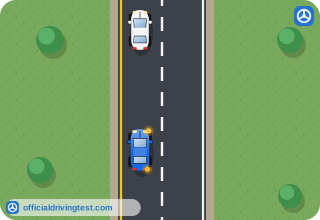
- Glancing at the side mirrors and the rearview mirror before every lane change or turn you make
- Checking your blind spot by turning your head and looking over your shoulder in the direction you plan on moving
- Looking far ahead to scan for traffic, signals, and hazards at the next intersection you reach
- Tilting your head back to adjust the rearview mirror before you start driving the vehicle
Show answer
Correct answer: Checking your blind spot by turning your head and looking over your shoulder in the direction you plan on moving
A head check means turning your head to look over your shoulder into the blind spot on the side you plan to move toward.
Source: Utah Driver Handbook (2026 edition (new 2026 laws effective May 6, 2026)), page 2 · Open this page in the manual (Manual page 2)
-
What does the handbook mean by a traffic check?
- A stop made at a police checkpoint where you must show your license and registration
- Counting the vehicles ahead of you to estimate how heavy the traffic is on that road
- Checking the fuel gauge and warning lights before starting the engine
- A defensive driving scan for other traffic, pedestrians, or other obstacles while driving
Show answer
Correct answer: A defensive driving scan for other traffic, pedestrians, or other obstacles while driving
A traffic check is a defensive scan for other traffic, pedestrians, and obstacles.
Source: Utah Driver Handbook (2026 edition (new 2026 laws effective May 6, 2026)), page 3 · Open this page in the manual (Manual page 3)
-
Which lights must your vehicle have working for the driving skills test?
- Front turn signals and fog lights, but not back signals
- Back turn signals and hazard lights only
- Brake lights and interior dome lights only
- Both front and back turn signal lights and brake lights
Show answer
Correct answer: Both front and back turn signal lights and brake lights
The vehicle needs both front and back turn signal lights and working brake lights.
Source: Utah Driver Handbook (2026 edition (new 2026 laws effective May 6, 2026)), page 25 · Open this page in the manual (Manual page 25)
-
What kind of horn must your vehicle have for the driving skills test?
- A horn that plays a tone of your choice
- A working horn designed for the vehicle
- A horn that sounds only when the engine is off
- A horn installed after the vehicle was sold
Show answer
Correct answer: A working horn designed for the vehicle
The test vehicle needs a working horn designed for that vehicle.
Source: Utah Driver Handbook (2026 edition (new 2026 laws effective May 6, 2026)), page 25 · Open this page in the manual (Manual page 25)
-
What must be true of the tires on your vehicle for the driving skills test?
- They are new within the past year
- They have no bald spots
- They are all the same brand
- They are filled with nitrogen
Show answer
Correct answer: They have no bald spots
The test vehicle’s tires must have no bald spots.
Source: Utah Driver Handbook (2026 edition (new 2026 laws effective May 6, 2026)), page 25 · Open this page in the manual (Manual page 25)
-
How may the examiner check that your vehicle has adequate brake pressure?
- By driving the vehicle without you
- By measuring the stopping distance on a freeway
- By checking only the emergency brake handle
- By asking you to step on the brake pedal
Show answer
Correct answer: By asking you to step on the brake pedal
You may be asked to step on the brake pedal to see if the brakes work properly.
Source: Utah Driver Handbook (2026 edition (new 2026 laws effective May 6, 2026)), page 25 · Open this page in the manual (Manual page 25)
-
What must be true of the driver’s side window on your vehicle for the driving skills test?
- It rolls down
- It is tinted
- It is made of laminated glass
- It opens by remote control only
Show answer
Correct answer: It rolls down
The driver’s side window must roll down.
Source: Utah Driver Handbook (2026 edition (new 2026 laws effective May 6, 2026)), page 25 · Open this page in the manual (Manual page 25)
-
What must the windshield of your vehicle allow for the driving skills test?
- A partial view through the center only
- A view that is tinted at the top
- An entire unobstructed field of vision
- A view covered by a parking permit
Show answer
Correct answer: An entire unobstructed field of vision
The windshield must allow an entire unobstructed field of vision.
Source: Utah Driver Handbook (2026 edition (new 2026 laws effective May 6, 2026)), page 25 · Open this page in the manual (Manual page 25)
-
What rear view mirrors must your vehicle have for the driving skills test?
- One, mounted inside the vehicle only
- Two, with one on the outside to the driver’s right
- Three, including one on each side
- Two, with one on the outside to the driver’s left
Show answer
Correct answer: Two, with one on the outside to the driver’s left
The vehicle needs two rear view mirrors, one of which must be on the outside, to the driver’s left.
Source: Utah Driver Handbook (2026 edition (new 2026 laws effective May 6, 2026)), page 25 · Open this page in the manual (Manual page 25)
-
How must the driver and front passenger doors of your vehicle open for the driving skills test?
- From the inside only, but not the outside
- From both the inside and the outside
- From the outside only
- From the driver’s door only
Show answer
Correct answer: From both the inside and the outside
The driver and front passenger doors must open from both inside and outside.
Source: Utah Driver Handbook (2026 edition (new 2026 laws effective May 6, 2026)), page 25 · Open this page in the manual (Manual page 25)
-
What must be true of the passenger seat in your vehicle for the driving skills test?
- It can be removed for cargo
- It is a bench seat in the front row
- It is permanently attached to the vehicle
- It has a folding backrest
Show answer
Correct answer: It is permanently attached to the vehicle
The passenger seat must be permanently attached to the vehicle.
Source: Utah Driver Handbook (2026 edition (new 2026 laws effective May 6, 2026)), page 25 · Open this page in the manual (Manual page 25)
-
Which brake must be working on your vehicle for the driving skills test?
- The emergency/parking brake
- The trailer brake
- The engine brake
- The tire pressure brake
Show answer
Correct answer: The emergency/parking brake
The test vehicle needs a working emergency/parking brake.
Source: Utah Driver Handbook (2026 edition (new 2026 laws effective May 6, 2026)), page 25 · Open this page in the manual (Manual page 25)
-
According to the safe driving tips, where should your hands be when you steer?
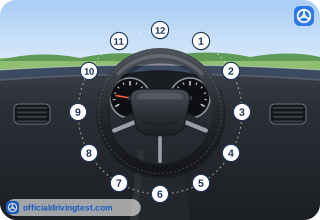
- Both hands in the center of the wheel
- One hand on the wheel and one on the gear shift
- Both hands on the outside of the wheel
- Both hands on the inside spokes of the wheel
Show answer
Correct answer: Both hands on the outside of the wheel
The tips say to steer smoothly with both hands on the outside of the wheel.
Source: Utah Driver Handbook (2026 edition (new 2026 laws effective May 6, 2026)), page 26 · Open this page in the manual (Manual page 26)
-
Which steering methods do the safe driving tips say you may use?
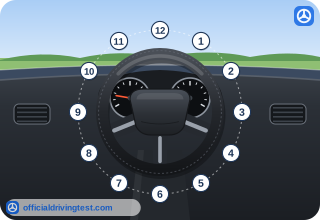
- Only hand-over-hand
- Only push-and-pull
- Either method, but only on straight roads
- Either hand-over-hand or push-and-pull
Show answer
Correct answer: Either hand-over-hand or push-and-pull
The tips say you may use the hand-over-hand or the push-and-pull method.
Source: Utah Driver Handbook (2026 edition (new 2026 laws effective May 6, 2026)), page 26 · Open this page in the manual (Manual page 26)
-
According to the safe driving tips, how should you accelerate?
- Quickly at first, then ease off once at speed
- Smoothly, without racing the engine or making it stall
- Gradually, with a pause at half throttle
- Sharply, to blend into traffic as quickly as you can
Show answer
Correct answer: Smoothly, without racing the engine or making it stall
The tips say to accelerate smoothly and not to race the engine or make it stall.
Source: Utah Driver Handbook (2026 edition (new 2026 laws effective May 6, 2026)), page 26 · Open this page in the manual (Manual page 26)
-
To avoid sudden jerks when stopping the vehicle, what do the safe driving tips say to do?
- Brake hard at the last moment, then release
- Take your foot off the accelerator only at the stop line
- Start braking well ahead of where you must stop
- Pump the brake pedal repeatedly as you stop
Show answer
Correct answer: Start braking well ahead of where you must stop
Stop gently by starting to brake well ahead of where you must stop.
Source: Utah Driver Handbook (2026 edition (new 2026 laws effective May 6, 2026)), page 26 · Open this page in the manual (Manual page 26)
-
What do the safe driving tips say you should not do as you come to a stop?
- Coast to a stop
- Brake gently
- Be aware of crosswalks
- Use the correct gear
Show answer
Correct answer: Coast to a stop
The tips say to be sure the vehicle is in the correct gear, not to grind the gears, and not to coast to a stop.
Source: Utah Driver Handbook (2026 edition (new 2026 laws effective May 6, 2026)), page 26 · Open this page in the manual (Manual page 26)
-
What do the safe driving tips say you should always do about hazards and mirrors?
- Scan for potential hazards and check your mirrors frequently
- Check your mirrors only before changing lanes
- Scan for hazards only when passing another vehicle
- Rely on your mirrors instead of scanning ahead
Show answer
Correct answer: Scan for potential hazards and check your mirrors frequently
Always scan for potential hazards and check your mirrors frequently.
Source: Utah Driver Handbook (2026 edition (new 2026 laws effective May 6, 2026)), page 26 · Open this page in the manual (Manual page 26)
-
Before which action do the safe driving tips say to look over the proper shoulder (head check/traffic check)?
- Braking for a red light
- Sounding your horn
- Checking your speedometer
- Pulling away from the curb
Show answer
Correct answer: Pulling away from the curb
Look over the proper shoulder before making lane changes, pulling away from the curb, or making turns.
Source: Utah Driver Handbook (2026 edition (new 2026 laws effective May 6, 2026)), page 26 · Open this page in the manual (Manual page 26)
-
When your seat is adjusted correctly, how much space should you leave between your chest and the steering wheel?
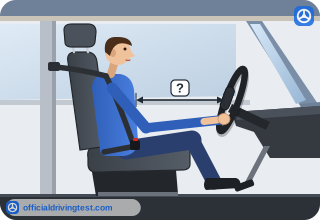
- 10 inches
- 4 inches
- 18 inches
- 24 inches
Show answer
Correct answer: 10 inches
The handbook says to leave 10 inches between your chest and the steering wheel, and not to lean the seat back.
Source: Utah Driver Handbook (2026 edition (new 2026 laws effective May 6, 2026)), page 27 · Open this page in the manual (Manual page 27)
-
Where should the top of the steering wheel be in relation to your body?
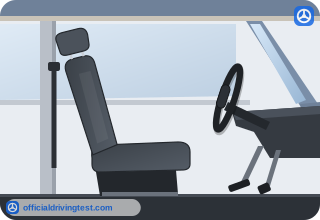
- Level with the top of your head
- Just above your shoulders but below your ears
- No higher than your shoulders and below chin level
- Higher than your shoulders so you can see over it
Show answer
Correct answer: No higher than your shoulders and below chin level
The top of the steering wheel should be no higher than your shoulders and below chin level.
Source: Utah Driver Handbook (2026 edition (new 2026 laws effective May 6, 2026)), page 27 · Open this page in the manual (Manual page 27)
-
Where should the headrest contact the back of your head?
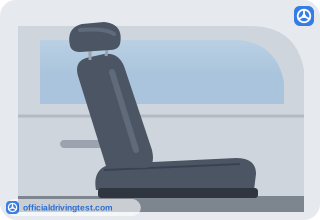
- At the base of your neck
- Above the level of your ears
- At the level of your shoulders
- Below the level of your ears
Show answer
Correct answer: Above the level of your ears
The headrest should touch the back of your head above ear level.
Source: Utah Driver Handbook (2026 edition (new 2026 laws effective May 6, 2026)), page 27 · Open this page in the manual (Manual page 27)
-
When your seat is adjusted correctly, how should you be able to move your foot?
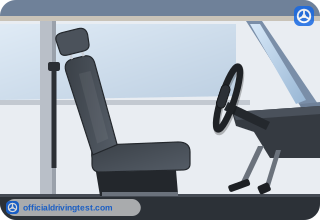
- Between the pedals only by lifting your whole leg off the floor
- Between the pedals only after sliding the seat back until your leg is straight
- From the brake to the gas pedal with your heel raised off the floor
- Easily from the brake to the gas pedal, with your heel on the floor
Show answer
Correct answer: Easily from the brake to the gas pedal, with your heel on the floor
With the seat set right, your foot moves easily from brake to gas pedal while the heel stays on the floor.
Source: Utah Driver Handbook (2026 edition (new 2026 laws effective May 6, 2026)), page 27 · Open this page in the manual (Manual page 27)
-
How should the inside mirror be adjusted?
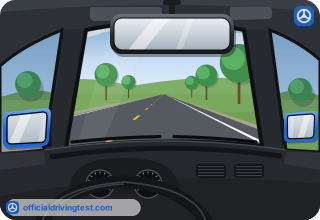
- So that it frames the rear window
- So that it shows mostly the back seat
- So that it shows the left side of your vehicle
- So that it points at the road just behind the bumper
Show answer
Correct answer: So that it frames the rear window
The inside mirror is set so that it frames the rear window.
Source: Utah Driver Handbook (2026 edition (new 2026 laws effective May 6, 2026)), page 27 · Open this page in the manual (Manual page 27)
-
If your vehicle has a day/night mirror, how should it be set?
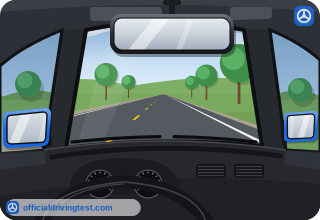
- To the night setting at all times
- To the day setting unless it is raining
- For the time of day you drive
- To the night setting whenever you drive on a highway
Show answer
Correct answer: For the time of day you drive
A day/night mirror should be set for the time of day you are driving.
Source: Utah Driver Handbook (2026 edition (new 2026 laws effective May 6, 2026)), page 27 · Open this page in the manual (Manual page 27)
-
How should you set your outside mirrors to minimize blind spots?
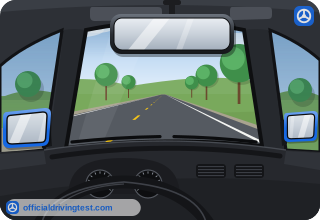
- So you can see as much of your own vehicle as possible
- So you can barely see the left and right sides of your vehicle
- So the mirrors point down at the road right beside the car
- So the mirrors show only the lane directly behind you
Show answer
Correct answer: So you can barely see the left and right sides of your vehicle
Setting the outside mirrors so you can barely see your vehicle's sides gives a wide view of the adjacent lanes.
Source: Utah Driver Handbook (2026 edition (new 2026 laws effective May 6, 2026)), page 27 · Open this page in the manual (Manual page 27)
-
Before starting a vehicle, what should be true of the gear or clutch?
- The vehicle is in neutral, with the clutch released
- The vehicle is in reverse, with the brake released
- The vehicle is in park, or the clutch is engaged on a manual
- The vehicle is in first gear, with the parking brake off
Show answer
Correct answer: The vehicle is in park, or the clutch is engaged on a manual
The vehicle must be in P (park) or the clutch engaged if it has manual gears.
Source: Utah Driver Handbook (2026 edition (new 2026 laws effective May 6, 2026)), page 30 · Open this page in the manual (Manual page 30)
-
After you turn on the engine, which of these should you check?
- Only the fuel level and the speedometer, before you move
- The lights and gauges, such as fuel level, ABS and air bags
- The tire pressure, the oil level and the coolant level
- The windshield wipers, the horn and the radio volume
Show answer
Correct answer: The lights and gauges, such as fuel level, ABS and air bags
After starting you check the lights and gauges, including fuel level, ABS and air bags.
Source: Utah Driver Handbook (2026 edition (new 2026 laws effective May 6, 2026)), page 30 · Open this page in the manual (Manual page 30)
-
When moving forward, what should you do after putting the vehicle in gear and before you accelerate?
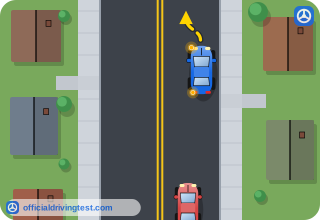
- Honk your horn to warn nearby traffic
- Turn on your high beams for visibility
- Turn on your hazard lights first
- Perform a traffic check and head check
Show answer
Correct answer: Perform a traffic check and head check
The steps are: brake, gear, traffic check and head check, signal if needed, then accelerate smoothly.
Source: Utah Driver Handbook (2026 edition (new 2026 laws effective May 6, 2026)), page 30 · Open this page in the manual (Manual page 30)
-
Why should you check behind the vehicle before you get in to back up?
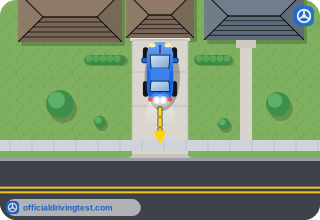
- You cannot see children or small objects from the driver's seat
- Your mirrors are always set too high for a clear view
- The rear window is usually too dirty to see through clearly
- Backing lights do not show what is behind the vehicle
Show answer
Correct answer: You cannot see children or small objects from the driver's seat
From the driver's seat you cannot see children or small objects behind the vehicle.
Source: Utah Driver Handbook (2026 edition (new 2026 laws effective May 6, 2026)), page 30 · Open this page in the manual (Manual page 30)
-
When backing, how should you hold the steering wheel and position your arm?
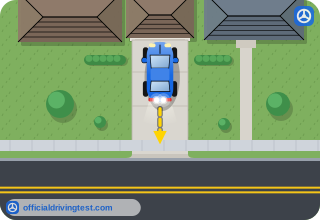
- Right hand on the wheel and left arm on the back of the driver's seat
- Both hands on the wheel and your arm on the door
- Left hand on the wheel and right arm on the back of the passenger seat
- Left hand on the wheel and left arm on the window
Show answer
Correct answer: Left hand on the wheel and right arm on the back of the passenger seat
You grasp the wheel with your left hand and put your right arm on the back of the passenger seat to look through the rear window.
Source: Utah Driver Handbook (2026 edition (new 2026 laws effective May 6, 2026)), page 30 · Open this page in the manual (Manual page 30)
-
Why must you look through the rear window when backing?
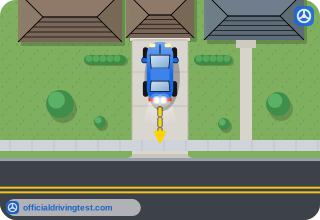
- The rear window shows the road more brightly
- Your mirrors do not show the area right behind your vehicle
- Your mirrors work only when moving forward
- The rear window shows how far you are from the curb
Show answer
Correct answer: Your mirrors do not show the area right behind your vehicle
Mirrors do not show the area right behind the vehicle, so you look through the rear window.
Source: Utah Driver Handbook (2026 edition (new 2026 laws effective May 6, 2026)), page 30 · Open this page in the manual (Manual page 30)
-
When backing, in which direction should you steer?
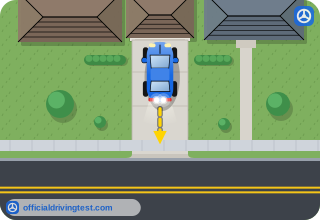
- In the direction you want the front of the vehicle to move
- Opposite to the direction you want the rear to move
- Straight until you are stopped
- In the direction you want the rear of the vehicle to move
Show answer
Correct answer: In the direction you want the rear of the vehicle to move
You steer toward the direction you want the rear of the vehicle to go.
Source: Utah Driver Handbook (2026 edition (new 2026 laws effective May 6, 2026)), page 30 · Open this page in the manual (Manual page 30)
-
How long should you keep looking to the rear when backing?
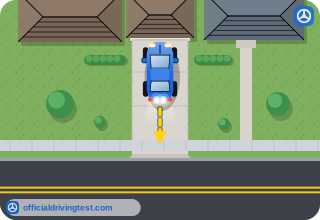
- Until you are stopped
- Only for the first few feet
- Until the vehicle is halfway to its destination
- Until you have checked the mirrors once
Show answer
Correct answer: Until you are stopped
You keep looking to the rear until you have come to a stop.
Source: Utah Driver Handbook (2026 edition (new 2026 laws effective May 6, 2026)), page 30 · Open this page in the manual (Manual page 30)
-
When backing, which side of the road should you keep your vehicle on?
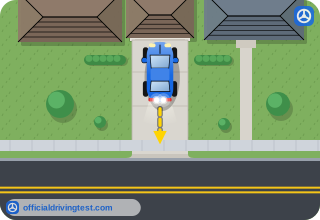
- The left-hand side
- The right-hand side
- The center of the road
- Whichever side has less traffic
Show answer
Correct answer: The right-hand side
Keep the vehicle on the right-hand side of the road and avoid backing unnecessarily long distances.
Source: Utah Driver Handbook (2026 edition (new 2026 laws effective May 6, 2026)), page 30 · Open this page in the manual (Manual page 30)
-
For how long should you signal before a lane change, according to the lane change steps?
- At least two seconds
- At least one second
- At least four seconds
- At least five seconds
Show answer
Correct answer: At least two seconds
The lane change steps say to signal for at least two seconds in the direction you intend to move.
Source: Utah Driver Handbook (2026 edition (new 2026 laws effective May 6, 2026)), page 30 · Open this page in the manual (Manual page 30)
-
How do you check your blind spot before changing lanes?
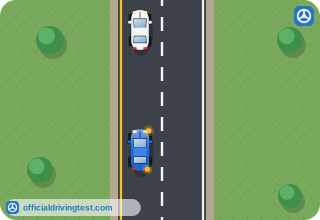
- Look only in your inside mirror and then move over when the lane seems clear
- Look over your shoulder in the opposite direction from your lane change
- Turn your head and look over your shoulder in the same direction you intend to move
- Look in your outside mirror for two full seconds before moving over
Show answer
Correct answer: Turn your head and look over your shoulder in the same direction you intend to move
A blind spot check means turning your head to look over your shoulder in the direction of the lane change.
Source: Utah Driver Handbook (2026 edition (new 2026 laws effective May 6, 2026)), page 30 · Open this page in the manual (Manual page 30)
-
When should you check traffic by looking over your shoulder (a head check)?
- Only when you are driving on a freeway or interstate
- When necessary, such as when changing lanes or merging
- Only when you are backing the vehicle up or parking
- Never, if your mirrors are properly adjusted
Show answer
Correct answer: When necessary, such as when changing lanes or merging
A head check is done when necessary, for example for a lane change or merging.
Source: Utah Driver Handbook (2026 edition (new 2026 laws effective May 6, 2026)), page 31 · Open this page in the manual (Manual page 31)
-
When should you cancel your turn signal?
- Before you begin the turn
- After you have driven one block
- Only when the signal stops clicking
- Upon completion of a turn or lane change
Show answer
Correct answer: Upon completion of a turn or lane change
Turn signals are cancelled upon completion of a turn or lane change.
Source: Utah Driver Handbook (2026 edition (new 2026 laws effective May 6, 2026)), page 31 · Open this page in the manual (Manual page 31)
-
What does the handbook say about the timing of turn signals?
- Do not signal too early or too late
- Signal as early as possible
- Signal only once you have begun the turn
- Signal only if another vehicle is nearby
Show answer
Correct answer: Do not signal too early or too late
Turn signals should be used when required, and not too early or too late.
Source: Utah Driver Handbook (2026 edition (new 2026 laws effective May 6, 2026)), page 31 · Open this page in the manual (Manual page 31)
-
Besides turn signals and stoplights, what can be used to give a signal?
- Your dome light
- Your high beams
- Your windshield wipers
- Your hand and arm
Show answer
Correct answer: Your hand and arm
The handbook says signals are given by turn signals, stoplights, or your hand and arm.
Source: Utah Driver Handbook (2026 edition (new 2026 laws effective May 6, 2026)), page 34 · Open this page in the manual (Manual page 34)
-
How long before turning must you signal?
- For one second
- For four seconds
- For two seconds
- For five seconds
Show answer
Correct answer: For two seconds
Signals are required for two seconds before turning.
Source: Utah Driver Handbook (2026 edition (new 2026 laws effective May 6, 2026)), page 34 · Open this page in the manual (Manual page 34)
-
When does the handbook say a signal is required in connection with a curb?
- Only when another vehicle is behind you
- Only when you pull away from a curb on a busy street
- Any time you pull to or from a curb
- Only when you park for more than a few minutes
Show answer
Correct answer: Any time you pull to or from a curb
A signal is required any time you pull to or from a curb.
Source: Utah Driver Handbook (2026 edition (new 2026 laws effective May 6, 2026)), page 35 · Open this page in the manual (Manual page 35)
-
What gives the signal that you intend to slow down or stop, if it works correctly and can be seen?
- Your hand and arm only
- Your brake lights
- Your emergency flashers
- Your left turn signal
Show answer
Correct answer: Your brake lights
Working brake lights that can be readily seen signal that you intend to slow down or stop.
Source: Utah Driver Handbook (2026 edition (new 2026 laws effective May 6, 2026)), page 35 · Open this page in the manual (Manual page 35)
-
When should you use your car's emergency flasher system?
- When you stop briefly to let a passenger out
- When you are waiting to make a left turn
- When you are changing lanes on a freeway
- When your car is disabled on the highway
Show answer
Correct answer: When your car is disabled on the highway
The handbook says the emergency flasher system is for use when your car is disabled on the highway.
Source: Utah Driver Handbook (2026 edition (new 2026 laws effective May 6, 2026)), page 35 · Open this page in the manual (Manual page 35)
-
Where should you keep your hands on the steering wheel at all times unless using other controls?
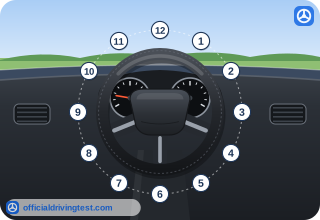
- Both hands on the inside of the wheel
- Both hands on the outside of the wheel
- One hand on the outside and one on the center hub
- One hand on the wheel and one resting in your lap
Show answer
Correct answer: Both hands on the outside of the wheel
Both hands stay on the outside of the wheel unless you are using other controls.
Source: Utah Driver Handbook (2026 edition (new 2026 laws effective May 6, 2026)), page 35 · Open this page in the manual (Manual page 35)
-
Which steering methods does the handbook say are acceptable?
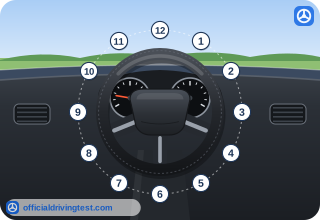
- Any method, if both hands stay on the outside of the wheel
- Only hand-over-hand steering, in every driving situation
- Only push/pull steering, in every driving situation
- Any method, if one hand stays on the inside of the wheel
Show answer
Correct answer: Any method, if both hands stay on the outside of the wheel
All steering methods are acceptable, such as hand-over-hand and push/pull, as long as both hands are on the outside of the wheel.
Source: Utah Driver Handbook (2026 edition (new 2026 laws effective May 6, 2026)), page 35 · Open this page in the manual (Manual page 35)
-
In which direction should you turn the steering wheel?
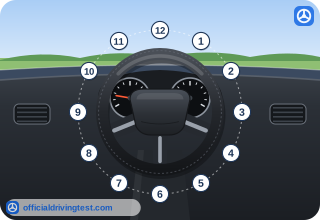
- The direction you want to go, but only when driving forward
- The opposite of the direction you want to go when in reverse
- Toward the nearest curb when in reverse
- The direction you want to go, forward or in reverse
Show answer
Correct answer: The direction you want to go, forward or in reverse
You always turn the wheel in the direction you want to go, whether forward or in reverse.
Source: Utah Driver Handbook (2026 edition (new 2026 laws effective May 6, 2026)), page 35 · Open this page in the manual (Manual page 35)
-
Which part of your hands should you use to grip the steering wheel?
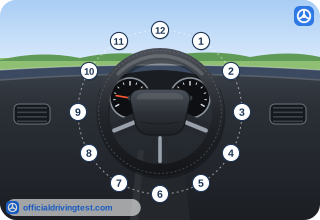
- Your palms, not your fingers
- Your palms and thumbs together
- Your fingers, not your palms
- Your thumbs wrapped around the inside rim
Show answer
Correct answer: Your fingers, not your palms
The handbook says to grip the wheel firmly but gently with your fingers, not the palms of your hands.
Source: Utah Driver Handbook (2026 edition (new 2026 laws effective May 6, 2026)), page 35 · Open this page in the manual (Manual page 35)
-
Where should you keep your thumbs on the steering wheel?
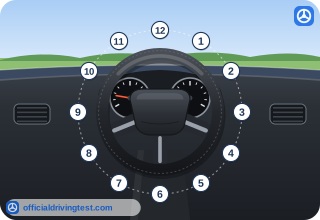
- Up along the face of the wheel
- Hooked over the inside of the rim
- Tucked under the rim
- Resting on the center hub
Show answer
Correct answer: Up along the face of the wheel
Thumbs stay up along the face of the steering wheel, never on the inside of it.
Source: Utah Driver Handbook (2026 edition (new 2026 laws effective May 6, 2026)), page 35 · Open this page in the manual (Manual page 35)
-
In which situation does the handbook say to use hand-over-hand steering?
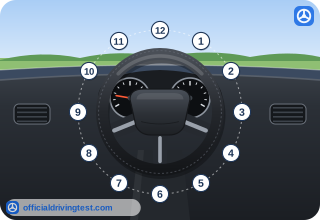
- Driving straight on a freeway
- Changing lanes on a multi-lane road
- Correcting a skid
- Slowing for a red light
Show answer
Correct answer: Correcting a skid
Hand-over-hand steering is for when steering is critical, such as parking, sharp right turns, or correcting a skid.
Source: Utah Driver Handbook (2026 edition (new 2026 laws effective May 6, 2026)), page 35 · Open this page in the manual (Manual page 35)
-
What is a benefit of pull-push steering?
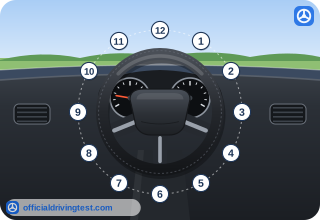
- It lets you steer with one hand while using other controls
- Smooth steering that reduces the potential for over-steering
- Faster turns with less hand movement on the wheel
- It keeps your hands crossing over the top of the wheel
Show answer
Correct answer: Smooth steering that reduces the potential for over-steering
Pulling down with one hand and pushing up with the other gives smooth steering and reduces over-steering.
Source: Utah Driver Handbook (2026 edition (new 2026 laws effective May 6, 2026)), page 35 · Open this page in the manual (Manual page 35)
-
When stopping normally, how should you apply the brake?
- Quickly, with a sharp push
- In short, repeated pumps
- Lightly at first, then hard at the last moment
- Smoothly, with steady pressure
Show answer
Correct answer: Smoothly, with steady pressure
The handbook says to apply the brake smoothly and use steady pressure.
Source: Utah Driver Handbook (2026 edition (new 2026 laws effective May 6, 2026)), page 35 · Open this page in the manual (Manual page 35)
-
When stopping, what does the handbook say to do before you move your foot to the brake pedal?
- Press the brake pedal hard
- Check your mirrors for traffic to the rear
- Shift into neutral
- Signal with your hand out the window
Show answer
Correct answer: Check your mirrors for traffic to the rear
The stopping steps start with checking your mirrors for traffic behind you, then moving your foot to the brake.
Source: Utah Driver Handbook (2026 edition (new 2026 laws effective May 6, 2026)), page 35 · Open this page in the manual (Manual page 35)
-
What do you need to use to drive up hills and steep mountains, because gravity slows your vehicle on an upgrade?
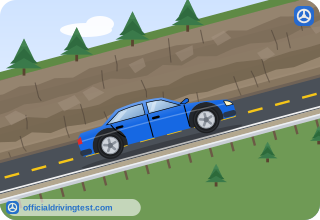
- Lower gears
- Higher gears
- Neutral
- Only the brake pedal
Show answer
Correct answer: Lower gears
The handbook says gravity slows your vehicle on an upgrade, so you need to use lower gears to drive up hills and steep mountains.
Source: Utah Driver Handbook (2026 edition (new 2026 laws effective May 6, 2026)), page 60 · Open this page in the manual (Manual page 60)
-
At night, which lights should you ensure are illuminated?
- Interior lights and headlights
- Headlights and taillights
- Parking lights and brake lights only
- Fog lights and hazard lights
Show answer
Correct answer: Headlights and taillights
The night driving tips say to ensure the headlights and taillights of the vehicle are illuminated.
Source: Utah Driver Handbook (2026 edition (new 2026 laws effective May 6, 2026)), page 60 · Open this page in the manual (Manual page 60)
-
The handbook says to use your lights any time conditions keep you from seeing how far ahead?
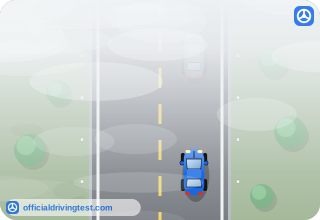
- 500 feet
- 300 feet
- 1,000 feet
- 200 feet
Show answer
Correct answer: 1,000 feet
The handbook says to use your lights any time conditions keep you from seeing 1,000 feet ahead.
Source: Utah Driver Handbook (2026 edition (new 2026 laws effective May 6, 2026)), page 61 · Open this page in the manual (Manual page 61)
-
When your high beams are on and a car is coming toward you, when should you dim your lights?
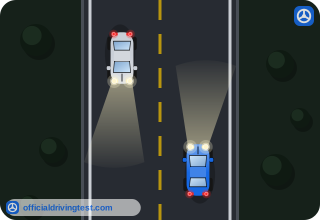
- Only after you get within 300 feet of the car
- Before you are within 500 feet of the car
- Only after you get within 200 feet of the car
- Only when the car is within 100 feet of you
Show answer
Correct answer: Before you are within 500 feet of the car
The handbook says to dim your lights before you get within 500 feet of an oncoming car.
Source: Utah Driver Handbook (2026 edition (new 2026 laws effective May 6, 2026)), page 60 · Open this page in the manual (Manual page 60)
-
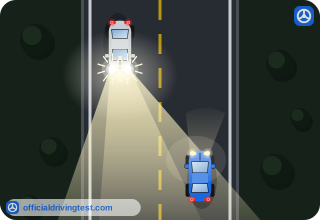
If an oncoming vehicle does not dim its high beams, where should you look to avoid being blinded?
- Directly at the oncoming headlights
- At the center line of the road
- Into your rearview mirror
- At the right side of the road
Show answer
Correct answer: At the right side of the road
The handbook says to look at the right side of the road if an oncoming vehicle does not dim, which helps avoid being blinded by the headlights.
Source: Utah Driver Handbook (2026 edition (new 2026 laws effective May 6, 2026)), page 60 · Open this page in the manual (Manual page 60)
-
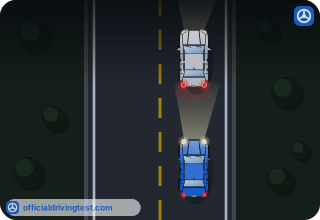
When you are following a car at night, at what distance should you dim your lights?
- When you are within 150 feet of the vehicle ahead
- When you are within 100 feet of the vehicle ahead
- When you are within 300 feet of the vehicle ahead
- When you are within 500 feet of the vehicle ahead
Show answer
Correct answer: When you are within 300 feet of the vehicle ahead
The handbook says to dim your lights when you are within 300 feet of the vehicle you are following.
Source: Utah Driver Handbook (2026 edition (new 2026 laws effective May 6, 2026)), page 60 · Open this page in the manual (Manual page 60)
-
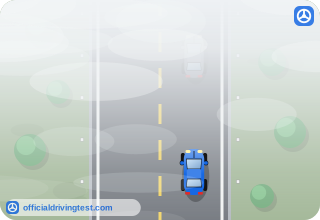
You must use your lights any time conditions keep you from seeing how far ahead?
- 1,000 feet
- 500 feet
- 300 feet
- 100 feet
Show answer
Correct answer: 1,000 feet
The handbook says to use your lights whenever you cannot see 1,000 feet ahead.
Source: Utah Driver Handbook (2026 edition (new 2026 laws effective May 6, 2026)), page 61 · Open this page in the manual (Manual page 61)
-
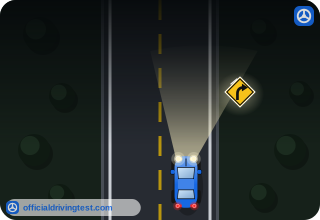
What does the handbook say about wearing sunglasses or colored lenses when driving at night?
- Do not wear them
- Wear them only on well-lit roads
- Wear them only when facing headlights
- Wear them only on rural roads
Show answer
Correct answer: Do not wear them
Tinted or colored lenses reduce the light you need for good vision, so do not wear them at night.
Source: Utah Driver Handbook (2026 edition (new 2026 laws effective May 6, 2026)), page 61 · Open this page in the manual (Manual page 61)
-
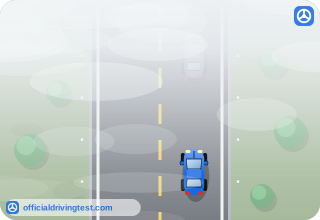
Which lights should you use to avoid glare in fog, rain or snow?
- High beams
- Parking lights
- Low beams
- Hazard lights
Show answer
Correct answer: Low beams
The handbook says to use low beams to avoid glare in fog, rain, or snow.
Source: Utah Driver Handbook (2026 edition (new 2026 laws effective May 6, 2026)), page 63 · Open this page in the manual (Manual page 63)
-
On a highway with a posted speed higher than 50 miles per hour, a street-legal ATV/UTV must also be equipped with what?
- A flashing amber beacon on the roof
- A reflector or reflective tape
- A second headlamp mounted on the rear
- A rear-facing camera and monitor
Show answer
Correct answer: A reflector or reflective tape
The extra equipment required where the posted speed is over 50 mph is a reflector or reflective tape.
Source: Utah Driver Handbook (2026 edition (new 2026 laws effective May 6, 2026)), page 86 · Open this page in the manual (Manual page 86)
-
What is the minimum tire tread required on a street-legal ATV/UTV?
- At least 1/32 inch
- At least 4/32 inch
- At least 6/32 inch
- At least 2/32 inch
Show answer
Correct answer: At least 2/32 inch
A street-legal ATV/UTV needs tires with at least 2/32 inch of tread.
Source: Utah Driver Handbook (2026 edition (new 2026 laws effective May 6, 2026)), page 86 · Open this page in the manual (Manual page 86)
-
A street-legal ATV/UTV must have a windshield unless the operator does what?
- Drives only during daylight hours on paved roads
- Drives only on dirt or gravel roads off the highway
- Stays below 25 miles per hour at all times
- Wears eye protection while operating the vehicle
Show answer
Correct answer: Wears eye protection while operating the vehicle
The windshield requirement is waived only when the operator wears eye protection.
Source: Utah Driver Handbook (2026 edition (new 2026 laws effective May 6, 2026)), page 86 · Open this page in the manual (Manual page 86)
-
What color may the electric turn signals on the front and rear of a street-legal ATV/UTV be?
- White or green
- Amber or red
- Blue or green
- White or blue
Show answer
Correct answer: Amber or red
The equipment list for street-legal ATV/UTV calls for amber or red electric turn signals on each side, front and rear.
Source: Utah Driver Handbook (2026 edition (new 2026 laws effective May 6, 2026)), page 86 · Open this page in the manual (Manual page 86)
-
On which side of the driver must a street-legal ATV/UTV have its rear view mirrors?
- The right side only
- Mounted on the windshield frame only
- The left side
- Mirrors are not required
Show answer
Correct answer: The left side
The equipment list for a street-legal ATV/UTV includes rear view mirrors on the left side of the driver.
Source: Utah Driver Handbook (2026 edition (new 2026 laws effective May 6, 2026)), page 86 · Open this page in the manual (Manual page 86)
-
How large may the tires on a street-legal ATV be?
- No larger than the tires its manufacturer made available
- Any size, as long as the tread is at least 2/32 inch
- No larger than the tires of a typical passenger car
- Up to two inches wider than the original tires
Show answer
Correct answer: No larger than the tires its manufacturer made available
The tires may be no larger than those the ATV manufacturer made available for that ATV.
Source: Utah Driver Handbook (2026 edition (new 2026 laws effective May 6, 2026)), page 86 · Open this page in the manual (Manual page 86)
-
What must be true of the speedometer on a street-legal ATV/UTV?
- It must show kilometers per hour as well as miles
- It must be a digital display, not a dial
- It must be illuminated for nighttime operation
- It must stop reading above 50 miles per hour
Show answer
Correct answer: It must be illuminated for nighttime operation
The speedometer must be lit so it can be read at night.
Source: Utah Driver Handbook (2026 edition (new 2026 laws effective May 6, 2026)), page 86 · Open this page in the manual (Manual page 86)
-
In which conditions may a vehicle’s safety features not work correctly?
- Only on dry, straight, level roads
- Only at night
- Rain, snow, ice, fog, hills, and curves
- Only above 65 miles per hour
Show answer
Correct answer: Rain, snow, ice, fog, hills, and curves
Weather such as rain, snow, ice, and fog, and terrain such as hills and curves, can keep safety features from working correctly.
Source: Utah Driver Handbook (2026 edition (new 2026 laws effective May 6, 2026)), page 90 · Open this page in the manual (Manual page 90)
-
What should you do with the sensors of your vehicle’s safety features?
- Cover them in cold weather
- Always keep them clean and damage-free
- Recalibrate them yourself every month
- Switch them off in rain
Show answer
Correct answer: Always keep them clean and damage-free
Dirty or damaged sensors can keep safety features from working, so keep them clean and undamaged.
Source: Utah Driver Handbook (2026 edition (new 2026 laws effective May 6, 2026)), page 90 · Open this page in the manual (Manual page 90)
-
How does the handbook say to learn how your vehicle’s safety features operate?
- Test them on a busy road
- Ask a passenger to demonstrate
- Assume they work like those of other vehicles
- Read your vehicle owner’s manual
Show answer
Correct answer: Read your vehicle owner’s manual
The owner’s manual explains how your own vehicle’s safety features work.
Source: Utah Driver Handbook (2026 edition (new 2026 laws effective May 6, 2026)), page 90 · Open this page in the manual (Manual page 90)
-
Apart from certain trucks with three or more axles, on which wheels must all motor vehicles have brakes that meet federal standards?
- The rear wheels only
- The front wheels only
- One front and one rear wheel
- All wheels
Show answer
Correct answer: All wheels
Motor vehicles must have brakes meeting federal standards on all wheels, with an exception for certain trucks.
Source: Utah Driver Handbook (2026 edition (new 2026 laws effective May 6, 2026)), page 90 · Open this page in the manual (Manual page 90)
-
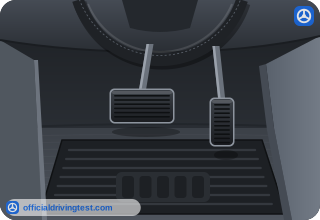
In a slippery situation, how should you brake if your vehicle has ABS brakes?
- Pump the pedal rapidly
- Apply constant and firm pressure without pumping
- Tap the pedal lightly several times
- Alternate the brake with the parking brake
Show answer
Correct answer: Apply constant and firm pressure without pumping
ABS brakes do not need to be pumped; firm, constant pressure gives a smooth, safe stop.
Source: Utah Driver Handbook (2026 edition (new 2026 laws effective May 6, 2026)), page 90 · Open this page in the manual (Manual page 90)
-
Buses, RVs, and trailers that are what width or more must have clearance lights?
- 60 inches
- 72 inches
- 80 inches
- 96 inches
Show answer
Correct answer: 80 inches
Clearance lights are required on buses, RVs, and trailers 80 inches or more in width.
Source: Utah Driver Handbook (2026 edition (new 2026 laws effective May 6, 2026)), page 91 · Open this page in the manual (Manual page 91)
-
From what distance at night must required clearance lights be visible?
- 500 feet
- 100 feet
- 250 feet
- 1,000 feet
Show answer
Correct answer: 500 feet
Clearance lights must be visible from 500 feet at night.
Source: Utah Driver Handbook (2026 edition (new 2026 laws effective May 6, 2026)), page 91 · Open this page in the manual (Manual page 91)
-
What does the handbook recommend about fire extinguishers?
- That all drivers carry at least one
- That only truck drivers carry one
- That none be carried in passenger vehicles
- That every vehicle carry two
Show answer
Correct answer: That all drivers carry at least one
Fire extinguishers are not required for all vehicles, but carrying at least one is recommended for all drivers.
Source: Utah Driver Handbook (2026 edition (new 2026 laws effective May 6, 2026)), page 91 · Open this page in the manual (Manual page 91)
-
A load extending how far beyond the bed or body of a vehicle must display two flags or lights on the rear of the load?
- One foot or more
- Two feet or more
- Four feet or more
- Six feet or more
Show answer
Correct answer: Four feet or more
A load that sticks out four feet or more must show two flags or lights at its rear.
Source: Utah Driver Handbook (2026 edition (new 2026 laws effective May 6, 2026)), page 91 · Open this page in the manual (Manual page 91)
-
Which marking for an extending load may be used only during the daytime?
- Lights
- Flags
- Red reflectors
- Flares
Show answer
Correct answer: Flags
Flags are for daytime use only, while lights are for nighttime.
Source: Utah Driver Handbook (2026 edition (new 2026 laws effective May 6, 2026)), page 91 · Open this page in the manual (Manual page 91)
-
How large must the flags on an extending load be?
- At least 6 inches square
- At least 18 inches square
- At least 24 inches square
- At least 12 inches square
Show answer
Correct answer: At least 12 inches square
Flags on an extending load must be at least 12 inches square.
Source: Utah Driver Handbook (2026 edition (new 2026 laws effective May 6, 2026)), page 91 · Open this page in the manual (Manual page 91)
-
How far must lights on an extending load be visible at night?
- At least 100 feet
- At least 250 feet
- At least 1,000 feet
- At least 500 feet
Show answer
Correct answer: At least 500 feet
Nighttime lights on an extending load must be visible for at least 500 feet.
Source: Utah Driver Handbook (2026 edition (new 2026 laws effective May 6, 2026)), page 91 · Open this page in the manual (Manual page 91)
-
What color must the headlights of vehicles other than motorcycles be?
- Amber
- White
- Blue
- Yellow
Show answer
Correct answer: White
Required headlights must be white.
Source: Utah Driver Handbook (2026 edition (new 2026 laws effective May 6, 2026)), page 91 · Open this page in the manual (Manual page 91)
-
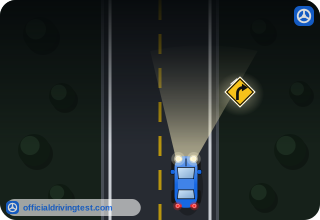
How far must required headlights be able to shine on high beams?
- 100 feet
- 200 feet
- 350 feet
- 500 feet
Show answer
Correct answer: 350 feet
Headlights must be able to shine 350 feet on high beams.
Source: Utah Driver Handbook (2026 edition (new 2026 laws effective May 6, 2026)), page 91 · Open this page in the manual (Manual page 91)
-
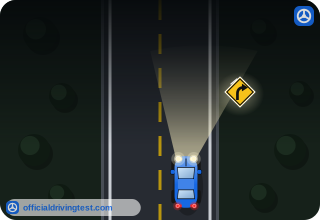
How far must required headlights be able to shine on low beams?
- 100 feet
- 50 feet
- 200 feet
- 350 feet
Show answer
Correct answer: 100 feet
Headlights must be able to shine 100 feet on low beams.
Source: Utah Driver Handbook (2026 edition (new 2026 laws effective May 6, 2026)), page 91 · Open this page in the manual (Manual page 91)
-
How many operational headlights must all vehicles except motorcycles have?
- At least two, one on each side
- One, in the center
- Three, including one fog light
- Four, two on each side
Show answer
Correct answer: At least two, one on each side
At least two operational headlights, one on each side, are required on vehicles other than motorcycles.
Source: Utah Driver Handbook (2026 edition (new 2026 laws effective May 6, 2026)), page 91 · Open this page in the manual (Manual page 91)
-
What indicator light must all vehicles have for their headlights?
- A low-beam warning buzzer
- A fog light indicator
- A high-beam indicator light
- A parking light timer
Show answer
Correct answer: A high-beam indicator light
Every vehicle must have a high-beam indicator light.
Source: Utah Driver Handbook (2026 edition (new 2026 laws effective May 6, 2026)), page 91 · Open this page in the manual (Manual page 91)
-
From what distance, under normal conditions, must the horn of a motor vehicle be heard?
- No less than 50 feet
- No less than 200 feet
- No less than 100 feet
- No less than 500 feet
Show answer
Correct answer: No less than 200 feet
The one required horn must be audible from no less than 200 feet under normal conditions.
Source: Utah Driver Handbook (2026 edition (new 2026 laws effective May 6, 2026)), page 91 · Open this page in the manual (Manual page 91)
-
At what distance must the license plate light let the license number be read?
- At least 25 feet
- At least 100 feet
- At least 200 feet
- At least 50 feet
Show answer
Correct answer: At least 50 feet
The white rear light must let the license number be read from at least 50 feet.
Source: Utah Driver Handbook (2026 edition (new 2026 laws effective May 6, 2026)), page 91 · Open this page in the manual (Manual page 91)
-
Which vehicle must be equipped with wheel covers, mudguards, flaps, or splash aprons behind the rearmost wheels?
- Any vehicle driven regularly on gravel roads
- Any vehicle with a rear spoiler or body kit
- Any vehicle with more than four doors
- Any vehicle with altered suspension or tire size
Show answer
Correct answer: Any vehicle with altered suspension or tire size
Altered suspension or tire size triggers the requirement for mudguards or flaps behind the rearmost wheels.
Source: Utah Driver Handbook (2026 edition (new 2026 laws effective May 6, 2026)), page 91 · Open this page in the manual (Manual page 91)
-
A trailer with an unladed weight of at least how many pounds must have mudguards or flaps behind the rearmost wheels?
- 500 pounds
- 750 pounds
- 1,000 pounds
- 2,000 pounds
Show answer
Correct answer: 750 pounds
A trailer with an unladed weight of 750 pounds or more needs mudguards, flaps, or splash aprons.
Source: Utah Driver Handbook (2026 edition (new 2026 laws effective May 6, 2026)), page 91 · Open this page in the manual (Manual page 91)
-
A vehicle with a gross vehicle weight rating of at least how many pounds must have mudguards or flaps behind the rearmost wheels?
- 6,000 pounds
- 8,500 pounds
- 10,500 pounds
- 14,000 pounds
Show answer
Correct answer: 10,500 pounds
A gross vehicle weight rating of 10,500 pounds or more triggers the mudguard or flap requirement.
Source: Utah Driver Handbook (2026 edition (new 2026 laws effective May 6, 2026)), page 91 · Open this page in the manual (Manual page 91)
-
How wide must mud flaps or guards be?
- At least as wide as the tires
- Half as wide as the tires
- Wide enough to cover the whole bumper
- Two inches narrower than the tires
Show answer
Correct answer: At least as wide as the tires
The flaps or guards must be at least as wide as the tires.
Source: Utah Driver Handbook (2026 edition (new 2026 laws effective May 6, 2026)), page 91 · Open this page in the manual (Manual page 91)
-
Which vehicles are exempt from the requirement for one functional parking brake?
- Motorcycles
- Buses
- Trucks
- Vehicles with automatic transmissions
Show answer
Correct answer: Motorcycles
Every vehicle except a motorcycle must have one functional parking brake.
Source: Utah Driver Handbook (2026 edition (new 2026 laws effective May 6, 2026)), page 91 · Open this page in the manual (Manual page 91)
-
What color may the parking lights mounted on the front of a vehicle be?
- Red or amber
- White or red
- White or amber
- Green or white
Show answer
Correct answer: White or amber
Front parking lights must be white or amber.
Source: Utah Driver Handbook (2026 edition (new 2026 laws effective May 6, 2026)), page 91 · Open this page in the manual (Manual page 91)
-
What must owners of vehicles equipped by the manufacturer with pollution control devices do?
- Remove the devices after five years
- Keep and maintain the equipment as effective as the original
- Replace the devices every year
- Keep the devices only in counties that test emissions
Show answer
Correct answer: Keep and maintain the equipment as effective as the original
Pollution control devices must be kept and maintained to work as well as the original equipment.
Source: Utah Driver Handbook (2026 edition (new 2026 laws effective May 6, 2026)), page 92 · Open this page in the manual (Manual page 92)
-
The pollution control law does not apply to which vehicles if their emissions meet all existing standards?
- Diesel vehicles
- Electric vehicles
- Vehicles with four-wheel drive
- Propane vehicles
Show answer
Correct answer: Propane vehicles
Propane vehicles that meet all existing emission standards are exempt from the pollution control device law.
Source: Utah Driver Handbook (2026 edition (new 2026 laws effective May 6, 2026)), page 92 · Open this page in the manual (Manual page 92)
-
What colors must the required reflectors on each side of a vehicle be?
- Red near the front and amber near the rear
- Amber near the front and red near the rear
- White near the front and red near the rear
- Amber near both the front and rear
Show answer
Correct answer: Amber near the front and red near the rear
Each side needs an amber reflector at or near the front and a red reflector at or near the rear.
Source: Utah Driver Handbook (2026 edition (new 2026 laws effective May 6, 2026)), page 92 · Open this page in the manual (Manual page 92)
-
Required reflectors must be placed between what heights above the ground?
- 10 and 40 inches
- 20 and 72 inches
- 15 and 60 inches
- 30 and 90 inches
Show answer
Correct answer: 15 and 60 inches
Reflectors must be at least 15 inches and no more than 60 inches above the ground.
Source: Utah Driver Handbook (2026 edition (new 2026 laws effective May 6, 2026)), page 92 · Open this page in the manual (Manual page 92)
-
Vehicles with an overall length of at least how many feet must have an additional amber reflector near the center of each side?
- 30 feet
- 20 feet
- 25 feet
- 40 feet
Show answer
Correct answer: 30 feet
Vehicles 30 feet or longer need an extra amber reflector at the center of each side.
Source: Utah Driver Handbook (2026 edition (new 2026 laws effective May 6, 2026)), page 92 · Open this page in the manual (Manual page 92)
-
What must towed vehicles with regular hitches or couplings have to prevent the vehicles from separating?
- One chain or cable strong enough to hold them together
- A warning flag attached to the hitch and the load
- A second set of tail lights on the towed vehicle
- A reflective strap on the tongue of the trailer
Show answer
Correct answer: One chain or cable strong enough to hold them together
A safety chain or cable strong enough to keep the vehicles joined is required.
Source: Utah Driver Handbook (2026 edition (new 2026 laws effective May 6, 2026)), page 92 · Open this page in the manual (Manual page 92)
-
What colors are the side markers on a bus, recreational vehicle, or trailer 80 inches or more in width?
- Red in front and amber at the rear
- White in front and red at the rear
- Amber in front and red at the rear
- Amber at both front and rear
Show answer
Correct answer: Amber in front and red at the rear
Side markers on wide buses, RVs, and trailers are amber at the front and red at the rear.
Source: Utah Driver Handbook (2026 edition (new 2026 laws effective May 6, 2026)), page 92 · Open this page in the manual (Manual page 92)
-
Apart from motorcycles and certain vehicles manufactured before 1956, how many red tail/stop lights must vehicles have mounted on the rear?
- One
- Three
- Four
- Two
Show answer
Correct answer: Two
Two red tail/stop lights are required on the rear.
Source: Utah Driver Handbook (2026 edition (new 2026 laws effective May 6, 2026)), page 92 · Open this page in the manual (Manual page 92)
-
From what distance to the rear, in regular sunlight, must tail/stop lights be visible?
- 100 feet
- 200 feet
- 1,000 feet
- 500 feet
Show answer
Correct answer: 500 feet
Tail/stop lights must be visible from 500 feet to the rear in regular sunlight.
Source: Utah Driver Handbook (2026 edition (new 2026 laws effective May 6, 2026)), page 92 · Open this page in the manual (Manual page 92)
-
What colors may the lights mounted on the front of a vehicle for turn signals be?
- Red, yellow, or amber
- White, yellow, or amber
- Red or blue
- White or green
Show answer
Correct answer: White, yellow, or amber
Front turn signals must be white, yellow, or amber.
Source: Utah Driver Handbook (2026 edition (new 2026 laws effective May 6, 2026)), page 92 · Open this page in the manual (Manual page 92)
-
From what distance in normal sunlight must turn signal lights be visible?
- 50 feet
- 200 feet
- 100 feet
- 500 feet
Show answer
Correct answer: 100 feet
Turn signals must be visible from 100 feet in normal sunlight.
Source: Utah Driver Handbook (2026 edition (new 2026 laws effective May 6, 2026)), page 92 · Open this page in the manual (Manual page 92)
-
Turn signals are not required on vehicles manufactured before what year, if the vehicle is less than 80 inches wide?
- 1953
- 1946
- 1956
- 1967
Show answer
Correct answer: 1953
Vehicles built before 1953 that are under 80 inches wide are exempt from turn signal requirements.
Source: Utah Driver Handbook (2026 edition (new 2026 laws effective May 6, 2026)), page 92 · Open this page in the manual (Manual page 92)
-
Which of these is given as an example of something that might obstruct your vision through the windshield?
- Something hanging from the rearview mirror
- A properly adjusted outside rear view mirror
- A working windshield wiper
- A fastened seat belt
Show answer
Correct answer: Something hanging from the rearview mirror
Items hanging from the rearview mirror can block your view, so the windshield must stay clear of such obstructions.
Source: Utah Driver Handbook (2026 edition (new 2026 laws effective May 6, 2026)), page 92 · Open this page in the manual (Manual page 92)
-
All vehicles with windshields must have at least how many wipers?
- Two
- Three
- One
- None, if they have a defroster
Show answer
Correct answer: One
At least one wiper is required to clear rain, snow, or other moisture.
Source: Utah Driver Handbook (2026 edition (new 2026 laws effective May 6, 2026)), page 92 · Open this page in the manual (Manual page 92)
-
If your vehicle was originally equipped with two windshield wipers, what must be true?
- One working wiper is enough
- Both must function properly
- The second may be removed
- Only the driver-side wiper must work
Show answer
Correct answer: Both must function properly
A vehicle originally built with two wipers must keep both working.
Source: Utah Driver Handbook (2026 edition (new 2026 laws effective May 6, 2026)), page 92 · Open this page in the manual (Manual page 92)
-
A wiper system with two or more speeds is required on all vehicles manufactured after what year?
- 1953
- 1956
- 1975
- 1967
Show answer
Correct answer: 1967
Vehicles built after 1967 must have a wiper system with two or more speeds.
Source: Utah Driver Handbook (2026 edition (new 2026 laws effective May 6, 2026)), page 92 · Open this page in the manual (Manual page 92)
-
What is the maximum length of a drawbar or other connection between two towed vehicles?
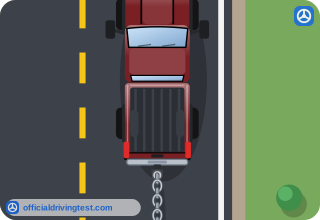
- 15 feet
- 10 feet
- 20 feet
- 25 feet
Show answer
Correct answer: 15 feet
A drawbar or other connection between tow vehicles may not be longer than 15 feet from one vehicle to the other.
Source: Utah Driver Handbook (2026 edition (new 2026 laws effective May 6, 2026)), page 93 · Open this page in the manual (Manual page 93)
-
What must be attached to a chain, rope, or cable that connects a towed vehicle?
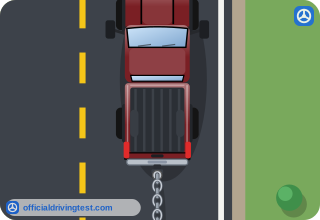
- A reflective strip wrapped around it
- A warning light that stays on in daylight
- A red flag or other signal
- A sign reading TOWING
Show answer
Correct answer: A red flag or other signal
When the connection is a chain, rope, or cable, a red flag or other signal must be attached to the connecting device.
Source: Utah Driver Handbook (2026 edition (new 2026 laws effective May 6, 2026)), page 93 · Open this page in the manual (Manual page 93)
-
At the minimum, how large must the flag on a towing chain, rope, or cable be?
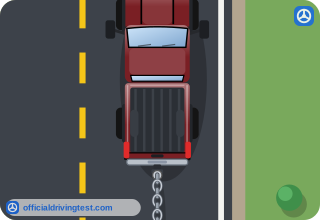
- No smaller than 6 inches square
- No smaller than 12 inches square
- No smaller than 18 inches square
- No smaller than 24 inches square
Show answer
Correct answer: No smaller than 12 inches square
The flag on the connecting device must be at least 12 inches square, which is one foot square.
Source: Utah Driver Handbook (2026 edition (new 2026 laws effective May 6, 2026)), page 93 · Open this page in the manual (Manual page 93)
-
A trailer being towed whips or swerves dangerously from side to side. What is the rule?
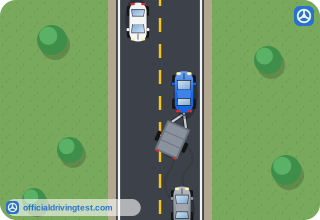
- Drivers may continue if the trailer has a red flag
- Drivers may continue at a reduced speed on the shoulder only
- Drivers may continue until the next exit
- No one may operate the train of vehicles
Show answer
Correct answer: No one may operate the train of vehicles
No person may operate a train of vehicles when a towed trailer or vehicle whips or swerves dangerously or unreasonably from side to side.
Source: Utah Driver Handbook (2026 edition (new 2026 laws effective May 6, 2026)), page 93 · Open this page in the manual (Manual page 93)
-
Which is one of the three easy things you can do to keep emissions as low as possible?
- Buy a new car every few years
- Drive only at night when it is cool
- Fill the tank to the top at every stop
- Drive your car wisely
Show answer
Correct answer: Drive your car wisely
The three things are to avoid unnecessary driving, maintain your car properly, and drive your car wisely.
Source: Utah Driver Handbook (2026 edition (new 2026 laws effective May 6, 2026)), page 99 · Open this page in the manual (Manual page 99)
-
If you expect to idle for more than how many seconds, will you save gas by turning the engine off and restarting it?
- 30 seconds
- 10 seconds
- 60 seconds
- 2 minutes
Show answer
Correct answer: 30 seconds
The fact sheet says turning off the engine saves gas if you expect to idle for more than 30 seconds.
Source: Utah Driver Handbook (2026 edition (new 2026 laws effective May 6, 2026)), page 99 · Open this page in the manual (Manual page 99)
-
What does the handbook suggest instead of idling in drive-up lanes?
- Keeping the engine running but turning the radio off
- Moving forward in short bursts to keep the engine warm
- Parking and going inside the restaurant or bank
- Switching to the highest gear while waiting in line
Show answer
Correct answer: Parking and going inside the restaurant or bank
Parking and going inside avoids long idles and the pollution they cause.
Source: Utah Driver Handbook (2026 edition (new 2026 laws effective May 6, 2026)), page 99 · Open this page in the manual (Manual page 99)
-
How can you “smooth” your driving in stop-and-go traffic?
- Accelerate quickly to get through gaps
- Accelerate and decelerate gradually
- Follow closely so traffic keeps moving
- Keep the engine revved between stops
Show answer
Correct answer: Accelerate and decelerate gradually
Smoothing your driving means accelerating and decelerating gradually and anticipating stops and starts.
Source: Utah Driver Handbook (2026 edition (new 2026 laws effective May 6, 2026)), page 99 · Open this page in the manual (Manual page 99)
-
To reduce stop-and-go driving whenever possible, what does the handbook suggest?
- Plan trips for the middle of rush hour to stay in motion
- Choose routes with the most traffic lights
- Leave early and drive faster than other traffic
- Plan trips outside rush hour and peak traffic periods
Show answer
Correct answer: Plan trips outside rush hour and peak traffic periods
Planning trips outside rush hour and peak traffic periods helps avoid stop-and-go driving.
Source: Utah Driver Handbook (2026 edition (new 2026 laws effective May 6, 2026)), page 99 · Open this page in the manual (Manual page 99)
-
What can using your vehicle's air conditioner do?
- Increase emissions and decrease fuel economy
- Lower emissions by cooling the engine
- Improve fuel economy at highway speeds
- Reduce engine wear in hot weather
Show answer
Correct answer: Increase emissions and decrease fuel economy
The air conditioner increases the load on the engine, which can raise emissions and lower fuel economy.
Source: Utah Driver Handbook (2026 edition (new 2026 laws effective May 6, 2026)), page 99 · Open this page in the manual (Manual page 99)
-
Instead of using the air conditioner, what does the handbook suggest to cool the inside of your vehicle?
- Idle the engine with the doors open
- Drive faster so the air flows through
- Open the window or the fresh air vent
- Add more coolant to the radiator
Show answer
Correct answer: Open the window or the fresh air vent
Opening the window or the fresh air vent, and parking in the shade, cools the vehicle without the extra engine load.
Source: Utah Driver Handbook (2026 edition (new 2026 laws effective May 6, 2026)), page 99 · Open this page in the manual (Manual page 99)
-
Which of these creates extra load on the engine, so the car burns more gas and emits more pollution?
- Coasting down a grade
- Carrying extra weight
- Accelerating gradually
- Driving on a flat road at a steady low speed
Show answer
Correct answer: Carrying extra weight
Extra load comes from the air conditioner, quick accelerations, high-speed driving, climbing grades, revving the engine, and carrying extra weight.
Source: Utah Driver Handbook (2026 edition (new 2026 laws effective May 6, 2026)), page 99 · Open this page in the manual (Manual page 99)
-
What does the handbook say about idling for long periods in cold weather?
- It helps emission controls warm up faster
- It is needed because modern vehicles require a long warm-up
- It improves fuel economy
- It can cause excessive engine wear
Show answer
Correct answer: It can cause excessive engine wear
Idling does not help in the cold, and long idling can cause excessive engine wear.
Source: Utah Driver Handbook (2026 edition (new 2026 laws effective May 6, 2026)), page 99 · Open this page in the manual (Manual page 99)
-
According to the handbook, modern vehicles are most efficient when they are doing what?
- Being driven
- Idling
- Parked with the engine running
- Warming up for several minutes
Show answer
Correct answer: Being driven
Modern vehicles need little warm-up and are most efficient when being driven.
Source: Utah Driver Handbook (2026 edition (new 2026 laws effective May 6, 2026)), page 99 · Open this page in the manual (Manual page 99)
-
What is it best to avoid when refueling, especially in hot weather?
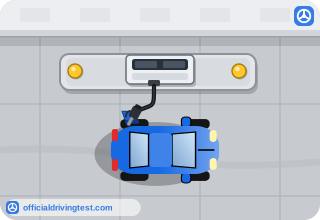
- Turning the engine off
- Refueling in the shade
- Topping off
- Paying at the pump
Show answer
Correct answer: Topping off
Avoid topping off the tank, especially in hot weather, to prevent spills and overfills.
Source: Utah Driver Handbook (2026 edition (new 2026 laws effective May 6, 2026)), page 99 · Open this page in the manual (Manual page 99)
-
Why should you watch for spills and overfills when refueling?
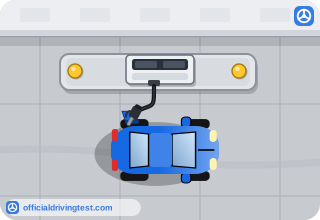
- Spilled gasoline lowers the octane rating of the fuel
- Spilled gasoline pollutes the air when it evaporates
- Spilled gasoline weakens the tires and the paint
- Spilled gasoline makes the engine idle roughly
Show answer
Correct answer: Spilled gasoline pollutes the air when it evaporates
Spilled gasoline evaporates and pollutes the air, so you should avoid spills and overfills at the gas station.
Source: Utah Driver Handbook (2026 edition (new 2026 laws effective May 6, 2026)), page 99 · Open this page in the manual (Manual page 99)
-
What is the most effective way to reduce vehicle emissions?
- Switching to premium gasoline
- Replacing the tires every year
- Warming the engine before each trip
- Using the vehicle less
Show answer
Correct answer: Using the vehicle less
The most effective way to cut vehicle emissions is to drive less.
Source: Utah Driver Handbook (2026 edition (new 2026 laws effective May 6, 2026)), page 100 · Open this page in the manual (Manual page 100)
-
Which is a way to reduce the amount you drive?
- Carpooling
- Idling in drive-up lanes
- Making a separate trip for each errand
- Driving to each destination separately
Show answer
Correct answer: Carpooling
Carpooling is one of the options listed, along with consolidating trips, telecommuting, public transit, biking, and walking.
Source: Utah Driver Handbook (2026 edition (new 2026 laws effective May 6, 2026)), page 100 · Open this page in the manual (Manual page 100)
-
How much pollution does biking or walking to your destination create?
- Very little
- About half as much as a car
- None at all
- Only a small amount in cold weather
Show answer
Correct answer: None at all
Biking or walking creates no pollution at all and also raises your fitness level.
Source: Utah Driver Handbook (2026 edition (new 2026 laws effective May 6, 2026)), page 100 · Open this page in the manual (Manual page 100)
-
What does the handbook suggest doing before you drive to the store?
- Drive by the store to see if it is open
- Call ahead to confirm the product is in stock
- Check the price at three different stores
- Ask a neighbor to buy the product instead
Show answer
Correct answer: Call ahead to confirm the product is in stock
Calling ahead to confirm the product is in stock is one of the ways to plan errands and avoid wasted driving.
Source: Utah Driver Handbook (2026 edition (new 2026 laws effective May 6, 2026)), page 100 · Open this page in the manual (Manual page 100)
-
What should you follow to reduce your vehicle's emissions and enhance performance?
- The same service schedule for every make of vehicle
- A maintenance schedule set by the Driver License Division
- The advice of other drivers on the road
- The manufacturer's recommended maintenance guidelines
Show answer
Correct answer: The manufacturer's recommended maintenance guidelines
Following the manufacturer's recommended maintenance guidelines reduces emissions and improves performance.
Source: Utah Driver Handbook (2026 edition (new 2026 laws effective May 6, 2026)), page 100 · Open this page in the manual (Manual page 100)
-
What does keeping your tires inflated to the recommended pressure do?
- Minimizes tire wear and helps fuel economy
- Removes the need for oil changes
- Reduces emissions only on the highway
- Increases tire wear but improves handling
Show answer
Correct answer: Minimizes tire wear and helps fuel economy
Correct tire pressure minimizes tire wear and gives the best possible fuel economy.
Source: Utah Driver Handbook (2026 edition (new 2026 laws effective May 6, 2026)), page 100 · Open this page in the manual (Manual page 100)
-
What does the handbook say about the simple adjustments that once occurred during tune-ups?
- They are still the best way to fix emissions
- They are now required before every registration
- They will no longer correct the problem
- They are now needed only on older vehicles
Show answer
Correct answer: They will no longer correct the problem
Modern emission control systems need a skilled technician, because the old simple tune-up adjustments no longer correct the problem.
Source: Utah Driver Handbook (2026 edition (new 2026 laws effective May 6, 2026)), page 100 · Open this page in the manual (Manual page 100)
-
Which is illegal for individual vehicle owners, fleet operators, and auto technicians?
- Changing a vehicle's oil without a certified technician
- Tampering with a vehicle's emission control system
- Keeping tires inflated to the recommended pressure
- Using the air conditioner in hot weather
Show answer
Correct answer: Tampering with a vehicle's emission control system
Tampering with an emission control system, or using leaded gasoline in a vehicle designed for unleaded, is illegal.
Source: Utah Driver Handbook (2026 edition (new 2026 laws effective May 6, 2026)), page 100 · Open this page in the manual (Manual page 100)
-
Using which fuel in a vehicle designed for unleaded gasoline is illegal?
- Premium gasoline
- Gasoline with additives
- Gasoline from an out-of-state station
- Leaded gasoline
Show answer
Correct answer: Leaded gasoline
Using leaded gasoline in a vehicle designed for unleaded gasoline is illegal and greatly increases pollution.
Source: Utah Driver Handbook (2026 edition (new 2026 laws effective May 6, 2026)), page 100 · Open this page in the manual (Manual page 100)
-
What is now illegal to do with new vehicles requiring leaded gasoline?
- Manufacture or sell them
- Drive them on public roads
- Register them in Utah
- Import them from other states
Show answer
Correct answer: Manufacture or sell them
It is illegal to manufacture or sell new vehicles that require leaded gasoline.
Source: Utah Driver Handbook (2026 edition (new 2026 laws effective May 6, 2026)), page 101 · Open this page in the manual (Manual page 101)
-
What is octane a measure of?
- How much energy a fuel contains per gallon when burned
- How quickly a fuel evaporates in hot weather conditions
- How much a fuel can be compressed before it ignites on its own
- How many additives were blended into a fuel mixture
Show answer
Correct answer: How much a fuel can be compressed before it ignites on its own
Octane measures how much a fuel can be compressed in an engine before it spontaneously combusts, not fuel power or quality.
Source: Utah Driver Handbook (2026 edition (new 2026 laws effective May 6, 2026)), page 101 · Open this page in the manual (Manual page 101)
-
Premium or super grade gasolines contain additives to increase what?
- Fuel power
- Octane
- Fuel economy
- Engine life
Show answer
Correct answer: Octane
These fuels contain additives to increase octane, which is not a measure of fuel power or quality.
Source: Utah Driver Handbook (2026 edition (new 2026 laws effective May 6, 2026)), page 101 · Open this page in the manual (Manual page 101)