Utah: Vehicle controls and equipment — Signaling, Steering and Stopping Practice Test
Questions in this part include: “When should you check traffic by looking over your shoulder (a head check)?” · “When does the handbook say a signal is required in connection with a curb?”
Independent educational site · not affiliated with any government agency or DMV
Ready? Test yourself
- Instant feedback with an explanation
- Every answer cites its source in the manual
- Your best score is saved on this device
- Keyboard: press 1 to 4 to answer and Enter for the next question
Questions are original and based on the official manual "Utah Driver Handbook" (2026 edition (new 2026 laws effective May 6, 2026)), Utah Department of Public Safety, Driver License Division.
All 17 questions in this practice test
Take the test above first, then use this list to study. Tap “Show answer” to see the correct answer and explanation.
Show the questions and answersHide the questions
-
When should you check traffic by looking over your shoulder (a head check)?
- Only when you are driving on a freeway or interstate
- When necessary, such as when changing lanes or merging
- Only when you are backing the vehicle up or parking
- Never, if your mirrors are properly adjusted
Show answer
Correct answer: When necessary, such as when changing lanes or merging
A head check is done when necessary, for example for a lane change or merging.
Source: Utah Driver Handbook (2026 edition (new 2026 laws effective May 6, 2026)), page 31 · Open this page in the manual (Manual page 31)
-
When should you cancel your turn signal?
- Before you begin the turn
- After you have driven one block
- Only when the signal stops clicking
- Upon completion of a turn or lane change
Show answer
Correct answer: Upon completion of a turn or lane change
Turn signals are cancelled upon completion of a turn or lane change.
Source: Utah Driver Handbook (2026 edition (new 2026 laws effective May 6, 2026)), page 31 · Open this page in the manual (Manual page 31)
-
What does the handbook say about the timing of turn signals?
- Do not signal too early or too late
- Signal as early as possible
- Signal only once you have begun the turn
- Signal only if another vehicle is nearby
Show answer
Correct answer: Do not signal too early or too late
Turn signals should be used when required, and not too early or too late.
Source: Utah Driver Handbook (2026 edition (new 2026 laws effective May 6, 2026)), page 31 · Open this page in the manual (Manual page 31)
-
Besides turn signals and stoplights, what can be used to give a signal?
- Your dome light
- Your high beams
- Your windshield wipers
- Your hand and arm
Show answer
Correct answer: Your hand and arm
The handbook says signals are given by turn signals, stoplights, or your hand and arm.
Source: Utah Driver Handbook (2026 edition (new 2026 laws effective May 6, 2026)), page 34 · Open this page in the manual (Manual page 34)
-
How long before turning must you signal?
- For one second
- For four seconds
- For two seconds
- For five seconds
Show answer
Correct answer: For two seconds
Signals are required for two seconds before turning.
Source: Utah Driver Handbook (2026 edition (new 2026 laws effective May 6, 2026)), page 34 · Open this page in the manual (Manual page 34)
-
When does the handbook say a signal is required in connection with a curb?
- Only when another vehicle is behind you
- Only when you pull away from a curb on a busy street
- Any time you pull to or from a curb
- Only when you park for more than a few minutes
Show answer
Correct answer: Any time you pull to or from a curb
A signal is required any time you pull to or from a curb.
Source: Utah Driver Handbook (2026 edition (new 2026 laws effective May 6, 2026)), page 35 · Open this page in the manual (Manual page 35)
-
What gives the signal that you intend to slow down or stop, if it works correctly and can be seen?
- Your hand and arm only
- Your brake lights
- Your emergency flashers
- Your left turn signal
Show answer
Correct answer: Your brake lights
Working brake lights that can be readily seen signal that you intend to slow down or stop.
Source: Utah Driver Handbook (2026 edition (new 2026 laws effective May 6, 2026)), page 35 · Open this page in the manual (Manual page 35)
-
When should you use your car's emergency flasher system?
- When you stop briefly to let a passenger out
- When you are waiting to make a left turn
- When you are changing lanes on a freeway
- When your car is disabled on the highway
Show answer
Correct answer: When your car is disabled on the highway
The handbook says the emergency flasher system is for use when your car is disabled on the highway.
Source: Utah Driver Handbook (2026 edition (new 2026 laws effective May 6, 2026)), page 35 · Open this page in the manual (Manual page 35)
-
Where should you keep your hands on the steering wheel at all times unless using other controls?
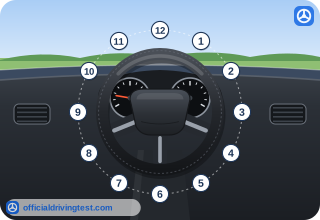
- Both hands on the inside of the wheel
- Both hands on the outside of the wheel
- One hand on the outside and one on the center hub
- One hand on the wheel and one resting in your lap
Show answer
Correct answer: Both hands on the outside of the wheel
Both hands stay on the outside of the wheel unless you are using other controls.
Source: Utah Driver Handbook (2026 edition (new 2026 laws effective May 6, 2026)), page 35 · Open this page in the manual (Manual page 35)
-
Which steering methods does the handbook say are acceptable?
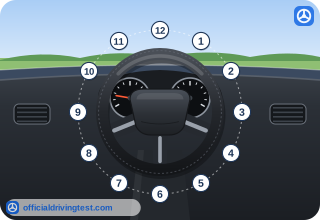
- Any method, if both hands stay on the outside of the wheel
- Only hand-over-hand steering, in every driving situation
- Only push/pull steering, in every driving situation
- Any method, if one hand stays on the inside of the wheel
Show answer
Correct answer: Any method, if both hands stay on the outside of the wheel
All steering methods are acceptable, such as hand-over-hand and push/pull, as long as both hands are on the outside of the wheel.
Source: Utah Driver Handbook (2026 edition (new 2026 laws effective May 6, 2026)), page 35 · Open this page in the manual (Manual page 35)
-
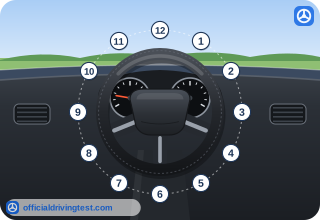
In which direction should you turn the steering wheel?
- The direction you want to go, but only when driving forward
- The opposite of the direction you want to go when in reverse
- Toward the nearest curb when in reverse
- The direction you want to go, forward or in reverse
Show answer
Correct answer: The direction you want to go, forward or in reverse
You always turn the wheel in the direction you want to go, whether forward or in reverse.
Source: Utah Driver Handbook (2026 edition (new 2026 laws effective May 6, 2026)), page 35 · Open this page in the manual (Manual page 35)
-
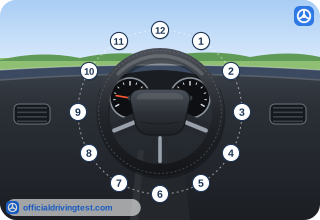
Which part of your hands should you use to grip the steering wheel?
- Your palms, not your fingers
- Your palms and thumbs together
- Your fingers, not your palms
- Your thumbs wrapped around the inside rim
Show answer
Correct answer: Your fingers, not your palms
The handbook says to grip the wheel firmly but gently with your fingers, not the palms of your hands.
Source: Utah Driver Handbook (2026 edition (new 2026 laws effective May 6, 2026)), page 35 · Open this page in the manual (Manual page 35)
-
Where should you keep your thumbs on the steering wheel?
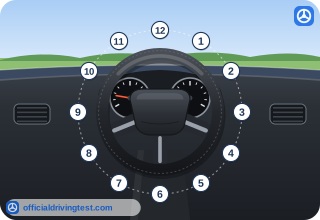
- Up along the face of the wheel
- Hooked over the inside of the rim
- Tucked under the rim
- Resting on the center hub
Show answer
Correct answer: Up along the face of the wheel
Thumbs stay up along the face of the steering wheel, never on the inside of it.
Source: Utah Driver Handbook (2026 edition (new 2026 laws effective May 6, 2026)), page 35 · Open this page in the manual (Manual page 35)
-
In which situation does the handbook say to use hand-over-hand steering?
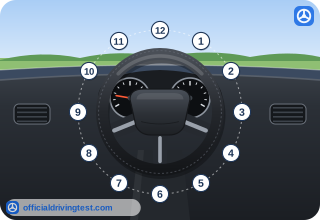
- Driving straight on a freeway
- Changing lanes on a multi-lane road
- Correcting a skid
- Slowing for a red light
Show answer
Correct answer: Correcting a skid
Hand-over-hand steering is for when steering is critical, such as parking, sharp right turns, or correcting a skid.
Source: Utah Driver Handbook (2026 edition (new 2026 laws effective May 6, 2026)), page 35 · Open this page in the manual (Manual page 35)
-
What is a benefit of pull-push steering?
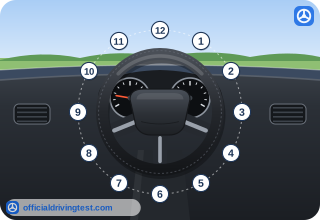
- It lets you steer with one hand while using other controls
- Smooth steering that reduces the potential for over-steering
- Faster turns with less hand movement on the wheel
- It keeps your hands crossing over the top of the wheel
Show answer
Correct answer: Smooth steering that reduces the potential for over-steering
Pulling down with one hand and pushing up with the other gives smooth steering and reduces over-steering.
Source: Utah Driver Handbook (2026 edition (new 2026 laws effective May 6, 2026)), page 35 · Open this page in the manual (Manual page 35)
-
When stopping normally, how should you apply the brake?
- Quickly, with a sharp push
- In short, repeated pumps
- Lightly at first, then hard at the last moment
- Smoothly, with steady pressure
Show answer
Correct answer: Smoothly, with steady pressure
The handbook says to apply the brake smoothly and use steady pressure.
Source: Utah Driver Handbook (2026 edition (new 2026 laws effective May 6, 2026)), page 35 · Open this page in the manual (Manual page 35)
-
When stopping, what does the handbook say to do before you move your foot to the brake pedal?
- Press the brake pedal hard
- Check your mirrors for traffic to the rear
- Shift into neutral
- Signal with your hand out the window
Show answer
Correct answer: Check your mirrors for traffic to the rear
The stopping steps start with checking your mirrors for traffic behind you, then moving your foot to the brake.
Source: Utah Driver Handbook (2026 edition (new 2026 laws effective May 6, 2026)), page 35 · Open this page in the manual (Manual page 35)