Texas: Signals & vehicle controls
Signaling, headlights, horns, required equipment, and what to do if your vehicle breaks down. Split into 3 shorter tests so you're not stuck in one long quiz.
Independent educational site · not affiliated with any government agency or DMV
Choose a part
Signals & vehicle controls — Part 1
Questions in this part include: “Regarding proper care of your vehicle, what does "Your Keys to Safe Driving" advise?”
Signals & vehicle controls — Part 2
Questions in this part include: “What type of glass must be used in new cars and in any glass replacement for a car?”
Signals & vehicle controls — Part 3
Questions in this part include: “Why is it especially important that your signal lights work properly during non-daylight hours?”
Questions are original and based on the official manual "Texas Driver Handbook" (Revised January 2026), Texas Department of Public Safety (DPS).
All 56 Signals & vehicle controls questions with answers
Choose a part above to take a practice test, or study every question and answer here.
Show the questions and answersHide the questions
1Part 119 questions
-
Regarding proper care of your vehicle, what does "Your Keys to Safe Driving" advise?
- Rely solely on the annual state inspection
- Only service the vehicle if a warning light appears
- Maintenance is optional if the vehicle is new
- Don't depend on yearly inspections; do regular maintenance
Show answer
Correct answer: Don't depend on yearly inspections; do regular maintenance
The handbook advises not to depend on yearly inspections alone, but to perform regular maintenance on your vehicle as needed.
Source: Texas Driver Handbook (Revised January 2026), page 67
-
To help prevent loose material from escaping, what must a vehicle bed not have?
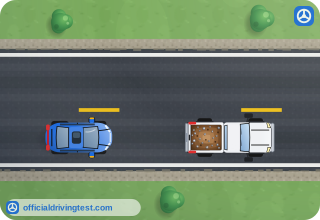
- Extra weight beyond the rated capacity
- Reflective tape on the tailgate
- A hole, crack, or other opening
- Any paint or rust on the surface
Show answer
Correct answer: A hole, crack, or other opening
A vehicle bed must not have a hole, crack, or other opening through which loose material can escape.
Source: Texas Driver Handbook (Revised January 2026), page 68
-
When transporting loose material such as dirt, sand, or gravel that could blow or spill, how must the top of the load generally be treated?
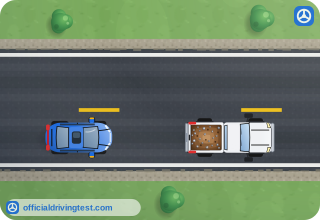
- Left uncovered as long as the vehicle drives slowly
- Covered only when driving on an interstate highway
- Covered only during rainy weather
- Covered with a canvas or tarp firmly secured front and back
Show answer
Correct answer: Covered with a canvas or tarp firmly secured front and back
The top of the load must be covered with a canvas, tarpaulin, or other covering firmly secured to the front and back to prevent the load from blowing or spilling.
Source: Texas Driver Handbook (Revised January 2026), page 68
-
Which type of load is exempt from the loose material covering requirements described in the handbook?
- Sand and gravel hauled to a construction site
- Wood chips
- Dirt
- Agricultural products in their natural state
Show answer
Correct answer: Agricultural products in their natural state
The requirement not to load or transport loose material capable of blowing or spilling does not apply to agricultural products in their natural state.
Source: Texas Driver Handbook (Revised January 2026), page 68
-
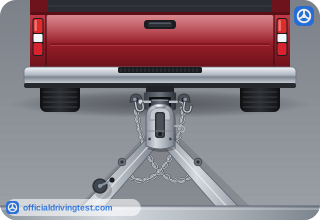
When is a driver required to use safety chains in Texas?
- Only on interstate highways and toll roads
- Only when driving at night
- When a passenger car or light truck tows a trailer
- Only when towing a boat
Show answer
Correct answer: When a passenger car or light truck tows a trailer
A person may not drive a passenger car or light truck towing a trailer, semi-trailer, or house trailer on a public highway in Texas unless safety chains are attached from the trailer to the towing vehicle.
Source: Texas Driver Handbook (Revised January 2026), page 68
-
Who must approve the types of safety chains and the manner of their attachment?
- The trailer dealer only
- The Department of Public Safety
- The vehicle manufacturer only
- The local sheriff's office
Show answer
Correct answer: The Department of Public Safety
The types of safety chains and the manner of attachment must be approved by DPS.
Source: Texas Driver Handbook (Revised January 2026), page 68
-
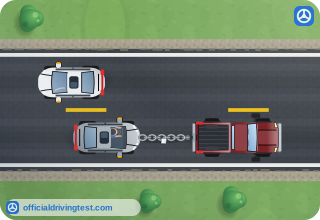
When one vehicle tows another with a drawbar, chain, rope, or cable, how long can that connection be at most?
- Not longer than 50 feet
- There is no length limit
- Not longer than 15 feet
- Not longer than 5 feet
Show answer
Correct answer: Not longer than 15 feet
The drawbar, chain, rope, cable, or other connection must not be longer than 15 feet from one vehicle to another.
Source: Texas Driver Handbook (Revised January 2026), page 68
-
When towing another vehicle with a chain, rope, or cable, what must be attached to the connection?
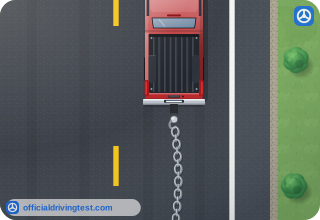
- A red reflector triangle at least 12 inches wide
- A flashing amber light
- A bell
- A white flag not less than 12 inches square
Show answer
Correct answer: A white flag not less than 12 inches square
The connection between towed vehicles must attach a white flag not less than 12 inches square.
Source: Texas Driver Handbook (Revised January 2026), page 68
-
According to the Texas Driver Handbook, which of the following must be inspected each year along with cars?
- Motorcycles, mopeds, scooters, and autocycles
- Only vehicles more than 10 years old
- Only commercial trucks and delivery vans
- Bicycles only
Show answer
Correct answer: Motorcycles, mopeds, scooters, and autocycles
All motor vehicles registered in Texas must be inspected each year, including motorcycles, mopeds, scooters, and autocycles.
Source: Texas Driver Handbook (Revised January 2026), page 15
-
What must you present at the time of your vehicle's inspection?
- Evidence of financial responsibility
- Your birth certificate
- A copy of your most recent tax return
- Proof of employment
Show answer
Correct answer: Evidence of financial responsibility
Evidence of financial responsibility for the vehicle being inspected must be presented at the time of the inspection.
Source: Texas Driver Handbook (Revised January 2026), page 15
-
What does the single registration sticker displayed on a Texas vehicle's windshield represent?
- Combined proof of registration and inspection
- Proof of inspection only
- Proof of vehicle ownership only
- Proof that parking tickets have been paid
Show answer
Correct answer: Combined proof of registration and inspection
Texas transitioned to a system requiring motorists to display only the valid registration sticker on the windshield, which serves as combined proof of registration and inspection.
Source: Texas Driver Handbook (Revised January 2026), page 15
-
For how long is a passing Vehicle Inspection Report (VIR) valid for registration purposes, from the month of inspection?
- 30 days
- 6 months
- 1 year
- 90 days
Show answer
Correct answer: 90 days
The VIR is only valid for 90 days from the month of inspection for registration purposes.
Source: Texas Driver Handbook (Revised January 2026), page 15
-
A vehicle's foot brake must be able to stop the car within what distance at a speed of 20 mph?
- 50 feet
- 10 feet
- 100 feet
- 25 feet
Show answer
Correct answer: 25 feet
The foot brake must stop the car within a distance of 25 feet at a speed of 20 mph.
Source: Texas Driver Handbook (Revised January 2026), page 15
-
How many taillights must most vehicles have under Texas equipment requirements?
- Three on all vehicles
- None are required
- Two, but only one on cars made before 1960
- One on all vehicles regardless of age
Show answer
Correct answer: Two, but only one on cars made before 1960
All vehicles must be equipped with two taillights, except cars manufactured before 1960, which are only required to have one.
Source: Texas Driver Handbook (Revised January 2026), page 15
-
If a vehicle is equipped with a third, high-mounted stop lamp, what does Texas require?
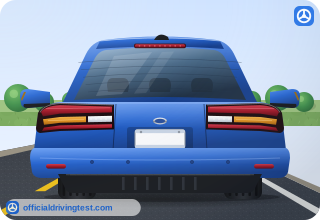
- It is optional equipment with no operating requirement
- All three brake lights must be operational
- Only the high-mounted lamp needs to work
- The two lower brake lights may be disconnected
Show answer
Correct answer: All three brake lights must be operational
All vehicles must have two working brake lights, and vehicles equipped with a third or high-mounted stop lamp require all three to be operational.
Source: Texas Driver Handbook (Revised January 2026), page 15
-
Texas requires two red reflectors on most vehicles, placed at what height and visible from what distance?
- 15 to 60 inches high, visible up to 600 feet
- 5 to 10 inches high, visible up to 100 feet
- 60 to 100 inches high, visible up to 1,000 feet
- No height requirement, visible up to 200 feet
Show answer
Correct answer: 15 to 60 inches high, visible up to 600 feet
Two red reflectors, one on each side, must be placed at a height of 15 to 60 inches and be visible up to 600 feet (350 feet for vehicles manufactured before 1960).
Source: Texas Driver Handbook (Revised January 2026), page 15
-
Which vehicles are NOT required to have electric turn signals under Texas law?
- Any car or truck more than 10 years old
- Vehicles with only one headlight
- Pre-1960 cars and trucks under 80 inches wide
- All pickup trucks
Show answer
Correct answer: Pre-1960 cars and trucks under 80 inches wide
Passenger cars and trucks less than 80 inches in width and manufactured before 1960 are not required to have electrical turn signals (motorcycles and certain trailers are also exempt).
Source: Texas Driver Handbook (Revised January 2026), page 15
-
A vehicle's horn must be audible from a minimum distance of how many feet?
- 50 feet
- 500 feet
- 1,000 feet
- 200 feet
Show answer
Correct answer: 200 feet
Horns must be heard for a minimum distance of 200 feet.
Source: Texas Driver Handbook (Revised January 2026), page 15
-
Vehicles of what model year or later must be equipped with an exhaust emission system to help reduce air pollution?
- 1980 or later
- 1950 or later
- 2000 or later
- 1968 or later
Show answer
Correct answer: 1968 or later
All 1968 or later models must be equipped with an exhaust emission system to help reduce air pollution.
Source: Texas Driver Handbook (Revised January 2026), page 15
2Part 219 questions
-
What type of glass must be used in new cars and in any glass replacement for a car?
- Any glass rated for at least five years
- Bulletproof glass
- Safety glass
- Tinted glass darker than 50%
Show answer
Correct answer: Safety glass
New cars must be equipped with safety glass, and replacements of glass for any car must also be safety glass.
Source: Texas Driver Handbook (Revised January 2026), page 15
-
How many license plates must most passenger and commercial vehicles display?
- Only one, on the front
- Two on the rear and none on the front
- One on the front and one on the rear
- Only one, on the rear
Show answer
Correct answer: One on the front and one on the rear
Vehicles must have one valid plate affixed to the front and one at the rear of passenger and commercial vehicles, except dealer and certain commercial vehicles that are only issued one license plate.
Source: Texas Driver Handbook (Revised January 2026), page 15
-
A rearview mirror must be able to reflect a view of the highway for at least what distance to the rear of the vehicle?
- 500 feet
- 20 feet
- 200 feet
- 50 feet
Show answer
Correct answer: 200 feet
A rearview mirror must be able to reflect a view of the highway for a distance of at least 200 feet to the rear of the vehicle.
Source: Texas Driver Handbook (Revised January 2026), page 15
-
Which vehicles must display a slow-moving vehicle emblem?
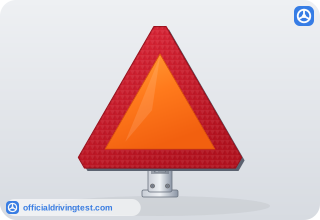
- School buses only
- Motorcycles only
- Farm tractors and animal-drawn vehicles
- All vehicles more than 20 years old
Show answer
Correct answer: Farm tractors and animal-drawn vehicles
Farm tractors and machinery, road construction machinery, animal-drawn vehicles, and certain other vehicles assigned to travel at 25 mph or less must display the slow-moving vehicle emblem.
Source: Texas Driver Handbook (Revised January 2026), page 15
-
What is the minimum tire tread depth required for a vehicle to be considered in safe condition in Texas?
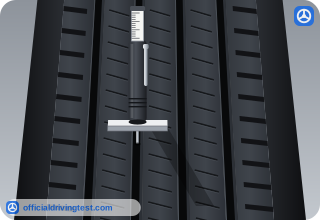
- 2/32 of an inch
- 1/32 of an inch
- 4/32 of an inch
- 6/32 of an inch
Show answer
Correct answer: 2/32 of an inch
All vehicles are required to have tires in proper and safe condition with a minimum tread depth of 2/32 of an inch.
Source: Texas Driver Handbook (Revised January 2026), page 15
-
During inspection, the fuel cap is checked on gasoline-powered vehicles within what age range?
- 10 to 30 years old
- All ages, with no exceptions
- 2 to 24 years old
- 1 to 5 years old
Show answer
Correct answer: 2 to 24 years old
The fuel cap on gasoline-powered vehicles from 2 to 24 years old will be checked to determine if it is missing or defective; several vehicle types, including antique vehicles and motorcycles, are exempt.
Source: Texas Driver Handbook (Revised January 2026), page 15
-
Which of the following is illegal equipment on a vehicle unless it is an emergency vehicle?
- A rearview mirror
- A parking brake
- Turn signals
- A bell or siren
Show answer
Correct answer: A bell or siren
A red light showing from the front, and a bell, siren, or exhaust whistle, are not allowed on a vehicle except on an emergency vehicle.
Source: Texas Driver Handbook (Revised January 2026), page 16
-
Anything extending beyond the body, running board, or fenders of a car must not exceed what limits?
- More than 12 inches on either side
- More than 1 inch on either side
- There is no limit as long as a flag is attached
- More than 3 inches on the left or 6 inches on the right
Show answer
Correct answer: More than 3 inches on the left or 6 inches on the right
It is illegal to have anything extending more than three inches beyond the left side or six inches beyond the right side of the body, running board, or fenders of a car.
Source: Texas Driver Handbook (Revised January 2026), page 16
-
Flashing red lights on the front of a vehicle are prohibited except on which vehicles?
- Emergency vehicles, school and church buses
- Taxis, limousines, and rideshare vehicles
- Farm tractors
- Motorcycles
Show answer
Correct answer: Emergency vehicles, school and church buses
Flashing red lights on the front are not allowed except on emergency vehicles, school buses, and church buses.
Source: Texas Driver Handbook (Revised January 2026), page 16
-
What is a "radar interference device," and what is its legal status in Texas?
- A cell phone signal booster; it is optional equipment
- A backup camera; it is required on new vehicles
- A device that disrupts speed radar or laser; it is illegal
- A GPS navigation device; it is required equipment
Show answer
Correct answer: A device that disrupts speed radar or laser; it is illegal
A radar interference device, designed to interfere with, scramble, disrupt, or cause a radar or laser speed-measuring device to malfunction, is not allowed on a vehicle.
Source: Texas Driver Handbook (Revised January 2026), page 16
-
What does the "minimum road clearance" rule prohibit?
- Modifying a vehicle so its body is below the wheel rims
- Driving with less than a full tank of gas
- Parking within 15 feet of a fire hydrant
- Installing tires larger than the factory-original size
Show answer
Correct answer: Modifying a vehicle so its body is below the wheel rims
A vehicle must not be modified or weighted in such a manner that the body is below the lowest part of the rims of the wheels.
Source: Texas Driver Handbook (Revised January 2026), page 16
-
Under Texas rules for optional spotlights, what must a driver do when a vehicle approaches from the opposite direction?
- Switch the spotlight to flashing mode
- Point the spotlight directly at the oncoming vehicle
- Increase the spotlight's brightness
- Turn the spotlight off
Show answer
Correct answer: Turn the spotlight off
Spotlights are optional equipment but must be turned off for a vehicle approaching from the opposite direction.
Source: Texas Driver Handbook (Revised January 2026), page 16
-
How many additional driving lights may be mounted on the front of a motor vehicle as optional equipment, and within what height range from the road surface?
- Up to five, mounted 6 to 20 inches from the road surface
- Only one, mounted at any height
- Up to three, mounted 60 to 100 inches from the road surface
- Up to three, mounted 12 to 42 inches from the road surface
Show answer
Correct answer: Up to three, mounted 12 to 42 inches from the road surface
Any motor vehicle may have up to three additional driving lights mounted on the front, not less than 12 inches but not more than 42 inches from the road surface.
Source: Texas Driver Handbook (Revised January 2026), page 16
-
According to the Texas Driver Handbook, you should always signal before doing which of the following?
- Adjusting your rearview mirror
- Turning on your headlights
- Checking your fuel gauge
- Changing lanes
Show answer
Correct answer: Changing lanes
The handbook lists changing lanes as one of the situations that always requires a signal.
Source: Texas Driver Handbook (Revised January 2026), page 38
-
A good driver always signals before making which maneuver?
- Turning on the radio
- Rolling down a window
- A turn
- Shifting into a lower gear on a hill
Show answer
Correct answer: A turn
Signaling communicates your intention and helps other drivers plan ahead; the handbook lists making a turn as a required signaling situation.
Source: Texas Driver Handbook (Revised January 2026), page 38
-
You should signal when pulling away from which type of parking?
- A private driveway with no traffic nearby
- A garage inside your home
- An empty parking lot with no other cars
- A parking space parallel to the curb
Show answer
Correct answer: A parking space parallel to the curb
The handbook specifically requires a signal when pulling away from a parking space parallel to the curb.
Source: Texas Driver Handbook (Revised January 2026), page 38
-
You are about to slow down or stop. What does the handbook say you should do?
- Signal your intention
- Only tap the brakes with no signal
- Turn on your hazard lights instead
- Flash your headlights
Show answer
Correct answer: Signal your intention
Slowing down or stopping is one of the situations listed in the handbook that always requires a signal.
Source: Texas Driver Handbook (Revised January 2026), page 38
-
The handbook says you should signal when entering or leaving a highway, and also when doing what else?
- Pulling over to the side of the road
- Adjusting your seat
- Opening the glove compartment
- Turning on the air conditioning
Show answer
Correct answer: Pulling over to the side of the road
The handbook lists entering/leaving a highway and pulling over to the side of the road as required signaling situations.
Source: Texas Driver Handbook (Revised January 2026), page 38
-
Besides turn signal lights, what does the handbook say you may use to signal?
- Hand and arm signals held well out of the window
- No signal is required if you drive slowly
- Continuous horn honking
- Repeatedly flashing your high beams
Show answer
Correct answer: Hand and arm signals held well out of the window
The handbook says you may either use turn signal lights or hand and arm signals. If using hand signals, extend your hand and arm well out of the car window.
Source: Texas Driver Handbook (Revised January 2026), page 38
3Part 318 questions
-
Why is it especially important that your signal lights work properly during non-daylight hours?
- Signal lights use less fuel at night
- Hand signals are usually hard to see in the dark
- Hand signals are illegal after sunset
- Police only check signal lights at night
Show answer
Correct answer: Hand signals are usually hard to see in the dark
Hand and arm signals are usually difficult to see during non-daylight hours, so working signal lights are important.
Source: Texas Driver Handbook (Revised January 2026), page 38
-
When signaling a stop using hand and arm signals, what should you also do to attract attention?
- Pump your brakes a few times
- Turn off your headlights
- Roll down all your windows
- Accelerate briefly
Show answer
Correct answer: Pump your brakes a few times
When signaling a stop with a hand signal, pump your brakes a few times to attract attention.
Source: Texas Driver Handbook (Revised January 2026), page 38
-
How long before turning or stopping should you signal continuously, and what should you do once the turn is complete?
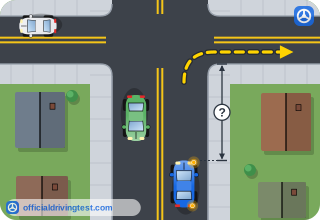
- Signal for at least 10 feet, and you may leave it on afterward
- Signal for at least half a mile, then leave it on for the next turn
- There is no minimum distance, just signal briefly at the last second
- Signal for at least 100 feet, then turn it off, as it still means "turn"
Show answer
Correct answer: Signal for at least 100 feet, then turn it off, as it still means "turn"
Signal continuously for at least 100 feet before turning or stopping, and turn off your signal once the turn is complete, since an unintended signal still means "turn" to other drivers.
Source: Texas Driver Handbook (Revised January 2026), page 38
-
Apart from any time people or vehicles cannot be seen clearly for at least 1,000 feet, when must you use your headlights in Texas?
- From one hour after sunset to one hour before sunrise
- Only on highways, never on city streets
- From 30 minutes after sunset to 30 minutes before sunrise
- Only after complete darkness
Show answer
Correct answer: From 30 minutes after sunset to 30 minutes before sunrise
Texas law requires headlights beginning 30 minutes after sunset until 30 minutes before sunrise, and anytime people or vehicles cannot be seen clearly for at least 1,000 feet.
Source: Texas Driver Handbook (Revised January 2026), page 47
-
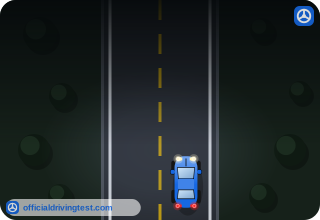
When driving at night, you should slow down enough to:
- Match the speed of the car behind you
- Stay exactly at the posted speed limit at all times
- Keep pace with oncoming traffic
- Be able to stop in the distance lit by your headlights
Show answer
Correct answer: Be able to stop in the distance lit by your headlights
Slow down when driving at night and be sure you can stop within the distance lit by your headlights.
Source: Texas Driver Handbook (Revised January 2026), page 47
-
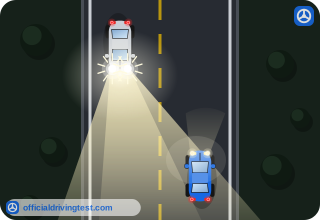
To avoid being blinded by the headlights of an approaching vehicle at night, you should:
- Flash your high beams repeatedly at the other driver
- Close your eyes briefly until the vehicle passes
- Shift your eyes to the lower right side of your traffic lane
- Stare directly at the oncoming headlights
Show answer
Correct answer: Shift your eyes to the lower right side of your traffic lane
Avoid looking directly into the headlights of approaching vehicles; shift your eyes down to the lower right side of your traffic lane.
Source: Texas Driver Handbook (Revised January 2026), page 47
-
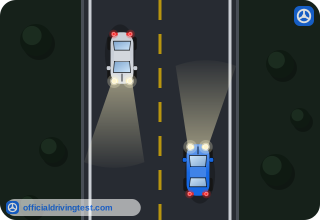
You should switch to low beam headlights when you are within how many feet of an approaching vehicle?
- 1,000 feet
- 50 feet
- 500 feet
- 100 feet
Show answer
Correct answer: 500 feet
Use low beam headlights within 500 feet of an approaching vehicle.
Source: Texas Driver Handbook (Revised January 2026), page 47
-
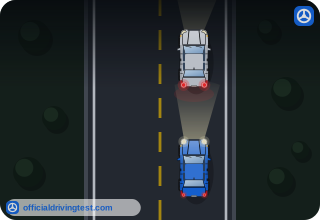
You should use low beam headlights when following another vehicle within:
- 50 feet
- 1,000 feet
- 150 feet
- 300 feet
Show answer
Correct answer: 300 feet
Use low beam headlights when following closely, within 300 feet, behind another vehicle.
Source: Texas Driver Handbook (Revised January 2026), page 47
-
According to the handbook, you should use low beam headlights when driving in:
- Clear weather with light traffic
- Bright sunshine
- An empty rural road with no other vehicles for miles
- Fog, heavy rain, sleet, snow, or dust
Show answer
Correct answer: Fog, heavy rain, sleet, snow, or dust
Use low beam headlights when driving in fog, heavy rain, sleet, snow, or dust, and also when on lighted roads.
Source: Texas Driver Handbook (Revised January 2026), page 47
-
If you must park on an unlighted highway at night, you should:
- Leave your parking lights or low beams on
- Turn off all lights to save the battery
- Turn on your high beam headlights
- Leave only your interior dome light on
Show answer
Correct answer: Leave your parking lights or low beams on
If you must park on an unlighted highway at night, leave your parking lights or low beam headlights on so other drivers can see you.
Source: Texas Driver Handbook (Revised January 2026), page 47
-
Which of these is equipment Texas law requires on passenger cars?
- Working brakes, horn, and lights
- A siren
- Flashing red and blue lights
- A CB radio
Show answer
Correct answer: Working brakes, horn, and lights
Texas law requires functional brakes, a horn, a muffler, a mirror, windshield wipers, and proper lighting on passenger vehicles.
Source: Texas Driver Handbook (Revised January 2026), page 15
-
What is the purpose of an exhaust emission control system on a vehicle?
- To make the engine louder
- To increase fuel consumption
- To cool the passenger cabin
- To help reduce air pollution
Show answer
Correct answer: To help reduce air pollution
The exhaust emission system controls and reduces harmful pollutants released into the air by the engine.
Source: Texas Driver Handbook (Revised January 2026), page 15
-
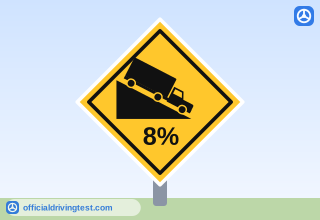
What should you do when driving down a steep grade in a car with a standard (manual) transmission?
- Shift into neutral and coast down
- Coast downhill with your foot on the clutch
- Turn off the engine to save fuel
- Shift into a low gear to help slow the vehicle
Show answer
Correct answer: Shift into a low gear to help slow the vehicle
When driving down a steep hill, you can shift into a low gear to help slow your vehicle. Never coast in neutral, and with a standard transmission never coast with your foot on the clutch.
Source: Texas Driver Handbook (Revised January 2026), page 49
-
In which gear should you drive when going down a steep hill?
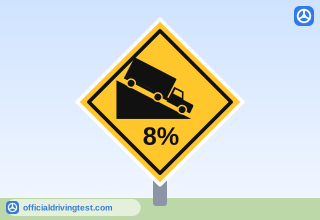
- A low gear
- The highest gear available
- Neutral
- Reverse
Show answer
Correct answer: A low gear
When driving down a steep hill, you can shift into a low gear to help slow your vehicle; never coast in neutral.
Source: Texas Driver Handbook (Revised January 2026), page 49
-
What is the maximum number of inches you may lawfully allow a load to extend beyond the left (driver's side) fender of your car?
- 24 inches
- No limit
- 3 inches
- 12 inches
Show answer
Correct answer: 3 inches
Texas law limits a load to extending no more than 3 inches beyond the left fender line, to avoid creating a hazard to oncoming traffic.
Source: Texas Driver Handbook (Revised January 2026), page 16
-
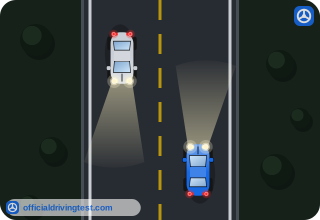
You should dim your high-beam headlights when you are within how many feet of an approaching oncoming car?
- 500 feet
- 50 feet
- 1,000 feet
- There is no requirement
Show answer
Correct answer: 500 feet
Texas law requires dimming high beams to low beams within 500 feet of an oncoming vehicle so you do not blind the other driver.
Source: Texas Driver Handbook (Revised January 2026), page 47
-
What lights should you leave on if you must park on an unlighted highway at night?
- Interior dome light only
- Parking lights or low-beam headlights
- High-beam headlights
- No lights at all to avoid blinding traffic
Show answer
Correct answer: Parking lights or low-beam headlights
If you must park on an unlighted highway at night, leave your parking lights or low beam headlights on.
Source: Texas Driver Handbook (Revised January 2026), page 47
-
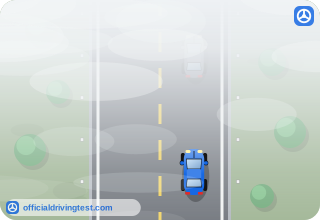
Which lights should you use when driving in fog?
- High beams to see further
- Hazard lights only, with headlights off
- Interior lights to see the dashboard
- Low-beam headlights, avoiding high beams
Show answer
Correct answer: Low-beam headlights, avoiding high beams
The handbook says to use your low beam headlights when driving in fog, heavy rain, sleet, snow, or dust.
Source: Texas Driver Handbook (Revised January 2026), page 47