Texas: Signals & vehicle controls — Part 1 Practice Test
Questions in this part include: “Regarding proper care of your vehicle, what does "Your Keys to Safe Driving" advise?” · “For how long is a passing Vehicle Inspection Report (VIR) valid for registration purposes, from the month of inspection?”
Independent educational site · not affiliated with any government agency or DMV
Ready? Test yourself
Answer to start, or tap Start below:
Regarding proper care of your vehicle, what does "Your Keys to Safe Driving" advise?
- Instant feedback with an explanation
- Every answer cites its source in the manual
- Your best score is saved on this device
- Keyboard: press 1 to 4 to answer and Enter for the next question
Questions are original and based on the official manual "Texas Driver Handbook" (Revised January 2026), Texas Department of Public Safety (DPS).
All 19 questions in this practice test
Take the test above first, then use this list to study. Tap “Show answer” to see the correct answer and explanation.
Show the questions and answersHide the questions
-
Regarding proper care of your vehicle, what does "Your Keys to Safe Driving" advise?
- Rely solely on the annual state inspection
- Only service the vehicle if a warning light appears
- Maintenance is optional if the vehicle is new
- Don't depend on yearly inspections; do regular maintenance
Show answer
Correct answer: Don't depend on yearly inspections; do regular maintenance
The handbook advises not to depend on yearly inspections alone, but to perform regular maintenance on your vehicle as needed.
Source: Texas Driver Handbook (Revised January 2026), page 67
-
To help prevent loose material from escaping, what must a vehicle bed not have?
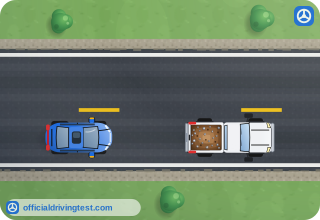
- Extra weight beyond the rated capacity
- Reflective tape on the tailgate
- A hole, crack, or other opening
- Any paint or rust on the surface
Show answer
Correct answer: A hole, crack, or other opening
A vehicle bed must not have a hole, crack, or other opening through which loose material can escape.
Source: Texas Driver Handbook (Revised January 2026), page 68
-
When transporting loose material such as dirt, sand, or gravel that could blow or spill, how must the top of the load generally be treated?
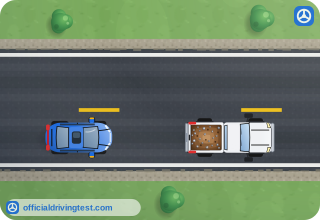
- Left uncovered as long as the vehicle drives slowly
- Covered only when driving on an interstate highway
- Covered only during rainy weather
- Covered with a canvas or tarp firmly secured front and back
Show answer
Correct answer: Covered with a canvas or tarp firmly secured front and back
The top of the load must be covered with a canvas, tarpaulin, or other covering firmly secured to the front and back to prevent the load from blowing or spilling.
Source: Texas Driver Handbook (Revised January 2026), page 68
-
Which type of load is exempt from the loose material covering requirements described in the handbook?
- Sand and gravel hauled to a construction site
- Wood chips
- Dirt
- Agricultural products in their natural state
Show answer
Correct answer: Agricultural products in their natural state
The requirement not to load or transport loose material capable of blowing or spilling does not apply to agricultural products in their natural state.
Source: Texas Driver Handbook (Revised January 2026), page 68
-
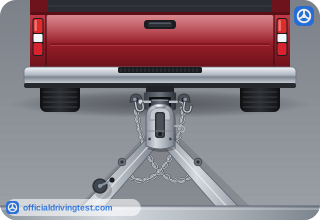
When is a driver required to use safety chains in Texas?
- Only on interstate highways and toll roads
- Only when driving at night
- When a passenger car or light truck tows a trailer
- Only when towing a boat
Show answer
Correct answer: When a passenger car or light truck tows a trailer
A person may not drive a passenger car or light truck towing a trailer, semi-trailer, or house trailer on a public highway in Texas unless safety chains are attached from the trailer to the towing vehicle.
Source: Texas Driver Handbook (Revised January 2026), page 68
-
Who must approve the types of safety chains and the manner of their attachment?
- The trailer dealer only
- The Department of Public Safety
- The vehicle manufacturer only
- The local sheriff's office
Show answer
Correct answer: The Department of Public Safety
The types of safety chains and the manner of attachment must be approved by DPS.
Source: Texas Driver Handbook (Revised January 2026), page 68
-
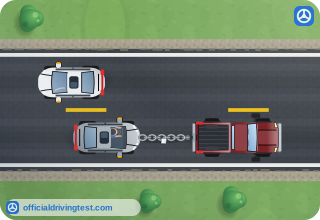
When one vehicle tows another with a drawbar, chain, rope, or cable, how long can that connection be at most?
- Not longer than 50 feet
- There is no length limit
- Not longer than 15 feet
- Not longer than 5 feet
Show answer
Correct answer: Not longer than 15 feet
The drawbar, chain, rope, cable, or other connection must not be longer than 15 feet from one vehicle to another.
Source: Texas Driver Handbook (Revised January 2026), page 68
-
When towing another vehicle with a chain, rope, or cable, what must be attached to the connection?
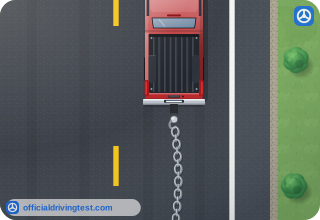
- A red reflector triangle at least 12 inches wide
- A flashing amber light
- A bell
- A white flag not less than 12 inches square
Show answer
Correct answer: A white flag not less than 12 inches square
The connection between towed vehicles must attach a white flag not less than 12 inches square.
Source: Texas Driver Handbook (Revised January 2026), page 68
-
According to the Texas Driver Handbook, which of the following must be inspected each year along with cars?
- Motorcycles, mopeds, scooters, and autocycles
- Only vehicles more than 10 years old
- Only commercial trucks and delivery vans
- Bicycles only
Show answer
Correct answer: Motorcycles, mopeds, scooters, and autocycles
All motor vehicles registered in Texas must be inspected each year, including motorcycles, mopeds, scooters, and autocycles.
Source: Texas Driver Handbook (Revised January 2026), page 15
-
What must you present at the time of your vehicle's inspection?
- Evidence of financial responsibility
- Your birth certificate
- A copy of your most recent tax return
- Proof of employment
Show answer
Correct answer: Evidence of financial responsibility
Evidence of financial responsibility for the vehicle being inspected must be presented at the time of the inspection.
Source: Texas Driver Handbook (Revised January 2026), page 15
-
What does the single registration sticker displayed on a Texas vehicle's windshield represent?
- Combined proof of registration and inspection
- Proof of inspection only
- Proof of vehicle ownership only
- Proof that parking tickets have been paid
Show answer
Correct answer: Combined proof of registration and inspection
Texas transitioned to a system requiring motorists to display only the valid registration sticker on the windshield, which serves as combined proof of registration and inspection.
Source: Texas Driver Handbook (Revised January 2026), page 15
-
For how long is a passing Vehicle Inspection Report (VIR) valid for registration purposes, from the month of inspection?
- 30 days
- 6 months
- 1 year
- 90 days
Show answer
Correct answer: 90 days
The VIR is only valid for 90 days from the month of inspection for registration purposes.
Source: Texas Driver Handbook (Revised January 2026), page 15
-
A vehicle's foot brake must be able to stop the car within what distance at a speed of 20 mph?
- 50 feet
- 10 feet
- 100 feet
- 25 feet
Show answer
Correct answer: 25 feet
The foot brake must stop the car within a distance of 25 feet at a speed of 20 mph.
Source: Texas Driver Handbook (Revised January 2026), page 15
-
How many taillights must most vehicles have under Texas equipment requirements?
- Three on all vehicles
- None are required
- Two, but only one on cars made before 1960
- One on all vehicles regardless of age
Show answer
Correct answer: Two, but only one on cars made before 1960
All vehicles must be equipped with two taillights, except cars manufactured before 1960, which are only required to have one.
Source: Texas Driver Handbook (Revised January 2026), page 15
-
If a vehicle is equipped with a third, high-mounted stop lamp, what does Texas require?
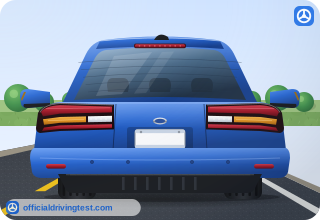
- It is optional equipment with no operating requirement
- All three brake lights must be operational
- Only the high-mounted lamp needs to work
- The two lower brake lights may be disconnected
Show answer
Correct answer: All three brake lights must be operational
All vehicles must have two working brake lights, and vehicles equipped with a third or high-mounted stop lamp require all three to be operational.
Source: Texas Driver Handbook (Revised January 2026), page 15
-
Texas requires two red reflectors on most vehicles, placed at what height and visible from what distance?
- 15 to 60 inches high, visible up to 600 feet
- 5 to 10 inches high, visible up to 100 feet
- 60 to 100 inches high, visible up to 1,000 feet
- No height requirement, visible up to 200 feet
Show answer
Correct answer: 15 to 60 inches high, visible up to 600 feet
Two red reflectors, one on each side, must be placed at a height of 15 to 60 inches and be visible up to 600 feet (350 feet for vehicles manufactured before 1960).
Source: Texas Driver Handbook (Revised January 2026), page 15
-
Which vehicles are NOT required to have electric turn signals under Texas law?
- Any car or truck more than 10 years old
- Vehicles with only one headlight
- Pre-1960 cars and trucks under 80 inches wide
- All pickup trucks
Show answer
Correct answer: Pre-1960 cars and trucks under 80 inches wide
Passenger cars and trucks less than 80 inches in width and manufactured before 1960 are not required to have electrical turn signals (motorcycles and certain trailers are also exempt).
Source: Texas Driver Handbook (Revised January 2026), page 15
-
A vehicle's horn must be audible from a minimum distance of how many feet?
- 50 feet
- 500 feet
- 1,000 feet
- 200 feet
Show answer
Correct answer: 200 feet
Horns must be heard for a minimum distance of 200 feet.
Source: Texas Driver Handbook (Revised January 2026), page 15
-
Vehicles of what model year or later must be equipped with an exhaust emission system to help reduce air pollution?
- 1980 or later
- 1950 or later
- 2000 or later
- 1968 or later
Show answer
Correct answer: 1968 or later
All 1968 or later models must be equipped with an exhaust emission system to help reduce air pollution.
Source: Texas Driver Handbook (Revised January 2026), page 15