Texas: Pavement markings Practice Test
Yellow and white lane lines, turn lanes, bike lanes, and edge lines.
Independent educational site · not affiliated with any government agency or DMV
Ready? Test yourself
Answer to start, or tap Start below:
On a two-lane rural road with two-way traffic, when may you cross the yellow center line to pass?
- Instant feedback with an explanation
- Every answer cites its source in the manual
- Your best score is saved on this device
- Keyboard: press 1 to 4 to answer and Enter for the next question
Questions are original and based on the official manual "Texas Driver Handbook" (Revised January 2026), Texas Department of Public Safety (DPS).
All 16 questions in this practice test
Take the test above first, then use this list to study. Tap “Show answer” to see the correct answer and explanation.
Show the questions and answersHide the questions
-
On a two-lane rural road with two-way traffic, when may you cross the yellow center line to pass?
- Only when driving at night
- Only when following a truck
- When the line is broken and it is safe to pass
- Anytime the vehicle ahead is going slower than you
Show answer
Correct answer: When the line is broken and it is safe to pass
Keep to the right of the yellow center line. You may cross a broken line when passing another vehicle or when the right half of the road is closed. Do not cross the line if it is not safe or it is a solid yellow line.
Source: Texas Driver Handbook (Revised January 2026), page 33
-
On a three-lane one-way road where each lane is marked with a broken white line, what does this allow?
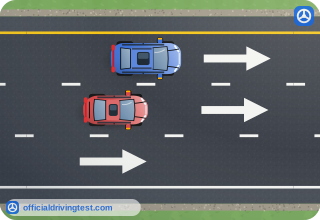
- You may drive in any lane
- Only the leftmost lane may be used
- Only commercial vehicles may change lanes
- You must remain in the lane you started in
Show answer
Correct answer: You may drive in any lane
When each lane on a one-way road is marked with a broken white line, you may drive in any lane.
Source: Texas Driver Handbook (Revised January 2026), page 33
-
When turning from a multi-lane one-way road, what should you do?
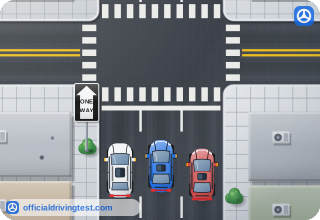
- Move to the lane nearest your turn well in advance
- Turn from whichever lane you happen to be in
- Move to the far lane away from your turn
- Signal only after you begin turning
Show answer
Correct answer: Move to the lane nearest your turn well in advance
When turning from a one-way road, make sure you move into the lane closest to the turn you are going to make well in advance of your turn.
Source: Texas Driver Handbook (Revised January 2026), page 33
-
According to the handbook, when should a vehicle enter a center left-turn lane?
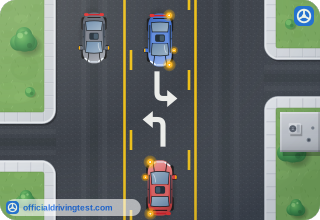
- Only where it has time to slow down or stop for a safe left turn
- Whenever it needs to pass slower traffic
- As a through-traffic lane when other lanes are congested
- Only when turning right at an intersection
Show answer
Correct answer: Only where it has time to slow down or stop for a safe left turn
The only time a vehicle should enter the center lane is at a point where the vehicle will have time to slow down or stop to make a safe left turn. The center lane should never be used for passing or as a through-traffic lane.
Source: Texas Driver Handbook (Revised January 2026), page 33
-
On a multi-lane highway with four or more lanes, what does a double yellow line mean?
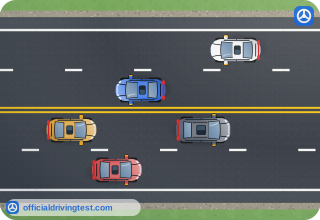
- It marks a carpool-only lane
- It indicates a school zone ahead
- You must not cross it to pass another vehicle
- You may cross it freely to pass slower vehicles
Show answer
Correct answer: You must not cross it to pass another vehicle
Do not cross the double yellow line to pass. Stay in your lane as much as possible. If you are driving slower, keep in the right-hand lane.
Source: Texas Driver Handbook (Revised January 2026), page 33
-
What does a solid yellow line on your side of the road indicate?
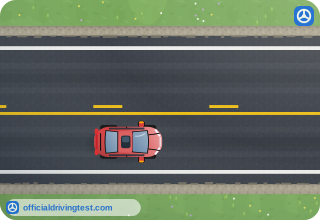
- A pedestrian crossing area
- A carpool lane
- An area reserved for parking
- A no-passing zone
Show answer
Correct answer: A no-passing zone
A solid yellow line on your side of the road marks a 'no-passing zone.'
Source: Texas Driver Handbook (Revised January 2026), page 34
-
Broken or dashed pavement lines permit you to...
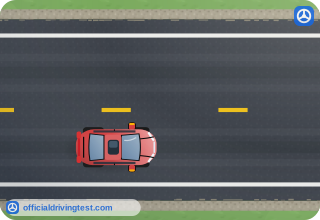
- Park along the roadway
- Make a U-turn at any point
- Exceed the posted speed limit
- Pass or change lanes, if safe
Show answer
Correct answer: Pass or change lanes, if safe
Broken or dashed lines permit you to pass or change lanes, if safe.
Source: Texas Driver Handbook (Revised January 2026), page 34
-
At an intersection with no stop line, white crosswalk lines are painted across the road. What do they indicate, and when must you stop before them?
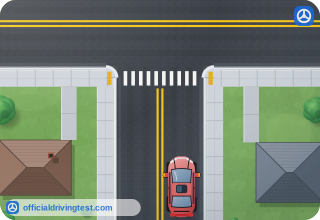
- A passing zone for vehicles; stop only when a police officer at the crossing directs you to
- A truck-only lane; stop only when a school bus is loading or unloading children
- A location where U-turns are permitted; stop only when traffic is approaching
- Pedestrian crossing areas; stop when signs, signals, or pedestrians in the crosswalk require it
Show answer
Correct answer: Pedestrian crossing areas; stop when signs, signals, or pedestrians in the crosswalk require it
White crosswalk lines are painted across a road to indicate pedestrian crossing areas. At intersections where stop lines are missing, you must stop before the crosswalk when required to stop by traffic signs, traffic signals, or pedestrians in the crosswalk.
Source: Texas Driver Handbook (Revised January 2026), page 34
-
Where present, what do white stop lines painted across pavement lanes require you to do?
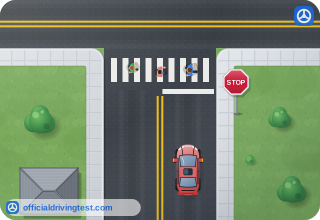
- Stop only if a police officer is present
- Slow down but not necessarily stop
- Stop only during school hours
- Stop behind the stop line
Show answer
Correct answer: Stop behind the stop line
White stop lines are painted across the pavement lanes at traffic signs or signals. Where these lines are present, you are required to stop behind the stop line.
Source: Texas Driver Handbook (Revised January 2026), page 34
-
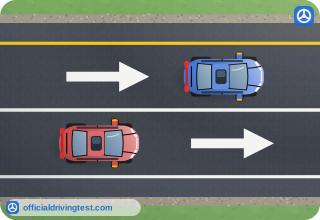
Solid white lines are used for pavement edge lines, shoulder markings, channelizing, transitions, and lane use control. What should you generally do regarding these lines?
- Cross them freely at any time
- Use them only as parking guides
- Ignore them unless a sign is also posted
- Avoid crossing a solid white line if possible
Show answer
Correct answer: Avoid crossing a solid white line if possible
Solid white lines are used for pavement edge lines, shoulder markings, channelizing, transitions, and lane use control. Crossing a solid white line should be avoided if possible.
Source: Texas Driver Handbook (Revised January 2026), page 34
-
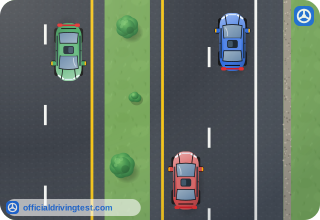
A solid yellow line found on the left edge of the road on interstate highways indicates that...
- The lane is for emergency vehicles only
- It marks a pedestrian crossing
- Driving to the left of the line is prohibited
- Passing is always permitted there
Show answer
Correct answer: Driving to the left of the line is prohibited
The solid yellow line on the left edge of the road is a guide for drivers indicating that driving to the left of the yellow line is prohibited. This type of yellow line can be found on interstate highways.
Source: Texas Driver Handbook (Revised January 2026), page 34
-
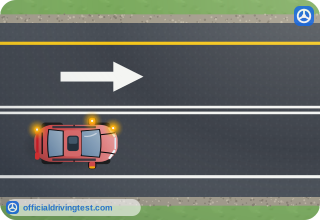
Where the pavement marking shows double solid white lines, what is prohibited?
- U-turns are permitted only there
- Passing is permitted only for emergency vehicles
- Crossing between the lanes is prohibited
- Parking is prohibited only on weekends
Show answer
Correct answer: Crossing between the lanes is prohibited
Crossing is prohibited where there is a pavement marking of double solid white lines.
Source: Texas Driver Handbook (Revised January 2026), page 34
-
On a one-way street, what color is a broken lane marker separating lanes going the same direction?
- Yellow
- White
- Red
- Blue
Show answer
Correct answer: White
White lines separate lanes of traffic moving in the same direction, such as on a one-way street; yellow lines separate opposing traffic.
Source: Texas Driver Handbook (Revised January 2026), page 33
-
You should never drive on the left half of the roadway when you are within how many feet of an intersection, bridge, or railroad crossing?
- 20 feet
- 50 feet
- 100 feet
- 500 feet
Show answer
Correct answer: 100 feet
Passing or driving on the left half of the roadway is prohibited within 100 feet of an intersection, bridge, or railroad crossing because visibility and safety are limited there.
Source: Texas Driver Handbook (Revised January 2026), page 38
-
Under which circumstance should you never attempt to pass the car ahead of you?
- On a straight, open highway with clear visibility
- When the car ahead is going well below the speed limit on a clear, straight road with a broken line
- When you have plenty of following distance
- When approaching a curve, hill crest, or intersection where you cannot see far enough ahead to pass safely
Show answer
Correct answer: When approaching a curve, hill crest, or intersection where you cannot see far enough ahead to pass safely
You should never pass when you cannot see far enough ahead to complete the maneuver safely, such as near curves, hill crests, or intersections.
Source: Texas Driver Handbook (Revised January 2026), page 38
-
Under what circumstances is overtaking and passing on the right not permitted?
- Whenever there is a passing lane available
- Only on interstate highways
- Only if the car ahead is turning right
- When it requires driving off the paved highway
Show answer
Correct answer: When it requires driving off the paved highway
The handbook says not to pass on the right by driving off the paved portion of the highway. You may pass on a paved shoulder when the vehicle you are passing is slowing or stopped on the main traveled portion of the highway, disabled, or preparing to make a left turn.
Source: Texas Driver Handbook (Revised January 2026), page 39