Texas: Signals & vehicle controls — Part 3 Practice Test
Questions in this part include: “Why is it especially important that your signal lights work properly during non-daylight hours?” · “Which of these is equipment Texas law requires on passenger cars?”
Independent educational site · not affiliated with any government agency or DMV
Ready? Test yourself
- Instant feedback with an explanation
- Every answer cites its source in the manual
- Your best score is saved on this device
Questions are original and based on the official manual "Texas Driver Handbook" (Revised January 2026), Texas Department of Public Safety (DPS).
All 18 questions in this practice test
Take the test above first, then use this list to study. Tap “Show answer” to see the correct answer and explanation.
Show the questions and answersHide the questions
-
Why is it especially important that your signal lights work properly during non-daylight hours?
- Signal lights use less fuel at night
- Hand signals are usually hard to see in the dark
- Hand signals are illegal after sunset
- Police only check signal lights at night
Show answer
Correct answer: Hand signals are usually hard to see in the dark
Hand and arm signals are usually difficult to see during non-daylight hours, so working signal lights are important.
Source: Texas Driver Handbook (Revised January 2026), page 38
-
When signaling a stop using hand and arm signals, what should you also do to attract attention?
- Pump your brakes a few times
- Turn off your headlights
- Roll down all your windows
- Accelerate briefly
Show answer
Correct answer: Pump your brakes a few times
When signaling a stop with a hand signal, pump your brakes a few times to attract attention.
Source: Texas Driver Handbook (Revised January 2026), page 38
-
How long before turning or stopping should you signal continuously, and what should you do once the turn is complete?
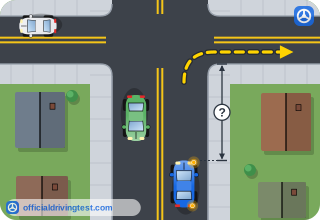
- Signal for at least 10 feet, and you may leave it on afterward
- Signal for at least half a mile, then leave it on for the next turn
- There is no minimum distance, just signal briefly at the last second
- Signal for at least 100 feet, then turn it off, as it still means "turn"
Show answer
Correct answer: Signal for at least 100 feet, then turn it off, as it still means "turn"
Signal continuously for at least 100 feet before turning or stopping, and turn off your signal once the turn is complete, since an unintended signal still means "turn" to other drivers.
Source: Texas Driver Handbook (Revised January 2026), page 38
-
Apart from any time people or vehicles cannot be seen clearly for at least 1,000 feet, when must you use your headlights in Texas?
- From one hour after sunset to one hour before sunrise
- Only on highways, never on city streets
- From 30 minutes after sunset to 30 minutes before sunrise
- Only after complete darkness
Show answer
Correct answer: From 30 minutes after sunset to 30 minutes before sunrise
Texas law requires headlights beginning 30 minutes after sunset until 30 minutes before sunrise, and anytime people or vehicles cannot be seen clearly for at least 1,000 feet.
Source: Texas Driver Handbook (Revised January 2026), page 47
-
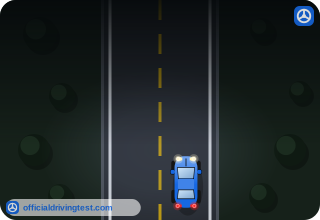
When driving at night, you should slow down enough to:
- Match the speed of the car behind you
- Stay exactly at the posted daytime speed limit
- Keep pace with oncoming traffic
- Be able to stop in the distance lit by your headlights
Show answer
Correct answer: Be able to stop in the distance lit by your headlights
Slow down when driving at night and be sure you can stop within the distance lit by your headlights.
Source: Texas Driver Handbook (Revised January 2026), page 47
-
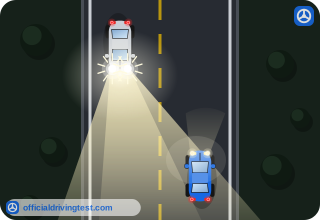
To avoid being blinded by the headlights of an approaching vehicle at night, you should:
- Flash your high beams repeatedly at the other driver
- Close your eyes briefly until the vehicle passes
- Shift your eyes to the lower right side of your traffic lane
- Stare directly at the oncoming headlights
Show answer
Correct answer: Shift your eyes to the lower right side of your traffic lane
Avoid looking directly into the headlights of approaching vehicles; shift your eyes down to the lower right side of your traffic lane.
Source: Texas Driver Handbook (Revised January 2026), page 47
-
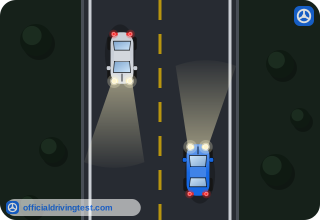
You should switch to low beam headlights when you are within how many feet of an approaching vehicle?
- 1,000 feet
- 50 feet
- 500 feet
- 100 feet
Show answer
Correct answer: 500 feet
Use low beam headlights within 500 feet of an approaching vehicle.
Source: Texas Driver Handbook (Revised January 2026), page 47
-
You should use low beam headlights when following another vehicle within:
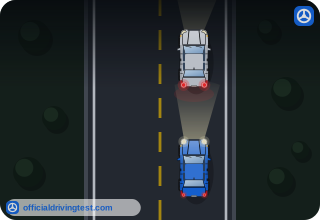
- 50 feet
- 1,000 feet
- 150 feet
- 300 feet
Show answer
Correct answer: 300 feet
Use low beam headlights when following closely, within 300 feet, behind another vehicle.
Source: Texas Driver Handbook (Revised January 2026), page 47
-
According to the handbook, you should use low beam headlights when driving in:
- Clear weather with light traffic
- Bright sunshine
- An empty rural road with no other vehicles for miles
- Fog, heavy rain, sleet, snow, or dust
Show answer
Correct answer: Fog, heavy rain, sleet, snow, or dust
Use low beam headlights when driving in fog, heavy rain, sleet, snow, or dust, and also when on lighted roads.
Source: Texas Driver Handbook (Revised January 2026), page 47
-
If you must park on an unlighted highway at night, you should:
- Leave your parking lights or low beams on
- Turn off all lights to save the battery
- Turn on your high beam headlights
- Leave only your interior dome light on
Show answer
Correct answer: Leave your parking lights or low beams on
If you must park on an unlighted highway at night, leave your parking lights or low beam headlights on so other drivers can see you.
Source: Texas Driver Handbook (Revised January 2026), page 47
-
Which of these is equipment Texas law requires on passenger cars?
- Working brakes, horn, and lights
- A siren
- Flashing red and blue lights
- A CB radio
Show answer
Correct answer: Working brakes, horn, and lights
Texas law requires functional brakes, a horn, a muffler, a mirror, windshield wipers, and proper lighting on passenger vehicles.
Source: Texas Driver Handbook (Revised January 2026), page 15
-
What is the purpose of an exhaust emission control system on a vehicle?
- To make the engine louder
- To increase fuel consumption
- To cool the passenger cabin
- To help reduce air pollution
Show answer
Correct answer: To help reduce air pollution
The exhaust emission system controls and reduces harmful pollutants released into the air by the engine.
Source: Texas Driver Handbook (Revised January 2026), page 15
-
What should you do when driving down a steep grade in a car with a standard (manual) transmission?
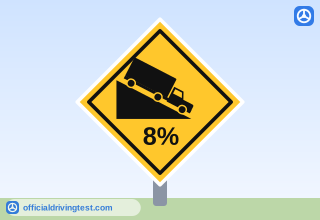
- Shift into neutral and coast down
- Coast downhill with your foot on the clutch
- Turn off the engine to save fuel
- Shift into a low gear to help slow the vehicle
Show answer
Correct answer: Shift into a low gear to help slow the vehicle
When driving down a steep hill, you can shift into a low gear to help slow your vehicle. Never coast in neutral, and with a standard transmission never coast with your foot on the clutch.
Source: Texas Driver Handbook (Revised January 2026), page 49
-
In which gear should you drive when going down a steep hill?
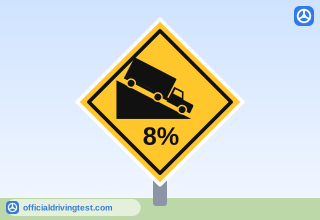
- A low gear
- The highest gear available
- Neutral
- Reverse
Show answer
Correct answer: A low gear
When driving down a steep hill, you can shift into a low gear to help slow your vehicle; never coast in neutral.
Source: Texas Driver Handbook (Revised January 2026), page 49
-
What is the maximum number of inches you may lawfully allow a load to extend beyond the left (driver's side) fender of your car?
- 24 inches
- No limit
- 3 inches
- 12 inches
Show answer
Correct answer: 3 inches
Texas law limits a load to extending no more than 3 inches beyond the left fender line, to avoid creating a hazard to oncoming traffic.
Source: Texas Driver Handbook (Revised January 2026), page 16
-
You should dim your high-beam headlights when you are within how many feet of an approaching oncoming car?
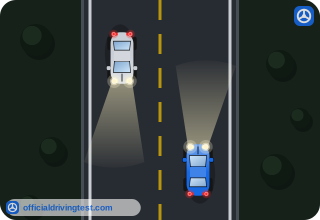
- 500 feet
- 50 feet
- 1,000 feet
- There is no requirement
Show answer
Correct answer: 500 feet
Texas law requires dimming high beams to low beams within 500 feet of an oncoming vehicle so you do not blind the other driver.
Source: Texas Driver Handbook (Revised January 2026), page 47
-
What lights should you leave on if you must park on an unlighted highway at night?
- Interior dome light only
- Parking lights or low-beam headlights
- High-beam headlights
- No lights at all to avoid blinding traffic
Show answer
Correct answer: Parking lights or low-beam headlights
If you must park on an unlighted highway at night, leave your parking lights or low beam headlights on.
Source: Texas Driver Handbook (Revised January 2026), page 47
-
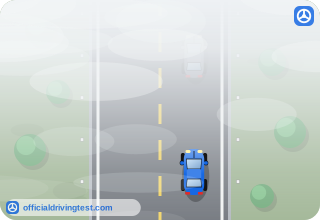
Which lights should you use when driving in fog?
- High beams to see further
- Hazard lights only, with headlights off
- Interior lights to see the dashboard
- Low-beam headlights, avoiding high beams
Show answer
Correct answer: Low-beam headlights, avoiding high beams
The handbook says to use your low beam headlights when driving in fog, heavy rain, sleet, snow, or dust.
Source: Texas Driver Handbook (Revised January 2026), page 47