Pavement markings in Texas
The Texas Driver Handbook shows or names everything on this page: 12 in all, on pages 33–34, 43, 50, 62.
Independent educational site · not affiliated with any government agency or DMV
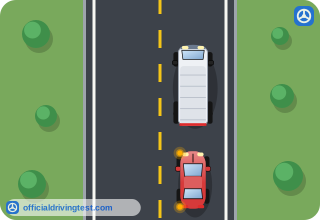
Two-lane road, two-way traffic
Keep to the right of the yellow center line. You may cross a broken line when passing another vehicle or when the right half of the road is closed. Do not cross the line if it is not safe or it is a solid yellow line.
Manual page 33
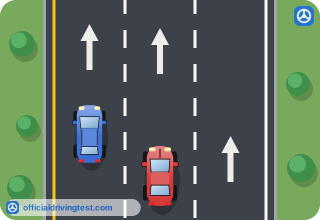
Three-lane one-way road
When each lane on a one way road is marked with a broken white line, you may drive in any lane. When turning from a one-way road, make sure you move into the lane closest to the turn you are going to make well in advance of your turn.
Manual page 33
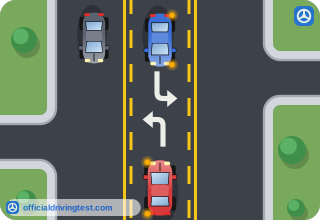
Center left-turn lane
The only time a vehicle should enter the center lane is at a point where the vehicle will have time to slow down or stop in order to make a safe left turn maneuver. (Special Note: "The center lane should never be used for passing or as a through-traffic lane.")
Manual page 33
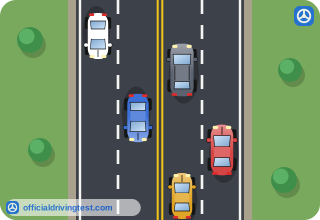
Four-lane highway
Do not cross the double yellow line to pass. Stay in your lane as much as possible. If you are driving slower, keep in the right-hand lane.
Manual page 33
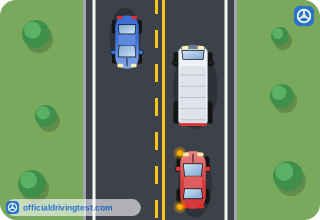
Solid and broken yellow lines
A solid yellow line on your side of the road marks a “no-passing zone.” Broken or dashed lines permit you to pass or change lanes, if safe.
Manual page 34
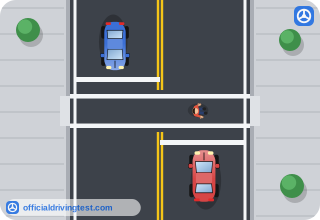
Crosswalk
White crosswalk lines are painted across a road to indicate pedestrian crossing areas. Pedestrians should use these areas when crossing the road. At intersections where stop lines are missing, you must stop before the crosswalk when required to stop by traffic signs, traffic signals, or pedestrians in the crosswalk.
Manual page 34
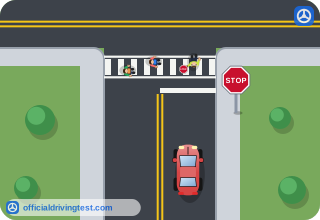
White stop line
White stop lines are painted across the pavement lanes at traffic signs or signals. Where these lines are present, you are required to stop behind the stop line.
Manual page 34
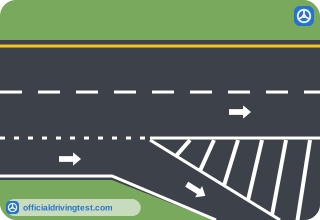
Solid white lines and gore
Solid white lines are used for pavement edge lines, shoulder markings, channelizing, transitions, and lane use control. Crossing a solid white line should be avoided if possible. The solid yellow line on the left edge of the road is a guide for drivers to indicate driving to the left of the yellow line is prohibited. This type of yellow line can be found on interstate highways.
Manual page 34
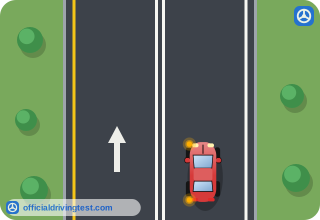
Double solid white lines
Crossing is prohibited where there is a pavement marking of double solid white lines.
Manual page 34
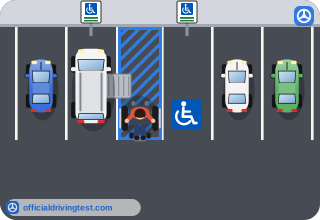
Accessible parking spaces and access aisle
Do not park in striped areas adjacent to disabled parking spaces or in a striped area in front of an entrance to a business adjacent to a disabled parking space. Striped areas are for wheelchair lifts.
Manual page 43
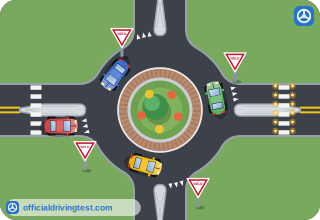
Roundabout pavement markings
Road signs, pavement markings and its design help guide drivers through a modern roundabout. ... Observe traffic signs and pavement markings when navigating a roundabout.
Manual page 50
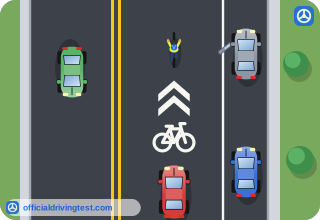
Shared lane marking
The shared lane marking may be used to: 1. Assist bicyclists with lateral positioning in a shared lane with on-street parallel parking in order to reduce the chance of a bicyclist impacting the open door of a parked vehicle 2. Assist bicyclists with lateral position in lanes too narrow for a motor vehicle and a bicycle to travel side by side within the same traffic lane 3. Alert road users of the lateral location bicyclists are likely to occupy within the traveled way 4. Encourage safe passing of bicyclists by motorists, or 5. Reduce the incidence of wrong-way bicycling
Manual page 62