South Dakota: Speed and following distance — Part 2 Practice Test
Questions in this part include: “What is total stopping distance?” · “What does your reaction time include?”
Independent educational site · not affiliated with any government agency or DMV
Ready? Test yourself
- Instant feedback with an explanation
- Every answer cites its source in the manual
- Your best score is saved on this device
- Keyboard: press 1 to 4 to answer and Enter for the next question
Questions are original and based on the official manual "South Dakota Driver License Manual" (Revised 11/2024), South Dakota Department of Public Safety.
All 17 questions in this practice test
Take the test above first, then use this list to study. Tap “Show answer” to see the correct answer and explanation.
Show the questions and answersHide the questions
-
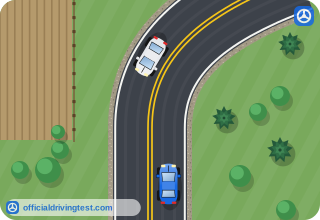
What could happen if you brake hard after entering a curve?
- The brakes would grip better
- The tires could lose traction
- The vehicle would stop in a straighter line
- The steering would become lighter
Show answer
Correct answer: The tires could lose traction
Hard braking in a curve can cause the tires to lose traction, so reduce speed before entering.
Source: South Dakota Driver License Manual (Revised 11/2024), page 50
-
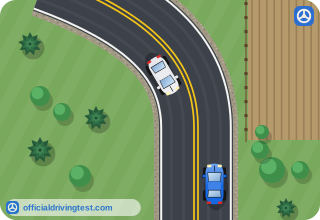
When should you reduce your speed for a curve?
- Halfway through the curve
- Only after you see the end of the curve
- After the curve begins to tighten
- Before entering the curve
Show answer
Correct answer: Before entering the curve
The manual says to always reduce speed before entering a curve to a safe speed.
Source: South Dakota Driver License Manual (Revised 11/2024), page 50
-
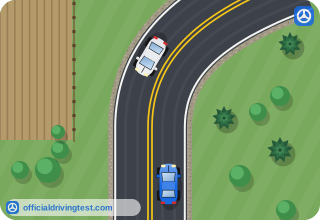
Which situation calls for reducing speed even more in a curve?
- When traction is good
- When there are no vehicles in front of you
- When you cannot see the end of the curve
- When it is daylight
Show answer
Correct answer: When you cannot see the end of the curve
Reduce speed more when traction is poor, when following other vehicles and when you cannot see the end of the curve.
Source: South Dakota Driver License Manual (Revised 11/2024), page 50
-
When should you reduce your speed on a slippery road?
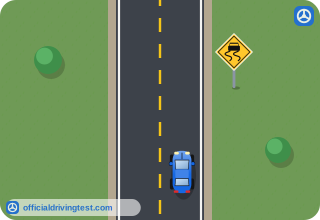
- At the first sign of rain, snow, sleet, or ice
- Only after the vehicle starts to skid
- Only when the road is fully covered in ice
- Only if other drivers have slowed down
Show answer
Correct answer: At the first sign of rain, snow, sleet, or ice
Wet or icy surfaces reduce grip, so it takes longer to stop and harder to turn without skidding.
Source: South Dakota Driver License Manual (Revised 11/2024), page 50
-
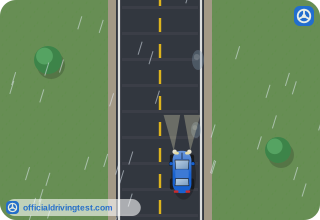
What is hydroplaning?
- The brakes overheat after long use on a long downhill
- The tires lose air pressure on wet pavement
- The engine stalls when it gets wet
- The steering tires ride up on pooled water, like water skis
Show answer
Correct answer: The steering tires ride up on pooled water, like water skis
Hydroplaning is when the steering tires start to ride up on pooled water.
Source: South Dakota Driver License Manual (Revised 11/2024), page 50
-
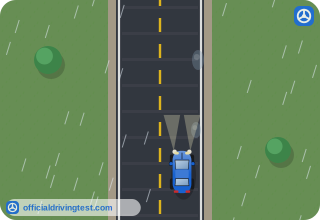
What is the best way to avoid traction loss from hydroplaning?
- Brake hard when you feel the tires slide
- Slow down in the rain or when the road has pooled water
- Speed up so the tires push through the water
- Turn the steering wheel sharply left and right
Show answer
Correct answer: Slow down in the rain or when the road has pooled water
Slowing down in the rain or on roads with puddles is the manual’s best way to avoid hydroplaning.
Source: South Dakota Driver License Manual (Revised 11/2024), page 50
-
What is total stopping distance?
- The distance the vehicle travels from the moment the brakes are first pressed until it stops
- The distance you can see ahead on a clear day in good light
- The distance between your vehicle and the one in front of you
- The distance the vehicle travels, in ideal conditions, from the time you realize you must stop until it stops
Show answer
Correct answer: The distance the vehicle travels, in ideal conditions, from the time you realize you must stop until it stops
It counts the distance from the moment you realize you must stop until the vehicle has stopped.
Source: South Dakota Driver License Manual (Revised 11/2024), page 50
-
What is the average perception time for an alert driver?
- ¾ second to 1 second
- 2 to 3 seconds
- 1½ to 2 seconds
- ¼ second to ½ second
Show answer
Correct answer: ¾ second to 1 second
Perception time is the time and distance it takes to recognize that you must stop.
Source: South Dakota Driver License Manual (Revised 11/2024), page 50
-
What does your reaction time include?
- Recognizing that you must stop and what to do next
- The time the brakes take to stop the vehicle
- Moving your foot from the gas pedal and starting to brake
- The time you spend looking in the mirrors
Show answer
Correct answer: Moving your foot from the gas pedal and starting to brake
Reaction time is the time and distance it takes to move your foot from the gas pedal and begin braking.
Source: South Dakota Driver License Manual (Revised 11/2024), page 50
-
At 50 mph on dry pavement with good brakes, how far can braking distance be?
- About 50 feet
- About 100 feet
- About 250 feet
- About 158 feet
Show answer
Correct answer: About 158 feet
The manual gives about 158 feet of braking distance at 50 mph on dry pavement with good brakes.
Source: South Dakota Driver License Manual (Revised 11/2024), page 50
-
How does speed affect stopping distance?
- Speed has no effect on how far the vehicle needs to stop
- The faster you travel, the more time and distance you need to stop
- Only braking distance changes with speed
- Only reaction time changes with speed
Show answer
Correct answer: The faster you travel, the more time and distance you need to stop
Speed is one of the factors that affects stopping distance: more speed means more distance.
Source: South Dakota Driver License Manual (Revised 11/2024), page 50
-
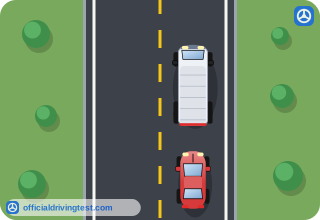
What minimum following distance should you always try to keep behind the vehicle in front?
- 1 second
- 2 seconds
- 4 seconds
- 3 seconds
Show answer
Correct answer: 4 seconds
Following closely limits your view and your time to react, so keep at least 4 seconds between your car and the vehicle ahead.
Source: South Dakota Driver License Manual (Revised 11/2024), page 51
-
How do you determine your following distance?
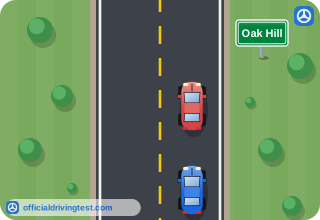
- Count the seconds until you reach the point the car ahead passed
- Count the car lengths between you and the vehicle ahead
- Compare your speed to the posted limit
- Count the lane lines between the two vehicles
Show answer
Correct answer: Count the seconds until you reach the point the car ahead passed
You pick a stationary point such as a sign or pole, watch the vehicle ahead pass it, and count the seconds until you reach it.
Source: South Dakota Driver License Manual (Revised 11/2024), page 51
-
You reach a stationary point before counting “one thousand four” after the vehicle ahead passed it. What does that mean?
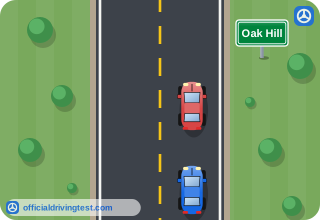
- You are following too closely
- You are following at a safe distance
- You are driving above the speed limit
- You need to speed up to keep pace
Show answer
Correct answer: You are following too closely
Passing the point before counting to one thousand four means you are following too closely, so reduce speed and count again.
Source: South Dakota Driver License Manual (Revised 11/2024), page 51
-
On slippery roads, why must you leave more space in front of you?
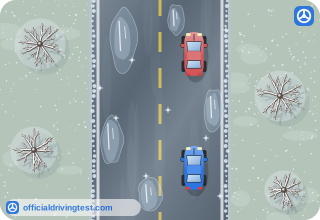
- Tires wear faster on wet pavement
- Other drivers will pass you more often
- You need more distance to stop the vehicle
- Your headlights shine less far ahead
Show answer
Correct answer: You need more distance to stop the vehicle
If the vehicle ahead suddenly stops on a slippery road, you will need the extra distance to stop safely.
Source: South Dakota Driver License Manual (Revised 11/2024), page 51
-
When the driver behind you wants to pass, what should you do?
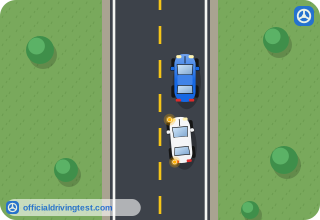
- Speed up to stay ahead of the pass
- Slow down to allow room in front of you
- Move onto the shoulder and stop
- Keep your speed and hold your lane
Show answer
Correct answer: Slow down to allow room in front of you
Slowing gives room in front of your vehicle and lets the pass be completed sooner.
Source: South Dakota Driver License Manual (Revised 11/2024), page 51
-
Why should you increase your following distance when hauling a heavy load or pulling a trailer?
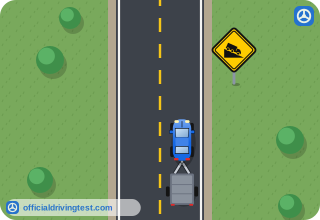
- The trailer reduces your top speed on the highway
- The trailer makes the turn signals harder to see
- The tires wear faster with extra weight
- The extra weight increases the stopping distance
Show answer
Correct answer: The extra weight increases the stopping distance
More weight means a longer distance is needed to stop.
Source: South Dakota Driver License Manual (Revised 11/2024), page 51