South Dakota: Right-of-way and turning — Part 4 Practice Test
Questions in this part include: “At 55 mph, about how long does it take to pass?” · “At 55 mph, about how much distance do you need to pass safely, counting the distance traveled by an oncoming vehicle?”
Independent educational site · not affiliated with any government agency or DMV
Ready? Test yourself
- Instant feedback with an explanation
- Every answer cites its source in the manual
- Your best score is saved on this device
- Keyboard: press 1 to 4 to answer and Enter for the next question
Questions are original and based on the official manual "South Dakota Driver License Manual" (Revised 11/2024), South Dakota Department of Public Safety.
All 17 questions in this practice test
Take the test above first, then use this list to study. Tap “Show answer” to see the correct answer and explanation.
Show the questions and answersHide the questions
-
What does the manual say about turning right on a red light?
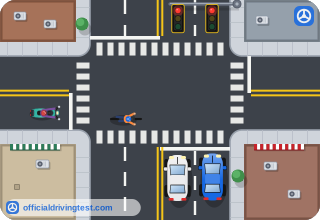
- You may never turn right on a red light
- You may turn right on red only at night
- You may turn right on red only if a sign allows it
- You may turn right on red unless it is prohibited
Show answer
Correct answer: You may turn right on red unless it is prohibited
The manual states that a right turn on red is allowed unless prohibited.
Source: South Dakota Driver License Manual (Revised 11/2024), page 48
-
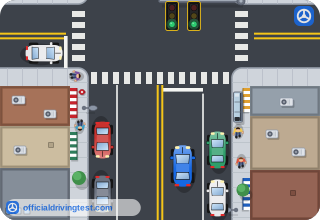
At an intersection, when should you still look left and right?
- Only when your own light is yellow or flashing
- Even if other traffic has a red light or a stop sign
- Only when there are no traffic signals
- Only when you see another car approaching
Show answer
Correct answer: Even if other traffic has a red light or a stop sign
Some drivers do not obey signals or signs, so you cannot rely on them to tell you no one will cross.
Source: South Dakota Driver License Manual (Revised 11/2024), page 48
-
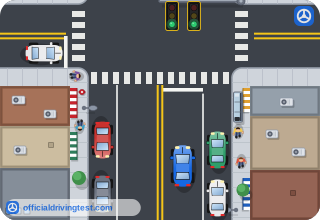
Why is it especially important to look left and right just after your light turns green?
- Pedestrians always have the right-of-way at that point in time
- Your green light may turn red at once
- Cross-street drivers may hurry through before their light turns red
- Drivers behind you will want to pass
Show answer
Correct answer: Cross-street drivers may hurry through before their light turns red
People on the cross street are most likely to rush through the intersection just after the light changes.
Source: South Dakota Driver License Manual (Revised 11/2024), page 48
-
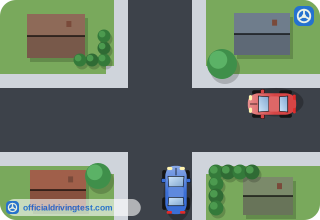
Your view of a cross street is blocked while you are stopped. What should you do?
- Edge forward slowly until you can see
- Accelerate quickly across the intersection
- Sound the horn and drive straight through
- Back up and take a different route
Show answer
Correct answer: Edge forward slowly until you can see
Moving forward slowly lets crossing drivers see the front of your vehicle before you can see them, so they can slow down or warn you.
Source: South Dakota Driver License Manual (Revised 11/2024), page 48
-
As a rule, how should you pass other vehicles?
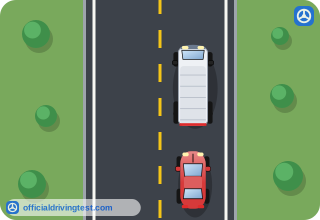
- One vehicle at a time, on the left side
- Several vehicles at once, on the left side
- One vehicle at a time, on the right side
- Several vehicles at once, on the shoulder
Show answer
Correct answer: One vehicle at a time, on the left side
Do not count on having enough time to pass several vehicles at once.
Source: South Dakota Driver License Manual (Revised 11/2024), page 53
-
What should you do while passing?
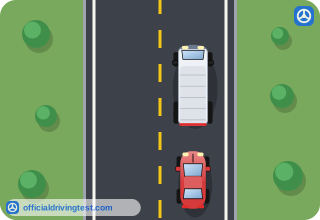
- Stay beside the other vehicle for safety
- Slow down in the passing lane
- Not linger in the passing lane
- Match the speed of the vehicle you are passing
Show answer
Correct answer: Not linger in the passing lane
Get around the vehicles as quickly as possible and move safely back into your lane.
Source: South Dakota Driver License Manual (Revised 11/2024), page 53
-
At 55 mph, about how long does it take to pass?
- About 3 seconds
- About 5 seconds
- About 20 seconds
- About 10 seconds
Show answer
Correct answer: About 10 seconds
At 55 mph you need about a 10 second gap in oncoming traffic and sight distance to pass.
Source: South Dakota Driver License Manual (Revised 11/2024), page 53
-
At 55 mph, about how much distance do you need to pass safely, counting the distance traveled by an oncoming vehicle?
- About 400 feet, or about one-tenth of a mile
- Over 1600 feet, or about one-third of a mile
- About 800 feet, or about one-half of a mile
- About 2000 feet, or about one mile
Show answer
Correct answer: Over 1600 feet, or about one-third of a mile
You travel over 800 feet in 10 seconds and so does an oncoming vehicle, which is over 1600 feet.
Source: South Dakota Driver License Manual (Revised 11/2024), page 53
-
You can see that a vehicle far away is coming closer. What does that mean about passing?
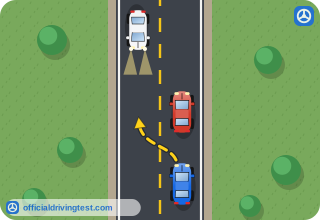
- It is far enough away for you to pass
- It is probably going slowly
- It may be too close for you to pass
- It will stop before it reaches you
Show answer
Correct answer: It may be too close for you to pass
A far-away vehicle seems to be standing still, so if you can see it getting closer, it may already be too close.
Source: South Dakota Driver License Manual (Revised 11/2024), page 53
-
When should you not start to pass near a hill or curve?
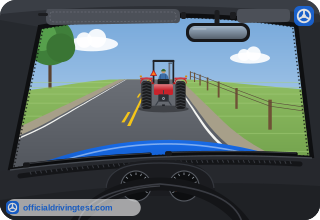
- If you are within one-third of a mile of it
- If you are within 100 feet of the hill or curve
- If you are within 500 feet of it
- If you are within one mile of it
Show answer
Correct answer: If you are within one-third of a mile of it
Treat a hill or curve as an oncoming vehicle just out of sight.
Source: South Dakota Driver License Manual (Revised 11/2024), page 53
-
Where is it dangerous and unlawful to pass?
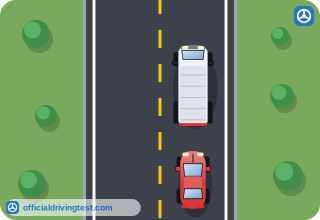
- Where vehicles may enter or cross the road, like intersections
- On any two-lane road with a dashed yellow center line
- On a straight road with a clear view ahead
- On a road with a posted speed limit of 55
Show answer
Correct answer: Where vehicles may enter or cross the road, like intersections
Your view can be blocked by the vehicle you are passing, and drivers turning right will not expect you in their lane.
Source: South Dakota Driver License Manual (Revised 11/2024), page 53
-
Which of these might cause you to lose space for passing?
- A wide, empty shoulder
- A narrow bridge that reduces the lane width
- A straight, dry road with no traffic
- A divided highway with a wide median
Show answer
Correct answer: A narrow bridge that reduces the lane width
A narrow bridge or other reduced lane width can cause other vehicles to move into your lane.
Source: South Dakota Driver License Manual (Revised 11/2024), page 53
-
What must you have before you pass?
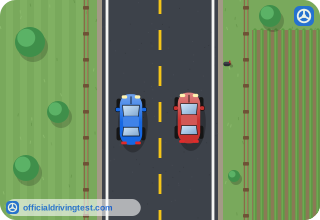
- A driver ahead who will make room for you
- A vehicle behind you that will slow down
- A clear view of only the next block
- Enough space to return to the driving lane
Show answer
Correct answer: Enough space to return to the driving lane
Do not count on other drivers to make room for you.
Source: South Dakota Driver License Manual (Revised 11/2024), page 53
-
How can you tell it is safe to return to the driving lane after passing?
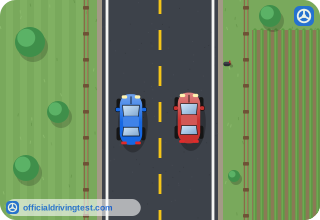
- You have passed the other vehicle’s front bumper
- You can see the other vehicle’s driver in the side mirror
- You can see both headlights of that vehicle in your rearview mirror
- You have counted to three after passing
Show answer
Correct answer: You can see both headlights of that vehicle in your rearview mirror
Seeing both headlights of the passed vehicle in your rearview mirror means you left enough room.
Source: South Dakota Driver License Manual (Revised 11/2024), page 53
-
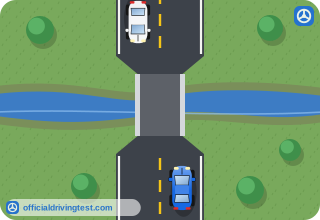
Two vehicles approach a narrow or single-lane bridge. Who generally has the right-of-way?
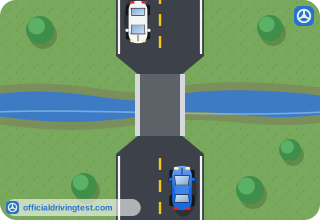
- The driver on the left
- The larger of the two vehicles
- The first driver to reach the bridge
- The faster of the two vehicles
Show answer
Correct answer: The first driver to reach the bridge
Drivers take turns crossing, and generally the first driver to the bridge has the right-of-way.
Source: South Dakota Driver License Manual (Revised 11/2024), page 67
-
What should you look for to identify narrow or single-lane bridges on a rural road?
- Warning signs
- Painted stop lines
- Flashing red lights
- Orange cones
Show answer
Correct answer: Warning signs
Warning signs identify narrow or single-lane bridges ahead.
Source: South Dakota Driver License Manual (Revised 11/2024), page 67
-
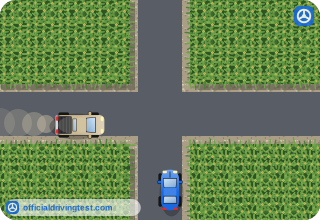
What should you do when approaching an uncontrolled rural intersection that has no yield or stop signs?
- Keep your speed because you have the right-of-way
- Slow down and be prepared to stop for other traffic
- Sound your horn and proceed through the intersection
- Stop only if you actually see another vehicle approaching
Show answer
Correct answer: Slow down and be prepared to stop for other traffic
Uncontrolled rural intersections can be very dangerous, so you slow down and get ready to stop for crossing or oncoming traffic.
Source: South Dakota Driver License Manual (Revised 11/2024), page 67