South Dakota: Right-of-way and turning — Part 2 Practice Test
Questions in this part include: “On what kind of roadway should a three-point turnabout (Y-turn) only be used?” · “A mid-block U-turn in a business district is allowed only where the street is divided and the turn is made at what?”
Independent educational site · not affiliated with any government agency or DMV
Ready? Test yourself
- Instant feedback with an explanation
- Every answer cites its source in the manual
- Your best score is saved on this device
- Keyboard: press 1 to 4 to answer and Enter for the next question
Questions are original and based on the official manual "South Dakota Driver License Manual" (Revised 11/2024), South Dakota Department of Public Safety.
All 18 questions in this practice test
Take the test above first, then use this list to study. Tap “Show answer” to see the correct answer and explanation.
Show the questions and answersHide the questions
-
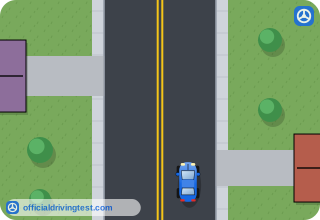
In a forward two-point turnabout, where do you position your vehicle before turning left into the driveway or alley?
- Close to the center of the road
- Against the right curb
- On the right shoulder
- Fully across the oncoming lane
Show answer
Correct answer: Close to the center of the road
You move close to the center of the road and turn into the driveway or alley as near as possible to the right side.
Source: South Dakota Driver License Manual (Revised 11/2024), page 38
-
On what kind of roadway should a three-point turnabout (Y-turn) only be used?
- A multi-lane roadway
- A divided highway
- A two-lane roadway
- An interstate highway
Show answer
Correct answer: A two-lane roadway
The manual says a three-point turnabout should only be used on a two-lane roadway.
Source: South Dakota Driver License Manual (Revised 11/2024), page 38
-
A three-point turnabout (Y-turn) is used only when the road is too narrow for what?
- A left turn
- Backing up
- A lane change
- A U-turn
Show answer
Correct answer: A U-turn
Use a three-point turnabout only when the road is too narrow for a U-turn and you cannot go around the block.
Source: South Dakota Driver License Manual (Revised 11/2024), page 38
-
What do you do at the start of a three-point turnabout, after checking the mirrors?
- Signal left and stop in the center of the road
- Signal right and stop on the right side of the road
- Turn hard left immediately without stopping
- Turn on the hazard lights and stop in the lane
Show answer
Correct answer: Signal right and stop on the right side of the road
The first step is to signal right, pull off to the right side of the road, and stop.
Source: South Dakota Driver License Manual (Revised 11/2024), page 38
-
In a three-point turnabout, how do you check your blind spots before turning hard left to the other side of the road?
- By checking only the inside mirror
- By checking only the side mirrors
- By looking over your left shoulder
- By honking and then proceeding
Show answer
Correct answer: By looking over your left shoulder
You activate the left turn signal, check traffic, and look over your left shoulder to check blind spots.
Source: South Dakota Driver License Manual (Revised 11/2024), page 38
-
At the end of a three-point turnabout, which lane do you drive forward into?
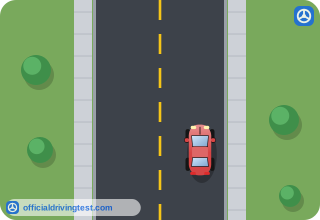
- The right lane of traffic heading in the new direction
- The left lane of traffic heading in the new direction
- The shoulder of the road
- The center of the road
Show answer
Correct answer: The right lane of traffic heading in the new direction
The last step is to turn hard left and drive forward into the right lane of traffic heading in the new direction.
Source: South Dakota Driver License Manual (Revised 11/2024), page 38
-
How is a U-turn made?
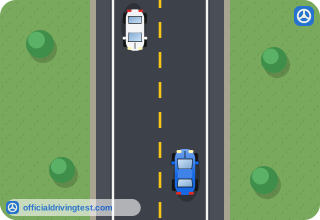
- In one smooth U-shaped motion
- In three backing and turning steps
- By driving around the block
- By backing into a driveway
Show answer
Correct answer: In one smooth U-shaped motion
A U-turn is a turn within the road made in one smooth U-shaped motion to end up traveling the opposite way.
Source: South Dakota Driver License Manual (Revised 11/2024), page 39
-
At an intersection where a police officer is controlling traffic, when may you make a U-turn?
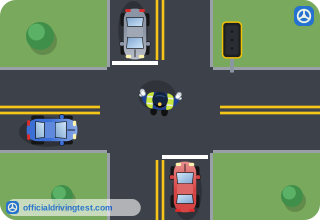
- Whenever the lanes are clear of traffic
- Only if you signal your intention first
- Only if the officer instructs you to
- Never, in any situation
Show answer
Correct answer: Only if the officer instructs you to
A U-turn is not allowed there unless the officer instructs you to make one.
Source: South Dakota Driver License Manual (Revised 11/2024), page 39
-
A mid-block U-turn in a business district is allowed only where the street is divided and the turn is made at what?
- Any gap in the oncoming traffic
- A legal opening or crossover
- A driveway entrance
- A private parking lot
Show answer
Correct answer: A legal opening or crossover
The exception to the mid-block U-turn ban is a divided street where the turn is made at a legal opening or crossover.
Source: South Dakota Driver License Manual (Revised 11/2024), page 39
-
You must not make a U-turn upon a curve or near the crest of a grade on an undivided highway where your vehicle cannot be seen from what distance?
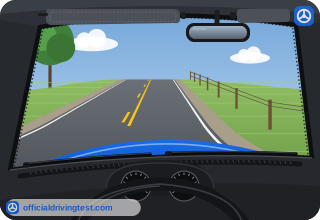
- 100 feet
- 300 feet
- 1,000 feet
- 500 feet
Show answer
Correct answer: 500 feet
The manual prohibits a U-turn there when the vehicle cannot be seen by other drivers within 500 feet.
Source: South Dakota Driver License Manual (Revised 11/2024), page 39
-
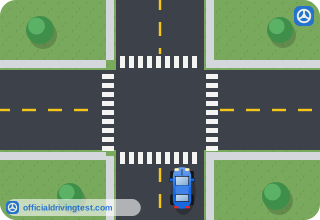
What should you do as you approach any intersection?
- Maintain your speed if you have the right-of-way
- Speed up to clear it quickly
- Reduce speed and search for hazards
- Search only for oncoming traffic
Show answer
Correct answer: Reduce speed and search for hazards
At all intersections you reduce speed and search for traffic control devices, cross and oncoming traffic, pedestrians, bicyclists, road conditions, and limited visibility.
Source: South Dakota Driver License Manual (Revised 11/2024), page 39
-
Why should you not rely on other road users to obey traffic signals and signs?
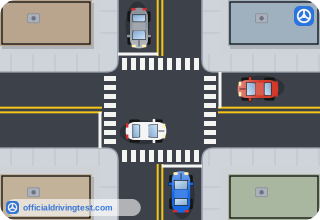
- Some may not yield the right-of-way
- Most drivers ignore traffic signals
- Signals are only advice, not law
- Signs apply only to commercial vehicles
Show answer
Correct answer: Some may not yield the right-of-way
Some road users may not yield the right-of-way, so you must be prepared to avoid a crash.
Source: South Dakota Driver License Manual (Revised 11/2024), page 39
-
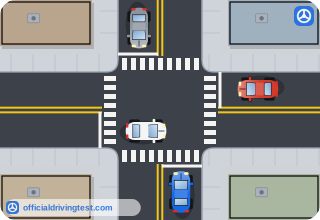
In what order does the manual recommend that you look before entering an intersection after stopping?
- Right, then left, then right again
- Left, then left again, then right
- Straight ahead only, then left
- Left, then right, then left again
Show answer
Correct answer: Left, then right, then left again
The manual recommends looking left, then right, and then left again before entering the intersection.
Source: South Dakota Driver License Manual (Revised 11/2024), page 39
-
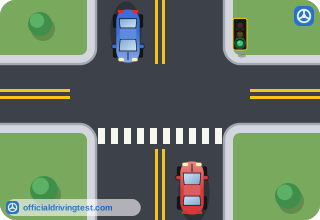
When a traffic signal turns green, what should you avoid doing?
- Checking for crossing traffic
- Immediately moving into the intersection
- Looking left, right, and left again
- Making sure your path of travel is clear
Show answer
Correct answer: Immediately moving into the intersection
You should take the time to make sure the path is clear and there is no crossing traffic before moving into the intersection.
Source: South Dakota Driver License Manual (Revised 11/2024), page 39
-
Why should you not turn into a lane just because an approaching vehicle has a turn signal active?
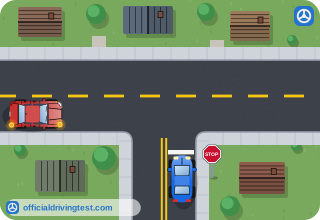
- A turn signal means the vehicle will stop for you
- Its driver may turn later or may have left the signal on
- Turn signals only apply to vehicles in the same lane
- Turn signals are used only at traffic signals
Show answer
Correct answer: Its driver may turn later or may have left the signal on
The driver may plan to turn after passing you or may have forgotten to turn off the signal from an earlier turn.
Source: South Dakota Driver License Manual (Revised 11/2024), page 39
-
In which direction does traffic move in a roundabout?
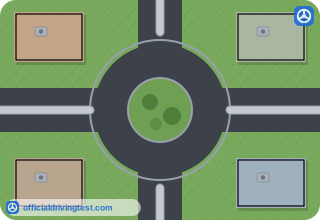
- Clockwise
- In both directions
- Whichever way is shorter
- Counterclockwise
Show answer
Correct answer: Counterclockwise
Roundabouts keep traffic moving one-way in a counterclockwise direction.
Source: South Dakota Driver License Manual (Revised 11/2024), page 39
-
Which vehicle may use the truck apron of a roundabout?
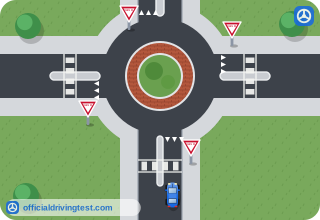
- A large truck
- A car
- An SUV
- A pickup truck
Show answer
Correct answer: A large truck
A truck apron is for the rear wheels of large trucks; cars, SUVs, and pickup trucks must not use it.
Source: South Dakota Driver License Manual (Revised 11/2024), page 39
-
When driving in a roundabout, you yield to traffic from which direction that is already in the roundabout?
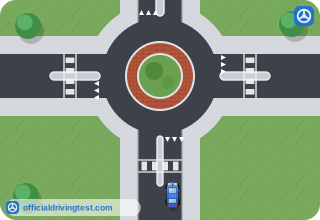
- Your right
- Straight ahead only
- Behind you
- Your left
Show answer
Correct answer: Your left
The steps for driving a roundabout say to yield to traffic on your left already in the roundabout.
Source: South Dakota Driver License Manual (Revised 11/2024), page 40