South Dakota: Railroad crossings Practice Test
Railroad crossing signs and signals, where to stop, and never trying to beat a train.
Independent educational site · not affiliated with any government agency or DMV
Ready? Test yourself
- Instant feedback with an explanation
- Every answer cites its source in the manual
- Your best score is saved on this device
- Keyboard: press 1 to 4 to answer and Enter for the next question
Questions are original and based on the official manual "South Dakota Driver License Manual" (Revised 11/2024), South Dakota Department of Public Safety.
All 14 questions in this practice test
Take the test above first, then use this list to study. Tap “Show answer” to see the correct answer and explanation.
Show the questions and answersHide the questions
-
What does the manual say about waiting for a train to cross in front of you?
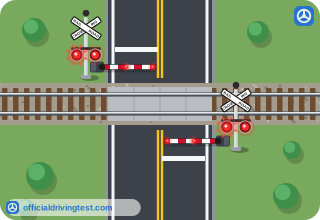
- Driving around lowered gates or trying to beat the train can be fatal
- You may drive around lowered gates if no train is in sight
- Try to beat the train when you are in a hurry
- Wait only when the train is close
Show answer
Correct answer: Driving around lowered gates or trying to beat the train can be fatal
Impatience at a crossing is dangerous: driving around lowered gates or racing a train can be fatal.
Source: South Dakota Driver License Manual (Revised 11/2024), page 22
-
A round yellow sign with an X symbol and the black letters RR is placed before a railroad crossing. What does it caution you to do?
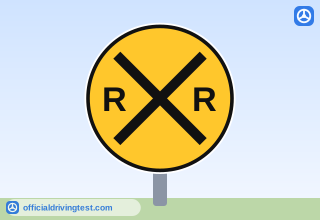
- Stop at once, whether or not a train is approaching
- Slow down, look and listen, and be ready to stop
- Speed up to cross before a train arrives
- Stop only if the lights are flashing
Show answer
Correct answer: Slow down, look and listen, and be ready to stop
The round yellow RR sign tells you to slow down, look, listen, and be ready to stop if a train is coming.
Source: South Dakota Driver License Manual (Revised 11/2024), page 33
-
A white, X-shaped sign with "Railroad Crossing" printed on it is also called what?
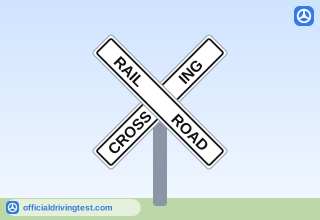
- A stop-track sign
- A rail-yield sign
- A train-gate sign
- A cross-buck sign
Show answer
Correct answer: A cross-buck sign
The white X-shaped railroad crossing sign at the crossing is also called a cross-buck sign.
Source: South Dakota Driver License Manual (Revised 11/2024), page 33
-
Why should you check for more than one track at every highway-railroad crossing?
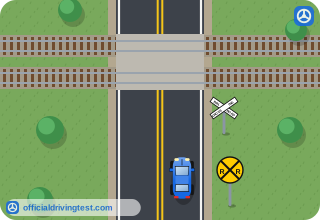
- Signs that show the number of tracks are never used
- Only the first track at a crossing ever has trains on it
- Trains on a second track always sound a horn first
- Not every crossing with several tracks has a sign saying so
Show answer
Correct answer: Not every crossing with several tracks has a sign saying so
Not all crossings with more than one track have signs, so you must look for more than one track or train yourself.
Source: South Dakota Driver License Manual (Revised 11/2024), page 34
-
Which statement about lights at railroad crossings is true?
- Every crossing has flashing lights
- Not all crossings have lights
- Only crossings with one track have lights
- Lights replace the cross-buck sign at every crossing
Show answer
Correct answer: Not all crossings have lights
Some crossings have no lights, so you cannot count on lights to warn you of a train.
Source: South Dakota Driver License Manual (Revised 11/2024), page 34
-
Side-by-side lights flash alternately at a railroad crossing. What must you do?
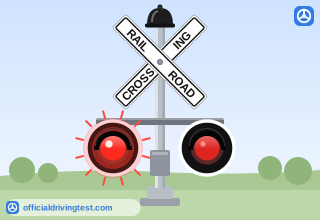
- Slow down and cross when clear
- Stop only if you see a train
- Stop
- Stop only if a gate is lowered
Show answer
Correct answer: Stop
When the lights at a crossing are flashing you must stop.
Source: South Dakota Driver License Manual (Revised 11/2024), page 34
-
What does the manual say about a crossing gate that lowers when a train is coming?
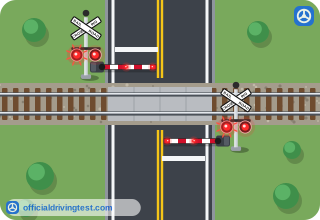
- Do not drive around the gate
- Drive around it if no train is visible
- Drive around it if the lights have stopped flashing
- Drive around it if a flagger waves you on
Show answer
Correct answer: Do not drive around the gate
A lowered crossing gate means a train is coming, and you must never drive around it.
Source: South Dakota Driver License Manual (Revised 11/2024), page 34
-
A bell or horn is sounding at a railroad crossing. When may you cross?
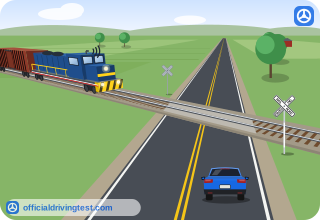
- After you have looked both ways first
- As soon as you have slowed to a crawl
- Not until the bell or horn has stopped
- Once the first train has passed you
Show answer
Correct answer: Not until the bell or horn has stopped
You must not cross while the bell or horn is sounding.
Source: South Dakota Driver License Manual (Revised 11/2024), page 34
-
Where is the Railroad Emergency Notification System (ENS) number typically located?
- On a blue sign at or near the crossing
- On a green sign at the next intersection
- On a white sign beside the traffic signal
- On a yellow sign far before the crossing
Show answer
Correct answer: On a blue sign at or near the crossing
The ENS number is typically on a blue sign on the railroad crossing sign or near the crossing.
Source: South Dakota Driver License Manual (Revised 11/2024), page 34
-
What is the Railroad Emergency Notification System (ENS) number used for?
- Getting train schedules for that crossing and line
- Paying a fine for a railroad crossing violation
- Asking the railroad to build a new crossing nearby
- Reporting problems with the crossing, tracks, or train
Show answer
Correct answer: Reporting problems with the crossing, tracks, or train
Every crossing has an emergency phone number so you can report problems with the crossing, tracks, or a train.
Source: South Dakota Driver License Manual (Revised 11/2024), page 34
-
What does the DOT number on the ENS sign identify?
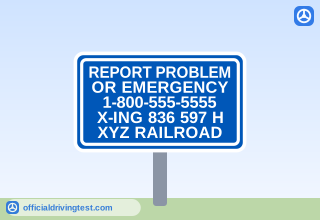
- The railroad company that owns the track
- The crossing's physical location
- The number of trains per day
- The year the crossing was built
Show answer
Correct answer: The crossing's physical location
The DOT number tells emergency crews and railroad staff exactly where the crossing is.
Source: South Dakota Driver License Manual (Revised 11/2024), page 34
-
What can railroad dispatchers do when a driver gives them the crossing's DOT number?
- Notify trains to stop or slow down
- Close the road at the next intersection
- Send a tow truck to the driver at once
- Lower the gates at every crossing nearby
Show answer
Correct answer: Notify trains to stop or slow down
With the DOT number, dispatchers know exactly where the crossing is and can have trains stop or slow.
Source: South Dakota Driver License Manual (Revised 11/2024), page 34
-
Why might you need to slow down at a railroad crossing?
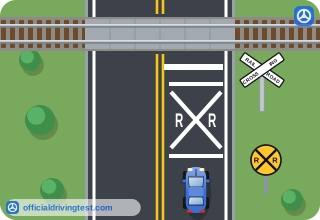
- Some crossings are bumpy
- The tracks are always icy
- The road always narrows there
- Trains stop and wait there
Show answer
Correct answer: Some crossings are bumpy
Some crossings are bumpy, so you should slow down to cross safely.
Source: South Dakota Driver License Manual (Revised 11/2024), page 46
-
Which vehicles need extra room ahead of you when approaching railroad crossings?
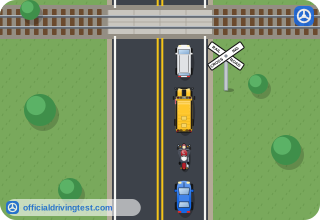
- Transit buses, school buses, and vehicles with hazardous materials
- Delivery vans carrying only light packages and small parcels
- Motorcycles and bicycles
- Passenger cars pulling small trailers
Show answer
Correct answer: Transit buses, school buses, and vehicles with hazardous materials
These vehicles are required to stop at railroad crossings, so leave extra room for them.
Source: South Dakota Driver License Manual (Revised 11/2024), page 51