South Dakota: Right-of-way and turning — Part 3 Practice Test
Questions in this part include: “Before turning right, what traffic must you make sure is not in your way?”
Independent educational site · not affiliated with any government agency or DMV
Ready? Test yourself
- Instant feedback with an explanation
- Every answer cites its source in the manual
- Your best score is saved on this device
- Keyboard: press 1 to 4 to answer and Enter for the next question
Questions are original and based on the official manual "South Dakota Driver License Manual" (Revised 11/2024), South Dakota Department of Public Safety.
All 17 questions in this practice test
Take the test above first, then use this list to study. Tap “Show answer” to see the correct answer and explanation.
Show the questions and answersHide the questions
-
What speed should you keep within a roundabout?
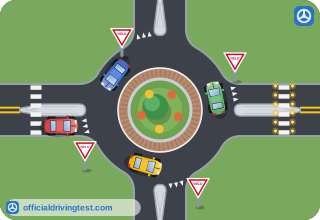
- A speed higher than on the approach
- Full highway speed
- A low speed
- Any speed, since you have the right-of-way
Show answer
Correct answer: A low speed
The steps for driving a roundabout say to keep your speed low within it.
Source: South Dakota Driver License Manual (Revised 11/2024), page 40
-
When should you turn on your right turn signal in a roundabout?
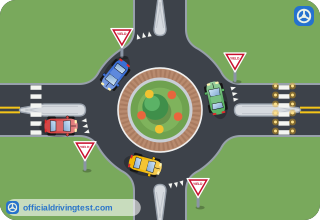
- As you approach the exit
- As you enter the roundabout
- After you have left the roundabout
- Only if another vehicle is waiting
Show answer
Correct answer: As you approach the exit
You signal right as you approach your exit.
Source: South Dakota Driver License Manual (Revised 11/2024), page 40
-
When may you enter a roundabout?
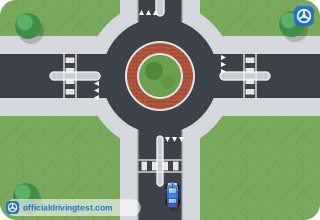
- When there is a safe gap in traffic
- As soon as you arrive at the entrance
- Right after the vehicle ahead of you enters
- Whenever you have signaled
Show answer
Correct answer: When there is a safe gap in traffic
You enter the roundabout when there is a safe gap in traffic.
Source: South Dakota Driver License Manual (Revised 11/2024), page 40
-
In a roundabout with two or more lanes, how do you know which lane to use?
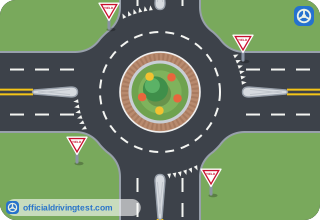
- Red signs and yellow arrows on the road
- Green signs and yellow arrows painted on the road
- Following the vehicle in front of you
- Black and white signs and white arrows on the road
Show answer
Correct answer: Black and white signs and white arrows on the road
Black and white signs on the side of the road and white arrows on the road show the correct lane.
Source: South Dakota Driver License Manual (Revised 11/2024), page 40
-
In a multi-lane roundabout, if you want to make a left turn, which lane should you generally be in?
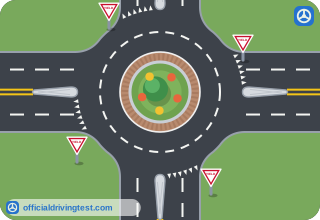
- The right lane
- Any lane you choose
- The left lane
- The lane with the least traffic
Show answer
Correct answer: The left lane
In general a left turn is made from the left lane or another lane signed and marked for left turns.
Source: South Dakota Driver License Manual (Revised 11/2024), page 40
-
When changing lanes, what do you do after you identify a gap in traffic and signal?
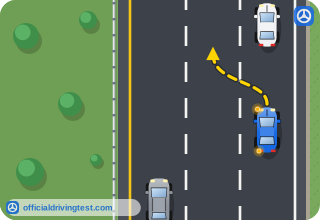
- Look again in the direction of the lane change
- Change lanes immediately after signaling
- Sound your horn to warn drivers
- Brake lightly before moving over
Show answer
Correct answer: Look again in the direction of the lane change
The steps are to check mirrors and blind spots, find a gap, signal, then look again in the direction of the lane change before steering in.
Source: South Dakota Driver License Manual (Revised 11/2024), page 45
-
What are blind spots?
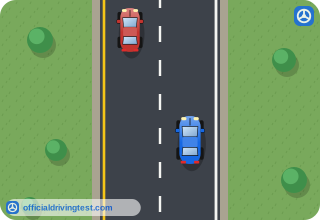
- Areas where road signs are hidden from view
- Areas of the road covered by ice or snow
- Areas around the vehicle where your view is obstructed
- Areas ahead of the vehicle hidden by hills or curves
Show answer
Correct answer: Areas around the vehicle where your view is obstructed
Blind spots are areas around the vehicle where you cannot see other vehicles or pedestrians in your mirrors.
Source: South Dakota Driver License Manual (Revised 11/2024), page 45
-
Which determines where a vehicle’s blind spots are?
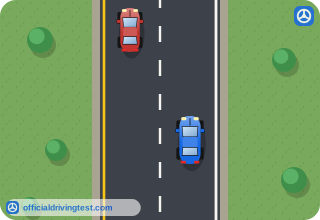
- The number of passengers riding in the vehicle
- The speed at which the vehicle is traveling
- The type of road surface and the weather
- Vehicle design and the position of the roof pillars
Show answer
Correct answer: Vehicle design and the position of the roof pillars
The design of the vehicle and the position of the pillars that support the roof determine the blind spot locations.
Source: South Dakota Driver License Manual (Revised 11/2024), page 45
-
Before making lane changes or turns, what should you do to look for hidden pedestrians or vehicles?
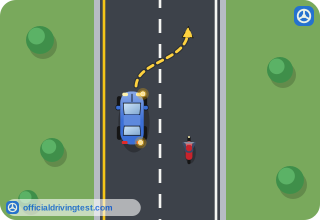
- Check only your rearview mirror
- Quickly turn your head to look
- Flash your headlights
- Slow to a stop
Show answer
Correct answer: Quickly turn your head to look
Mirrors do not show blind spots, so you quickly turn your head to look for hidden pedestrians or vehicles.
Source: South Dakota Driver License Manual (Revised 11/2024), page 45
-
Before entering an intersection, what should you do?
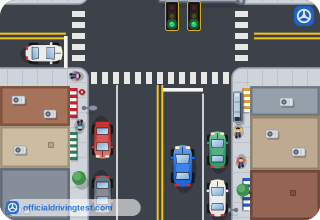
- Look only to the left for approaching vehicles
- Look straight ahead and rely on the traffic signal
- Look only at the vehicle directly in front of you
- Look to both the left and right for vehicles and pedestrians
Show answer
Correct answer: Look to both the left and right for vehicles and pedestrians
You must check both directions for approaching vehicles and crossing pedestrians before you enter.
Source: South Dakota Driver License Manual (Revised 11/2024), page 48
-
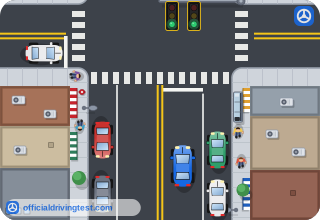
How does the manual describe an intersection?
- Only a place where two public streets meet
- Only a place controlled by a traffic signal
- Any place where traffic merges or crosses
- Only a place with a marked crosswalk
Show answer
Correct answer: Any place where traffic merges or crosses
Intersections include side streets, driveways, shopping center entrances and parking lot entrances, not just street corners.
Source: South Dakota Driver License Manual (Revised 11/2024), page 48
-
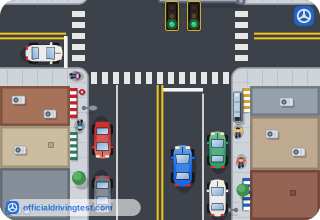
When you are stopped at an intersection, when should you look to both the left and right?
- Just before you start moving
- Only after you are already moving
- Only if the traffic light is still red
- Only when you see another vehicle nearby
Show answer
Correct answer: Just before you start moving
The manual says that if you are stopped, you look both ways just before you begin to move.
Source: South Dakota Driver License Manual (Revised 11/2024), page 48
-
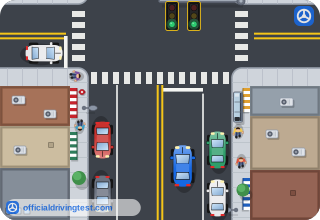
Before you start to move through an intersection, what should you make sure of?
- The vehicle behind you is far enough back to pass
- The cross street has a stop sign for its drivers
- Your headlights are on so you can be seen clearly
- The path is clear so you will not block the intersection
Show answer
Correct answer: The path is clear so you will not block the intersection
You look across the intersection first so that you do not end up stopped in it and blocking it.
Source: South Dakota Driver License Manual (Revised 11/2024), page 48
-
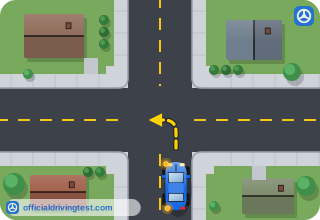
Before turning left across oncoming traffic, what should you look for first?
- A vehicle that will let you go first
- A safe gap in the traffic
- A green arrow on the cross street
- A parked car you can wait behind
Show answer
Correct answer: A safe gap in the traffic
You must find a safe gap in oncoming traffic before you turn left.
Source: South Dakota Driver License Manual (Revised 11/2024), page 48
-
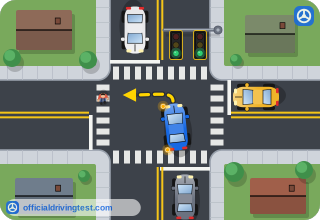
Before turning left, why should you look at the street you are turning onto?
- To check whether the street allows parking there
- To avoid being stranded in the path of oncoming traffic
- To read the street name before you arrive
- To see whether you must signal at all
Show answer
Correct answer: To avoid being stranded in the path of oncoming traffic
If vehicles or pedestrians are in your path on that street, you could be left stuck in front of oncoming traffic.
Source: South Dakota Driver License Manual (Revised 11/2024), page 48
-
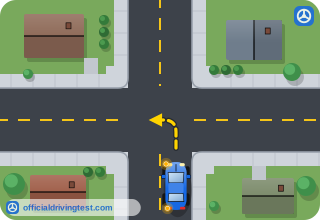
Just before you turn left across oncoming traffic, what should you do?
- Look in the mirror at the vehicle waiting behind you
- Look only at the road you are leaving
- Look at the pedestrian signal alone
- Look one more time in the direction of oncoming traffic
Show answer
Correct answer: Look one more time in the direction of oncoming traffic
A final look at oncoming traffic makes sure nothing has changed before you commit to the turn.
Source: South Dakota Driver License Manual (Revised 11/2024), page 48
-
Before turning right, what traffic must you make sure is not in your way?
- Traffic approaching from the left and oncoming traffic turning left
- Only traffic approaching from behind you and from the right
- Only oncoming traffic that is going straight
- Only vehicles stopped on the cross street
Show answer
Correct answer: Traffic approaching from the left and oncoming traffic turning left
The manual says to check for traffic approaching from the left and for oncoming traffic turning left into your path.
Source: South Dakota Driver License Manual (Revised 11/2024), page 48