South Dakota: Emergency vehicles, police stops and work zones — Part 3 Practice Test
Questions in this part include: “Which of these does the manual list among emergency vehicles?” · “What may happen if you are caught speeding in a work zone?”
Independent educational site · not affiliated with any government agency or DMV
Ready? Test yourself
- Instant feedback with an explanation
- Every answer cites its source in the manual
- Your best score is saved on this device
- Keyboard: press 1 to 4 to answer and Enter for the next question
Questions are original and based on the official manual "South Dakota Driver License Manual" (Revised 11/2024), South Dakota Department of Public Safety.
All 16 questions in this practice test
Take the test above first, then use this list to study. Tap “Show answer” to see the correct answer and explanation.
Show the questions and answersHide the questions
-
On a two-lane highway where the speed limit is posted at 20 mph or less, to what speed must you slow near a stopped vehicle with amber, yellow, or blue lights?
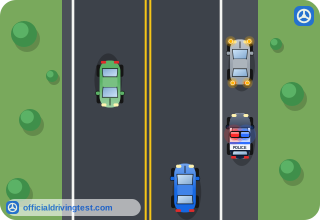
- 5 mph
- 10 mph
- 15 mph
- A complete stop
Show answer
Correct answer: 5 mph
When the limit is posted at twenty miles per hour or less, the required speed is five miles per hour.
Source: South Dakota Driver License Manual (Revised 11/2024), page 2
-
Which of these does the manual list among emergency vehicles?
- School buses
- Mail delivery trucks
- Ambulances
- Taxis
Show answer
Correct answer: Ambulances
The manual says emergency vehicles include law enforcement vehicles, ambulances, and fire department vehicles.
Source: South Dakota Driver License Manual (Revised 11/2024), page 2
-
A violation of South Dakota’s law on stopped emergency vehicles and vehicles with warning lights is what kind of offense?
- A class 3 misdemeanor
- A class 2 misdemeanor
- A class 6 felony
- A petty offense
Show answer
Correct answer: A class 2 misdemeanor
The manual says a violation is a class 2 misdemeanor, punishable by a fine and/or time in county jail.
Source: South Dakota Driver License Manual (Revised 11/2024), page 2
-
What is the offense for violating the move-over law and causing an accident with a stopped emergency vehicle using its red visual signals?
- A Class 1 felony
- A Class 3 misdemeanor
- A petty offense
- A Class 1 misdemeanor
Show answer
Correct answer: A Class 1 misdemeanor
A person who violates the law and causes an accident with such a vehicle is guilty of a Class 1 misdemeanor.
Source: South Dakota Driver License Manual (Revised 11/2024), page 2
-
What is a work zone?
- An area where roadwork takes place, which may involve lane closures
- Any road where the posted speed limit sign has an orange background on it
- An area where only workers on foot are allowed and all vehicles are banned
- A lane that is reserved for emergency vehicles and snowplows on a freeway
Show answer
Correct answer: An area where roadwork takes place, which may involve lane closures
A work zone is where roadwork is being done, and it can include lane closures, detours, and moving equipment.
Source: South Dakota Driver License Manual (Revised 11/2024), page 66
-
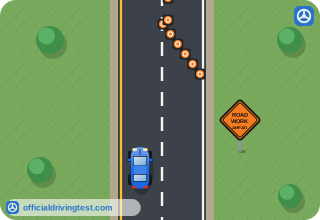
When should you reduce your speed in a work zone?
- Only when workers are visible
- Always, even if no workers are present
- Only when one of the lanes is closed
- Only when you are driving at night
Show answer
Correct answer: Always, even if no workers are present
Narrower lanes and rough pavement can make a work zone hazardous even with no workers there.
Source: South Dakota Driver License Manual (Revised 11/2024), page 66
-
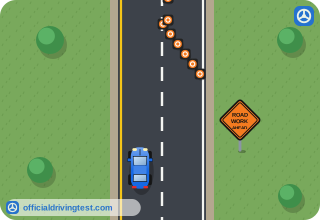
Why should you reduce your speed in a work zone even if there are no workers present?
- Workers may be hidden inside the large construction equipment
- Speed limits in work zones are always set at 25 mph by state law
- Police are always waiting for speeders just ahead of the work zone
- Narrower lanes and rough pavement can create a hazardous condition
Show answer
Correct answer: Narrower lanes and rough pavement can create a hazardous condition
Even without workers, narrow lanes and rough pavement make a work zone hazardous.
Source: South Dakota Driver License Manual (Revised 11/2024), page 66
-
What may happen if you are caught speeding in a work zone?
- Your license is always suspended
- You must retake the driving test
- The fine may be doubled
- The fine is the same as elsewhere
Show answer
Correct answer: The fine may be doubled
The manual says fines for speeding in a work zone may be doubled.
Source: South Dakota Driver License Manual (Revised 11/2024), page 66
-
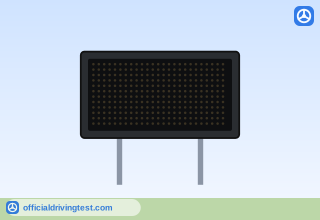
What may digital signs and messages in a work zone warn you about?
- Changing conditions ahead, such as slowed traffic
- Which lane the workers will use next week or next month
- Where the nearest gas station or rest area can be found
- The fine for every possible traffic violation in the work zone
Show answer
Correct answer: Changing conditions ahead, such as slowed traffic
Digital signs can warn of changing conditions or what to look out for, such as slow or stopped traffic ahead.
Source: South Dakota Driver License Manual (Revised 11/2024), page 66
-
When should you use extreme caution while driving through a work zone at night?
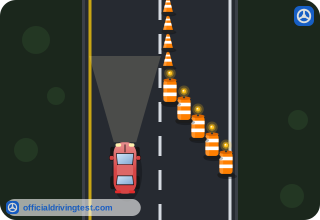
- Only if workers are present
- Only if the lanes are closed
- Only if the speed limit is reduced
- Whether or not workers are present
Show answer
Correct answer: Whether or not workers are present
Extreme caution is needed at night in a work zone regardless of whether any workers are there.
Source: South Dakota Driver License Manual (Revised 11/2024), page 66
-
How should you adjust your lane position in a work zone?
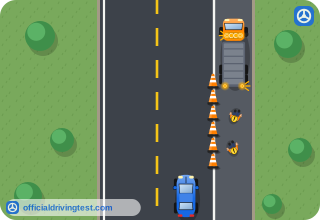
- To stay as close to the cones as you can
- To allow space for workers and construction vehicles
- To stay in the center of the roadway
- To keep moving toward the shoulder at all times
Show answer
Correct answer: To allow space for workers and construction vehicles
You should position your vehicle so there is room for workers and construction vehicles.
Source: South Dakota Driver License Manual (Revised 11/2024), page 66
-
How long should you observe the posted work zone signs?
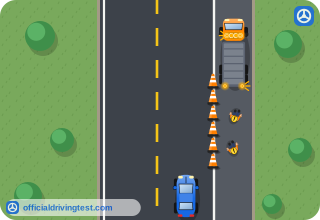
- Until you pass the last cone
- Until you see a green traffic light
- Until the lane widens
- Until you see "End Road Work"
Show answer
Correct answer: Until you see "End Road Work"
Work zone signs apply until you reach the "End Road Work" sign.
Source: South Dakota Driver License Manual (Revised 11/2024), page 66
-
What should you do about delays in a work zone?
- Pass slow traffic using the shoulder
- Expect them, plan for them, and leave early
- Drive faster before you reach the work zone
- Follow the vehicle ahead more closely
Show answer
Correct answer: Expect them, plan for them, and leave early
You should expect delays, plan for them, and leave early so you arrive on time.
Source: South Dakota Driver License Manual (Revised 11/2024), page 66
-
When you can, what should you do about work zones?
- Use alternate routes and avoid them
- Drive through them at night
- Drive through them at the posted speed limit only
- Follow a large vehicle through them
Show answer
Correct answer: Use alternate routes and avoid them
When possible, the manual says to use alternate routes and avoid work zones.
Source: South Dakota Driver License Manual (Revised 11/2024), page 66
-
As a driver in a work zone, what should you do with your speed and following distance?
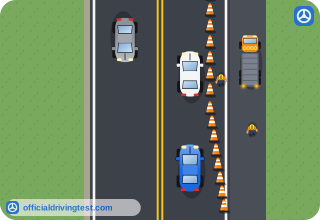
- Keep your speed and increase the following distance
- Reduce your speed and shorten the following distance
- Reduce your speed and increase the following distance
- Match the speed of the fastest vehicle
Show answer
Correct answer: Reduce your speed and increase the following distance
In a work zone you slow down and leave more space between you and the vehicle ahead.
Source: South Dakota Driver License Manual (Revised 11/2024), page 66
-
As a driver in a work zone, what should you watch for and be prepared to do?
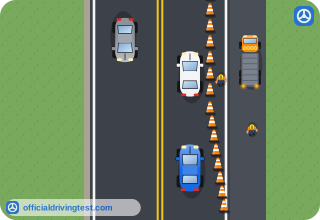
- Watch the traffic around you and be prepared to stop
- Watch only the workers and be prepared to swerve
- Watch only the signs and be prepared to speed up
- Watch only the cones and be prepared to change lanes
Show answer
Correct answer: Watch the traffic around you and be prepared to stop
You need to watch all traffic around you and be ready to stop.
Source: South Dakota Driver License Manual (Revised 11/2024), page 66