South Dakota: Emergency vehicles, police stops and work zones — Part 1 Practice Test
Questions in this part include: “What are drums, cones, tubes, and barricades used for in work zones?” · “During an enforcement stop, when should you leave your vehicle?”
Independent educational site · not affiliated with any government agency or DMV
Ready? Test yourself
- Instant feedback with an explanation
- Every answer cites its source in the manual
- Your best score is saved on this device
- Keyboard: press 1 to 4 to answer and Enter for the next question
Questions are original and based on the official manual "South Dakota Driver License Manual" (Revised 11/2024), South Dakota Department of Public Safety.
All 17 questions in this practice test
Take the test above first, then use this list to study. Tap “Show answer” to see the correct answer and explanation.
Show the questions and answersHide the questions
-
In a work zone, a person with a sign or flag controls traffic. What must you do?
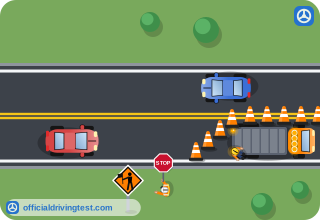
- Follow posted signs instead
- Follow their instructions
- Ignore them if the road looks clear
- Follow them only when workers are visible
Show answer
Correct answer: Follow their instructions
A person directing traffic with a sign or flag tells you whether to go, slow, or stop, and you must follow them.
Source: South Dakota Driver License Manual (Revised 11/2024), page 34
-
What are drums, cones, tubes, and barricades used for in work zones?
- To mark where parking is allowed along the road
- To show where passing is permitted ahead
- To tell drivers the speed limit ahead
- To keep traffic out of hazardous work zones
Show answer
Correct answer: To keep traffic out of hazardous work zones
These barriers keep traffic out of hazardous work zones and, with signs and markings, guide you through.
Source: South Dakota Driver License Manual (Revised 11/2024), page 34
-
You see a work zone warning sign with a traffic signal symbol. Where do you stop for the temporary signal?
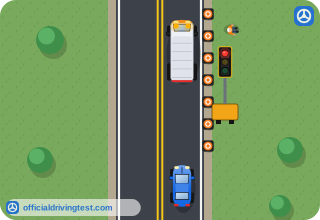
- In the middle of the intersection
- Beyond the signal, in the crosswalk
- At the cone nearest the signal
- At the white line, if present
Show answer
Correct answer: At the white line, if present
Temporary traffic signals may be used in work zones, and you stop at the white line if there is one.
Source: South Dakota Driver License Manual (Revised 11/2024), page 34
-
What may happen to fines for speeding in a work zone?
- They may be waived when no workers are present
- They may be doubled
- They are the same as elsewhere
- They apply only at night
Show answer
Correct answer: They may be doubled
The manual says fines for speeding in a work zone may be doubled.
Source: South Dakota Driver License Manual (Revised 11/2024), page 34
-
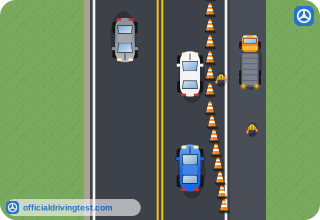
How should you drive through a work zone?
- Follow closely to keep traffic moving
- Keep your speed and watch for workers
- Reduce your speed and be ready to stop suddenly
- Use the left lane to pass construction traffic
Show answer
Correct answer: Reduce your speed and be ready to stop suddenly
You should slow down in work zones, be prepared to stop suddenly, and never tailgate.
Source: South Dakota Driver License Manual (Revised 11/2024), page 34
-
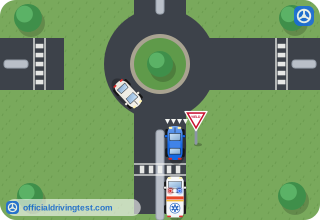
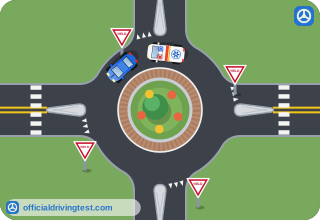
An emergency vehicle approaches and you have not yet entered the roundabout. What should you do?
- Enter and continue to your exit
- Stop in the circle
- Pull over and allow it to pass
- Speed up to enter ahead of it
Show answer
Correct answer: Pull over and allow it to pass
If you have not entered the roundabout, you pull over and let emergency vehicles pass.
Source: South Dakota Driver License Manual (Revised 11/2024), page 40
-
An emergency vehicle approaches and you have already entered the roundabout. What should you do?
- Stop where you are inside the roundabout
- Continue to your exit, then pull over
- Pull over immediately inside the circle
- Circle until the vehicle has passed
Show answer
Correct answer: Continue to your exit, then pull over
Once inside, you continue to your exit and then pull over; stopping in the roundabout is to be avoided.
Source: South Dakota Driver License Manual (Revised 11/2024), page 40
-
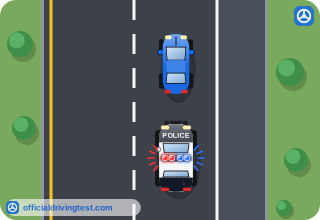
During an enforcement stop, how should you acknowledge the officer’s presence?
- Flash your headlights
- Turn on your hazard lights
- Turn on your right turn signal
- Sound your horn
Show answer
Correct answer: Turn on your right turn signal
Turning on your right turn signal lets the officer know you recognize their presence.
Source: South Dakota Driver License Manual (Revised 11/2024), page 46
-
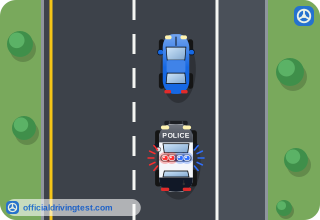
During an enforcement stop, where should you move your vehicle?
- Onto the center median
- To the opposite side of a two-lane roadway
- Into the nearest left turn lane
- To the right shoulder of the road
Show answer
Correct answer: To the right shoulder of the road
You move to the right shoulder; stopping in the median or on the opposite side of a two-lane road endangers you and the officer.
Source: South Dakota Driver License Manual (Revised 11/2024), page 46
-
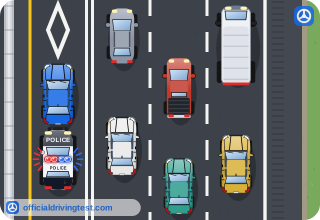
On a freeway during an enforcement stop, where should you stop if you are in the carpool/HOV lane?
- On the left shoulder next to the HOV lane
- Completely on the right shoulder
- In the HOV lane with your hazard lights on
- In the lane closest to the right shoulder
Show answer
Correct answer: Completely on the right shoulder
On a freeway you move completely onto the right shoulder, even from the carpool/HOV lane.
Source: South Dakota Driver License Manual (Revised 11/2024), page 46
-
When it is dark during an enforcement stop, what kind of location should you look for?
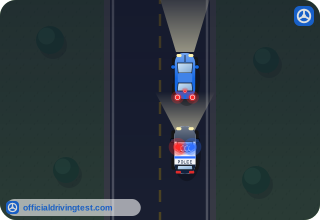
- The darkest part of the shoulder
- A place far from any buildings
- A well-lit location
- Any spot in the center median
Show answer
Correct answer: A well-lit location
When it is dark you look for well-lit places, such as areas with street or freeway lights, near restaurants, or service stations.
Source: South Dakota Driver License Manual (Revised 11/2024), page 46
-
During an enforcement stop, what should you do with your cell phone conversation and your radio?
- End the call and turn off the radio
- Keep the call going on speaker
- Turn the radio down only
- Pause the call and leave the radio on low
Show answer
Correct answer: End the call and turn off the radio
The officer needs your full attention, so you end the call and turn off the radio.
Source: South Dakota Driver License Manual (Revised 11/2024), page 47
-
During an enforcement stop, when should you leave your vehicle?
- Only if the officer directs you to
- As soon as you stop on the shoulder
- Whenever you need to show your documents
- When the officer approaches your window
Show answer
Correct answer: Only if the officer directs you to
Remain inside your vehicle unless the officer directs you otherwise.
Source: South Dakota Driver License Manual (Revised 11/2024), page 47
-
During an enforcement stop, what should you do with your hands and your passengers’ hands?
- Keep them hidden in your pockets
- Keep them out of sight below the dashboard
- Keep them in clear view
- Reach toward the glove compartment for documents
Show answer
Correct answer: Keep them in clear view
You place your hands, and all passengers’ hands, in clear view, such as on the steering wheel or on top of your lap.
Source: South Dakota Driver License Manual (Revised 11/2024), page 47
-
If your windows are tinted, what does the manual recommend during an enforcement stop?
- Leave them up and open the door when the officer arrives
- Roll them down after stopping and before the officer makes contact
- Roll them down only after the officer taps on the glass
- Turn on the interior light and keep the windows up
Show answer
Correct answer: Roll them down after stopping and before the officer makes contact
It is recommended to roll down tinted windows after stopping on the right shoulder and before the officer makes contact with you.
Source: South Dakota Driver License Manual (Revised 11/2024), page 47
-
What equipment do emergency vehicles have to help them move through traffic?
- Wide mirrors and extra brake lights
- Loud engines and fog lights
- Sirens, flashing lights, and special horns
- Reflective stripes and rear sirens only
Show answer
Correct answer: Sirens, flashing lights, and special horns
The manual says emergency vehicles are equipped with sirens, flashing lights, and special horns.
Source: South Dakota Driver License Manual (Revised 11/2024), page 64
-
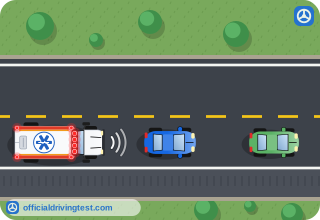
An emergency vehicle approaches with its flashing lights and sirens on. What must you do?
- Speed up so that you can clear the lane quickly ahead of it
- Yield the right-of-way by pulling over to the edge of the road
- Stop right where you are, even if you are in an intersection
- Move into the left lane and keep going at the same speed
Show answer
Correct answer: Yield the right-of-way by pulling over to the edge of the road
You must yield by pulling over to the edge of the road so the emergency vehicle can pass.
Source: South Dakota Driver License Manual (Revised 11/2024), page 64