South Dakota: Emergency vehicles, police stops and work zones — Part 2 Practice Test
Questions in this part include: “How do the consequences of running from law enforcement compare with the initial traffic citation?”
Independent educational site · not affiliated with any government agency or DMV
Ready? Test yourself
- Instant feedback with an explanation
- Every answer cites its source in the manual
- Your best score is saved on this device
- Keyboard: press 1 to 4 to answer and Enter for the next question
Questions are original and based on the official manual "South Dakota Driver License Manual" (Revised 11/2024), South Dakota Department of Public Safety.
All 16 questions in this practice test
Take the test above first, then use this list to study. Tap “Show answer” to see the correct answer and explanation.
Show the questions and answersHide the questions
-
While yielding to an emergency vehicle, what should you avoid?
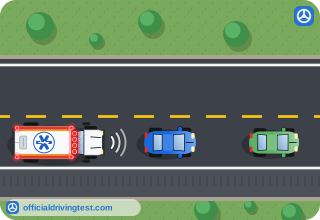
- Pulling over to the edge of the road
- Using your turn signal
- Slowing down
- Blocking intersections
Show answer
Correct answer: Blocking intersections
The manual says to avoid blocking intersections when you yield to an emergency vehicle.
Source: South Dakota Driver License Manual (Revised 11/2024), page 64
-
When pulled over by law enforcement, where should you move your vehicle?
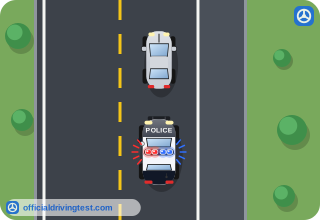
- To the left side near the center line
- Into the next intersection
- Stay in the travel lane with the flashers on
- Off the travel portion of the road to the right side
Show answer
Correct answer: Off the travel portion of the road to the right side
You should move quickly and safely off the travel portion of the road to the right side, in a spot that will not interfere with other vehicles.
Source: South Dakota Driver License Manual (Revised 11/2024), page 64
-
When pulled over by law enforcement, should you get out of your vehicle?
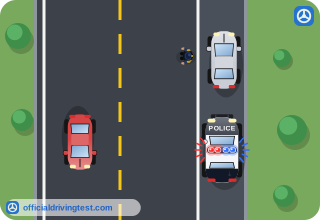
- Yes, walk back to the officer’s vehicle
- No, remain in it unless requested to get out
- Yes, stand beside your vehicle with your hands visible
- No, but open your door so the officer can see you
Show answer
Correct answer: No, remain in it unless requested to get out
The manual says to remain in the vehicle unless requested to get out.
Source: South Dakota Driver License Manual (Revised 11/2024), page 64
-
When pulled over by law enforcement, what should you do with the engine and hazard flashers?
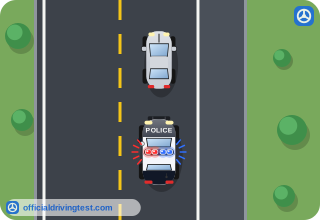
- Leave the engine running and turn off all lights
- Turn off the engine and leave the lights off
- Turn off the engine and turn on the hazard flashers
- Leave the engine running and turn on the high beams
Show answer
Correct answer: Turn off the engine and turn on the hazard flashers
You turn off the engine and turn on the hazard flashers, and at night the interior lights as well.
Source: South Dakota Driver License Manual (Revised 11/2024), page 64
-
When pulled over by law enforcement at night, what should you turn on to help the officer see inside the vehicle?
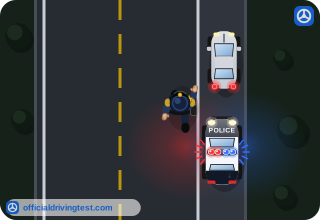
- The interior lights
- The high beams
- The fog lights
- The parking lights only
Show answer
Correct answer: The interior lights
At night the interior lights help the officer see that everything is in order inside the vehicle.
Source: South Dakota Driver License Manual (Revised 11/2024), page 64
-
When pulled over by law enforcement, what should you do with your seatbelt?
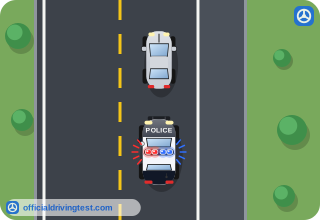
- Keep it fastened and ask passengers to do the same
- Unfasten it so you can reach your documents
- Unfasten it to show the officer you are not hiding
- Unfasten only your passengers’ belts
Show answer
Correct answer: Keep it fastened and ask passengers to do the same
The manual says to remain calm and keep your seatbelt fastened, and to ask passengers to do so as well.
Source: South Dakota Driver License Manual (Revised 11/2024), page 64
-
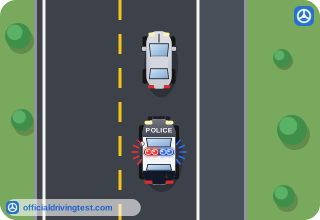
Why should you keep your hands on the steering wheel and limit movements when pulled over?
- So the vehicle stays in gear while you wait
- So the officer can see your hands to take fingerprints
- So the officer does not think you are hiding something
- So you can drive away quickly if you need to
Show answer
Correct answer: So the officer does not think you are hiding something
Limiting movements keeps the officer from thinking you are hiding or searching for something.
Source: South Dakota Driver License Manual (Revised 11/2024), page 64
-
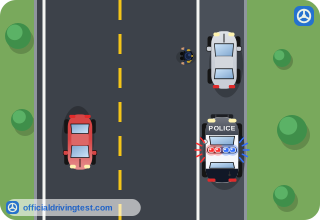
The officer asks for your license, proof of insurance, and registration. What should you do?
- Reach for them quickly using both hands to save the officer’s time
- Say where they are and reach slowly, keeping one hand on the wheel
- Get out of the vehicle and carry them to the officer’s car
- Reach for them without a word so you do not startle the officer
Show answer
Correct answer: Say where they are and reach slowly, keeping one hand on the wheel
Tell the officer where the documents are located and reach for them slowly with one hand on the wheel.
Source: South Dakota Driver License Manual (Revised 11/2024), page 65
-
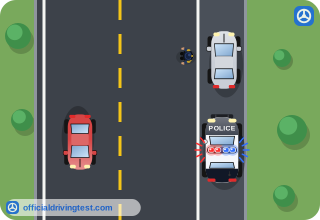
How should you answer an officer’s questions during a stop?
- Briefly, with only yes or no
- Only after you have called your insurance company
- Only after you have stepped out of the vehicle
- Fully and clearly
Show answer
Correct answer: Fully and clearly
The manual says to answer the officer’s questions fully and clearly.
Source: South Dakota Driver License Manual (Revised 11/2024), page 65
-
How do the consequences of running from law enforcement compare with the initial traffic citation?
- They are about the same
- They are less severe if you stop within a mile
- They replace the initial citation
- They are more severe
Show answer
Correct answer: They are more severe
The manual says the consequences of running from law enforcement are more severe than the initial traffic citation.
Source: South Dakota Driver License Manual (Revised 11/2024), page 65
-
You approach an authorized emergency vehicle that is stopped and using red visual signals. What does South Dakota law require?
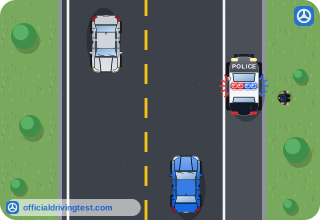
- Slow down and pass with caution without stopping
- Come to a complete stop before reaching the vehicle
- Change lanes and speed up to clear the area
- Stop only if the emergency vehicle is in your lane
Show answer
Correct answer: Come to a complete stop before reaching the vehicle
The law requires all motorists approaching from any direction to stop completely before reaching the stopped emergency vehicle.
Source: South Dakota Driver License Manual (Revised 11/2024), page 2
-
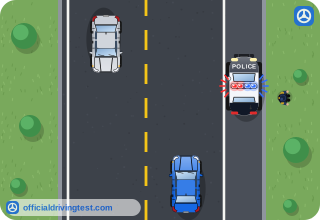
You stopped for an emergency vehicle using red visual signals. When may you proceed?
- As soon as the emergency lights stop flashing for a moment
- As soon as another vehicle drives around it ahead of you
- As soon as the emergency vehicle turns off its siren
- Unless otherwise directed, only after making sure it is safe
Show answer
Correct answer: Unless otherwise directed, only after making sure it is safe
After stopping you may proceed with caution, unless otherwise directed, only after making sure it is safe to do so.
Source: South Dakota Driver License Manual (Revised 11/2024), page 2
-
Besides red visual signals on an emergency vehicle, which warning lights on a stopped vehicle trigger South Dakota’s move-over law?
- Green, white, or purple
- White only
- Green or orange
- Amber, yellow, or blue
Show answer
Correct answer: Amber, yellow, or blue
The law applies to any stopped vehicle using amber, yellow, or blue warning lights.
Source: South Dakota Driver License Manual (Revised 11/2024), page 2
-
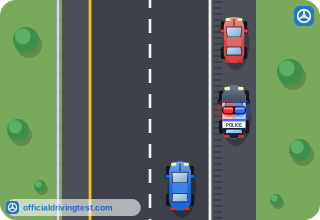
On an interstate or highway with two or more lanes in your direction, what must you do when approaching a stopped vehicle with amber, yellow, or blue lights?
- Merge into the lane closest to the vehicle
- Merge into the lane farthest from the vehicle
- Stay in your lane and sound your horn
- Move to the shoulder and stop
Show answer
Correct answer: Merge into the lane farthest from the vehicle
The law requires merging into the lane farthest from the vehicle and proceeding with caution, unless otherwise directed.
Source: South Dakota Driver License Manual (Revised 11/2024), page 2
-
How far before a stopped vehicle with amber, yellow, or blue lights must you merge over or slow down?
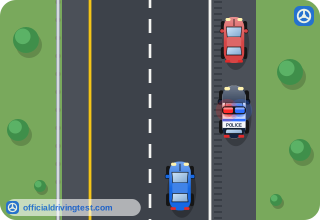
- At least 50 feet
- At least 150 feet
- At least 300 feet
- At least 600 feet
Show answer
Correct answer: At least 300 feet
Both the merge rule and the slow-down rule apply at least three hundred feet before the vehicle.
Source: South Dakota Driver License Manual (Revised 11/2024), page 2
-
On a two-lane highway posted above 20 mph, how much must you slow when approaching a stopped vehicle with amber, yellow, or blue lights?
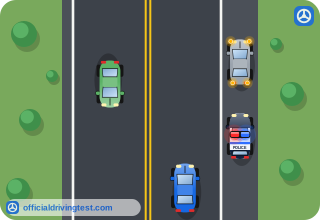
- To at least 20 mph less than the posted speed limit
- To at least 10 mph less than the posted speed limit
- To at least 5 mph less than the posted speed limit
- To at least 30 mph less than the posted speed limit
Show answer
Correct answer: To at least 20 mph less than the posted speed limit
On two-lane highways, motorists must slow to a speed at least twenty miles per hour less than the posted limit.
Source: South Dakota Driver License Manual (Revised 11/2024), page 2