South Dakota: Emergency vehicles, police stops and work zones
Yielding to emergency vehicles, South Dakota’s move-over law, what to do during an enforcement stop, and work zones. Split into 3 shorter tests so you're not stuck in one long quiz.
Independent educational site · not affiliated with any government agency or DMV
Choose a part
Emergency vehicles, police stops and work zones — Part 1
Questions in this part include: “What are drums, cones, tubes, and barricades used for in work zones?”
StartEmergency vehicles, police stops and work zones — Part 2
Questions in this part include: “How do the consequences of running from law enforcement compare with the initial traffic citation?”
StartEmergency vehicles, police stops and work zones — Part 3
Questions in this part include: “Which of these does the manual list among emergency vehicles?”
StartAll 49 Emergency vehicles, police stops and work zones questions with answers
Choose a part above to take a practice test, or study every question and answer here.
Show the questions and answersHide the questions
-
In a work zone, a person with a sign or flag controls traffic. What must you do?
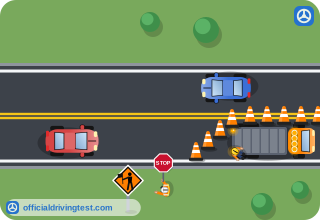
- Follow posted signs instead
- Follow their instructions
- Ignore them if the road looks clear
- Follow them only when workers are visible
Show answer
Correct answer: Follow their instructions
A person directing traffic with a sign or flag tells you whether to go, slow, or stop, and you must follow them.
Source: South Dakota Driver License Manual (Revised 11/2024), page 34
-
What are drums, cones, tubes, and barricades used for in work zones?
- To mark where parking is allowed along the road
- To show where passing is permitted ahead
- To tell drivers the speed limit ahead
- To keep traffic out of hazardous work zones
Show answer
Correct answer: To keep traffic out of hazardous work zones
These barriers keep traffic out of hazardous work zones and, with signs and markings, guide you through.
Source: South Dakota Driver License Manual (Revised 11/2024), page 34
-
You see a work zone warning sign with a traffic signal symbol. Where do you stop for the temporary signal?
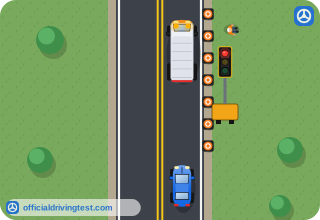
- In the middle of the intersection
- Beyond the signal, in the crosswalk
- At the cone nearest the signal
- At the white line, if present
Show answer
Correct answer: At the white line, if present
Temporary traffic signals may be used in work zones, and you stop at the white line if there is one.
Source: South Dakota Driver License Manual (Revised 11/2024), page 34
-
What may happen to fines for speeding in a work zone?
- They may be waived when no workers are present
- They may be doubled
- They are the same as elsewhere
- They apply only at night
Show answer
Correct answer: They may be doubled
The manual says fines for speeding in a work zone may be doubled.
Source: South Dakota Driver License Manual (Revised 11/2024), page 34
-
How should you drive through a work zone?
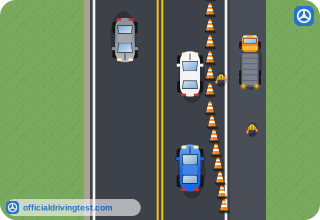
- Follow closely to keep traffic moving
- Keep your speed and watch for workers
- Reduce your speed and be ready to stop suddenly
- Use the left lane to pass construction traffic
Show answer
Correct answer: Reduce your speed and be ready to stop suddenly
You should slow down in work zones, be prepared to stop suddenly, and never tailgate.
Source: South Dakota Driver License Manual (Revised 11/2024), page 34
-
An emergency vehicle approaches and you have not yet entered the roundabout. What should you do?
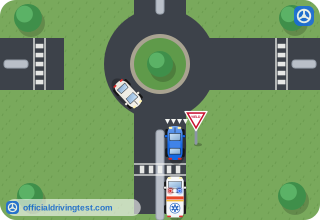
- Enter and continue to your exit
- Stop in the circle
- Pull over and allow it to pass
- Speed up to enter ahead of it
Show answer
Correct answer: Pull over and allow it to pass
If you have not entered the roundabout, you pull over and let emergency vehicles pass.
Source: South Dakota Driver License Manual (Revised 11/2024), page 40
-
An emergency vehicle approaches and you have already entered the roundabout. What should you do?
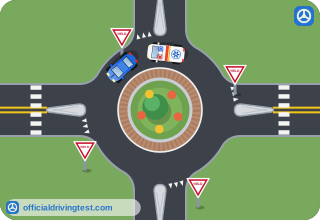
- Stop where you are inside the roundabout
- Continue to your exit, then pull over
- Pull over immediately inside the circle
- Circle until the vehicle has passed
Show answer
Correct answer: Continue to your exit, then pull over
Once inside, you continue to your exit and then pull over; stopping in the roundabout is to be avoided.
Source: South Dakota Driver License Manual (Revised 11/2024), page 40
-
During an enforcement stop, how should you acknowledge the officer’s presence?
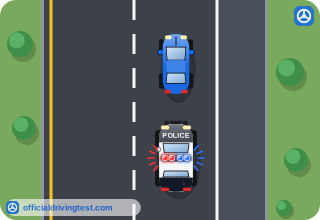
- Flash your headlights
- Turn on your hazard lights
- Turn on your right turn signal
- Sound your horn
Show answer
Correct answer: Turn on your right turn signal
Turning on your right turn signal lets the officer know you recognize their presence.
Source: South Dakota Driver License Manual (Revised 11/2024), page 46
-
During an enforcement stop, where should you move your vehicle?
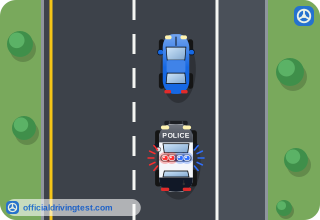
- Onto the center median
- To the opposite side of a two-lane roadway
- Into the nearest left turn lane
- To the right shoulder of the road
Show answer
Correct answer: To the right shoulder of the road
You move to the right shoulder; stopping in the median or on the opposite side of a two-lane road endangers you and the officer.
Source: South Dakota Driver License Manual (Revised 11/2024), page 46
-
On a freeway during an enforcement stop, where should you stop if you are in the carpool/HOV lane?
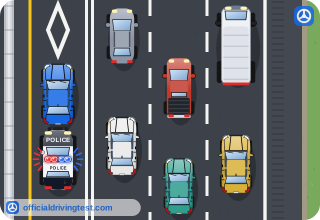
- On the left shoulder next to the HOV lane
- Completely on the right shoulder
- In the HOV lane with your hazard lights on
- In the lane closest to the right shoulder
Show answer
Correct answer: Completely on the right shoulder
On a freeway you move completely onto the right shoulder, even from the carpool/HOV lane.
Source: South Dakota Driver License Manual (Revised 11/2024), page 46
-
When it is dark during an enforcement stop, what kind of location should you look for?
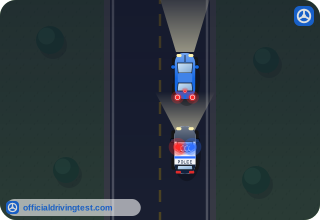
- The darkest part of the shoulder
- A place far from any buildings
- A well-lit location
- Any spot in the center median
Show answer
Correct answer: A well-lit location
When it is dark you look for well-lit places, such as areas with street or freeway lights, near restaurants, or service stations.
Source: South Dakota Driver License Manual (Revised 11/2024), page 46
-
During an enforcement stop, what should you do with your cell phone conversation and your radio?
- End the call and turn off the radio
- Keep the call going on speaker
- Turn the radio down only
- Pause the call and leave the radio on low
Show answer
Correct answer: End the call and turn off the radio
The officer needs your full attention, so you end the call and turn off the radio.
Source: South Dakota Driver License Manual (Revised 11/2024), page 47
-
During an enforcement stop, when should you leave your vehicle?
- Only if the officer directs you to
- As soon as you stop on the shoulder
- Whenever you need to show your documents
- When the officer approaches your window
Show answer
Correct answer: Only if the officer directs you to
Remain inside your vehicle unless the officer directs you otherwise.
Source: South Dakota Driver License Manual (Revised 11/2024), page 47
-
During an enforcement stop, what should you do with your hands and your passengers’ hands?
- Keep them hidden in your pockets
- Keep them out of sight below the dashboard
- Keep them in clear view
- Reach toward the glove compartment for documents
Show answer
Correct answer: Keep them in clear view
You place your hands, and all passengers’ hands, in clear view, such as on the steering wheel or on top of your lap.
Source: South Dakota Driver License Manual (Revised 11/2024), page 47
-
If your windows are tinted, what does the manual recommend during an enforcement stop?
- Leave them up and open the door when the officer arrives
- Roll them down after stopping and before the officer makes contact
- Roll them down only after the officer taps on the glass
- Turn on the interior light and keep the windows up
Show answer
Correct answer: Roll them down after stopping and before the officer makes contact
It is recommended to roll down tinted windows after stopping on the right shoulder and before the officer makes contact with you.
Source: South Dakota Driver License Manual (Revised 11/2024), page 47
-
What equipment do emergency vehicles have to help them move through traffic?
- Wide mirrors and extra brake lights
- Loud engines and fog lights
- Sirens, flashing lights, and special horns
- Reflective stripes and rear sirens only
Show answer
Correct answer: Sirens, flashing lights, and special horns
The manual says emergency vehicles are equipped with sirens, flashing lights, and special horns.
Source: South Dakota Driver License Manual (Revised 11/2024), page 64
-
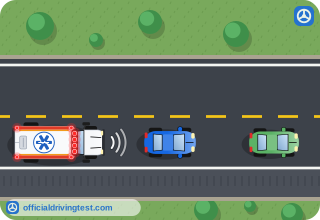
An emergency vehicle approaches with its flashing lights and sirens on. What must you do?
- Speed up so that you can clear the lane quickly ahead of it
- Yield the right-of-way by pulling over to the edge of the road
- Stop right where you are, even if you are in an intersection
- Move into the left lane and keep going at the same speed
Show answer
Correct answer: Yield the right-of-way by pulling over to the edge of the road
You must yield by pulling over to the edge of the road so the emergency vehicle can pass.
Source: South Dakota Driver License Manual (Revised 11/2024), page 64
-
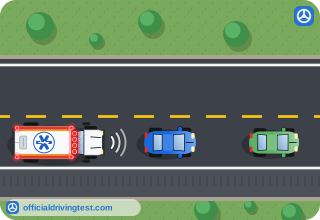
While yielding to an emergency vehicle, what should you avoid?
- Pulling over to the edge of the road
- Using your turn signal
- Slowing down
- Blocking intersections
Show answer
Correct answer: Blocking intersections
The manual says to avoid blocking intersections when you yield to an emergency vehicle.
Source: South Dakota Driver License Manual (Revised 11/2024), page 64
-
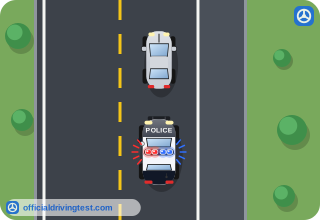
When pulled over by law enforcement, where should you move your vehicle?
- To the left side near the center line
- Into the next intersection
- Stay in the travel lane with the flashers on
- Off the travel portion of the road to the right side
Show answer
Correct answer: Off the travel portion of the road to the right side
You should move quickly and safely off the travel portion of the road to the right side, in a spot that will not interfere with other vehicles.
Source: South Dakota Driver License Manual (Revised 11/2024), page 64
-
When pulled over by law enforcement, should you get out of your vehicle?
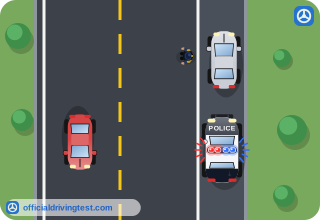
- Yes, walk back to the officer’s vehicle
- No, remain in it unless requested to get out
- Yes, stand beside your vehicle with your hands visible
- No, but open your door so the officer can see you
Show answer
Correct answer: No, remain in it unless requested to get out
The manual says to remain in the vehicle unless requested to get out.
Source: South Dakota Driver License Manual (Revised 11/2024), page 64
-
When pulled over by law enforcement, what should you do with the engine and hazard flashers?
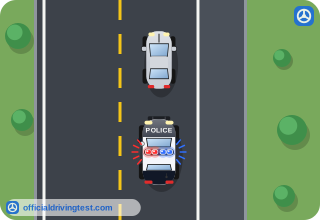
- Leave the engine running and turn off all lights
- Turn off the engine and leave the lights off
- Turn off the engine and turn on the hazard flashers
- Leave the engine running and turn on the high beams
Show answer
Correct answer: Turn off the engine and turn on the hazard flashers
You turn off the engine and turn on the hazard flashers, and at night the interior lights as well.
Source: South Dakota Driver License Manual (Revised 11/2024), page 64
-
When pulled over by law enforcement at night, what should you turn on to help the officer see inside the vehicle?
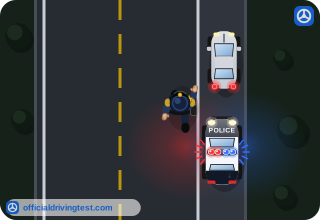
- The interior lights
- The high beams
- The fog lights
- The parking lights only
Show answer
Correct answer: The interior lights
At night the interior lights help the officer see that everything is in order inside the vehicle.
Source: South Dakota Driver License Manual (Revised 11/2024), page 64
-
When pulled over by law enforcement, what should you do with your seatbelt?
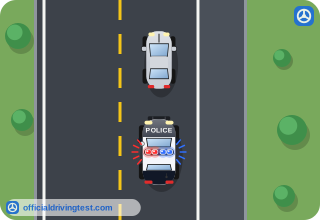
- Keep it fastened and ask passengers to do the same
- Unfasten it so you can reach your documents
- Unfasten it to show the officer you are not hiding
- Unfasten only your passengers’ belts
Show answer
Correct answer: Keep it fastened and ask passengers to do the same
The manual says to remain calm and keep your seatbelt fastened, and to ask passengers to do so as well.
Source: South Dakota Driver License Manual (Revised 11/2024), page 64
-
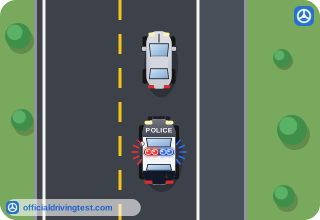
Why should you keep your hands on the steering wheel and limit movements when pulled over?
- So the vehicle stays in gear while you wait
- So the officer can see your hands to take fingerprints
- So the officer does not think you are hiding something
- So you can drive away quickly if you need to
Show answer
Correct answer: So the officer does not think you are hiding something
Limiting movements keeps the officer from thinking you are hiding or searching for something.
Source: South Dakota Driver License Manual (Revised 11/2024), page 64
-
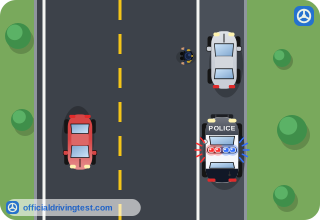
The officer asks for your license, proof of insurance, and registration. What should you do?
- Reach for them quickly using both hands to save the officer’s time
- Say where they are and reach slowly, keeping one hand on the wheel
- Get out of the vehicle and carry them to the officer’s car
- Reach for them without a word so you do not startle the officer
Show answer
Correct answer: Say where they are and reach slowly, keeping one hand on the wheel
Tell the officer where the documents are located and reach for them slowly with one hand on the wheel.
Source: South Dakota Driver License Manual (Revised 11/2024), page 65
-
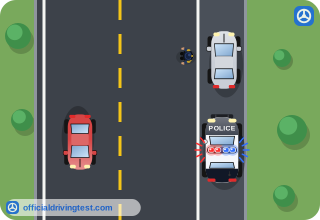
How should you answer an officer’s questions during a stop?
- Briefly, with only yes or no
- Only after you have called your insurance company
- Only after you have stepped out of the vehicle
- Fully and clearly
Show answer
Correct answer: Fully and clearly
The manual says to answer the officer’s questions fully and clearly.
Source: South Dakota Driver License Manual (Revised 11/2024), page 65
-
How do the consequences of running from law enforcement compare with the initial traffic citation?
- They are about the same
- They are less severe if you stop within a mile
- They replace the initial citation
- They are more severe
Show answer
Correct answer: They are more severe
The manual says the consequences of running from law enforcement are more severe than the initial traffic citation.
Source: South Dakota Driver License Manual (Revised 11/2024), page 65
-
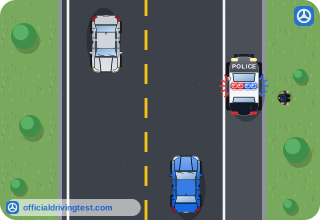
You approach an authorized emergency vehicle that is stopped and using red visual signals. What does South Dakota law require?
- Slow down and pass with caution without stopping
- Come to a complete stop before reaching the vehicle
- Change lanes and speed up to clear the area
- Stop only if the emergency vehicle is in your lane
Show answer
Correct answer: Come to a complete stop before reaching the vehicle
The law requires all motorists approaching from any direction to stop completely before reaching the stopped emergency vehicle.
Source: South Dakota Driver License Manual (Revised 11/2024), page 2
-
You stopped for an emergency vehicle using red visual signals. When may you proceed?
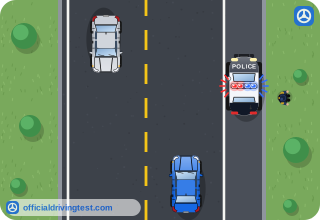
- As soon as the emergency lights stop flashing for a moment
- As soon as another vehicle drives around it ahead of you
- As soon as the emergency vehicle turns off its siren
- Unless otherwise directed, only after making sure it is safe
Show answer
Correct answer: Unless otherwise directed, only after making sure it is safe
After stopping you may proceed with caution, unless otherwise directed, only after making sure it is safe to do so.
Source: South Dakota Driver License Manual (Revised 11/2024), page 2
-
Besides red visual signals on an emergency vehicle, which warning lights on a stopped vehicle trigger South Dakota’s move-over law?
- Green, white, or purple
- White only
- Green or orange
- Amber, yellow, or blue
Show answer
Correct answer: Amber, yellow, or blue
The law applies to any stopped vehicle using amber, yellow, or blue warning lights.
Source: South Dakota Driver License Manual (Revised 11/2024), page 2
-
On an interstate or highway with two or more lanes in your direction, what must you do when approaching a stopped vehicle with amber, yellow, or blue lights?
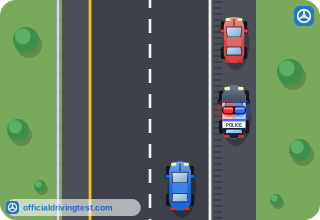
- Merge into the lane closest to the vehicle
- Merge into the lane farthest from the vehicle
- Stay in your lane and sound your horn
- Move to the shoulder and stop
Show answer
Correct answer: Merge into the lane farthest from the vehicle
The law requires merging into the lane farthest from the vehicle and proceeding with caution, unless otherwise directed.
Source: South Dakota Driver License Manual (Revised 11/2024), page 2
-
How far before a stopped vehicle with amber, yellow, or blue lights must you merge over or slow down?
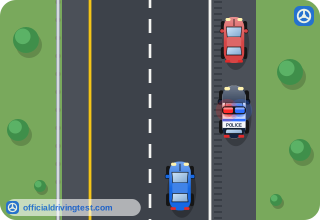
- At least 50 feet
- At least 150 feet
- At least 300 feet
- At least 600 feet
Show answer
Correct answer: At least 300 feet
Both the merge rule and the slow-down rule apply at least three hundred feet before the vehicle.
Source: South Dakota Driver License Manual (Revised 11/2024), page 2
-
On a two-lane highway posted above 20 mph, how much must you slow when approaching a stopped vehicle with amber, yellow, or blue lights?
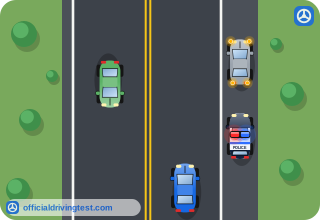
- To at least 20 mph less than the posted speed limit
- To at least 10 mph less than the posted speed limit
- To at least 5 mph less than the posted speed limit
- To at least 30 mph less than the posted speed limit
Show answer
Correct answer: To at least 20 mph less than the posted speed limit
On two-lane highways, motorists must slow to a speed at least twenty miles per hour less than the posted limit.
Source: South Dakota Driver License Manual (Revised 11/2024), page 2
-
On a two-lane highway where the speed limit is posted at 20 mph or less, to what speed must you slow near a stopped vehicle with amber, yellow, or blue lights?
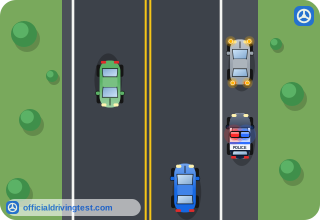
- 5 mph
- 10 mph
- 15 mph
- A complete stop
Show answer
Correct answer: 5 mph
When the limit is posted at twenty miles per hour or less, the required speed is five miles per hour.
Source: South Dakota Driver License Manual (Revised 11/2024), page 2
-
Which of these does the manual list among emergency vehicles?
- School buses
- Mail delivery trucks
- Ambulances
- Taxis
Show answer
Correct answer: Ambulances
The manual says emergency vehicles include law enforcement vehicles, ambulances, and fire department vehicles.
Source: South Dakota Driver License Manual (Revised 11/2024), page 2
-
A violation of South Dakota’s law on stopped emergency vehicles and vehicles with warning lights is what kind of offense?
- A class 3 misdemeanor
- A class 2 misdemeanor
- A class 6 felony
- A petty offense
Show answer
Correct answer: A class 2 misdemeanor
The manual says a violation is a class 2 misdemeanor, punishable by a fine and/or time in county jail.
Source: South Dakota Driver License Manual (Revised 11/2024), page 2
-
What is the offense for violating the move-over law and causing an accident with a stopped emergency vehicle using its red visual signals?
- A Class 1 felony
- A Class 3 misdemeanor
- A petty offense
- A Class 1 misdemeanor
Show answer
Correct answer: A Class 1 misdemeanor
A person who violates the law and causes an accident with such a vehicle is guilty of a Class 1 misdemeanor.
Source: South Dakota Driver License Manual (Revised 11/2024), page 2
-
What is a work zone?
- An area where roadwork takes place, which may involve lane closures
- Any road where the posted speed limit sign has an orange background on it
- An area where only workers on foot are allowed and all vehicles are banned
- A lane that is reserved for emergency vehicles and snowplows on a freeway
Show answer
Correct answer: An area where roadwork takes place, which may involve lane closures
A work zone is where roadwork is being done, and it can include lane closures, detours, and moving equipment.
Source: South Dakota Driver License Manual (Revised 11/2024), page 66
-
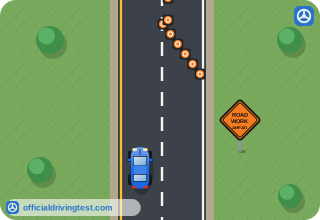
When should you reduce your speed in a work zone?
- Only when workers are visible
- Always, even if no workers are present
- Only when one of the lanes is closed
- Only when you are driving at night
Show answer
Correct answer: Always, even if no workers are present
Narrower lanes and rough pavement can make a work zone hazardous even with no workers there.
Source: South Dakota Driver License Manual (Revised 11/2024), page 66
-
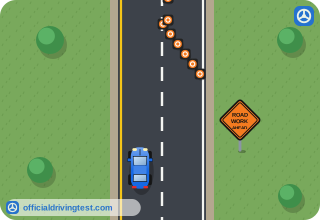
Why should you reduce your speed in a work zone even if there are no workers present?
- Workers may be hidden inside the large construction equipment
- Speed limits in work zones are always set at 25 mph by state law
- Police are always waiting for speeders just ahead of the work zone
- Narrower lanes and rough pavement can create a hazardous condition
Show answer
Correct answer: Narrower lanes and rough pavement can create a hazardous condition
Even without workers, narrow lanes and rough pavement make a work zone hazardous.
Source: South Dakota Driver License Manual (Revised 11/2024), page 66
-
What may happen if you are caught speeding in a work zone?
- Your license is always suspended
- You must retake the driving test
- The fine may be doubled
- The fine is the same as elsewhere
Show answer
Correct answer: The fine may be doubled
The manual says fines for speeding in a work zone may be doubled.
Source: South Dakota Driver License Manual (Revised 11/2024), page 66
-
What may digital signs and messages in a work zone warn you about?
- Changing conditions ahead, such as slowed traffic
- Which lane the workers will use next week or next month
- Where the nearest gas station or rest area can be found
- The fine for every possible traffic violation in the work zone
Show answer
Correct answer: Changing conditions ahead, such as slowed traffic
Digital signs can warn of changing conditions or what to look out for, such as slow or stopped traffic ahead.
Source: South Dakota Driver License Manual (Revised 11/2024), page 66
-
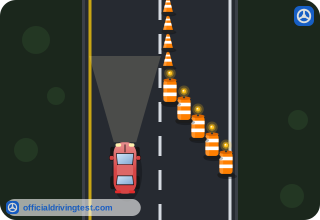
When should you use extreme caution while driving through a work zone at night?
- Only if workers are present
- Only if the lanes are closed
- Only if the speed limit is reduced
- Whether or not workers are present
Show answer
Correct answer: Whether or not workers are present
Extreme caution is needed at night in a work zone regardless of whether any workers are there.
Source: South Dakota Driver License Manual (Revised 11/2024), page 66
-
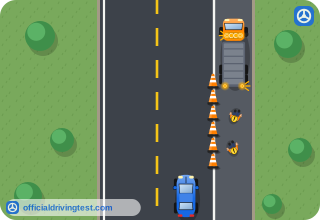
How should you adjust your lane position in a work zone?
- To stay as close to the cones as you can
- To allow space for workers and construction vehicles
- To stay in the center of the roadway
- To keep moving toward the shoulder at all times
Show answer
Correct answer: To allow space for workers and construction vehicles
You should position your vehicle so there is room for workers and construction vehicles.
Source: South Dakota Driver License Manual (Revised 11/2024), page 66
-
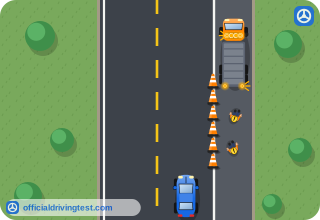
How long should you observe the posted work zone signs?
- Until you pass the last cone
- Until you see a green traffic light
- Until the lane widens
- Until you see "End Road Work"
Show answer
Correct answer: Until you see "End Road Work"
Work zone signs apply until you reach the "End Road Work" sign.
Source: South Dakota Driver License Manual (Revised 11/2024), page 66
-
What should you do about delays in a work zone?
- Pass slow traffic using the shoulder
- Expect them, plan for them, and leave early
- Drive faster before you reach the work zone
- Follow the vehicle ahead more closely
Show answer
Correct answer: Expect them, plan for them, and leave early
You should expect delays, plan for them, and leave early so you arrive on time.
Source: South Dakota Driver License Manual (Revised 11/2024), page 66
-
When you can, what should you do about work zones?
- Use alternate routes and avoid them
- Drive through them at night
- Drive through them at the posted speed limit only
- Follow a large vehicle through them
Show answer
Correct answer: Use alternate routes and avoid them
When possible, the manual says to use alternate routes and avoid work zones.
Source: South Dakota Driver License Manual (Revised 11/2024), page 66
-
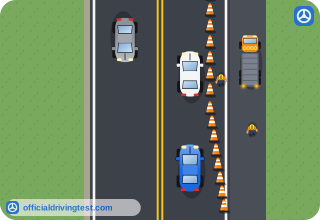
As a driver in a work zone, what should you do with your speed and following distance?
- Keep your speed and increase the following distance
- Reduce your speed and shorten the following distance
- Reduce your speed and increase the following distance
- Match the speed of the fastest vehicle
Show answer
Correct answer: Reduce your speed and increase the following distance
In a work zone you slow down and leave more space between you and the vehicle ahead.
Source: South Dakota Driver License Manual (Revised 11/2024), page 66
-
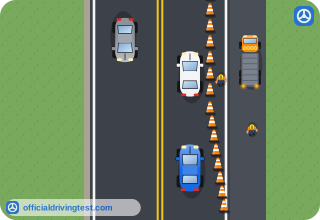
As a driver in a work zone, what should you watch for and be prepared to do?
- Watch the traffic around you and be prepared to stop
- Watch only the workers and be prepared to swerve
- Watch only the signs and be prepared to speed up
- Watch only the cones and be prepared to change lanes
Show answer
Correct answer: Watch the traffic around you and be prepared to stop
You need to watch all traffic around you and be ready to stop.
Source: South Dakota Driver License Manual (Revised 11/2024), page 66