South Carolina: Speed and following distance — Part 3 Practice Test
Questions in this part include: “What minimum following distance should you try to keep behind the vehicle in front of you?” · “If you find you are following too closely, what should you do?”
Independent educational site · not affiliated with any government agency or DMV
Ready? Test yourself
- Instant feedback with an explanation
- Every answer cites its source in the manual
- Your best score is saved on this device
- Keyboard: press 1 to 4 to answer and Enter for the next question
Questions are original and based on the official manual "South Carolina Driver's Manual" (2026 (posted April 2026)), South Carolina Department of Motor Vehicles.
All 18 questions in this practice test
Take the test above first, then use this list to study. Tap “Show answer” to see the correct answer and explanation.
Show the questions and answersHide the questions
-
What minimum following distance should you try to keep behind the vehicle in front of you?
- 2 seconds
- 3 seconds
- 4 seconds
- 6 seconds
Show answer
Correct answer: 4 seconds
The manual says to keep a minimum following distance of 4 seconds behind the vehicle in front.
Source: South Carolina Driver's Manual (2026 (posted April 2026)), page 8-6 · Open this page in the manual (Manual page 8-6)
-
When checking your following distance, which part of the vehicle ahead do you watch pass a stationary point?
- The rear of the vehicle
- The front of the vehicle
- The side doors of the vehicle
- The side mirrors of the vehicle
Show answer
Correct answer: The rear of the vehicle
You watch when the rear of the vehicle ahead passes a sign, pole, or other stationary point, then count until you reach it.
Source: South Carolina Driver's Manual (2026 (posted April 2026)), page 8-6 · Open this page in the manual (Manual page 8-6)
-
When you count your following distance, you are following too closely if you pass the stationary point before counting to what?
- One thousand two
- One thousand three
- One thousand six
- One thousand four
Show answer
Correct answer: One thousand four
Reaching the point before you count to four means you are closer than 4 seconds.
Source: South Carolina Driver's Manual (2026 (posted April 2026)), page 8-6 · Open this page in the manual (Manual page 8-6)
-
If you find you are following too closely, what should you do?
- Increase your speed to match the vehicle ahead and recount
- Reduce speed and then count again at another stationary point
- Move to another lane and count again at the same point
- Tap the brakes twice and keep your current speed
Show answer
Correct answer: Reduce speed and then count again at another stationary point
Slow down, count again at another fixed point, and repeat until you are following no closer than 4 seconds.
Source: South Carolina Driver's Manual (2026 (posted April 2026)), page 8-6 · Open this page in the manual (Manual page 8-6)
-
How can you check the accuracy of your estimate of a 4 second following distance?
- Guess how many seconds you are from an object, then count the seconds it takes to reach it
- Compare your distance with one car length for every 10 miles per hour of speed
- Ask a passenger to estimate how many car lengths you are from the vehicle ahead
- Use your speedometer to measure the distance in feet to the car ahead
Show answer
Correct answer: Guess how many seconds you are from an object, then count the seconds it takes to reach it
The manual says to guess how many seconds away you are from an object and then count the seconds it takes to reach it.
Source: South Carolina Driver's Manual (2026 (posted April 2026)), page 8-6 · Open this page in the manual (Manual page 8-6)
-
When driving on slippery roads, what should you do about the space in front of your vehicle?
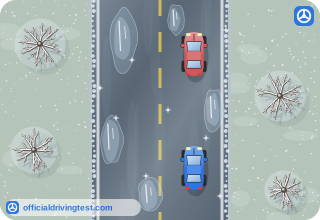
- Keep it the same as on dry roads
- Shorten it to keep the other vehicle in view
- Increase your following distance
- Stay close to the vehicle ahead to follow its path
Show answer
Correct answer: Increase your following distance
Slippery roads are one of the situations where you need more space in front of your vehicle.
Source: South Carolina Driver's Manual (2026 (posted April 2026)), page 8-6 · Open this page in the manual (Manual page 8-6)
-
At night, in fog, or in inclement weather, what should you do about the distance between you and the vehicle ahead?
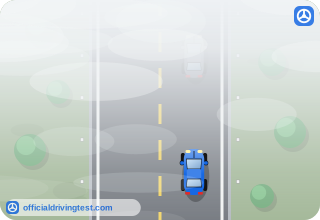
- Reduce it so you can see the taillights
- Increase your following distance
- Keep it unchanged if you are driving slowly
- Hold it at exactly 4 seconds at all times
Show answer
Correct answer: Increase your following distance
Night, fog and inclement weather are situations in which you need more space in front of your vehicle.
Source: South Carolina Driver's Manual (2026 (posted April 2026)), page 8-7 · Open this page in the manual (Manual page 8-7)
-
Which vehicle should you give extra following distance because it is required to stop at railroad crossings?
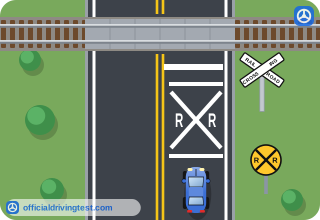
- A taxi
- A passenger car
- A compact car
- A school bus
Show answer
Correct answer: A school bus
Transit buses, school buses and vehicles carrying hazardous materials stop at railroad crossings, so you need more space behind them.
Source: South Carolina Driver's Manual (2026 (posted April 2026)), page 8-7 · Open this page in the manual (Manual page 8-7)
-
What should you do about your following distance behind a truck, bus, recreational vehicle, or vehicle pulling a trailer?
- Shorten it so you can see around it
- Keep it the same as behind a car
- Increase it to give yourself more space
- Reduce it at night so you can see its lights
Show answer
Correct answer: Increase it to give yourself more space
Large vehicles such as trucks, buses, RVs and vehicles pulling trailers are a situation where you need more space in front of your vehicle.
Source: South Carolina Driver's Manual (2026 (posted April 2026)), page 8-7 · Open this page in the manual (Manual page 8-7)
-
What does a space cushion on the sides of your vehicle allow you to do?
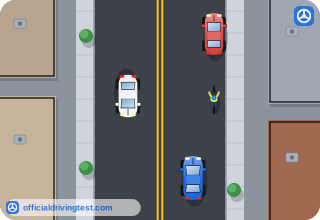
- Move right or left
- Drive closer to the center line
- Pass without using a signal
- Reduce your following distance
Show answer
Correct answer: Move right or left
A space cushion on the sides gives you room to move right or left if you need to.
Source: South Carolina Driver's Manual (2026 (posted April 2026)), page 8-7 · Open this page in the manual (Manual page 8-7)
-
Why should you avoid driving next to other vehicles for long periods of time?
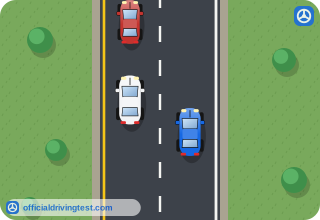
- Your vehicle may block their view of road signs and traffic signals ahead
- It increases the chance that you will exceed the posted speed limit
- Other drivers cannot hear your horn when you travel alongside them for long
- You may be in their blind spot, which reduces the space you may need to avoid a collision
Show answer
Correct answer: You may be in their blind spot, which reduces the space you may need to avoid a collision
Staying beside another vehicle may put you in its blind spot and take away space you may need to avoid a collision.
Source: South Carolina Driver's Manual (2026 (posted April 2026)), page 8-7 · Open this page in the manual (Manual page 8-7)
-
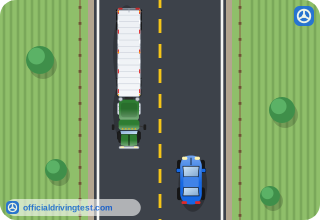
To keep space between you and oncoming traffic, what should you avoid doing?
- Keeping your eyes moving while you search
- Crowding the centerline marking
- Signaling before you change lanes
- Making space for vehicles that are entering
Show answer
Correct answer: Crowding the centerline marking
The manual says to avoid crowding the centerline marking and to keep as much space as possible from oncoming traffic.
Source: South Carolina Driver's Manual (2026 (posted April 2026)), page 8-7 · Open this page in the manual (Manual page 8-7)
-
What should you do to make space for vehicles entering a multiple-lane or limited access roadway?
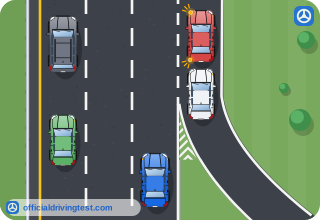
- Move over a lane or adjust your speed
- Speed up to stay ahead of them
- Stay in your lane at the same speed
- Sound your horn to warn them
Show answer
Correct answer: Move over a lane or adjust your speed
You can make room for entering vehicles by moving over a lane or adjusting your speed.
Source: South Carolina Driver's Manual (2026 (posted April 2026)), page 8-7 · Open this page in the manual (Manual page 8-7)
-
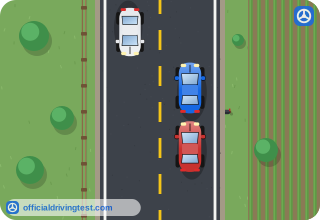
Which of these helps keep the driver behind you at a safe following distance?
- Changing your speed often
- Driving close to the car ahead
- Braking suddenly to make the driver back off
- Keeping a steady speed
Show answer
Correct answer: Keeping a steady speed
The manual says you can help the driver behind keep a safe distance by keeping a steady speed, signaling in advance and keeping more space in front.
Source: South Carolina Driver's Manual (2026 (posted April 2026)), page 8-8 · Open this page in the manual (Manual page 8-8)
-
Before you reduce speed or turn, what can you do to help the driver behind you keep a safe distance?
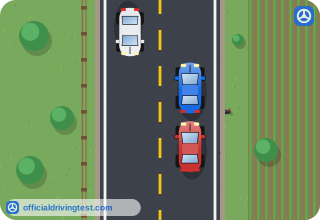
- Tap your horn to warn the driver behind you
- Move closer to the vehicle in front of you
- Keep more space to the front of your vehicle
- Slow down without signaling so you stay predictable
Show answer
Correct answer: Keep more space to the front of your vehicle
Leaving more space in front of you before slowing or turning helps the driver behind you stay at a safe distance.
Source: South Carolina Driver's Manual (2026 (posted April 2026)), page 8-8 · Open this page in the manual (Manual page 8-8)
-
In a school zone, when must you obey a slower speed limit?
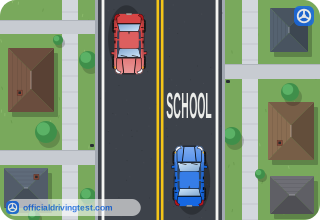
- Only when a school bus is in view
- When lights are flashing or children are present
- Only during the first hour of the school day
- Only when a police officer is present
Show answer
Correct answer: When lights are flashing or children are present
In a school zone you must obey a slower speed limit when lights are flashing or children are present.
Source: South Carolina Driver's Manual (2026 (posted April 2026)), page 10-2 · Open this page in the manual (Manual page 10-2)
-
How much should you add to your following distance for night driving conditions?
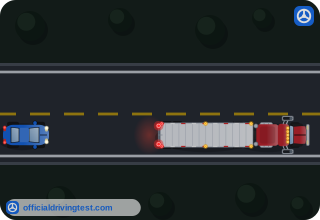
- At least three additional seconds
- At least four additional seconds
- At least one additional second
- No additional seconds
Show answer
Correct answer: At least one additional second
At night you should add at least one extra second to your following distance.
Source: South Carolina Driver's Manual (2026 (posted April 2026)), page 11-2 · Open this page in the manual (Manual page 11-2)
-
How much should you add to your following distance for driving on unfamiliar roadways at night?
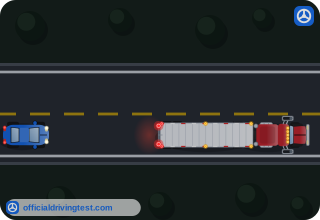
- At least six additional seconds
- At least two additional seconds
- At least five additional seconds
- Half an additional second
Show answer
Correct answer: At least two additional seconds
On unfamiliar roads at night you should add at least two extra seconds to your following distance.
Source: South Carolina Driver's Manual (2026 (posted April 2026)), page 11-2 · Open this page in the manual (Manual page 11-2)