South Carolina: Speed and following distance
Looking ahead, adjusting speed for the road and weather, stopping distance, the four-second following distance and keeping space around your vehicle. Split into 4 shorter tests so you're not stuck in one long quiz.
Independent educational site · not affiliated with any government agency or DMV
Choose a part
Speed and following distance — Part 1
Questions in this part include: “What should you do about searching for hazards while you drive?”
StartSpeed and following distance — Part 2
Questions in this part include: “Which of these can cause flooding on roads?”
StartSpeed and following distance — Part 3
Questions in this part include: “What minimum following distance should you try to keep behind the vehicle in front of you?”
StartSpeed and following distance — Part 4
Questions in this part include: “On a narrow rural road with ditches or drop-offs instead of shoulders, what should you do?”
StartAll 71 Speed and following distance questions with answers
Choose a part above to take a practice test, or study every question and answer here.
Show the questions and answersHide the questions
-
What should you do about searching for hazards while you drive?
- Develop a searching pattern and use it every time you drive
- Search for hazards only when traffic is heavy or the weather is bad
- Search for hazards only before you start the vehicle
- Look only at the vehicle directly in front of your car
Show answer
Correct answer: Develop a searching pattern and use it every time you drive
The manual says you should develop a searching pattern and use it every time you drive, looking ahead, to the sides and behind.
Source: South Carolina Driver's Manual (2026 (posted April 2026)), page 8-1 · Open this page in the manual (Manual page 8-1)
-
How should you use your eyes while searching the roadway?
- Fix them on the vehicle directly ahead of you
- Focus them on the center line of the road
- Keep them moving and avoid staring at any one thing
- Stay locked on the nearest hazard until it passes
Show answer
Correct answer: Keep them moving and avoid staring at any one thing
Staring at one thing makes you miss other problems, so you should keep your eyes moving and searching.
Source: South Carolina Driver's Manual (2026 (posted April 2026)), page 8-1 · Open this page in the manual (Manual page 8-1)
-
Ideally, how far ahead of your vehicle should you try to look?
- 2 to 3 seconds
- 20 to 30 seconds
- 5 to 8 seconds
- 12 to 15 seconds
Show answer
Correct answer: 20 to 30 seconds
The manual says you should ideally try to look at what is happening 20 to 30 seconds in front of your vehicle.
Source: South Carolina Driver's Manual (2026 (posted April 2026)), page 8-1 · Open this page in the manual (Manual page 8-1)
-
Looking well down your planned path of travel gives you extra time. What can that time help you avoid?
- Having to signal before every lane change you make
- Having to check your mirrors before you slow down
- Having to follow the posted speed limit on the road
- Being forced to use emergency braking and steering
Show answer
Correct answer: Being forced to use emergency braking and steering
Extra time from looking far ahead lets you make better decisions and possibly avoid emergency braking and steering.
Source: South Carolina Driver's Manual (2026 (posted April 2026)), page 8-1 · Open this page in the manual (Manual page 8-1)
-
Which of these limits how far you can see ahead and should be avoided?
- Checking your mirrors before changing lanes
- Adjusting your road position to see better
- Following too close to a larger vehicle
- Searching to the sides of your vehicle
Show answer
Correct answer: Following too close to a larger vehicle
A larger vehicle in front blocks your view, so avoid following it too closely and adjust your speed and road position.
Source: South Carolina Driver's Manual (2026 (posted April 2026)), page 8-2 · Open this page in the manual (Manual page 8-2)
-
Why should you search to the sides of your vehicle?
- To see if other roadway users are about to cross your path
- To check whether your tires are losing traction
- To judge how many seconds you are behind the car ahead
- To make sure your headlights are shining on the road
Show answer
Correct answer: To see if other roadway users are about to cross your path
Searching the sides shows you roadway users who are about to cross your path.
Source: South Carolina Driver's Manual (2026 (posted April 2026)), page 8-2 · Open this page in the manual (Manual page 8-2)
-
Which of these is a time when you especially need to check the traffic behind you with your mirrors?
- While parked with the engine turned off
- While waiting in a parking space for a passenger
- While reading a map before you leave home
- When entering an intersection
Show answer
Correct answer: When entering an intersection
The manual says to be aware of traffic behind you especially when changing lanes, slowing down or stopping, or entering an intersection.
Source: South Carolina Driver's Manual (2026 (posted April 2026)), page 8-2 · Open this page in the manual (Manual page 8-2)
-
What does driving safely require you to adjust your vehicle speed for?
- The age of your vehicle's tires
- Roadway and traffic conditions
- The make and model of vehicles near you
- How much fuel is left in your tank
Show answer
Correct answer: Roadway and traffic conditions
Safe driving means adjusting speed for roadway and traffic conditions, along with keeping a following distance and obeying speed limits.
Source: South Carolina Driver's Manual (2026 (posted April 2026)), page 8-2 · Open this page in the manual (Manual page 8-2)
-
What should you do before entering a curve?
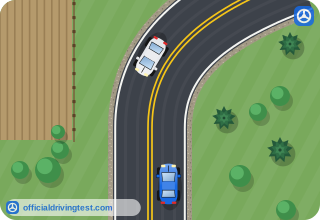
- Reduce speed to a safe speed before you enter
- Hold your speed until you reach the middle of the curve
- Brake hard once you are inside the curve
- Speed up so you can get through the curve quickly
Show answer
Correct answer: Reduce speed to a safe speed before you enter
You should always reduce speed to a safe speed before entering a curve rather than braking after you are in it.
Source: South Carolina Driver's Manual (2026 (posted April 2026)), page 8-2 · Open this page in the manual (Manual page 8-2)
-
In a curve, a safe speed is one that allows you to do what?
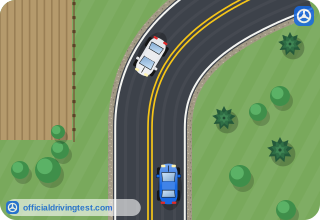
- Brake firmly at the midpoint of the curve
- Coast through the curve without touching either pedal
- Apply slight and constant acceleration through the curve
- Change lanes freely while you are in the curve
Show answer
Correct answer: Apply slight and constant acceleration through the curve
The manual defines a safe curve speed as one that lets you accelerate slightly and constantly through the curve.
Source: South Carolina Driver's Manual (2026 (posted April 2026)), page 8-2 · Open this page in the manual (Manual page 8-2)
-
When should you reduce your speed even more when approaching a curve?
- When the road is dry and traction is good
- When you cannot see the end of the curve
- When no other vehicles are on the road
- When you are not following any other vehicle
Show answer
Correct answer: When you cannot see the end of the curve
You should slow more when traction is poor, when following other vehicles, and when you cannot see the end of the curve.
Source: South Carolina Driver's Manual (2026 (posted April 2026)), page 8-2 · Open this page in the manual (Manual page 8-2)
-
Hard braking after you enter a curve could cause what?
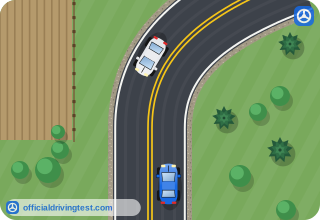
- The steering wheel to lock up
- The headlights to go dim
- The engine to overheat quickly
- The vehicle tires to lose traction
Show answer
Correct answer: The vehicle tires to lose traction
Braking hard once you are in a curve could make the tires lose traction.
Source: South Carolina Driver's Manual (2026 (posted April 2026)), page 8-2 · Open this page in the manual (Manual page 8-2)
-
When should you reduce speed on a road that may become slippery?
- Only after the road is covered with snow or ice
- Only after you begin to skid on the surface
- At the first sign of rain, snow, sleet, or ice
- Only when your tires have already started to slip
Show answer
Correct answer: At the first sign of rain, snow, sleet, or ice
The manual says to reduce speed at the first sign of rain, snow, sleet, or ice, not after problems appear.
Source: South Carolina Driver's Manual (2026 (posted April 2026)), page 8-3 · Open this page in the manual (Manual page 8-3)
-
How does a slippery road affect driving?
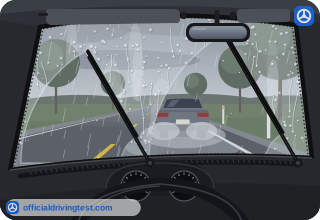
- It takes longer to stop and is harder to turn without skidding
- It takes less distance to stop but makes turning harder
- Tires grip the same as on dry roads, but you see less
- It makes stopping easier but makes accelerating harder
Show answer
Correct answer: It takes longer to stop and is harder to turn without skidding
On a slippery road tires do not grip as well, so stopping takes longer and turning without skidding is harder.
Source: South Carolina Driver's Manual (2026 (posted April 2026)), page 8-3 · Open this page in the manual (Manual page 8-3)
-
What is hydroplaning?
- When the brakes overheat and fade after driving through deep water
- When the engine stalls because water has reached the exhaust pipe
- When the rear tires lock and slide sideways on dry pavement
- When the steering tires ride on a layer of water on top of the road surface
Show answer
Correct answer: When the steering tires ride on a layer of water on top of the road surface
Hydroplaning means the steering tires ride on a layer of water on the road, much like water skis.
Source: South Carolina Driver's Manual (2026 (posted April 2026)), page 8-3 · Open this page in the manual (Manual page 8-3)
-
What is the best way to avoid traction loss from hydroplaning?
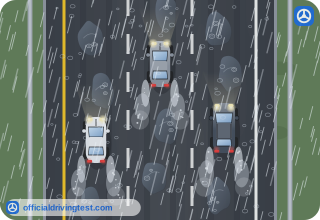
- Brake hard as soon as you notice water on the road surface
- Slow down in the rain or on roads with pooled water or puddles
- Steer back and forth to push water out from under the tires
- Speed up so your tires cross the water more quickly
Show answer
Correct answer: Slow down in the rain or on roads with pooled water or puddles
Slowing down in rain, or on a road wet with pooled water or puddles, is the best way to avoid losing traction.
Source: South Carolina Driver's Manual (2026 (posted April 2026)), page 8-3 · Open this page in the manual (Manual page 8-3)
-
What should you do if you see a flooded roadway or barricades blocking it?
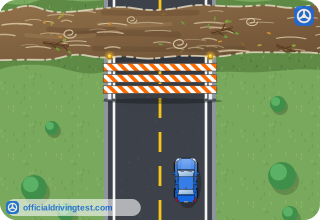
- Find another route to your destination
- Drive through slowly in a low gear
- Follow another vehicle across the water
- Go around the barricades if the water looks shallow
Show answer
Correct answer: Find another route to your destination
The manual says to find another route when you see a flooded roadway or barricades blocking one.
Source: South Carolina Driver's Manual (2026 (posted April 2026)), page 8-4 · Open this page in the manual (Manual page 8-4)
-
How quickly can flash floods occur?
- Only after several days of continuous rain
- Only after a river has been rising for a week
- Within a few minutes or hours of excessive rainfall
- Only at night after a thunderstorm has passed
Show answer
Correct answer: Within a few minutes or hours of excessive rainfall
Flash floods can come rapidly and unexpectedly, within minutes or hours of excessive rainfall.
Source: South Carolina Driver's Manual (2026 (posted April 2026)), page 8-4 · Open this page in the manual (Manual page 8-4)
-
Which of these can cause flooding on roads?
- A strong wind on a dry day
- A dam or levee breaking
- A long period of extreme heat
- Freezing temperatures at night
Show answer
Correct answer: A dam or levee breaking
The manual lists broken dams or levees among the causes of flooding, along with overflowing rivers, snow run-off and heavy rain.
Source: South Carolina Driver's Manual (2026 (posted April 2026)), page 8-4 · Open this page in the manual (Manual page 8-4)
-
Why should you be especially cautious near flooded areas at night?
- Floodwaters move faster after dark
- Barricades are taken down after dark
- Water is always deeper at night
- Visibility is limited
Show answer
Correct answer: Visibility is limited
Be cautious near flooded areas, especially at night, when visibility is limited.
Source: South Carolina Driver's Manual (2026 (posted April 2026)), page 8-4 · Open this page in the manual (Manual page 8-4)
-
How deep does water need to be to reach the bottom of most passenger cars, causing loss of control or possible stalling?
- Two inches
- Twelve inches
- Six inches
- Eighteen inches
Show answer
Correct answer: Six inches
The manual says six inches of water reaches the bottom of most passenger cars and can cause loss of control or stalling.
Source: South Carolina Driver's Manual (2026 (posted April 2026)), page 8-4 · Open this page in the manual (Manual page 8-4)
-
How much moving water can carry away most vehicles, including sport utility vehicles and pick-up trucks?
- Two feet
- Two inches
- Four inches
- Eight inches
Show answer
Correct answer: Two feet
The manual says two feet of moving water can carry away most vehicles, even SUVs and pick-up trucks.
Source: South Carolina Driver's Manual (2026 (posted April 2026)), page 8-4 · Open this page in the manual (Manual page 8-4)
-
Why should you not cross a flooded road even if the water looks shallow?
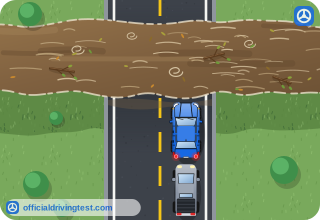
- Shallow water always damages the engine
- Shallow water makes the road surface sticky
- Tires cannot grip any road covered in water
- Water can hide dips and other unseen hazards
Show answer
Correct answer: Water can hide dips and other unseen hazards
Floodwater can hide dips and other hazards you cannot see, so you should not try to cross.
Source: South Carolina Driver's Manual (2026 (posted April 2026)), page 8-4 · Open this page in the manual (Manual page 8-4)
-
How can floodwaters damage roadways?
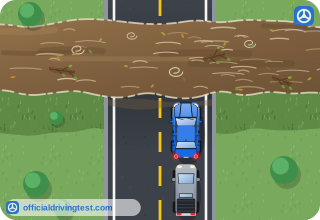
- By melting the pavement markings
- By washing away the underlying road surface
- By raising the road surface above its original level
- By hardening the surface until it cracks
Show answer
Correct answer: By washing away the underlying road surface
Floodwaters can wash away the underlying road surface, which is another reason not to drive through them.
Source: South Carolina Driver's Manual (2026 (posted April 2026)), page 8-4 · Open this page in the manual (Manual page 8-4)
-
If there is no other route around a flooded road, what should you do?
- Proceed to higher ground and wait for the water to subside
- Drive through the shallowest part of the water slowly
- Wait at the edge of the water until another car crosses
- Park next to the water until the barricades are removed
Show answer
Correct answer: Proceed to higher ground and wait for the water to subside
When no other route exists you should go to higher ground and wait for the water to go down.
Source: South Carolina Driver's Manual (2026 (posted April 2026)), page 8-4 · Open this page in the manual (Manual page 8-4)
-
What is total stopping distance?
- The distance your vehicle travels from the moment you press the brake pedal until it stops
- The distance between your front bumper and the vehicle ahead when you apply the brakes
- The distance traveled, in ideal conditions, from realizing you must stop until the vehicle stops
- The distance your vehicle travels from seeing a hazard until you begin to steer away
Show answer
Correct answer: The distance traveled, in ideal conditions, from realizing you must stop until the vehicle stops
Total stopping distance runs from the moment you realize you must stop until the vehicle actually stops, in ideal conditions.
Source: South Carolina Driver's Manual (2026 (posted April 2026)), page 8-5 · Open this page in the manual (Manual page 8-5)
-
How does your speed affect your stopping distance?
- Speed only affects stopping distance on wet or icy roads
- The faster you travel, the more time and distance is needed to stop
- Faster travel shortens the distance because brakes work harder
- Speed has no effect when your brakes are in good condition
Show answer
Correct answer: The faster you travel, the more time and distance is needed to stop
Higher speed means more time and distance to stop.
Source: South Carolina Driver's Manual (2026 (posted April 2026)), page 8-5 · Open this page in the manual (Manual page 8-5)
-
What is perception time?
- The time and distance it takes you to check your mirrors before stopping
- The time and distance it takes you to downshift to a lower gear
- The time and distance it takes to count your following distance
- The time and distance it takes you to recognize you must stop
Show answer
Correct answer: The time and distance it takes you to recognize you must stop
Perception time is the time and distance it takes you to recognize that you must stop.
Source: South Carolina Driver's Manual (2026 (posted April 2026)), page 8-5 · Open this page in the manual (Manual page 8-5)
-
What is the average perception time for an alert driver?
- ¼ second to ½ second
- 2 to 3 seconds
- ¾ second to 1 second
- 3 to 4 seconds
Show answer
Correct answer: ¾ second to 1 second
The manual gives three-quarters of a second to one second as the average perception time for an alert driver.
Source: South Carolina Driver's Manual (2026 (posted April 2026)), page 8-5 · Open this page in the manual (Manual page 8-5)
-
What is reaction time?
- The time and distance it takes to move your foot from the gas pedal and begin applying the brakes
- The time and distance it takes you to notice a hazard and decide to steer around it
- The time and distance it takes you to look in the mirror and decide to change lanes
- The time and distance it takes to shift into a lower gear and slow the vehicle
Show answer
Correct answer: The time and distance it takes to move your foot from the gas pedal and begin applying the brakes
Reaction time covers moving your foot from the gas pedal and starting to apply the brakes.
Source: South Carolina Driver's Manual (2026 (posted April 2026)), page 8-5 · Open this page in the manual (Manual page 8-5)
-
What is the average reaction time of the average driver?
- 1½ to 2 seconds
- 2 to 3 seconds
- 3 to 4 seconds
- ¾ second to 1 second
Show answer
Correct answer: ¾ second to 1 second
The manual gives three-quarters of a second to one second as the average driver's reaction time.
Source: South Carolina Driver's Manual (2026 (posted April 2026)), page 8-5 · Open this page in the manual (Manual page 8-5)
-
What is braking distance?
- The time and distance between your vehicle and the one ahead of it
- The time and distance it takes for your brakes to slow and stop your vehicle
- The distance a vehicle travels while the driver decides to brake
- The time and distance a vehicle needs to accelerate to highway speed
Show answer
Correct answer: The time and distance it takes for your brakes to slow and stop your vehicle
Braking distance is the time and distance your brakes need to slow and stop the vehicle.
Source: South Carolina Driver's Manual (2026 (posted April 2026)), page 8-5 · Open this page in the manual (Manual page 8-5)
-
At 50 mph on dry pavement with good brakes, braking distance can be about how far?
- About 158 feet
- About 98 feet
- About 212 feet
- About 400 feet
Show answer
Correct answer: About 158 feet
The manual says braking distance at 50 mph on dry pavement with good brakes can be about 158 feet.
Source: South Carolina Driver's Manual (2026 (posted April 2026)), page 8-5 · Open this page in the manual (Manual page 8-5)
-
What is the space between your vehicle and other roadway users usually called?
- A buffer zone
- A safety margin
- A space cushion
- A clear zone
Show answer
Correct answer: A space cushion
The manual calls this space a space cushion and says to always try to keep a safe one around your vehicle.
Source: South Carolina Driver's Manual (2026 (posted April 2026)), page 8-5 · Open this page in the manual (Manual page 8-5)
-
How does more space between your vehicle and other roadway users help you?
- It reduces your stopping distance
- It gives you more time to react
- It lets you drive at higher speeds
- It removes the need to use mirrors
Show answer
Correct answer: It gives you more time to react
The more space you allow, the more time you have to react.
Source: South Carolina Driver's Manual (2026 (posted April 2026)), page 8-5 · Open this page in the manual (Manual page 8-5)
-
How does following a vehicle too closely affect you?
- It helps you see farther ahead and gives you extra time to react
- It has no effect as long as you are traveling below the speed limit
- It lets the driver behind you see your brake lights more easily
- It limits your vision of the road and does not give you enough time to react
Show answer
Correct answer: It limits your vision of the road and does not give you enough time to react
Following too closely limits your view of the road and leaves too little time to react and avoid a collision.
Source: South Carolina Driver's Manual (2026 (posted April 2026)), page 8-5 · Open this page in the manual (Manual page 8-5)
-
What minimum following distance should you try to keep behind the vehicle in front of you?
- 2 seconds
- 3 seconds
- 4 seconds
- 6 seconds
Show answer
Correct answer: 4 seconds
The manual says to keep a minimum following distance of 4 seconds behind the vehicle in front.
Source: South Carolina Driver's Manual (2026 (posted April 2026)), page 8-6 · Open this page in the manual (Manual page 8-6)
-
When checking your following distance, which part of the vehicle ahead do you watch pass a stationary point?
- The rear of the vehicle
- The front of the vehicle
- The side doors of the vehicle
- The side mirrors of the vehicle
Show answer
Correct answer: The rear of the vehicle
You watch when the rear of the vehicle ahead passes a sign, pole, or other stationary point, then count until you reach it.
Source: South Carolina Driver's Manual (2026 (posted April 2026)), page 8-6 · Open this page in the manual (Manual page 8-6)
-
When you count your following distance, you are following too closely if you pass the stationary point before counting to what?
- One thousand two
- One thousand three
- One thousand six
- One thousand four
Show answer
Correct answer: One thousand four
Reaching the point before you count to four means you are closer than 4 seconds.
Source: South Carolina Driver's Manual (2026 (posted April 2026)), page 8-6 · Open this page in the manual (Manual page 8-6)
-
If you find you are following too closely, what should you do?
- Increase your speed to match the vehicle ahead and recount
- Reduce speed and then count again at another stationary point
- Move to another lane and count again at the same point
- Tap the brakes twice and keep your current speed
Show answer
Correct answer: Reduce speed and then count again at another stationary point
Slow down, count again at another fixed point, and repeat until you are following no closer than 4 seconds.
Source: South Carolina Driver's Manual (2026 (posted April 2026)), page 8-6 · Open this page in the manual (Manual page 8-6)
-
How can you check the accuracy of your estimate of a 4 second following distance?
- Guess how many seconds you are from an object, then count the seconds it takes to reach it
- Compare your distance with one car length for every 10 miles per hour of speed
- Ask a passenger to estimate how many car lengths you are from the vehicle ahead
- Use your speedometer to measure the distance in feet to the car ahead
Show answer
Correct answer: Guess how many seconds you are from an object, then count the seconds it takes to reach it
The manual says to guess how many seconds away you are from an object and then count the seconds it takes to reach it.
Source: South Carolina Driver's Manual (2026 (posted April 2026)), page 8-6 · Open this page in the manual (Manual page 8-6)
-
When driving on slippery roads, what should you do about the space in front of your vehicle?
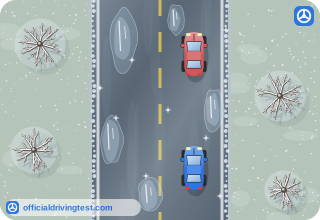
- Keep it the same as on dry roads
- Shorten it to keep the other vehicle in view
- Increase your following distance
- Stay close to the vehicle ahead to follow its path
Show answer
Correct answer: Increase your following distance
Slippery roads are one of the situations where you need more space in front of your vehicle.
Source: South Carolina Driver's Manual (2026 (posted April 2026)), page 8-6 · Open this page in the manual (Manual page 8-6)
-
At night, in fog, or in inclement weather, what should you do about the distance between you and the vehicle ahead?
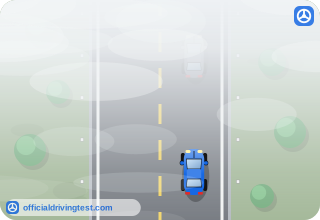
- Reduce it so you can see the taillights
- Increase your following distance
- Keep it unchanged if you are driving slowly
- Hold it at exactly 4 seconds at all times
Show answer
Correct answer: Increase your following distance
Night, fog and inclement weather are situations in which you need more space in front of your vehicle.
Source: South Carolina Driver's Manual (2026 (posted April 2026)), page 8-7 · Open this page in the manual (Manual page 8-7)
-
Which vehicle should you give extra following distance because it is required to stop at railroad crossings?
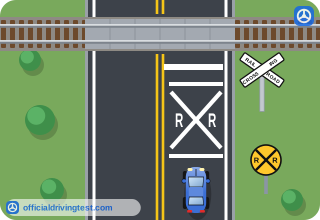
- A taxi
- A passenger car
- A compact car
- A school bus
Show answer
Correct answer: A school bus
Transit buses, school buses and vehicles carrying hazardous materials stop at railroad crossings, so you need more space behind them.
Source: South Carolina Driver's Manual (2026 (posted April 2026)), page 8-7 · Open this page in the manual (Manual page 8-7)
-
What should you do about your following distance behind a truck, bus, recreational vehicle, or vehicle pulling a trailer?
- Shorten it so you can see around it
- Keep it the same as behind a car
- Increase it to give yourself more space
- Reduce it at night so you can see its lights
Show answer
Correct answer: Increase it to give yourself more space
Large vehicles such as trucks, buses, RVs and vehicles pulling trailers are a situation where you need more space in front of your vehicle.
Source: South Carolina Driver's Manual (2026 (posted April 2026)), page 8-7 · Open this page in the manual (Manual page 8-7)
-
What does a space cushion on the sides of your vehicle allow you to do?
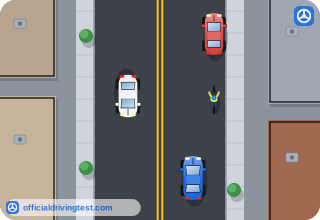
- Move right or left
- Drive closer to the center line
- Pass without using a signal
- Reduce your following distance
Show answer
Correct answer: Move right or left
A space cushion on the sides gives you room to move right or left if you need to.
Source: South Carolina Driver's Manual (2026 (posted April 2026)), page 8-7 · Open this page in the manual (Manual page 8-7)
-
Why should you avoid driving next to other vehicles for long periods of time?
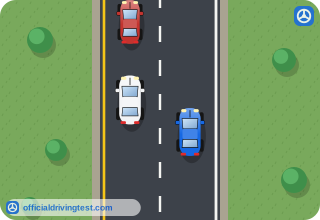
- Your vehicle may block their view of road signs and traffic signals ahead
- It increases the chance that you will exceed the posted speed limit
- Other drivers cannot hear your horn when you travel alongside them for long
- You may be in their blind spot, which reduces the space you may need to avoid a collision
Show answer
Correct answer: You may be in their blind spot, which reduces the space you may need to avoid a collision
Staying beside another vehicle may put you in its blind spot and take away space you may need to avoid a collision.
Source: South Carolina Driver's Manual (2026 (posted April 2026)), page 8-7 · Open this page in the manual (Manual page 8-7)
-
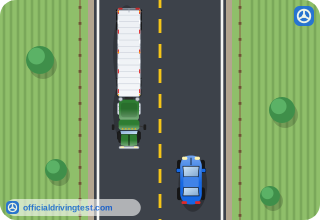
To keep space between you and oncoming traffic, what should you avoid doing?
- Keeping your eyes moving while you search
- Crowding the centerline marking
- Signaling before you change lanes
- Making space for vehicles that are entering
Show answer
Correct answer: Crowding the centerline marking
The manual says to avoid crowding the centerline marking and to keep as much space as possible from oncoming traffic.
Source: South Carolina Driver's Manual (2026 (posted April 2026)), page 8-7 · Open this page in the manual (Manual page 8-7)
-
What should you do to make space for vehicles entering a multiple-lane or limited access roadway?
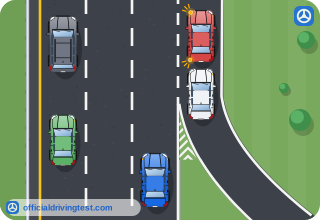
- Move over a lane or adjust your speed
- Speed up to stay ahead of them
- Stay in your lane at the same speed
- Sound your horn to warn them
Show answer
Correct answer: Move over a lane or adjust your speed
You can make room for entering vehicles by moving over a lane or adjusting your speed.
Source: South Carolina Driver's Manual (2026 (posted April 2026)), page 8-7 · Open this page in the manual (Manual page 8-7)
-
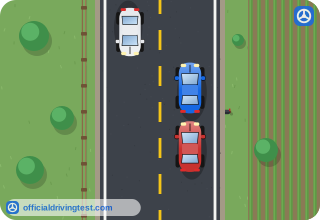
Which of these helps keep the driver behind you at a safe following distance?
- Changing your speed often
- Driving close to the car ahead
- Braking suddenly to make the driver back off
- Keeping a steady speed
Show answer
Correct answer: Keeping a steady speed
The manual says you can help the driver behind keep a safe distance by keeping a steady speed, signaling in advance and keeping more space in front.
Source: South Carolina Driver's Manual (2026 (posted April 2026)), page 8-8 · Open this page in the manual (Manual page 8-8)
-
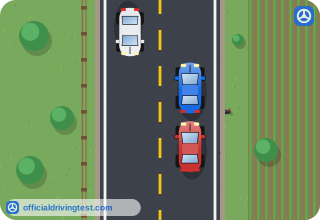
Before you reduce speed or turn, what can you do to help the driver behind you keep a safe distance?
- Tap your horn to warn the driver behind you
- Move closer to the vehicle in front of you
- Keep more space to the front of your vehicle
- Slow down without signaling so you stay predictable
Show answer
Correct answer: Keep more space to the front of your vehicle
Leaving more space in front of you before slowing or turning helps the driver behind you stay at a safe distance.
Source: South Carolina Driver's Manual (2026 (posted April 2026)), page 8-8 · Open this page in the manual (Manual page 8-8)
-
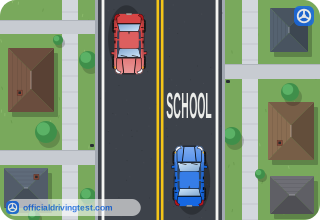
In a school zone, when must you obey a slower speed limit?
- Only when a school bus is in view
- When lights are flashing or children are present
- Only during the first hour of the school day
- Only when a police officer is present
Show answer
Correct answer: When lights are flashing or children are present
In a school zone you must obey a slower speed limit when lights are flashing or children are present.
Source: South Carolina Driver's Manual (2026 (posted April 2026)), page 10-2 · Open this page in the manual (Manual page 10-2)
-
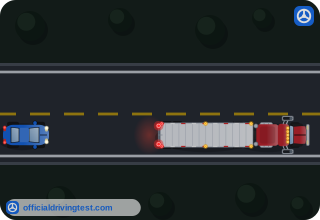
How much should you add to your following distance for night driving conditions?
- At least three additional seconds
- At least four additional seconds
- At least one additional second
- No additional seconds
Show answer
Correct answer: At least one additional second
At night you should add at least one extra second to your following distance.
Source: South Carolina Driver's Manual (2026 (posted April 2026)), page 11-2 · Open this page in the manual (Manual page 11-2)
-
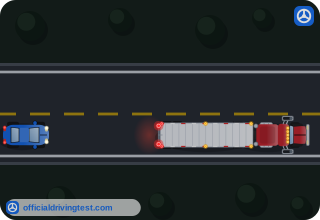
How much should you add to your following distance for driving on unfamiliar roadways at night?
- At least six additional seconds
- At least two additional seconds
- At least five additional seconds
- Half an additional second
Show answer
Correct answer: At least two additional seconds
On unfamiliar roads at night you should add at least two extra seconds to your following distance.
Source: South Carolina Driver's Manual (2026 (posted April 2026)), page 11-2 · Open this page in the manual (Manual page 11-2)
-
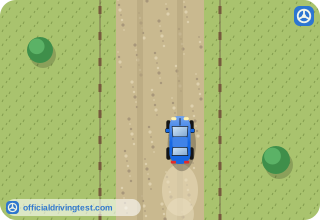
What should you do on gravel or dirt roads?
- Keep your normal speed and following distance
- Increase your speed so the tires grip better
- Reduce your speed and increase your following distance
- Stay close to the vehicle ahead to avoid dust
Show answer
Correct answer: Reduce your speed and increase your following distance
Traction is reduced on gravel or dirt, so slow down, leave more space, and expect that you may skid when stopping.
Source: South Carolina Driver's Manual (2026 (posted April 2026)), page 11-5 · Open this page in the manual (Manual page 11-5)
-
On a narrow rural road with ditches or drop-offs instead of shoulders, what should you do?
- Reduce speed and center your vehicle in your lane
- Drive on the edge to give oncoming traffic room
- Keep to the right edge of your lane
- Drive over the center line when no one is coming
Show answer
Correct answer: Reduce speed and center your vehicle in your lane
You should slow down, center your vehicle in your lane, and watch for oncoming traffic that may try to share your lane.
Source: South Carolina Driver's Manual (2026 (posted April 2026)), page 11-5 · Open this page in the manual (Manual page 11-5)
-
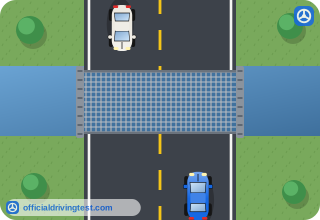
What should you do when crossing open bridge gratings or steel bridges?
- Speed up slightly so the tires grip the surface
- Follow closely to keep up with traffic ahead
- Slow down, follow farther back, and keep a firm grip
- Loosen your grip so the wheel can move freely
Show answer
Correct answer: Slow down, follow farther back, and keep a firm grip
These surfaces reduce traction, so reduce speed, increase following distance, and hold the wheel firmly.
Source: South Carolina Driver's Manual (2026 (posted April 2026)), page 11-5 · Open this page in the manual (Manual page 11-5)
-
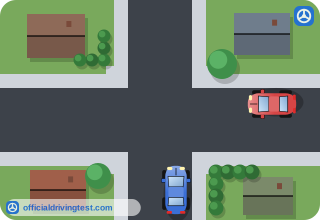
What are blind corners?
- Corners with sharp curves marked by signs
- Street corners you cannot see around
- Intersections where traffic signals are broken
- Corners where parking is not allowed
Show answer
Correct answer: Street corners you cannot see around
Blind corners are street corners you cannot see around, often caused by trees, crops, or steep hills.
Source: South Carolina Driver's Manual (2026 (posted April 2026)), page 11-5 · Open this page in the manual (Manual page 11-5)
-
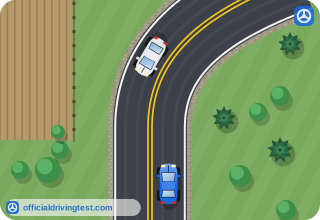
In an area of reduced vision, such as a blind corner, what should you always do?
- Sound your horn and keep your speed
- Stay in the center of the road for a better view
- Speed up to clear the hazard quickly
- Reduce your speed and be prepared to stop
Show answer
Correct answer: Reduce your speed and be prepared to stop
Where you cannot see far ahead, slow down and be ready to stop.
Source: South Carolina Driver's Manual (2026 (posted April 2026)), page 11-5 · Open this page in the manual (Manual page 11-5)
-
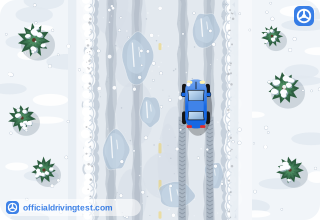
Winter weather conditions call for which kind of driving?
- Faster acceleration to avoid losing momentum
- Slower speeds, acceleration, steering, and braking
- Sharper steering to react to slick spots
- Harder braking to test road conditions
Show answer
Correct answer: Slower speeds, acceleration, steering, and braking
Winter conditions call for slower speeds, slower acceleration, slower steering, and slower braking.
Source: South Carolina Driver's Manual (2026 (posted April 2026)), page 11-6 · Open this page in the manual (Manual page 11-6)
-
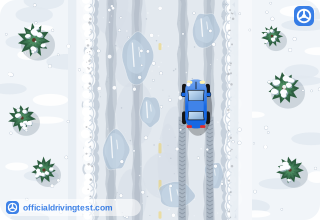
In winter conditions, what is best for slowing down or stopping?
- Applying the brakes firmly and quickly
- Taking your foot off the pedals and coasting
- Applying the brakes gently
- Waiting until the last moment to brake
Show answer
Correct answer: Applying the brakes gently
You should test road conditions carefully, and gentle braking is best for slowing or stopping.
Source: South Carolina Driver's Manual (2026 (posted April 2026)), page 11-7 · Open this page in the manual (Manual page 11-7)
-
When there is snow or ice, what distance should you allow between your vehicle and others?
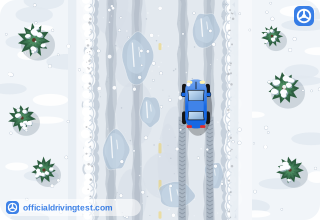
- Additional distance
- Less distance
- The usual distance
- Half the usual distance
Show answer
Correct answer: Additional distance
Snow and ice make it harder to stop, so you should allow additional distance between vehicles.
Source: South Carolina Driver's Manual (2026 (posted April 2026)), page 11-7 · Open this page in the manual (Manual page 11-7)
-
What is the maximum recommended speed for most vehicle-trailer combinations?
- 45 mph
- 65 mph
- 70 mph
- 55 mph
Show answer
Correct answer: 55 mph
The manual gives 55 mph as the maximum recommended speed for most vehicle-trailer combinations.
Source: South Carolina Driver's Manual (2026 (posted April 2026)), page 11-11 · Open this page in the manual (Manual page 11-11)
-
While towing a trailer, which statement about the posted speed limit is true?
- You may exceed it by 5 mph on level roads
- It does not apply to vehicles towing trailers
- You may exceed it to pass a truck safely
- You must never exceed it
Show answer
Correct answer: You must never exceed it
Even though 55 mph is recommended, you must never exceed the posted speed limit.
Source: South Carolina Driver's Manual (2026 (posted April 2026)), page 11-11 · Open this page in the manual (Manual page 11-11)
-
If driving conditions worsen while towing a trailer, what must you do?
- Keep the same speed
- Reduce speed even more
- Stop and unhook the trailer
- Switch to your high beams
Show answer
Correct answer: Reduce speed even more
When conditions worsen you must slow down even more.
Source: South Carolina Driver's Manual (2026 (posted April 2026)), page 11-11 · Open this page in the manual (Manual page 11-11)
-
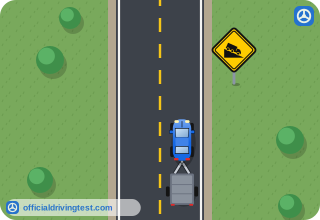
When towing a trailer, when should you slow down for a downgrade?
- Halfway down the hill
- At the bottom of the hill
- Before starting down the hill
- Once the trailer starts to push
Show answer
Correct answer: Before starting down the hill
Slow down before you start down the hill.
Source: South Carolina Driver's Manual (2026 (posted April 2026)), page 11-11 · Open this page in the manual (Manual page 11-11)
-
How does a vehicle-trailer combination compare with a car when stopping?
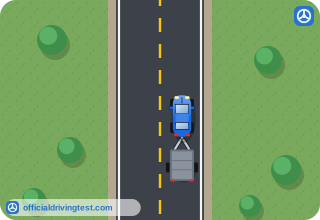
- It requires more distance to stop
- It stops in the same distance
- It stops in a shorter distance when dry
- It stops faster when loaded heavily in front
Show answer
Correct answer: It requires more distance to stop
A vehicle-trailer combination needs more distance to stop, so leave extra space ahead.
Source: South Carolina Driver's Manual (2026 (posted April 2026)), page 11-11 · Open this page in the manual (Manual page 11-11)
-
When towing a trailer in rain, snow, or fog, how much space should you allow ahead?
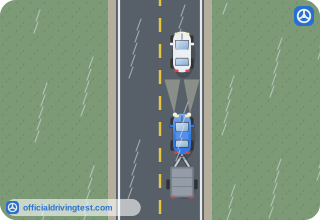
- Even more space than normal towing
- The same space as in dry weather
- Less space, since you drive slower
- Only one extra car length
Show answer
Correct answer: Even more space than normal towing
In rain, snow, or fog you should allow even more space than the extra space already needed when towing.
Source: South Carolina Driver's Manual (2026 (posted April 2026)), page 11-11 · Open this page in the manual (Manual page 11-11)
-
How does towing a trailer affect passing?
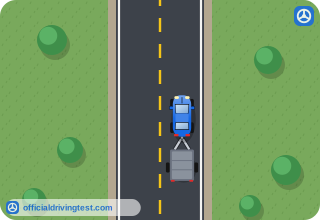
- Passing is easier because the trailer adds weight
- Your vehicle needs the same time and distance
- Your vehicle needs more time and distance to pass
- Passing is allowed only on hills
Show answer
Correct answer: Your vehicle needs more time and distance to pass
When towing, your vehicle will require more time and distance to pass.
Source: South Carolina Driver's Manual (2026 (posted April 2026)), page 11-11 · Open this page in the manual (Manual page 11-11)
-
Where should you never pass when towing a trailer?
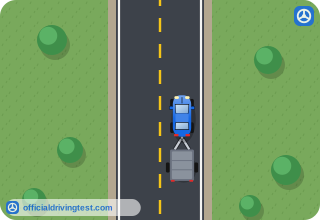
- On straight, level roads
- On hills or curves
- On roads with a wide shoulder
- On two-lane roads in daylight
Show answer
Correct answer: On hills or curves
You should have plenty of clear highway ahead and never pass on hills or curves.
Source: South Carolina Driver's Manual (2026 (posted April 2026)), page 11-12 · Open this page in the manual (Manual page 11-12)
-
What speed should you use when backing up a trailer?
- Go at a moderate pace
- Go in short bursts of speed
- Go quickly so it does not jackknife
- Go slowly
Show answer
Correct answer: Go slowly
You should back up a trailer slowly.
Source: South Carolina Driver's Manual (2026 (posted April 2026)), page 11-12 · Open this page in the manual (Manual page 11-12)