South Carolina: Speed and following distance — Part 2 Practice Test
Questions in this part include: “Which of these can cause flooding on roads?” · “What is the average perception time for an alert driver?”
Independent educational site · not affiliated with any government agency or DMV
Ready? Test yourself
- Instant feedback with an explanation
- Every answer cites its source in the manual
- Your best score is saved on this device
- Keyboard: press 1 to 4 to answer and Enter for the next question
Questions are original and based on the official manual "South Carolina Driver's Manual" (2026 (posted April 2026)), South Carolina Department of Motor Vehicles.
All 18 questions in this practice test
Take the test above first, then use this list to study. Tap “Show answer” to see the correct answer and explanation.
Show the questions and answersHide the questions
-
Which of these can cause flooding on roads?
- A strong wind on a dry day
- A dam or levee breaking
- A long period of extreme heat
- Freezing temperatures at night
Show answer
Correct answer: A dam or levee breaking
The manual lists broken dams or levees among the causes of flooding, along with overflowing rivers, snow run-off and heavy rain.
Source: South Carolina Driver's Manual (2026 (posted April 2026)), page 8-4 · Open this page in the manual (Manual page 8-4)
-
Why should you be especially cautious near flooded areas at night?
- Floodwaters move faster after dark
- Barricades are taken down after dark
- Water is always deeper at night
- Visibility is limited
Show answer
Correct answer: Visibility is limited
Be cautious near flooded areas, especially at night, when visibility is limited.
Source: South Carolina Driver's Manual (2026 (posted April 2026)), page 8-4 · Open this page in the manual (Manual page 8-4)
-
How deep does water need to be to reach the bottom of most passenger cars, causing loss of control or possible stalling?
- Two inches
- Twelve inches
- Six inches
- Eighteen inches
Show answer
Correct answer: Six inches
The manual says six inches of water reaches the bottom of most passenger cars and can cause loss of control or stalling.
Source: South Carolina Driver's Manual (2026 (posted April 2026)), page 8-4 · Open this page in the manual (Manual page 8-4)
-
How much moving water can carry away most vehicles, including sport utility vehicles and pick-up trucks?
- Two feet
- Two inches
- Four inches
- Eight inches
Show answer
Correct answer: Two feet
The manual says two feet of moving water can carry away most vehicles, even SUVs and pick-up trucks.
Source: South Carolina Driver's Manual (2026 (posted April 2026)), page 8-4 · Open this page in the manual (Manual page 8-4)
-
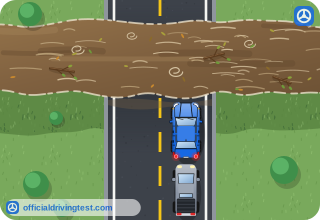
Why should you not cross a flooded road even if the water looks shallow?
- Shallow water always damages the engine
- Shallow water makes the road surface sticky
- Tires cannot grip any road covered in water
- Water can hide dips and other unseen hazards
Show answer
Correct answer: Water can hide dips and other unseen hazards
Floodwater can hide dips and other hazards you cannot see, so you should not try to cross.
Source: South Carolina Driver's Manual (2026 (posted April 2026)), page 8-4 · Open this page in the manual (Manual page 8-4)
-
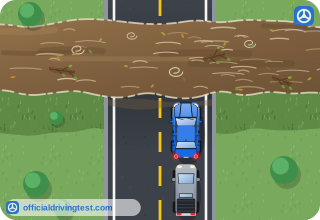
How can floodwaters damage roadways?
- By melting the pavement markings
- By washing away the underlying road surface
- By raising the road surface above its original level
- By hardening the surface until it cracks
Show answer
Correct answer: By washing away the underlying road surface
Floodwaters can wash away the underlying road surface, which is another reason not to drive through them.
Source: South Carolina Driver's Manual (2026 (posted April 2026)), page 8-4 · Open this page in the manual (Manual page 8-4)
-
If there is no other route around a flooded road, what should you do?
- Proceed to higher ground and wait for the water to subside
- Drive through the shallowest part of the water slowly
- Wait at the edge of the water until another car crosses
- Park next to the water until the barricades are removed
Show answer
Correct answer: Proceed to higher ground and wait for the water to subside
When no other route exists you should go to higher ground and wait for the water to go down.
Source: South Carolina Driver's Manual (2026 (posted April 2026)), page 8-4 · Open this page in the manual (Manual page 8-4)
-
What is total stopping distance?
- The distance your vehicle travels from the moment you press the brake pedal until it stops
- The distance between your front bumper and the vehicle ahead when you apply the brakes
- The distance traveled, in ideal conditions, from realizing you must stop until the vehicle stops
- The distance your vehicle travels from seeing a hazard until you begin to steer away
Show answer
Correct answer: The distance traveled, in ideal conditions, from realizing you must stop until the vehicle stops
Total stopping distance runs from the moment you realize you must stop until the vehicle actually stops, in ideal conditions.
Source: South Carolina Driver's Manual (2026 (posted April 2026)), page 8-5 · Open this page in the manual (Manual page 8-5)
-
How does your speed affect your stopping distance?
- Speed only affects stopping distance on wet or icy roads
- The faster you travel, the more time and distance is needed to stop
- Faster travel shortens the distance because brakes work harder
- Speed has no effect when your brakes are in good condition
Show answer
Correct answer: The faster you travel, the more time and distance is needed to stop
Higher speed means more time and distance to stop.
Source: South Carolina Driver's Manual (2026 (posted April 2026)), page 8-5 · Open this page in the manual (Manual page 8-5)
-
What is perception time?
- The time and distance it takes you to check your mirrors before stopping
- The time and distance it takes you to downshift to a lower gear
- The time and distance it takes to count your following distance
- The time and distance it takes you to recognize you must stop
Show answer
Correct answer: The time and distance it takes you to recognize you must stop
Perception time is the time and distance it takes you to recognize that you must stop.
Source: South Carolina Driver's Manual (2026 (posted April 2026)), page 8-5 · Open this page in the manual (Manual page 8-5)
-
What is the average perception time for an alert driver?
- ¼ second to ½ second
- 2 to 3 seconds
- ¾ second to 1 second
- 3 to 4 seconds
Show answer
Correct answer: ¾ second to 1 second
The manual gives three-quarters of a second to one second as the average perception time for an alert driver.
Source: South Carolina Driver's Manual (2026 (posted April 2026)), page 8-5 · Open this page in the manual (Manual page 8-5)
-
What is reaction time?
- The time and distance it takes to move your foot from the gas pedal and begin applying the brakes
- The time and distance it takes you to notice a hazard and decide to steer around it
- The time and distance it takes you to look in the mirror and decide to change lanes
- The time and distance it takes to shift into a lower gear and slow the vehicle
Show answer
Correct answer: The time and distance it takes to move your foot from the gas pedal and begin applying the brakes
Reaction time covers moving your foot from the gas pedal and starting to apply the brakes.
Source: South Carolina Driver's Manual (2026 (posted April 2026)), page 8-5 · Open this page in the manual (Manual page 8-5)
-
What is the average reaction time of the average driver?
- 1½ to 2 seconds
- 2 to 3 seconds
- 3 to 4 seconds
- ¾ second to 1 second
Show answer
Correct answer: ¾ second to 1 second
The manual gives three-quarters of a second to one second as the average driver's reaction time.
Source: South Carolina Driver's Manual (2026 (posted April 2026)), page 8-5 · Open this page in the manual (Manual page 8-5)
-
What is braking distance?
- The time and distance between your vehicle and the one ahead of it
- The time and distance it takes for your brakes to slow and stop your vehicle
- The distance a vehicle travels while the driver decides to brake
- The time and distance a vehicle needs to accelerate to highway speed
Show answer
Correct answer: The time and distance it takes for your brakes to slow and stop your vehicle
Braking distance is the time and distance your brakes need to slow and stop the vehicle.
Source: South Carolina Driver's Manual (2026 (posted April 2026)), page 8-5 · Open this page in the manual (Manual page 8-5)
-
At 50 mph on dry pavement with good brakes, braking distance can be about how far?
- About 158 feet
- About 98 feet
- About 212 feet
- About 400 feet
Show answer
Correct answer: About 158 feet
The manual says braking distance at 50 mph on dry pavement with good brakes can be about 158 feet.
Source: South Carolina Driver's Manual (2026 (posted April 2026)), page 8-5 · Open this page in the manual (Manual page 8-5)
-
What is the space between your vehicle and other roadway users usually called?
- A buffer zone
- A safety margin
- A space cushion
- A clear zone
Show answer
Correct answer: A space cushion
The manual calls this space a space cushion and says to always try to keep a safe one around your vehicle.
Source: South Carolina Driver's Manual (2026 (posted April 2026)), page 8-5 · Open this page in the manual (Manual page 8-5)
-
How does more space between your vehicle and other roadway users help you?
- It reduces your stopping distance
- It gives you more time to react
- It lets you drive at higher speeds
- It removes the need to use mirrors
Show answer
Correct answer: It gives you more time to react
The more space you allow, the more time you have to react.
Source: South Carolina Driver's Manual (2026 (posted April 2026)), page 8-5 · Open this page in the manual (Manual page 8-5)
-
How does following a vehicle too closely affect you?
- It helps you see farther ahead and gives you extra time to react
- It has no effect as long as you are traveling below the speed limit
- It lets the driver behind you see your brake lights more easily
- It limits your vision of the road and does not give you enough time to react
Show answer
Correct answer: It limits your vision of the road and does not give you enough time to react
Following too closely limits your view of the road and leaves too little time to react and avoid a collision.
Source: South Carolina Driver's Manual (2026 (posted April 2026)), page 8-5 · Open this page in the manual (Manual page 8-5)