South Carolina: Right-of-way and turning — Part 4 Practice Test
Questions in this part include: “What does a restricted crossing U-turn (RCUT) intersection eliminate from cross street approaches?” · “What is another name for a roundabout?”
Independent educational site · not affiliated with any government agency or DMV
Ready? Test yourself
- Instant feedback with an explanation
- Every answer cites its source in the manual
- Your best score is saved on this device
- Keyboard: press 1 to 4 to answer and Enter for the next question
Questions are original and based on the official manual "South Carolina Driver's Manual" (2026 (posted April 2026)), South Carolina Department of Motor Vehicles.
All 16 questions in this practice test
Take the test above first, then use this list to study. Tap “Show answer” to see the correct answer and explanation.
Show the questions and answersHide the questions
-
At a DDI, what do vehicles making a left turn on to or off of ramps no longer do?
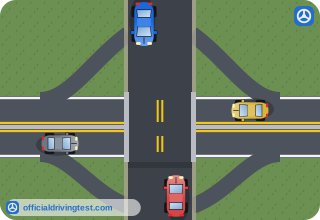
- Cross the paths of approaching through vehicles
- Share a lane with right-turning vehicles
- Enter the interchange from a side street
- Yield to pedestrians at crosswalks
Show answer
Correct answer: Cross the paths of approaching through vehicles
The DDI design removes the need for left-turning vehicles to cross the paths of approaching through vehicles.
Source: South Carolina Driver's Manual (2026 (posted April 2026)), page 7-5 · Open this page in the manual (Manual page 7-5)
-
Compared with a conventional diamond interchange, what does the DDI design do to the number of vehicle-to-vehicle conflict points?
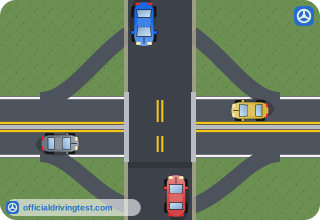
- Slightly increases it
- Leaves it unchanged
- Significantly reduces it
- Significantly increases it
Show answer
Correct answer: Significantly reduces it
The DDI design significantly reduces the number of vehicle-to-vehicle conflict points compared to a conventional diamond interchange.
Source: South Carolina Driver's Manual (2026 (posted April 2026)), page 7-5 · Open this page in the manual (Manual page 7-5)
-
How does a DDI affect the severity of conflicts between vehicles?
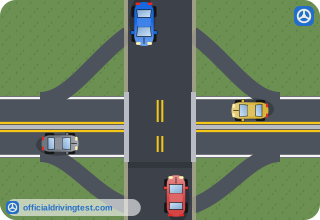
- It increases their severity
- It reduces their severity
- It has no effect on severity
- It raises severity at the ramps
Show answer
Correct answer: It reduces their severity
The manual says the DDI also reduces the severity of conflicts.
Source: South Carolina Driver's Manual (2026 (posted April 2026)), page 7-6 · Open this page in the manual (Manual page 7-6)
-
What does a restricted crossing U-turn (RCUT) intersection eliminate from cross street approaches?
- The right-turn and through movements
- All left-turn and right-turn movements
- The stop signs and traffic signals
- The left-turn and through movements
Show answer
Correct answer: The left-turn and through movements
An RCUT removes the left-turn and through movements from the cross street approaches.
Source: South Carolina Driver's Manual (2026 (posted April 2026)), page 7-6 · Open this page in the manual (Manual page 7-6)
-
How does an RCUT intersection require cross street drivers to make left-turn and through movements?
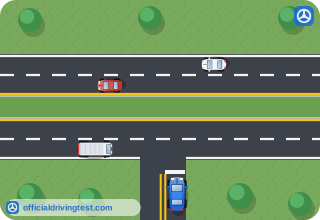
- Turn right, then make a U-turn at a median opening
- Turn left directly across the main road after stopping
- Cross on a signal-controlled bridge over the road
- Turn left after yielding on a separate side road
Show answer
Correct answer: Turn right, then make a U-turn at a median opening
RCUT drivers turn right onto the main road and then make a U-turn at a one-way median opening.
Source: South Carolina Driver's Manual (2026 (posted April 2026)), page 7-6 · Open this page in the manual (Manual page 7-6)
-
How may an RCUT intersection be controlled?
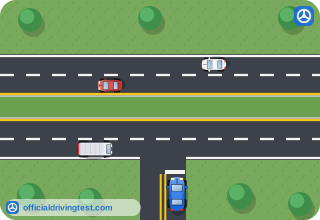
- Only by a traffic signal, never by signs
- Only by a stop sign on the cross street
- A signal, a stop sign, or a merge or yield sign
- By yield signs only
Show answer
Correct answer: A signal, a stop sign, or a merge or yield sign
An RCUT may be controlled by a traffic signal, a stop sign, or a merge or yield sign.
Source: South Carolina Driver's Manual (2026 (posted April 2026)), page 7-6 · Open this page in the manual (Manual page 7-6)
-
What is another name for a roundabout?
- A diverging diamond
- A traffic circle
- A zipper merge
- A three-point turnabout
Show answer
Correct answer: A traffic circle
The manual says a roundabout is also known as a traffic circle.
Source: South Carolina Driver's Manual (2026 (posted April 2026)), page 7-7 · Open this page in the manual (Manual page 7-7)
-
In which direction do vehicles travel around the center island of a roundabout?
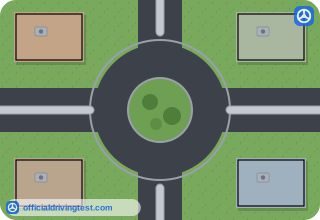
- Clockwise
- Back and forth across the island
- Toward the nearest exit only
- Counterclockwise
Show answer
Correct answer: Counterclockwise
Vehicles travel counterclockwise around the raised center island of a roundabout.
Source: South Carolina Driver's Manual (2026 (posted April 2026)), page 7-7 · Open this page in the manual (Manual page 7-7)
-
Who has the right-of-way at a roundabout?
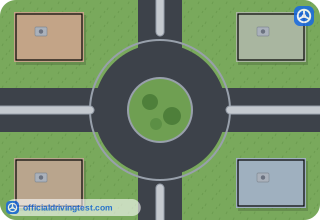
- Traffic already circulating in it
- Traffic waiting to enter the roundabout
- The vehicle that arrives first at the entrance
- Traffic entering from the right
Show answer
Correct answer: Traffic already circulating in it
Entering traffic must yield the right-of-way to circulating traffic.
Source: South Carolina Driver's Manual (2026 (posted April 2026)), page 7-7 · Open this page in the manual (Manual page 7-7)
-
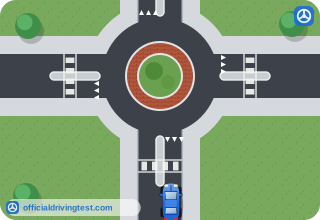
How should you approach a roundabout or traffic circle?
- Speed up to merge with circulating traffic
- Stop completely at the entrance every time
- Slow down to enter it
- Stay in the left lane until you are inside
Show answer
Correct answer: Slow down to enter it
You should slow down to enter a roundabout or traffic circle.
Source: South Carolina Driver's Manual (2026 (posted April 2026)), page 7-7 · Open this page in the manual (Manual page 7-7)
-
In a roundabout or traffic circle, what do you do after you proceed to the appropriate exit?
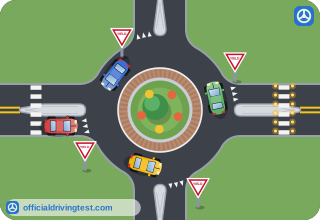
- Sound your horn and exit
- Exit without signaling
- Stop in the circle to let others pass
- Signal your intent and exit
Show answer
Correct answer: Signal your intent and exit
You proceed to the appropriate exit, signal your intent, and exit.
Source: South Carolina Driver's Manual (2026 (posted April 2026)), page 7-7 · Open this page in the manual (Manual page 7-7)
-
To make a left turn at a roundabout, how far around do you go before completing your turn?
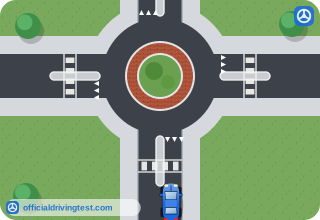
- About three-quarters of the way around
- About one-quarter of the way around
- About halfway around
- A full lap, then exit on the next road
Show answer
Correct answer: About three-quarters of the way around
For a left turn you yield to traffic in the roundabout and go three-quarters of the way around before completing the turn.
Source: South Carolina Driver's Manual (2026 (posted April 2026)), page 7-7 · Open this page in the manual (Manual page 7-7)
-
How should you make a U-turn at a roundabout?
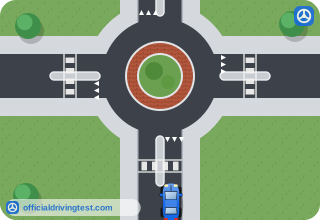
- Go three-quarters of the way around, then exit
- Stop at the entrance and back out onto the road
- Stay right and exit on the same road you entered
- Go halfway around and exit on the next road
Show answer
Correct answer: Stay right and exit on the same road you entered
For a U-turn you yield, stay to the right, continue around the roundabout and exit on the same road you entered from.
Source: South Carolina Driver's Manual (2026 (posted April 2026)), page 7-7 · Open this page in the manual (Manual page 7-7)
-
Which types of collisions do roundabouts eliminate compared with traditional intersections?
- Rear-end and lane-change
- Head-on and high-speed right-angle
- Low-speed parking lot collisions
- Collisions with fixed objects
Show answer
Correct answer: Head-on and high-speed right-angle
Roundabouts are safer because they eliminate head-on and high-speed right-angle collisions.
Source: South Carolina Driver's Manual (2026 (posted April 2026)), page 7-8 · Open this page in the manual (Manual page 7-8)
-
When changing lanes, how do you check your blind spots?
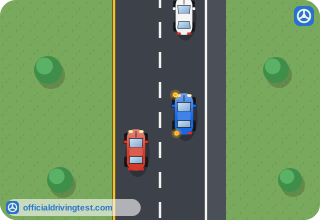
- By checking only your rearview mirror, since it shows every area beside and behind you
- By glancing at the side mirror on the side toward which you plan to move
- By sounding your horn and moving over once other drivers have slowed
- By turning your head and looking over your shoulder in the direction you plan to move
Show answer
Correct answer: By turning your head and looking over your shoulder in the direction you plan to move
Blind spots are checked by turning your head and looking over your shoulder toward the lane you want to enter.
Source: South Carolina Driver's Manual (2026 (posted April 2026)), page 7-14 · Open this page in the manual (Manual page 7-14)
-
When changing lanes, after you identify a gap in traffic and signal, what do you do before steering into the lane?
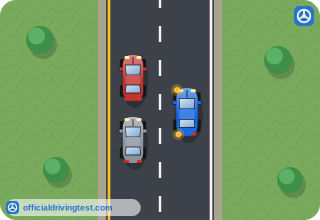
- Look again in the direction of the lane change
- Brake to slow down below the other traffic
- Sound your horn to warn other drivers
- Cancel your turn signal
Show answer
Correct answer: Look again in the direction of the lane change
After finding a gap and signaling, you look again toward the new lane, adjust speed, and then steer into the lane.
Source: South Carolina Driver's Manual (2026 (posted April 2026)), page 7-14 · Open this page in the manual (Manual page 7-14)