South Carolina: Emergencies and winter driving — Part 3 Practice Test
Questions in this part include: “How can you make sure the defroster is working properly?” · “Why should you generally avoid hills in winter conditions?”
Independent educational site · not affiliated with any government agency or DMV
Ready? Test yourself
- Instant feedback with an explanation
- Every answer cites its source in the manual
- Your best score is saved on this device
- Keyboard: press 1 to 4 to answer and Enter for the next question
Questions are original and based on the official manual "South Carolina Driver's Manual" (2026 (posted April 2026)), South Carolina Department of Motor Vehicles.
All 20 questions in this practice test
Take the test above first, then use this list to study. Tap “Show answer” to see the correct answer and explanation.
Show the questions and answersHide the questions
-
How can you make sure the defroster is working properly?
- Wipe the inside of the windshield with a cloth
- Activate the fan and place your hand on the dashboard
- Turn on the wipers and watch the glass clear
- Switch on the headlights and check the dash lights
Show answer
Correct answer: Activate the fan and place your hand on the dashboard
Running the fan and feeling the dashboard with your hand confirms that the defroster is working.
Source: South Carolina Driver's Manual (2026 (posted April 2026)), page 11-6 · Open this page in the manual (Manual page 11-6)
-
What can help give a rear wheel drive car traction in winter?
- Removing all weight from the trunk
- Putting extra weight on the roof rack
- Keeping the fuel tank nearly empty
- Loading extra weight into the trunk
Show answer
Correct answer: Loading extra weight into the trunk
Extra weight in the trunk helps a rear wheel drive car grip the road.
Source: South Carolina Driver's Manual (2026 (posted April 2026)), page 11-6 · Open this page in the manual (Manual page 11-6)
-
Why should you keep a full tank of gasoline in winter driving?
- To keep the engine from overheating in cold air
- To reduce wear on the tires in snow
- To make the battery charge more quickly in cold
- To prevent condensation that may freeze in the tank
Show answer
Correct answer: To prevent condensation that may freeze in the tank
A full tank prevents condensation inside the gas tank, which may freeze and cause further problems.
Source: South Carolina Driver's Manual (2026 (posted April 2026)), page 11-7 · Open this page in the manual (Manual page 11-7)
-
When possible, where should you travel on snowy roads?

- In the untouched snow beside the other tracks
- In the tracks where other vehicles have gone
- In the deepest snow to slow the vehicle down
- Along the shoulder where snow is packed down
Show answer
Correct answer: In the tracks where other vehicles have gone
When possible, travel in the tracks where other vehicles have gone before.
Source: South Carolina Driver's Manual (2026 (posted April 2026)), page 11-7 · Open this page in the manual (Manual page 11-7)
-
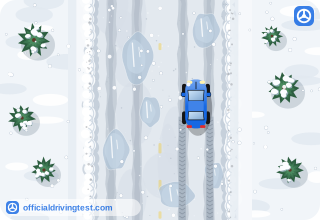
What should you avoid using in winter driving conditions?
- Cruise control
- The defroster
- Your low beams
- Tire chains
Show answer
Correct answer: Cruise control
The manual says to avoid cruise control in winter driving conditions.
Source: South Carolina Driver's Manual (2026 (posted April 2026)), page 11-7 · Open this page in the manual (Manual page 11-7)
-
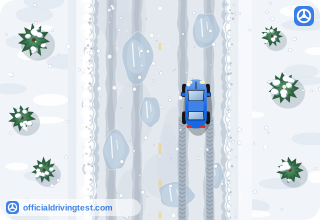
How should you approach intersections in winter driving conditions?
- Faster, to avoid stopping on ice
- With your high beams on
- With caution
- Without braking at all
Show answer
Correct answer: With caution
The manual lists approaching intersections with caution as a winter driving technique.
Source: South Carolina Driver's Manual (2026 (posted April 2026)), page 11-7 · Open this page in the manual (Manual page 11-7)
-
Why should you generally avoid hills in winter conditions?
- The engine will overheat when climbing in cold weather
- A stopped vehicle may be unable to get going again
- Tire chains cannot be used when driving on hills
- Downhill braking is impossible once snow has fallen
Show answer
Correct answer: A stopped vehicle may be unable to get going again
If you stop on a hill, it is extremely difficult, if not impossible, to get going again.
Source: South Carolina Driver's Manual (2026 (posted April 2026)), page 11-7 · Open this page in the manual (Manual page 11-7)
-
If you must drive on a hill in winter conditions, what should you do?
- Accelerate hard at the bottom to reach the top
- Stop partway up to check your traction
- Switch on cruise control to hold a steady pace
- Drive slowly, keep a steady pace, and leave space ahead
Show answer
Correct answer: Drive slowly, keep a steady pace, and leave space ahead
On a hill you should drive slowly, keep a steady pace, and keep a good distance from the vehicle ahead.
Source: South Carolina Driver's Manual (2026 (posted April 2026)), page 11-7 · Open this page in the manual (Manual page 11-7)
-
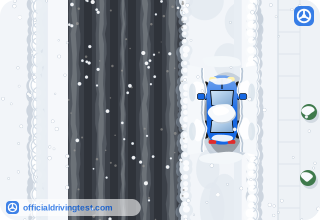
What happens if you spin your wheels when your vehicle is stuck in snow?
- It melts the snow under the tires
- It warms the tires so they grip better
- It packs the snow into a firm track
- It digs the vehicle in deeper
Show answer
Correct answer: It digs the vehicle in deeper
Spinning the wheels only digs the vehicle in deeper.
Source: South Carolina Driver's Manual (2026 (posted April 2026)), page 11-7 · Open this page in the manual (Manual page 11-7)
-
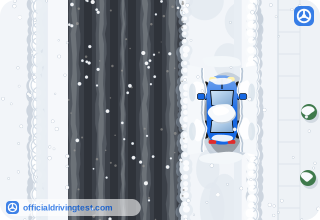
What can you do to push snow out of the way when your vehicle is stuck?
- Keep the wheels straight and press the gas hard
- Turn your wheels from side to side a few times
- Let air out of the tires until they are soft
- Shift into park and rev the engine
Show answer
Correct answer: Turn your wheels from side to side a few times
Turning the wheels from side to side a few times pushes snow out of the way.
Source: South Carolina Driver's Manual (2026 (posted April 2026)), page 11-7 · Open this page in the manual (Manual page 11-7)
-
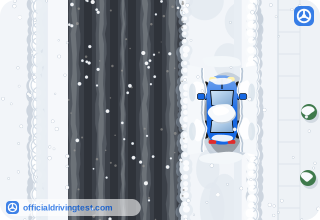
How should you use the gas pedal to ease a stuck car out of snow?
- With a steady hard push
- With quick bursts of full throttle
- With a light touch
- Not at all
Show answer
Correct answer: With a light touch
A light touch on the gas eases the car out without digging it in.
Source: South Carolina Driver's Manual (2026 (posted April 2026)), page 11-7 · Open this page in the manual (Manual page 11-7)
-
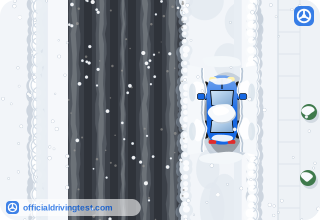
Which tool can you use to clear snow away from the wheels and the underside of a stuck car?
- A shovel
- A jack
- A tow strap
- A tire gauge
Show answer
Correct answer: A shovel
A shovel clears snow from around the wheels and under the car.
Source: South Carolina Driver's Manual (2026 (posted April 2026)), page 11-7 · Open this page in the manual (Manual page 11-7)
-
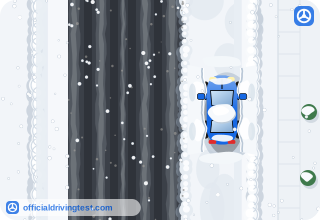
Which of these can you pour in the path of the wheels to help get traction?
- Cat litter
- Motor oil
- Water
- Antifreeze
Show answer
Correct answer: Cat litter
Sand, cat litter, gravel, or salt poured in the path of the wheels can help get traction.
Source: South Carolina Driver's Manual (2026 (posted April 2026)), page 11-8 · Open this page in the manual (Manual page 11-8)
-
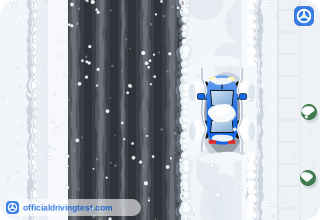
Which item can you place under the wheels of a stuck vehicle to help get traction?
- Plastic sheeting
- Wet towels
- Newspaper
- Soap
Show answer
Correct answer: Newspaper
Cardboard, newspaper, or brush under the wheels can help a stuck vehicle get traction.
Source: South Carolina Driver's Manual (2026 (posted April 2026)), page 11-8 · Open this page in the manual (Manual page 11-8)
-
In which direction should you steer if your vehicle starts to skid?
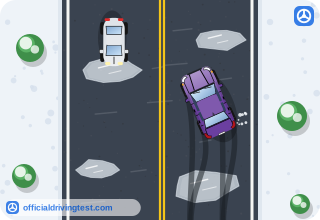
- Away from the direction you want to go
- Toward the nearest edge of the road
- Straight ahead without turning at all
- The direction you want the front to go
Show answer
Correct answer: The direction you want the front to go
You steer in the direction you want the front of the vehicle to go.
Source: South Carolina Driver's Manual (2026 (posted April 2026)), page 11-8 · Open this page in the manual (Manual page 11-8)
-
What does the manual say about abandoning your vehicle in the roadway during winter driving?
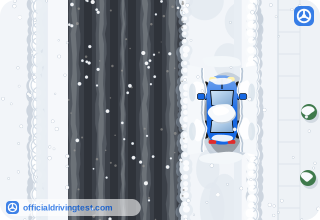
- Do not do it, if possible
- Do it so rescuers can find you
- Do it only if the engine stalls
- Do it whenever snow falls
Show answer
Correct answer: Do not do it, if possible
You should not abandon your vehicle in the roadway, if possible.
Source: South Carolina Driver's Manual (2026 (posted April 2026)), page 11-8 · Open this page in the manual (Manual page 11-8)
-
If a trailer begins to sway or whip, what should you do?
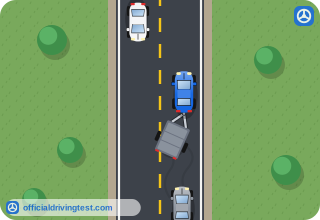
- Brake hard and steer toward the shoulder
- Speed up to pull the trailer straight
- Steer straight and reduce speed gradually
- Steer sharply in the opposite direction
Show answer
Correct answer: Steer straight and reduce speed gradually
You steer straight and slow down gradually, without braking, and never speed up.
Source: South Carolina Driver's Manual (2026 (posted April 2026)), page 11-10 · Open this page in the manual (Manual page 11-10)
-
After stopping a swaying trailer, what does the manual say to check first?
- Whether the trailer is loaded heavier in front
- Whether the hitch-ball has been greased
- Whether the brake fluid is at the full mark
- Whether the trailer has the correct license plate
Show answer
Correct answer: Whether the trailer is loaded heavier in front
The cargo should be checked first to be sure the trailer is loaded heavier in front, and reloaded if necessary.
Source: South Carolina Driver's Manual (2026 (posted April 2026)), page 11-11 · Open this page in the manual (Manual page 11-11)
-
If the trailer starts to jackknife while you are backing, what should you do?
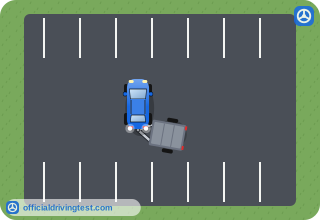
- Stop and pull ahead to straighten out
- Keep backing and turn the wheel harder
- Speed up to pull the trailer back in line
- Stop, then keep backing up in the same direction
Show answer
Correct answer: Stop and pull ahead to straighten out
You stop, pull ahead to straighten the trailer, and then start again.
Source: South Carolina Driver's Manual (2026 (posted April 2026)), page 11-12 · Open this page in the manual (Manual page 11-12)
-
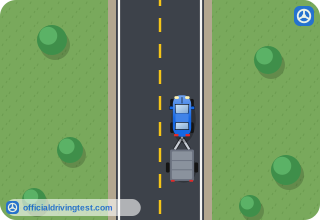
If you hear an unusual noise or suspect trouble while towing, what should you do?
- Keep driving until you reach your destination
- Slow down and turn on your hazard flashers
- Stop in the right lane and check immediately
- Stop at a safe place off the roadway to check
Show answer
Correct answer: Stop at a safe place off the roadway to check
You stop at a safe place off the roadway to check the problem.
Source: South Carolina Driver's Manual (2026 (posted April 2026)), page 11-12 · Open this page in the manual (Manual page 11-12)