South Carolina: Emergency vehicles, police stops and work zones — Part 1 Practice Test
Questions in this part include: “What may happen if you endanger a highway worker?” · “When does a law enforcement officer conduct a traffic stop?”
Independent educational site · not affiliated with any government agency or DMV
Ready? Test yourself
- Instant feedback with an explanation
- Every answer cites its source in the manual
- Your best score is saved on this device
- Keyboard: press 1 to 4 to answer and Enter for the next question
Questions are original and based on the official manual "South Carolina Driver's Manual" (2026 (posted April 2026)), South Carolina Department of Motor Vehicles.
All 18 questions in this practice test
Take the test above first, then use this list to study. Tap “Show answer” to see the correct answer and explanation.
Show the questions and answersHide the questions
-
Which of these do work zone signs warn you about?
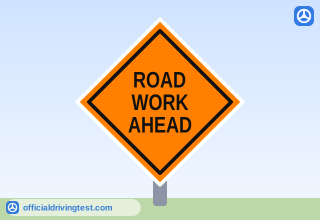
- Poor or suddenly changing road surfaces
- Hospital services at the next exit ahead
- A mandatory hurricane evacuation route
- Places where parking is allowed ahead
Show answer
Correct answer: Poor or suddenly changing road surfaces
Work zone signs warn of workers ahead, reduced speed zones, detours, slow-moving equipment, and poor or suddenly changing road surfaces.
Source: South Carolina Driver's Manual (2026 (posted April 2026)), page 6-7 · Open this page in the manual (Manual page 6-7)
-
An orange diamond sign shows a person holding out a small flag on a stick. What does it warn you of?
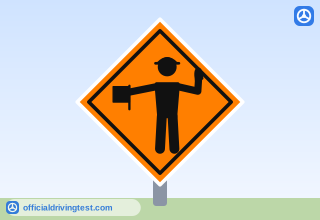
- Workers Ahead
- One Lane Road Ahead
- Road Construction Ahead
- Flagger Ahead
Show answer
Correct answer: Flagger Ahead
An orange diamond with a figure holding a flag warns that a flagger is ahead.
Source: South Carolina Driver's Manual (2026 (posted April 2026)), page 6-8 · Open this page in the manual (Manual page 6-8)
-
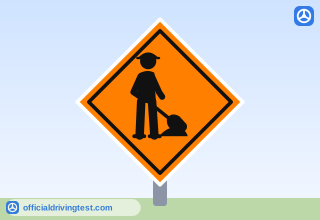
An orange diamond sign shows a person digging with a shovel. What does it warn you of?
- Flagger Ahead
- Workers Ahead
- One Lane Road Ahead
- Detour
Show answer
Correct answer: Workers Ahead
An orange diamond with a figure digging warns that workers are ahead.
Source: South Carolina Driver's Manual (2026 (posted April 2026)), page 6-8 · Open this page in the manual (Manual page 6-8)
-
In a work zone, a person with a sign or flag tells you which way to travel or to slow down or stop. What must you do?
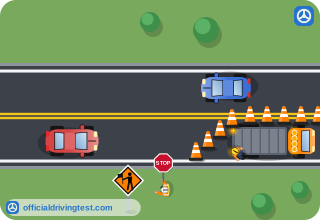
- Follow the person's instructions
- Follow them only when workers are close to the road
- Follow them unless the road ahead looks clear
- Follow them only if the signs match the road markings
Show answer
Correct answer: Follow the person's instructions
Traffic in work zones may be controlled by a person with a sign or flag, and you must follow their instructions.
Source: South Carolina Driver's Manual (2026 (posted April 2026)), page 6-8 · Open this page in the manual (Manual page 6-8)
-
What are barriers such as drums, cones, and tubes (panels) used for in work zones?
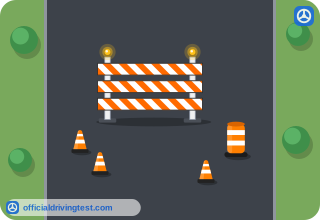
- To mark places where workers may park their vehicles
- To show drivers the speed limit in the work zone
- To warn drivers of an upcoming railroad crossing
- To keep traffic out of hazardous work zones
Show answer
Correct answer: To keep traffic out of hazardous work zones
Drums, cones, and tubes keep traffic out of hazardous work zones and, with signs and road markings, guide you through safely.
Source: South Carolina Driver's Manual (2026 (posted April 2026)), page 6-8 · Open this page in the manual (Manual page 6-8)
-
You see a warning sign showing the symbol of a traffic signal in a work zone. Where do you stop for the temporary signal?
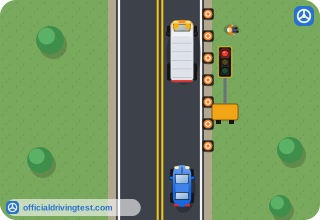
- Beside the signal pole, whether or not there is a line
- Past the signal, if the intersection looks clear
- At the white line, if one is present
- At the point where you first see the red light
Show answer
Correct answer: At the white line, if one is present
Temporary traffic signals may be used in work zones; stop at the white line, if it is present.
Source: South Carolina Driver's Manual (2026 (posted April 2026)), page 6-8 · Open this page in the manual (Manual page 6-8)
-
How should you drive in a work zone?
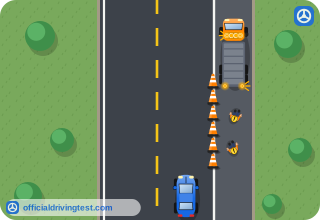
- Keep your speed but be ready to change lanes
- Speed up to leave the workers behind quickly
- Slow down only when workers are in view
- Reduce your speed and be prepared to stop suddenly
Show answer
Correct answer: Reduce your speed and be prepared to stop suddenly
The manual tells you to give workers a brake: reduce your speed and be prepared to stop suddenly.
Source: South Carolina Driver's Manual (2026 (posted April 2026)), page 6-9 · Open this page in the manual (Manual page 6-9)
-
Which of these should you not do in a work zone?
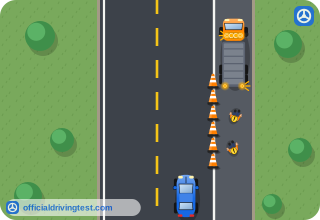
- Reduce your speed
- Follow a flagger's instructions
- Tailgate the vehicle ahead
- Be prepared to stop suddenly
Show answer
Correct answer: Tailgate the vehicle ahead
The manual says not to tailgate in work zones, where traffic may need to stop suddenly.
Source: South Carolina Driver's Manual (2026 (posted April 2026)), page 6-9 · Open this page in the manual (Manual page 6-9)
-
What may happen if you endanger a highway worker?
- Your driver's license is revoked automatically for a full year
- You may be fined and have points assessed against your driving record
- Your vehicle is taken away at the scene by the highway patrol
- You must retake the written test within ten days of the incident
Show answer
Correct answer: You may be fined and have points assessed against your driving record
Endangering a highway worker may bring a fine and points on your driving record.
Source: South Carolina Driver's Manual (2026 (posted April 2026)), page 6-9 · Open this page in the manual (Manual page 6-9)
-
Why are emergency vehicles equipped with sirens, flashing lights, and special horns?
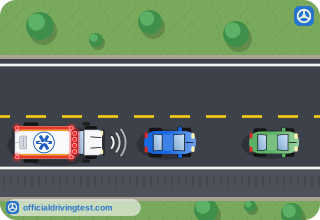
- To tell nearby drivers to stop where they are
- To show that the vehicle is parked
- To help them move more efficiently through traffic
- To warn drivers that a road is closed
Show answer
Correct answer: To help them move more efficiently through traffic
This equipment helps emergency vehicles move through traffic more efficiently.
Source: South Carolina Driver's Manual (2026 (posted April 2026)), page 10-11 · Open this page in the manual (Manual page 10-11)
-
What must you do when an emergency vehicle approaches with its flashing lights and siren on?
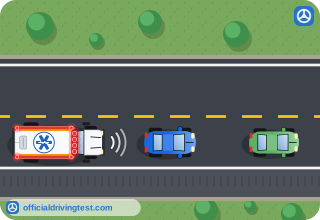
- Speed up to stay ahead of it
- Pull over to the edge of the road to yield
- Stop in your lane right where you are
- Continue at your speed and stay in your lane
Show answer
Correct answer: Pull over to the edge of the road to yield
You must yield right-of-way by pulling over to the edge of the road so the emergency vehicle can pass more easily.
Source: South Carolina Driver's Manual (2026 (posted April 2026)), page 10-12 · Open this page in the manual (Manual page 10-12)
-
When you pull over for an emergency vehicle, what should you avoid whenever possible?
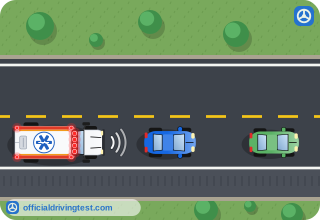
- Pulling over to the edge of the road to let it pass
- Yielding the right-of-way to the emergency vehicle
- Stopping for the emergency vehicle as it passes
- Blocking intersections, roadways, or driveways
Show answer
Correct answer: Blocking intersections, roadways, or driveways
While making way for an emergency vehicle, try not to block intersections, roadways or driveways.
Source: South Carolina Driver's Manual (2026 (posted April 2026)), page 10-12 · Open this page in the manual (Manual page 10-12)
-
When does a law enforcement officer conduct a traffic stop?
- Only when a driver is suspected of impaired driving
- Only when the driver is a first-time offender
- Only when a vehicle is parked on the shoulder
- When a violation is seen or an investigation is under way
Show answer
Correct answer: When a violation is seen or an investigation is under way
An officer stops a vehicle because he or she sees a traffic violation or is conducting a police investigation.
Source: South Carolina Driver's Manual (2026 (posted April 2026)), page 10-12 · Open this page in the manual (Manual page 10-12)
-
What should you do when you see emergency lights behind you?
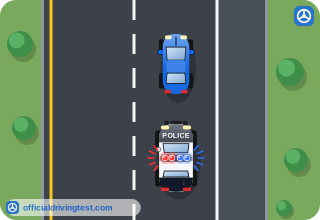
- Speed up until you reach a well-lit place where you can stop
- Stay calm, signal, and pull over as soon and safely as possible
- Stop immediately in your lane and wait for the officer to come
- Turn on your high beams and keep driving at the same speed
Show answer
Correct answer: Stay calm, signal, and pull over as soon and safely as possible
You should stay calm, signal and pull to the side of the roadway as soon as you safely can.
Source: South Carolina Driver's Manual (2026 (posted April 2026)), page 10-12 · Open this page in the manual (Manual page 10-12)
-
After pulling over for a traffic stop, what should you turn off?
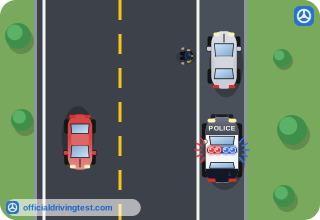
- Only the headlights
- The hazard flashers
- The ignition and the radio
- Nothing, leave the engine running
Show answer
Correct answer: The ignition and the radio
After stopping, turn off the ignition and the radio.
Source: South Carolina Driver's Manual (2026 (posted April 2026)), page 10-12 · Open this page in the manual (Manual page 10-12)
-
After pulling over for a traffic stop, what should you turn on?
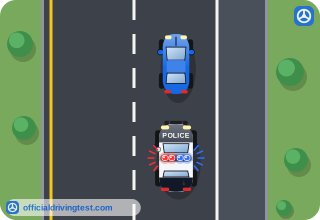
- Your hazard flashers
- Your high beams
- Your windshield wipers
- Your fog lights
Show answer
Correct answer: Your hazard flashers
The manual tells you to turn on your hazard flashers once you have stopped.
Source: South Carolina Driver's Manual (2026 (posted April 2026)), page 10-12 · Open this page in the manual (Manual page 10-12)
-
During a traffic stop, what should you do unless the officer directs you to exit?
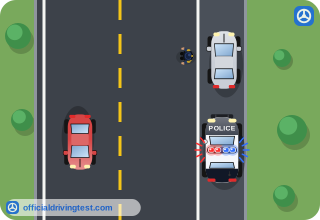
- Walk back to the officer's vehicle
- Step out and stand beside your door
- Stay in your vehicle
- Stand at the rear of your vehicle
Show answer
Correct answer: Stay in your vehicle
Remain in the vehicle unless the officer tells you to get out.
Source: South Carolina Driver's Manual (2026 (posted April 2026)), page 10-12 · Open this page in the manual (Manual page 10-12)
-
Where should you keep your hands during a traffic stop?
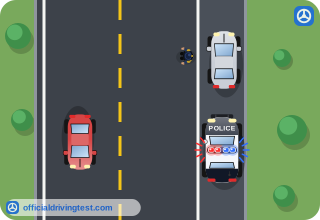
- On the steering wheel
- On the dashboard
- In your lap
- Reaching toward the glove box
Show answer
Correct answer: On the steering wheel
Hands on the steering wheel can be easily seen by the officer.
Source: South Carolina Driver's Manual (2026 (posted April 2026)), page 10-12 · Open this page in the manual (Manual page 10-12)