Rhode Island: Speed and following distance — Part 1 Practice Test
Questions in this part include: “Why does the Governor's message say it is essential to adhere to speed limits?” · “How is total stopping distance made up?”
Independent educational site · not affiliated with any government agency or DMV
Ready? Test yourself
- Instant feedback with an explanation
- Every answer cites its source in the manual
- Your best score is saved on this device
- Keyboard: press 1 to 4 to answer and Enter for the next question
Questions are original and based on the official manual "Rhode Island Driver’s Manual" (April 2024), Rhode Island Division of Motor Vehicles (DMV).
All 19 questions in this practice test
Take the test above first, then use this list to study. Tap “Show answer” to see the correct answer and explanation.
Show the questions and answersHide the questions
-
Why does the Governor's message say it is essential to adhere to speed limits?
- Most serious crashes involve excessive speed
- Speed limits are the same on every road
- Excessive speed is a risk only on highways
- Slow drivers cause most serious crashes
Show answer
Correct answer: Most serious crashes involve excessive speed
The message gives the reason that most serious crashes involve excessive speed.
Source: Rhode Island Driver’s Manual (April 2024), page 2
-
Which three things must happen for you to stop your vehicle?
- Signal, steer, and brake
- Perceive the danger, signal, and accelerate
- Perceive the danger, react to it, and brake
- Slow down, shift gears, and brake
Show answer
Correct answer: Perceive the danger, react to it, and brake
Stopping needs you to perceive the danger, react to it, and then brake.
Source: Rhode Island Driver’s Manual (April 2024), page 28
-
What is your perception distance?
- The distance your vehicle travels from when the brakes are applied until it stops
- The distance your vehicle travels between recognizing the danger and reacting to it
- The distance your vehicle travels while your foot moves to the brake pedal
- The total distance needed to stop the vehicle
Show answer
Correct answer: The distance your vehicle travels between recognizing the danger and reacting to it
Perception distance is the distance traveled between recognizing the danger and reacting to it.
Source: Rhode Island Driver’s Manual (April 2024), page 28
-
What is your reaction distance?
- The distance your vehicle travels between recognizing the danger and deciding to react
- The distance your vehicle travels after the brakes are applied
- The distance your vehicle travels from the danger to the stop sign
- The distance your vehicle travels while you move to step on the brake
Show answer
Correct answer: The distance your vehicle travels while you move to step on the brake
Reaction distance is the distance traveled while you move your foot to step on the brake.
Source: Rhode Island Driver’s Manual (April 2024), page 28
-
What is your braking distance?
- The distance your vehicle travels while you move your foot to the brake
- The distance your vehicle travels from when you see the danger until you react
- The distance your vehicle travels in the last second before the stop
- The distance your vehicle travels from when the brakes are applied until it is stopped
Show answer
Correct answer: The distance your vehicle travels from when the brakes are applied until it is stopped
Braking distance runs from the moment the brakes are applied until the vehicle stops.
Source: Rhode Island Driver’s Manual (April 2024), page 28
-
How is total stopping distance made up?
- Reaction distance plus braking distance, with no perception distance
- Perception distance plus reaction distance plus braking distance
- Perception distance plus braking distance, with no reaction distance
- Braking distance multiplied by the driver's reaction time
Show answer
Correct answer: Perception distance plus reaction distance plus braking distance
Total stopping distance is the sum of the perception, reaction and braking distances.
Source: Rhode Island Driver’s Manual (April 2024), page 28
-
After seeing danger, about how long does it take the average driver to apply the brake?
- About 1/4 of a second
- About 1 1/2 seconds
- About 3/4 of a second
- About 2 seconds
Show answer
Correct answer: About 3/4 of a second
The manual says the average driver needs about three-quarters of a second to apply the brake.
Source: Rhode Island Driver’s Manual (April 2024), page 28
-
What happens to the distance your vehicle travels before you can apply the brake as your driving speed gets higher?
- It gets longer
- It gets shorter
- It stays the same
- It changes only on wet roads
Show answer
Correct answer: It gets longer
At higher speeds the vehicle covers more ground before the driver can apply the brake.
Source: Rhode Island Driver’s Manual (April 2024), page 28
-
Why is braking distance much longer on wet or icy roads?
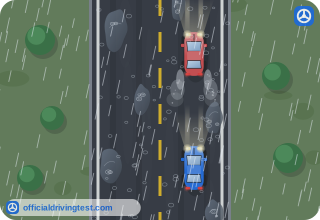
- The driver's reaction time is slower
- Tires are heavier when wet
- Traction is reduced
- Brakes work only at low speeds
Show answer
Correct answer: Traction is reduced
Reduced traction makes braking distance much longer, so the manual says you must drive slower in these conditions.
Source: Rhode Island Driver’s Manual (April 2024), page 28
-
When are roads especially slippery in the rain?
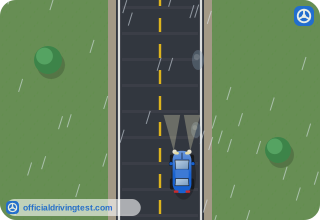
- When it first starts to rain
- After it has rained for an hour
- Just after the rain stops
- Only when the rain is heavy
Show answer
Correct answer: When it first starts to rain
Oil, rubber, dirt and water combine to make the road especially slippery at the start of a rain.
Source: Rhode Island Driver’s Manual (April 2024), page 28
-
On dry level pavement, with a driver reaction time of 3/4 second, what total stopping distance does the manual give for a vehicle traveling 30 mph?
- 55 feet
- 95 feet
- 110 feet
- 75 feet
Show answer
Correct answer: 75 feet
At 30 mph the manual's chart gives a total stopping distance of 75 feet.
Source: Rhode Island Driver’s Manual (April 2024), page 28
-
On dry level pavement, with a driver reaction time of 3/4 second, what total stopping distance does the manual give for a vehicle traveling 50 mph?
- 145 feet
- 175 feet
- 210 feet
- 250 feet
Show answer
Correct answer: 175 feet
At 50 mph the manual's total stopping distance is 175 feet.
Source: Rhode Island Driver’s Manual (April 2024), page 28
-
On dry level pavement, with a driver reaction time of 3/4 second, what total stopping distance does the manual give for a vehicle traveling 60 mph?
- 240 feet
- 200 feet
- 280 feet
- 300 feet
Show answer
Correct answer: 240 feet
At 60 mph the manual's total stopping distance is 240 feet.
Source: Rhode Island Driver’s Manual (April 2024), page 28
-
On dry level pavement, with a driver reaction time of 3/4 second, what total stopping distance does the manual give for a vehicle traveling 70 mph?
- 265 feet
- 350 feet
- 315 feet
- 400 feet
Show answer
Correct answer: 315 feet
At 70 mph the manual's total stopping distance is 315 feet.
Source: Rhode Island Driver’s Manual (April 2024), page 28
-
What is velocitizing?
- Losing steering control when the front tires lose contact with a wet road
- Beginning to feel that you are going slower than your actual speed
- Feeling that you are going faster than your actual speed
- Becoming drowsy on long drives
Show answer
Correct answer: Beginning to feel that you are going slower than your actual speed
Velocitizing is the false feeling that you are going slower than you really are.
Source: Rhode Island Driver’s Manual (April 2024), page 28
-
How can you avoid velocitizing when driving long distances on the highway?
- Hold your speed exactly the same
- Drive in the left lane
- Turn up the radio volume
- Vary your speed slightly
Show answer
Correct answer: Vary your speed slightly
Varying your speed slightly helps you avoid velocitizing on long highway drives.
Source: Rhode Island Driver’s Manual (April 2024), page 28
-
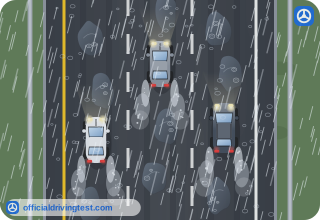
What is hydroplaning?
- The rear wheels lock up on a dry road and the vehicle slides sideways
- The engine floods after driving through deep standing water for a while
- You begin to feel that you are going slower than you actually are going
- The front tires lose contact with a wet road surface and you lose steering capability
Show answer
Correct answer: The front tires lose contact with a wet road surface and you lose steering capability
Hydroplaning is when the front tires lift off a wet road and steering is lost.
Source: Rhode Island Driver’s Manual (April 2024), page 28
-
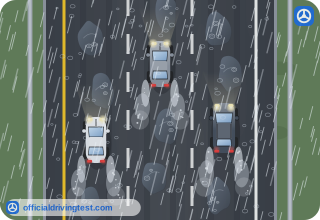
Which of these helps guard against hydroplaning?
- Letting some air out of the tires so they grip the road better
- Keeping tire pressure at the manufacturer's recommended standard
- Driving on the shoulder whenever it is raining
- Keeping your speed up to push water aside
Show answer
Correct answer: Keeping tire pressure at the manufacturer's recommended standard
Keeping tires inflated to the recommended pressure, reducing speed and being careful in the rain all guard against hydroplaning.
Source: Rhode Island Driver’s Manual (April 2024), page 28
-
According to the manual, what speed limit does Rhode Island law set in residential areas?
- 25 miles per hour
- 20 miles per hour
- 30 miles per hour
- 15 miles per hour
Show answer
Correct answer: 25 miles per hour
Rhode Island law sets the limit at 25 mph in residential areas.
Source: Rhode Island Driver’s Manual (April 2024), page 35