Rhode Island: Speed and following distance
Rhode Island speed limits, stopping distances, the three-second rule, lane positions and defensive driving systems. Split into 3 shorter tests so you're not stuck in one long quiz.
Independent educational site · not affiliated with any government agency or DMV
Choose a part
Speed and following distance — Part 1
Questions in this part include: “Why does the Governor's message say it is essential to adhere to speed limits?”
StartSpeed and following distance — Part 2
Questions in this part include: “According to the manual, what speed limits does Rhode Island law set on most highways?”
StartSpeed and following distance — Part 3
Questions in this part include: “According to the Smith System key "Aim High In Steering," where should you look?”
StartAll 55 Speed and following distance questions with answers
Choose a part above to take a practice test, or study every question and answer here.
Show the questions and answersHide the questions
-
Why does the Governor's message say it is essential to adhere to speed limits?
- Most serious crashes involve excessive speed
- Speed limits are the same on every road
- Excessive speed is a risk only on highways
- Slow drivers cause most serious crashes
Show answer
Correct answer: Most serious crashes involve excessive speed
The message gives the reason that most serious crashes involve excessive speed.
Source: Rhode Island Driver’s Manual (April 2024), page 2
-
Which three things must happen for you to stop your vehicle?
- Signal, steer, and brake
- Perceive the danger, signal, and accelerate
- Perceive the danger, react to it, and brake
- Slow down, shift gears, and brake
Show answer
Correct answer: Perceive the danger, react to it, and brake
Stopping needs you to perceive the danger, react to it, and then brake.
Source: Rhode Island Driver’s Manual (April 2024), page 28
-
What is your perception distance?
- The distance your vehicle travels from when the brakes are applied until it stops
- The distance your vehicle travels between recognizing the danger and reacting to it
- The distance your vehicle travels while your foot moves to the brake pedal
- The total distance needed to stop the vehicle
Show answer
Correct answer: The distance your vehicle travels between recognizing the danger and reacting to it
Perception distance is the distance traveled between recognizing the danger and reacting to it.
Source: Rhode Island Driver’s Manual (April 2024), page 28
-
What is your reaction distance?
- The distance your vehicle travels between recognizing the danger and deciding to react
- The distance your vehicle travels after the brakes are applied
- The distance your vehicle travels from the danger to the stop sign
- The distance your vehicle travels while you move to step on the brake
Show answer
Correct answer: The distance your vehicle travels while you move to step on the brake
Reaction distance is the distance traveled while you move your foot to step on the brake.
Source: Rhode Island Driver’s Manual (April 2024), page 28
-
What is your braking distance?
- The distance your vehicle travels while you move your foot to the brake
- The distance your vehicle travels from when you see the danger until you react
- The distance your vehicle travels in the last second before the stop
- The distance your vehicle travels from when the brakes are applied until it is stopped
Show answer
Correct answer: The distance your vehicle travels from when the brakes are applied until it is stopped
Braking distance runs from the moment the brakes are applied until the vehicle stops.
Source: Rhode Island Driver’s Manual (April 2024), page 28
-
How is total stopping distance made up?
- Reaction distance plus braking distance, with no perception distance
- Perception distance plus reaction distance plus braking distance
- Perception distance plus braking distance, with no reaction distance
- Braking distance multiplied by the driver's reaction time
Show answer
Correct answer: Perception distance plus reaction distance plus braking distance
Total stopping distance is the sum of the perception, reaction and braking distances.
Source: Rhode Island Driver’s Manual (April 2024), page 28
-
After seeing danger, about how long does it take the average driver to apply the brake?
- About 1/4 of a second
- About 1 1/2 seconds
- About 3/4 of a second
- About 2 seconds
Show answer
Correct answer: About 3/4 of a second
The manual says the average driver needs about three-quarters of a second to apply the brake.
Source: Rhode Island Driver’s Manual (April 2024), page 28
-
What happens to the distance your vehicle travels before you can apply the brake as your driving speed gets higher?
- It gets longer
- It gets shorter
- It stays the same
- It changes only on wet roads
Show answer
Correct answer: It gets longer
At higher speeds the vehicle covers more ground before the driver can apply the brake.
Source: Rhode Island Driver’s Manual (April 2024), page 28
-
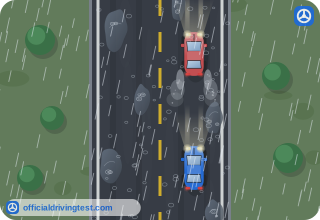
Why is braking distance much longer on wet or icy roads?
- The driver's reaction time is slower
- Tires are heavier when wet
- Traction is reduced
- Brakes work only at low speeds
Show answer
Correct answer: Traction is reduced
Reduced traction makes braking distance much longer, so the manual says you must drive slower in these conditions.
Source: Rhode Island Driver’s Manual (April 2024), page 28
-
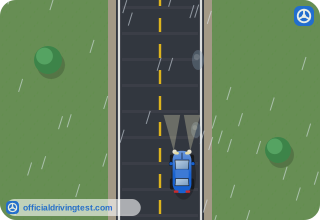
When are roads especially slippery in the rain?
- When it first starts to rain
- After it has rained for an hour
- Just after the rain stops
- Only when the rain is heavy
Show answer
Correct answer: When it first starts to rain
Oil, rubber, dirt and water combine to make the road especially slippery at the start of a rain.
Source: Rhode Island Driver’s Manual (April 2024), page 28
-
On dry level pavement, with a driver reaction time of 3/4 second, what total stopping distance does the manual give for a vehicle traveling 30 mph?
- 55 feet
- 95 feet
- 110 feet
- 75 feet
Show answer
Correct answer: 75 feet
At 30 mph the manual's chart gives a total stopping distance of 75 feet.
Source: Rhode Island Driver’s Manual (April 2024), page 28
-
On dry level pavement, with a driver reaction time of 3/4 second, what total stopping distance does the manual give for a vehicle traveling 50 mph?
- 145 feet
- 175 feet
- 210 feet
- 250 feet
Show answer
Correct answer: 175 feet
At 50 mph the manual's total stopping distance is 175 feet.
Source: Rhode Island Driver’s Manual (April 2024), page 28
-
On dry level pavement, with a driver reaction time of 3/4 second, what total stopping distance does the manual give for a vehicle traveling 60 mph?
- 240 feet
- 200 feet
- 280 feet
- 300 feet
Show answer
Correct answer: 240 feet
At 60 mph the manual's total stopping distance is 240 feet.
Source: Rhode Island Driver’s Manual (April 2024), page 28
-
On dry level pavement, with a driver reaction time of 3/4 second, what total stopping distance does the manual give for a vehicle traveling 70 mph?
- 265 feet
- 350 feet
- 315 feet
- 400 feet
Show answer
Correct answer: 315 feet
At 70 mph the manual's total stopping distance is 315 feet.
Source: Rhode Island Driver’s Manual (April 2024), page 28
-
What is velocitizing?
- Losing steering control when the front tires lose contact with a wet road
- Beginning to feel that you are going slower than your actual speed
- Feeling that you are going faster than your actual speed
- Becoming drowsy on long drives
Show answer
Correct answer: Beginning to feel that you are going slower than your actual speed
Velocitizing is the false feeling that you are going slower than you really are.
Source: Rhode Island Driver’s Manual (April 2024), page 28
-
How can you avoid velocitizing when driving long distances on the highway?
- Hold your speed exactly the same
- Drive in the left lane
- Turn up the radio volume
- Vary your speed slightly
Show answer
Correct answer: Vary your speed slightly
Varying your speed slightly helps you avoid velocitizing on long highway drives.
Source: Rhode Island Driver’s Manual (April 2024), page 28
-
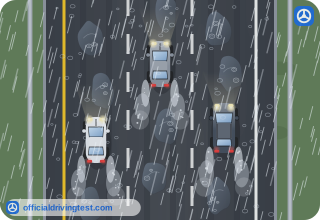
What is hydroplaning?
- The rear wheels lock up on a dry road and the vehicle slides sideways
- The engine floods after driving through deep standing water for a while
- You begin to feel that you are going slower than you actually are going
- The front tires lose contact with a wet road surface and you lose steering capability
Show answer
Correct answer: The front tires lose contact with a wet road surface and you lose steering capability
Hydroplaning is when the front tires lift off a wet road and steering is lost.
Source: Rhode Island Driver’s Manual (April 2024), page 28
-
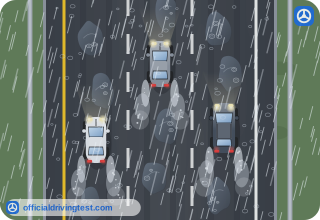
Which of these helps guard against hydroplaning?
- Letting some air out of the tires so they grip the road better
- Keeping tire pressure at the manufacturer's recommended standard
- Driving on the shoulder whenever it is raining
- Keeping your speed up to push water aside
Show answer
Correct answer: Keeping tire pressure at the manufacturer's recommended standard
Keeping tires inflated to the recommended pressure, reducing speed and being careful in the rain all guard against hydroplaning.
Source: Rhode Island Driver’s Manual (April 2024), page 28
-
According to the manual, what speed limit does Rhode Island law set in residential areas?
- 25 miles per hour
- 20 miles per hour
- 30 miles per hour
- 15 miles per hour
Show answer
Correct answer: 25 miles per hour
Rhode Island law sets the limit at 25 mph in residential areas.
Source: Rhode Island Driver’s Manual (April 2024), page 35
-
According to the manual, what speed limits does Rhode Island law set on most highways?
- 40 to 55 miles per hour
- 45 to 60 miles per hour
- 50 to 65 miles per hour
- 55 to 70 miles per hour
Show answer
Correct answer: 50 to 65 miles per hour
Rhode Island law sets limits of 50-65 mph on most highways.
Source: Rhode Island Driver’s Manual (April 2024), page 35
-
What is the easiest way to tell whether you are a safe distance from the vehicle ahead of you?
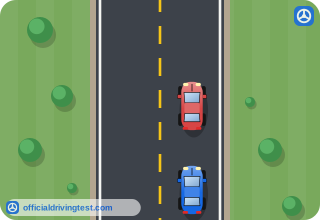
- The two-second following-distance rule
- The three-second following-distance rule
- The six-second following-distance rule
- One car length for every 10 mph
Show answer
Correct answer: The three-second following-distance rule
The manual names the three-second following-distance rule as the easiest way to judge a safe distance.
Source: Rhode Island Driver’s Manual (April 2024), page 35
-
If the roadway is wet or slippery, how much following distance do you need?
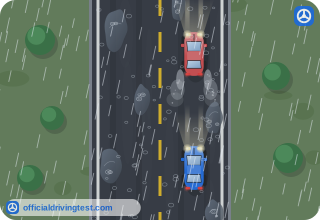
- Less distance, because you are driving slower
- The same distance as on a dry road
- No set distance, as long as you use low beams
- Additional distance (more seconds)
Show answer
Correct answer: Additional distance (more seconds)
On a wet or slippery road you need additional distance, meaning more seconds.
Source: Rhode Island Driver’s Manual (April 2024), page 35
-
If you are being tailgated, what does the manual say to do to avoid the risk of aggressive driving or road rage?
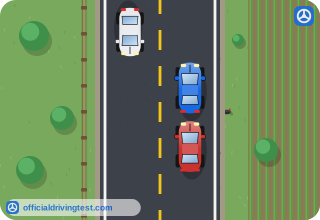
- Change lanes or let the driver pass you
- Speed up to put distance between you and the tailgater
- Brake hard to make the driver back off
- Stay in your lane and hold your speed so the driver gives up
Show answer
Correct answer: Change lanes or let the driver pass you
You should change lanes or allow the driver to pass you.
Source: Rhode Island Driver’s Manual (April 2024), page 35
-
Which of these should you never do when you are being tailgated?
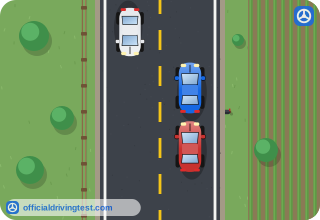
- Change lanes
- Allow the driver to pass you
- Speed up
- Stay calm and ignore the incident
Show answer
Correct answer: Speed up
The manual says never to speed up, because the tailgater may keep tailgating at the higher speed.
Source: Rhode Island Driver’s Manual (April 2024), page 35
-
What does the Basic Speed Law in Rhode Island require of motorists?
- To drive at the posted speed limit in all conditions
- To drive at least 50 miles per hour on a highway
- To drive only as fast as the road conditions dictate
- To drive below 25 miles per hour near homes
Show answer
Correct answer: To drive only as fast as the road conditions dictate
The Basic Speed Law requires drivers to go only as fast as road conditions allow.
Source: Rhode Island Driver’s Manual (April 2024), page 36
-
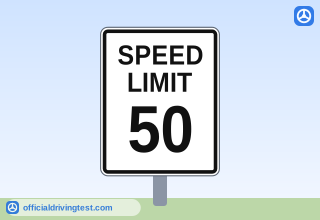
Under the Basic Speed Law, what does the posted speed limit sign show?
- The speed you must always drive
- The maximum speed for ideal conditions
- The minimum safe speed in any weather
- The speed that is safe for the worst conditions
Show answer
Correct answer: The maximum speed for ideal conditions
The speed limit is the maximum for ideal conditions, so drivers must adjust their speed to the conditions.
Source: Rhode Island Driver’s Manual (April 2024), page 36
-
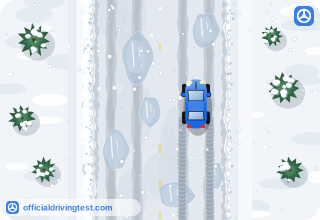
How fast should you drive on ice or snow compared with the posted speed limit?
- At the posted speed limit
- A few miles per hour over, to keep traction
- Well below the posted speed limit
- At the lowest speed posted on the road
Show answer
Correct answer: Well below the posted speed limit
The manual says to take it slow and drive well below the posted speed limit on ice or snow.
Source: Rhode Island Driver’s Manual (April 2024), page 46
-
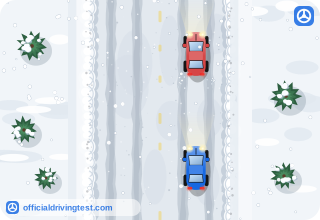
What should you do with your following distance when driving on ice or snow?
- Keep it the same as on dry roads
- Reduce it so that you can see much farther ahead
- Reduce it when approaching bridges
- Increase it, leaving plenty of room between vehicles
Show answer
Correct answer: Increase it, leaving plenty of room between vehicles
The manual says to increase the following distance on ice or snow.
Source: Rhode Island Driver’s Manual (April 2024), page 46
-
Which four steps make up the IPDE system for defensive driving?
- Identify, Predict, Decide, Execute
- Inspect, Plan, Drive, Evaluate
- Identify, Prepare, Drive, Exit
- Inspect, Predict, Direct, Escape
Show answer
Correct answer: Identify, Predict, Decide, Execute
IPDE is a thinking-doing process whose letters stand for identifying hazards, predicting conflicts, deciding on an action and executing it.
Source: Rhode Island Driver’s Manual (April 2024), page 50
-
In the IPDE system, what do you do in the "Predict" step?
- Act by maneuvering the vehicle to avoid conflict
- Locate every hazard by getting the big picture
- Judge where possible points of conflict may occur
- Determine when and where to take action
Show answer
Correct answer: Judge where possible points of conflict may occur
The Predict step is judging where points of conflict could arise before they happen.
Source: Rhode Island Driver’s Manual (April 2024), page 50
-
In the IPDE system, which step means acting by maneuvering the vehicle to avoid a conflict?
- Predict
- Execute
- Identify
- Decide
Show answer
Correct answer: Execute
Execute is the "doing" step, where you maneuver the vehicle to avoid the conflict.
Source: Rhode Island Driver’s Manual (April 2024), page 50
-
How many zones does the zone system describe around your vehicle?
- Four
- Five
- Eight
- Six
Show answer
Correct answer: Six
The zone system uses six areas of space around the vehicle, each as wide as a lane and extending as far as you can see.
Source: Rhode Island Driver’s Manual (April 2024), page 50
-
In the zone system, what is an open zone?
- An area you can drive in without restrictions to your line of sight or path of travel
- An area where no other vehicles are allowed to travel in your direction
- The space directly behind your vehicle that you see only in the mirrors
- An area with no traffic signs or signals within your line of sight
Show answer
Correct answer: An area you can drive in without restrictions to your line of sight or path of travel
An open zone is one where nothing restricts your line of sight or the path you intend to take.
Source: Rhode Island Driver’s Manual (April 2024), page 50
-
In the orderly visual search pattern, how far ahead is the target area where you search intersections, driveways and parked vehicles?
- 1-2 seconds
- 20-25 seconds
- 12-15 seconds
- 30-35 seconds
Show answer
Correct answer: 12-15 seconds
You evaluate your front zones in the area you will reach after traveling 12-15 seconds.
Source: Rhode Island Driver’s Manual (April 2024), page 50
-
On what principle was the Smith System, developed by Harold L. Smith, based?
- A fixed set of safe speeds for each type of road and weather
- A "space-cushion" between your vehicle and everything else on the road
- Staying in the lane that has the least traffic at all times
- Using the horn to warn every other road user of your presence
Show answer
Correct answer: A "space-cushion" between your vehicle and everything else on the road
The Smith System uses a space cushion between your vehicle and everything else on the road.
Source: Rhode Island Driver’s Manual (April 2024), page 50
-
How many keys to collision free driving does the Smith System have?
- Five
- Three
- Four
- Seven
Show answer
Correct answer: Five
The Smith System has five keys to collision free driving.
Source: Rhode Island Driver’s Manual (April 2024), page 50
-
What does the Smith System key "Leave Yourself an Out" tell you to do?
- Plan to leave the highway at the next available exit ramp
- Stay in the far-right lane at all times
- Keep plenty of space between you and the next vehicle
- Park in the first available space
Show answer
Correct answer: Keep plenty of space between you and the next vehicle
Because situations you don't plan on can occur, keep plenty of space between your vehicle and the next one.
Source: Rhode Island Driver’s Manual (April 2024), page 50
-
According to the Smith System key "Aim High In Steering," where should you look?
- Down at your hood so you can judge your lane position
- Ahead 4 to 6 seconds and 12 to 15 seconds, not down at the hood
- At the vehicle beside you in the next lane
- At the edge line on the right side of the road ahead of you
Show answer
Correct answer: Ahead 4 to 6 seconds and 12 to 15 seconds, not down at the hood
Aiming high means looking well ahead at the middle of your lane instead of down at the fender or hood.
Source: Rhode Island Driver’s Manual (April 2024), page 50
-
According to the Smith System key "Get The Overall Picture," how far ahead should you look?
- Half a block in cities and towns and a quarter mile on highways
- Two blocks in cities and towns and one mile on highways
- A full block in cities and towns and one mile on highways
- A full block in cities and towns and half a mile on highways
Show answer
Correct answer: A full block in cities and towns and half a mile on highways
You should see everything in the space you are moving into, which means a full block ahead in town and half a mile on highways.
Source: Rhode Island Driver’s Manual (April 2024), page 50
-
What does the Smith System key "Keep Your Eyes Moving" tell you to do?
- Continually and quickly scan and glance ahead, to the sides and in mirrors
- Fix your eyes on the vehicle directly ahead of you at all times
- Look only at the road surface about ten feet in front of your hood
- Check only the speedometer and gauges
Show answer
Correct answer: Continually and quickly scan and glance ahead, to the sides and in mirrors
Drivers should not stare at one thing but keep scanning ahead, to the side and in the rear and side mirrors.
Source: Rhode Island Driver’s Manual (April 2024), page 50
-
What does the Smith System key "Make Sure They See You" say you can do if needed?
- Turn on your hazard lights and stop in the lane
- Hold the horn down until the other driver reacts
- Tap your horn or flick your headlights
- Drive onto the shoulder
Show answer
Correct answer: Tap your horn or flick your headlights
Do not assume other road users see your vehicle; a tap of the horn or a flick of the headlights can alert them.
Source: Rhode Island Driver’s Manual (April 2024), page 50
-
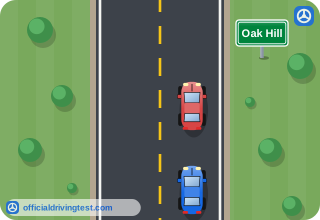
What does the manual say about the three-second following-distance rule?
- It guarantees that you can always stop in time to avoid a collision
- It cannot always guarantee time to stop, but it works in most situations
- It applies only on freeways and not on city streets or roads
- It applies only in daylight on dry roads with no other traffic
Show answer
Correct answer: It cannot always guarantee time to stop, but it works in most situations
The rule is a useful guide that works in most situations but does not guarantee you can stop in time.
Source: Rhode Island Driver’s Manual (April 2024), page 50
-
When using the three-second rule, when do you start counting?
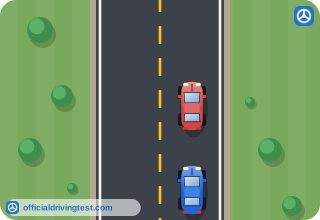
- When your own front bumper passes a fixed point on the road
- When the vehicle ahead turns on its brake lights
- When the vehicle ahead is three car lengths away from you
- When the rear bumper of the vehicle ahead passes a fixed point
Show answer
Correct answer: When the rear bumper of the vehicle ahead passes a fixed point
You start counting when the rear bumper of the vehicle you are following passes a fixed point such as a sign, pole or tree.
Source: Rhode Island Driver’s Manual (April 2024), page 51
-
Using the three-second rule, your front bumper passes the fixed point before you finish counting to three. What should you do?
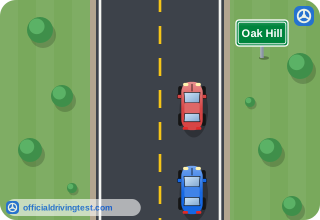
- Reduce your speed and count to three again
- Keep your speed, because three seconds is only a guide
- Speed up and pass the vehicle ahead
- Sound your horn to warn the driver ahead
Show answer
Correct answer: Reduce your speed and count to three again
Passing the point too soon means you are following too close, so you slow down and check again.
Source: Rhode Island Driver’s Manual (April 2024), page 51
-
Under adverse weather or road conditions, how should you change your following distance?
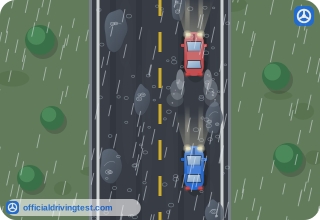
- Double it, whatever the conditions
- Add one second in total, however many conditions there are
- Add an additional second for each imperfect condition
- Keep it the same and reduce your speed instead
Show answer
Correct answer: Add an additional second for each imperfect condition
Each imperfect condition adds one second to the three-second following distance.
Source: Rhode Island Driver’s Manual (April 2024), page 51
-
What is the "point of no return" in the manual?
- The spot past which a driver is no longer allowed to turn around or reverse on the road ahead
- The distance needed to stop completely before entering the intersection, given your speed and road condition
- The distance at which a driver first sees the intersection and must begin to slow down
- The spot where a yellow light turns red for every vehicle approaching the intersection
Show answer
Correct answer: The distance needed to stop completely before entering the intersection, given your speed and road condition
It is the stopping distance, based on your speed and the roadway condition, needed to avoid entering the intersection.
Source: Rhode Island Driver’s Manual (April 2024), page 51
-
What must take place at the point of no return so that you do not enter the intersection or crash into another vehicle or fixed object?
- Turning
- Accelerating
- Sounding your horn
- Braking
Show answer
Correct answer: Braking
At that point braking must happen to ensure you stop short of the intersection or obstacle.
Source: Rhode Island Driver’s Manual (April 2024), page 51
-
How many lane positions does the manual describe within a single lane of travel?
- Three
- Two
- Four
- Five
Show answer
Correct answer: Three
The manual describes three positions within a lane: the middle and positions near the left and right lines.
Source: Rhode Island Driver’s Manual (April 2024), page 51
-
Which lane position is the safest under normal driving situations when no potential hazards exist to the left and right of the roadway?
- Along the left line of the lane
- Along the right line or curb of the lane
- In the middle of the lane
- On the lane line itself
Show answer
Correct answer: In the middle of the lane
Lane position 1, the middle of the lane, is the safest when there are no potential hazards on either side.
Source: Rhode Island Driver’s Manual (April 2024), page 51
-
If hazards exist to the right of your vehicle, where in your lane should you drive?
- In the middle of the lane
- Three to six inches from the left line of the lane
- Three to six inches from the right line or curb
- As close to the right curb as you can get
Show answer
Correct answer: Three to six inches from the left line of the lane
Lane position 2 puts you three to six inches from the left line, away from hazards on the right.
Source: Rhode Island Driver’s Manual (April 2024), page 51
-
If hazards exist to the left of your vehicle or you intend to turn right, where in your lane should you position your vehicle?
- In the middle of the lane
- Three to six inches from the left line of the lane
- Straddling the right lane line
- Three to six inches from the right line or curb of the lane
Show answer
Correct answer: Three to six inches from the right line or curb of the lane
Lane position 3 is three to six inches from the right line or curb, used when hazards are on the left or you will turn right.
Source: Rhode Island Driver’s Manual (April 2024), page 51
-
You see a potential hazard ahead, such as children playing in the street. What should you do?
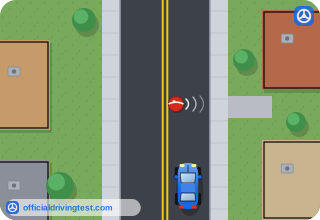
- Reduce speed right away and stop if necessary
- Keep your speed until you reach the hazard
- Sound the horn and keep going
- Change lanes without slowing down
Show answer
Correct answer: Reduce speed right away and stop if necessary
You should not wait until you come upon the hazard; reduce speed right away and stop if necessary.
Source: Rhode Island Driver’s Manual (April 2024), page 54
-
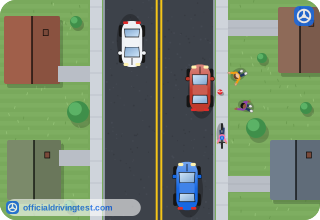
What does the manual say to do when children are in the vicinity, especially in school zones?
- Sound the horn to warn them
- Always reduce speed and use extra caution
- Keep your speed but watch the sidewalks
- Stop and wait for them to leave
Show answer
Correct answer: Always reduce speed and use extra caution
The manual says to always reduce speed and use extra caution when children are nearby, especially in school zones.
Source: Rhode Island Driver’s Manual (April 2024), page 56
-
According to the fine schedule, what is the fine for following too closely?
- $55.00
- $125.00
- $180.00
- $85.00
Show answer
Correct answer: $85.00
The fine schedule lists following too closely at $85.00.
Source: Rhode Island Driver’s Manual (April 2024), page 59
-
According to the fine schedule, what is the minimum fine for driving 11 mph in excess of the posted speed limit?
- $85.00
- $120.00
- $200.00
- $350.00
Show answer
Correct answer: $200.00
The fine schedule sets a minimum fine of $200.00 for driving 11 mph in excess of the posted speed limit.
Source: Rhode Island Driver’s Manual (April 2024), page 59