Rhode Island: Speed and following distance — Part 2 Practice Test
Questions in this part include: “According to the manual, what speed limits does Rhode Island law set on most highways?” · “How many zones does the zone system describe around your vehicle?”
Independent educational site · not affiliated with any government agency or DMV
Ready? Test yourself
- Instant feedback with an explanation
- Every answer cites its source in the manual
- Your best score is saved on this device
- Keyboard: press 1 to 4 to answer and Enter for the next question
Questions are original and based on the official manual "Rhode Island Driver’s Manual" (April 2024), Rhode Island Division of Motor Vehicles (DMV).
All 18 questions in this practice test
Take the test above first, then use this list to study. Tap “Show answer” to see the correct answer and explanation.
Show the questions and answersHide the questions
-
According to the manual, what speed limits does Rhode Island law set on most highways?
- 40 to 55 miles per hour
- 45 to 60 miles per hour
- 50 to 65 miles per hour
- 55 to 70 miles per hour
Show answer
Correct answer: 50 to 65 miles per hour
Rhode Island law sets limits of 50-65 mph on most highways.
Source: Rhode Island Driver’s Manual (April 2024), page 35
-
What is the easiest way to tell whether you are a safe distance from the vehicle ahead of you?
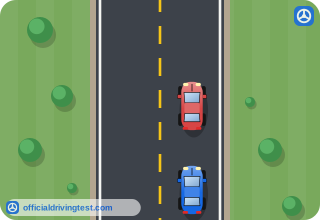
- The two-second following-distance rule
- The three-second following-distance rule
- The six-second following-distance rule
- One car length for every 10 mph
Show answer
Correct answer: The three-second following-distance rule
The manual names the three-second following-distance rule as the easiest way to judge a safe distance.
Source: Rhode Island Driver’s Manual (April 2024), page 35
-
If the roadway is wet or slippery, how much following distance do you need?
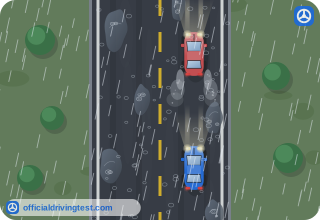
- Less distance, because you are driving slower
- The same distance as on a dry road
- No set distance, as long as you use low beams
- Additional distance (more seconds)
Show answer
Correct answer: Additional distance (more seconds)
On a wet or slippery road you need additional distance, meaning more seconds.
Source: Rhode Island Driver’s Manual (April 2024), page 35
-
If you are being tailgated, what does the manual say to do to avoid the risk of aggressive driving or road rage?
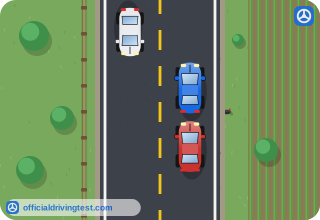
- Change lanes or let the driver pass you
- Speed up to put distance between you and the tailgater
- Brake hard to make the driver back off
- Stay in your lane and hold your speed so the driver gives up
Show answer
Correct answer: Change lanes or let the driver pass you
You should change lanes or allow the driver to pass you.
Source: Rhode Island Driver’s Manual (April 2024), page 35
-
Which of these should you never do when you are being tailgated?
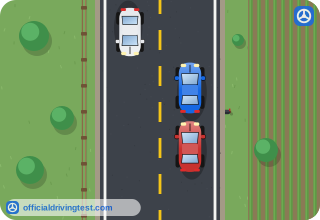
- Change lanes
- Allow the driver to pass you
- Speed up
- Stay calm and ignore the incident
Show answer
Correct answer: Speed up
The manual says never to speed up, because the tailgater may keep tailgating at the higher speed.
Source: Rhode Island Driver’s Manual (April 2024), page 35
-
What does the Basic Speed Law in Rhode Island require of motorists?
- To drive at the posted speed limit in all conditions
- To drive at least 50 miles per hour on a highway
- To drive only as fast as the road conditions dictate
- To drive below 25 miles per hour near homes
Show answer
Correct answer: To drive only as fast as the road conditions dictate
The Basic Speed Law requires drivers to go only as fast as road conditions allow.
Source: Rhode Island Driver’s Manual (April 2024), page 36
-
Under the Basic Speed Law, what does the posted speed limit sign show?
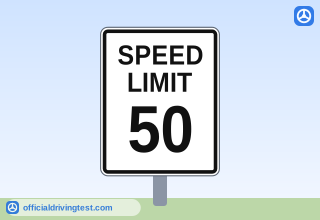
- The speed you must always drive
- The maximum speed for ideal conditions
- The minimum safe speed in any weather
- The speed that is safe for the worst conditions
Show answer
Correct answer: The maximum speed for ideal conditions
The speed limit is the maximum for ideal conditions, so drivers must adjust their speed to the conditions.
Source: Rhode Island Driver’s Manual (April 2024), page 36
-
How fast should you drive on ice or snow compared with the posted speed limit?
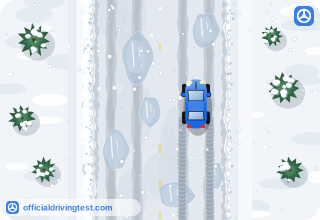
- At the posted speed limit
- A few miles per hour over, to keep traction
- Well below the posted speed limit
- At the lowest speed posted on the road
Show answer
Correct answer: Well below the posted speed limit
The manual says to take it slow and drive well below the posted speed limit on ice or snow.
Source: Rhode Island Driver’s Manual (April 2024), page 46
-
What should you do with your following distance when driving on ice or snow?
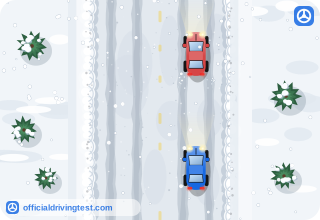
- Keep it the same as on dry roads
- Reduce it so that you can see much farther ahead
- Reduce it when approaching bridges
- Increase it, leaving plenty of room between vehicles
Show answer
Correct answer: Increase it, leaving plenty of room between vehicles
The manual says to increase the following distance on ice or snow.
Source: Rhode Island Driver’s Manual (April 2024), page 46
-
Which four steps make up the IPDE system for defensive driving?
- Identify, Predict, Decide, Execute
- Inspect, Plan, Drive, Evaluate
- Identify, Prepare, Drive, Exit
- Inspect, Predict, Direct, Escape
Show answer
Correct answer: Identify, Predict, Decide, Execute
IPDE is a thinking-doing process whose letters stand for identifying hazards, predicting conflicts, deciding on an action and executing it.
Source: Rhode Island Driver’s Manual (April 2024), page 50
-
In the IPDE system, what do you do in the "Predict" step?
- Act by maneuvering the vehicle to avoid conflict
- Locate every hazard by getting the big picture
- Judge where possible points of conflict may occur
- Determine when and where to take action
Show answer
Correct answer: Judge where possible points of conflict may occur
The Predict step is judging where points of conflict could arise before they happen.
Source: Rhode Island Driver’s Manual (April 2024), page 50
-
In the IPDE system, which step means acting by maneuvering the vehicle to avoid a conflict?
- Predict
- Execute
- Identify
- Decide
Show answer
Correct answer: Execute
Execute is the "doing" step, where you maneuver the vehicle to avoid the conflict.
Source: Rhode Island Driver’s Manual (April 2024), page 50
-
How many zones does the zone system describe around your vehicle?
- Four
- Five
- Eight
- Six
Show answer
Correct answer: Six
The zone system uses six areas of space around the vehicle, each as wide as a lane and extending as far as you can see.
Source: Rhode Island Driver’s Manual (April 2024), page 50
-
In the zone system, what is an open zone?
- An area you can drive in without restrictions to your line of sight or path of travel
- An area where no other vehicles are allowed to travel in your direction
- The space directly behind your vehicle that you see only in the mirrors
- An area with no traffic signs or signals within your line of sight
Show answer
Correct answer: An area you can drive in without restrictions to your line of sight or path of travel
An open zone is one where nothing restricts your line of sight or the path you intend to take.
Source: Rhode Island Driver’s Manual (April 2024), page 50
-
In the orderly visual search pattern, how far ahead is the target area where you search intersections, driveways and parked vehicles?
- 1-2 seconds
- 20-25 seconds
- 12-15 seconds
- 30-35 seconds
Show answer
Correct answer: 12-15 seconds
You evaluate your front zones in the area you will reach after traveling 12-15 seconds.
Source: Rhode Island Driver’s Manual (April 2024), page 50
-
On what principle was the Smith System, developed by Harold L. Smith, based?
- A fixed set of safe speeds for each type of road and weather
- A "space-cushion" between your vehicle and everything else on the road
- Staying in the lane that has the least traffic at all times
- Using the horn to warn every other road user of your presence
Show answer
Correct answer: A "space-cushion" between your vehicle and everything else on the road
The Smith System uses a space cushion between your vehicle and everything else on the road.
Source: Rhode Island Driver’s Manual (April 2024), page 50
-
How many keys to collision free driving does the Smith System have?
- Five
- Three
- Four
- Seven
Show answer
Correct answer: Five
The Smith System has five keys to collision free driving.
Source: Rhode Island Driver’s Manual (April 2024), page 50
-
What does the Smith System key "Leave Yourself an Out" tell you to do?
- Plan to leave the highway at the next available exit ramp
- Stay in the far-right lane at all times
- Keep plenty of space between you and the next vehicle
- Park in the first available space
Show answer
Correct answer: Keep plenty of space between you and the next vehicle
Because situations you don't plan on can occur, keep plenty of space between your vehicle and the next one.
Source: Rhode Island Driver’s Manual (April 2024), page 50