Rhode Island: Speed and following distance — Part 3 Practice Test
Questions in this part include: “According to the Smith System key "Aim High In Steering," where should you look?” · “What is the "point of no return" in the manual?”
Independent educational site · not affiliated with any government agency or DMV
Ready? Test yourself
- Instant feedback with an explanation
- Every answer cites its source in the manual
- Your best score is saved on this device
- Keyboard: press 1 to 4 to answer and Enter for the next question
Questions are original and based on the official manual "Rhode Island Driver’s Manual" (April 2024), Rhode Island Division of Motor Vehicles (DMV).
All 18 questions in this practice test
Take the test above first, then use this list to study. Tap “Show answer” to see the correct answer and explanation.
Show the questions and answersHide the questions
-
According to the Smith System key "Aim High In Steering," where should you look?
- Down at your hood so you can judge your lane position
- Ahead 4 to 6 seconds and 12 to 15 seconds, not down at the hood
- At the vehicle beside you in the next lane
- At the edge line on the right side of the road ahead of you
Show answer
Correct answer: Ahead 4 to 6 seconds and 12 to 15 seconds, not down at the hood
Aiming high means looking well ahead at the middle of your lane instead of down at the fender or hood.
Source: Rhode Island Driver’s Manual (April 2024), page 50
-
According to the Smith System key "Get The Overall Picture," how far ahead should you look?
- Half a block in cities and towns and a quarter mile on highways
- Two blocks in cities and towns and one mile on highways
- A full block in cities and towns and one mile on highways
- A full block in cities and towns and half a mile on highways
Show answer
Correct answer: A full block in cities and towns and half a mile on highways
You should see everything in the space you are moving into, which means a full block ahead in town and half a mile on highways.
Source: Rhode Island Driver’s Manual (April 2024), page 50
-
What does the Smith System key "Keep Your Eyes Moving" tell you to do?
- Continually and quickly scan and glance ahead, to the sides and in mirrors
- Fix your eyes on the vehicle directly ahead of you at all times
- Look only at the road surface about ten feet in front of your hood
- Check only the speedometer and gauges
Show answer
Correct answer: Continually and quickly scan and glance ahead, to the sides and in mirrors
Drivers should not stare at one thing but keep scanning ahead, to the side and in the rear and side mirrors.
Source: Rhode Island Driver’s Manual (April 2024), page 50
-
What does the Smith System key "Make Sure They See You" say you can do if needed?
- Turn on your hazard lights and stop in the lane
- Hold the horn down until the other driver reacts
- Tap your horn or flick your headlights
- Drive onto the shoulder
Show answer
Correct answer: Tap your horn or flick your headlights
Do not assume other road users see your vehicle; a tap of the horn or a flick of the headlights can alert them.
Source: Rhode Island Driver’s Manual (April 2024), page 50
-
What does the manual say about the three-second following-distance rule?
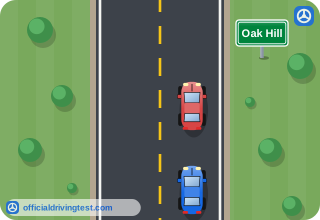
- It guarantees that you can always stop in time to avoid a collision
- It cannot always guarantee time to stop, but it works in most situations
- It applies only on freeways and not on city streets or roads
- It applies only in daylight on dry roads with no other traffic
Show answer
Correct answer: It cannot always guarantee time to stop, but it works in most situations
The rule is a useful guide that works in most situations but does not guarantee you can stop in time.
Source: Rhode Island Driver’s Manual (April 2024), page 50
-
When using the three-second rule, when do you start counting?
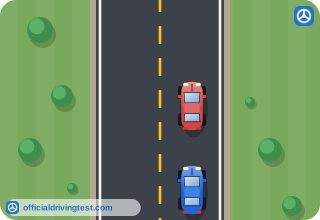
- When your own front bumper passes a fixed point on the road
- When the vehicle ahead turns on its brake lights
- When the vehicle ahead is three car lengths away from you
- When the rear bumper of the vehicle ahead passes a fixed point
Show answer
Correct answer: When the rear bumper of the vehicle ahead passes a fixed point
You start counting when the rear bumper of the vehicle you are following passes a fixed point such as a sign, pole or tree.
Source: Rhode Island Driver’s Manual (April 2024), page 51
-
Using the three-second rule, your front bumper passes the fixed point before you finish counting to three. What should you do?
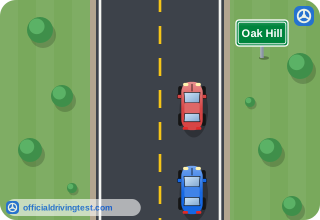
- Reduce your speed and count to three again
- Keep your speed, because three seconds is only a guide
- Speed up and pass the vehicle ahead
- Sound your horn to warn the driver ahead
Show answer
Correct answer: Reduce your speed and count to three again
Passing the point too soon means you are following too close, so you slow down and check again.
Source: Rhode Island Driver’s Manual (April 2024), page 51
-
Under adverse weather or road conditions, how should you change your following distance?
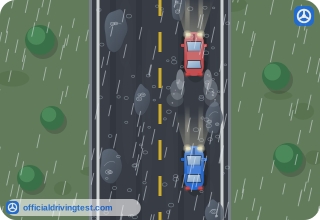
- Double it, whatever the conditions
- Add one second in total, however many conditions there are
- Add an additional second for each imperfect condition
- Keep it the same and reduce your speed instead
Show answer
Correct answer: Add an additional second for each imperfect condition
Each imperfect condition adds one second to the three-second following distance.
Source: Rhode Island Driver’s Manual (April 2024), page 51
-
What is the "point of no return" in the manual?
- The spot past which a driver is no longer allowed to turn around or reverse on the road ahead
- The distance needed to stop completely before entering the intersection, given your speed and road condition
- The distance at which a driver first sees the intersection and must begin to slow down
- The spot where a yellow light turns red for every vehicle approaching the intersection
Show answer
Correct answer: The distance needed to stop completely before entering the intersection, given your speed and road condition
It is the stopping distance, based on your speed and the roadway condition, needed to avoid entering the intersection.
Source: Rhode Island Driver’s Manual (April 2024), page 51
-
What must take place at the point of no return so that you do not enter the intersection or crash into another vehicle or fixed object?
- Turning
- Accelerating
- Sounding your horn
- Braking
Show answer
Correct answer: Braking
At that point braking must happen to ensure you stop short of the intersection or obstacle.
Source: Rhode Island Driver’s Manual (April 2024), page 51
-
How many lane positions does the manual describe within a single lane of travel?
- Three
- Two
- Four
- Five
Show answer
Correct answer: Three
The manual describes three positions within a lane: the middle and positions near the left and right lines.
Source: Rhode Island Driver’s Manual (April 2024), page 51
-
Which lane position is the safest under normal driving situations when no potential hazards exist to the left and right of the roadway?
- Along the left line of the lane
- Along the right line or curb of the lane
- In the middle of the lane
- On the lane line itself
Show answer
Correct answer: In the middle of the lane
Lane position 1, the middle of the lane, is the safest when there are no potential hazards on either side.
Source: Rhode Island Driver’s Manual (April 2024), page 51
-
If hazards exist to the right of your vehicle, where in your lane should you drive?
- In the middle of the lane
- Three to six inches from the left line of the lane
- Three to six inches from the right line or curb
- As close to the right curb as you can get
Show answer
Correct answer: Three to six inches from the left line of the lane
Lane position 2 puts you three to six inches from the left line, away from hazards on the right.
Source: Rhode Island Driver’s Manual (April 2024), page 51
-
If hazards exist to the left of your vehicle or you intend to turn right, where in your lane should you position your vehicle?
- In the middle of the lane
- Three to six inches from the left line of the lane
- Straddling the right lane line
- Three to six inches from the right line or curb of the lane
Show answer
Correct answer: Three to six inches from the right line or curb of the lane
Lane position 3 is three to six inches from the right line or curb, used when hazards are on the left or you will turn right.
Source: Rhode Island Driver’s Manual (April 2024), page 51
-
You see a potential hazard ahead, such as children playing in the street. What should you do?
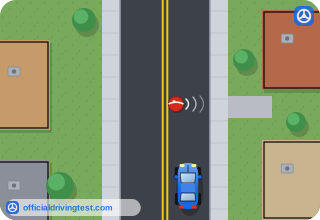
- Reduce speed right away and stop if necessary
- Keep your speed until you reach the hazard
- Sound the horn and keep going
- Change lanes without slowing down
Show answer
Correct answer: Reduce speed right away and stop if necessary
You should not wait until you come upon the hazard; reduce speed right away and stop if necessary.
Source: Rhode Island Driver’s Manual (April 2024), page 54
-
What does the manual say to do when children are in the vicinity, especially in school zones?
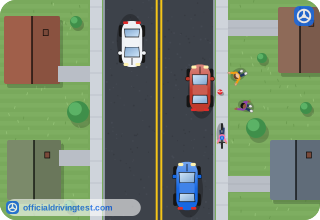
- Sound the horn to warn them
- Always reduce speed and use extra caution
- Keep your speed but watch the sidewalks
- Stop and wait for them to leave
Show answer
Correct answer: Always reduce speed and use extra caution
The manual says to always reduce speed and use extra caution when children are nearby, especially in school zones.
Source: Rhode Island Driver’s Manual (April 2024), page 56
-
According to the fine schedule, what is the fine for following too closely?
- $55.00
- $125.00
- $180.00
- $85.00
Show answer
Correct answer: $85.00
The fine schedule lists following too closely at $85.00.
Source: Rhode Island Driver’s Manual (April 2024), page 59
-
According to the fine schedule, what is the minimum fine for driving 11 mph in excess of the posted speed limit?
- $85.00
- $120.00
- $200.00
- $350.00
Show answer
Correct answer: $200.00
The fine schedule sets a minimum fine of $200.00 for driving 11 mph in excess of the posted speed limit.
Source: Rhode Island Driver’s Manual (April 2024), page 59