Rhode Island: Sharing the road — Part 5 Practice Test
Questions in this part include: “Who must wear a certified bicycle helmet on a public highway, bicycle path or other public right-of-way?” · “What is "dooring"?”
Independent educational site · not affiliated with any government agency or DMV
Ready? Test yourself
- Instant feedback with an explanation
- Every answer cites its source in the manual
- Your best score is saved on this device
- Keyboard: press 1 to 4 to answer and Enter for the next question
Questions are original and based on the official manual "Rhode Island Driver’s Manual" (April 2024), Rhode Island Division of Motor Vehicles (DMV).
All 17 questions in this practice test
Take the test above first, then use this list to study. Tap “Show answer” to see the correct answer and explanation.
Show the questions and answersHide the questions
-
When there is a safe bicycle path near the roadway, what should riders do?
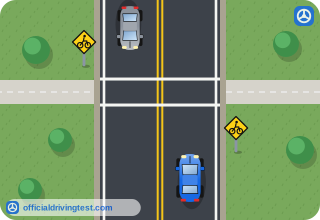
- Ride on the sidewalk
- Ride in the road but on the left side
- Use the path rather than the road
- Use either the path or the road, whichever is faster
Show answer
Correct answer: Use the path rather than the road
The manual says riders should use a safe bicycle path rather than the road.
Source: Rhode Island Driver’s Manual (April 2024), page 54
-
Who must wear a certified bicycle helmet on a public highway, bicycle path or other public right-of-way?
- Any rider or passenger twelve years of age or younger
- Any rider or passenger fifteen years of age or younger
- Any rider or passenger seventeen years of age or younger
- Only riders who are on public highways
Show answer
Correct answer: Any rider or passenger fifteen years of age or younger
The helmet rule covers any person fifteen or younger riding a bicycle or riding as a passenger on one.
Source: Rhode Island Driver’s Manual (April 2024), page 54
-
Why should you give bicyclists plenty of clearance on the street?
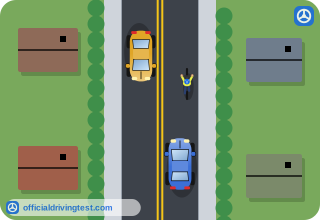
- They are required to ride in the middle of the lane at all times of day
- They cannot hear approaching vehicles because of their helmets
- They must stop at every intersection, even without a stop sign
- Hazards like potholes, glass and storm grates may make them move into your path
Show answer
Correct answer: Hazards like potholes, glass and storm grates may make them move into your path
Road hazards that drivers do not easily see can make a bicyclist swerve or slow, so extra room is needed.
Source: Rhode Island Driver’s Manual (April 2024), page 54
-
How must automobiles yield to bicyclists?
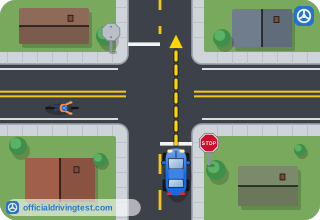
- In the same way as for other types of vehicles
- Only when the bicyclist is in a bicycle lane
- Only when the bicyclist signals
- Only when the bicyclist is wearing a helmet
Show answer
Correct answer: In the same way as for other types of vehicles
The manual says automobiles must yield to bicyclists in the same way as for other vehicles.
Source: Rhode Island Driver’s Manual (April 2024), page 55
-
Which of these is a sign that a bicyclist is inexperienced?
- Riding in a smooth and straight manner
- Wearing a helmet
- Weaving or wobbling
- Riding close to the right side of the road
Show answer
Correct answer: Weaving or wobbling
The manual lists weaving, wobbling and riding against traffic without a helmet as signs of inexperience, and says to give such riders plenty of room.
Source: Rhode Island Driver’s Manual (April 2024), page 55
-
What does the manual say about sounding your horn as you approach a cyclist?
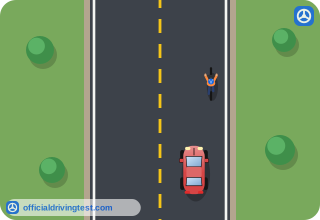
- Do not, because the loud noise can startle the cyclist
- Do it, so the cyclist knows that you are approaching
- Do it twice, to be sure that the cyclist hears you
- Do it only at night, when the cyclist is hard to see
Show answer
Correct answer: Do not, because the loud noise can startle the cyclist
A loud horn can startle a cyclist and cause the cyclist to swerve.
Source: Rhode Island Driver’s Manual (April 2024), page 55
-
When approaching or passing a bicyclist, what does the manual say you should avoid?
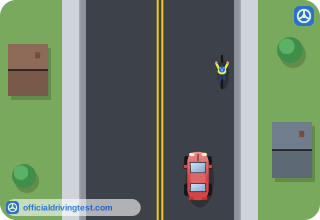
- Slowing down to leave extra room for the bicyclist
- Leaving extra clearance on the side of the bicyclist
- Talking on a cell phone, text messaging or other distractions
- Checking your mirrors for traffic behind you
Show answer
Correct answer: Talking on a cell phone, text messaging or other distractions
The manual says to avoid cell phone use, texting and other distractions when approaching or passing a bicyclist.
Source: Rhode Island Driver’s Manual (April 2024), page 55
-
When passing a bicyclist, how much clearance does the manual say to allow, as much as possible?
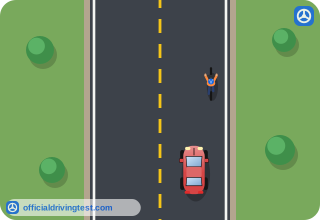
- 1-2 feet
- 3-5 feet
- 7-9 feet
- 10-12 feet
Show answer
Correct answer: 3-5 feet
The manual suggests allowing as much clearance as possible, 3-5 feet, when passing a bicyclist.
Source: Rhode Island Driver’s Manual (April 2024), page 55
-
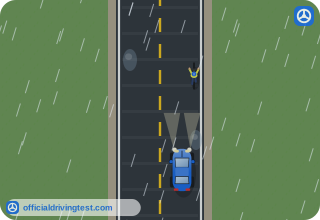
In inclement weather, what should you give bicyclists?
- The right-of-way at all times
- Less room, because they ride slowly
- Nothing different from usual
- Extra trailing and passing room
Show answer
Correct answer: Extra trailing and passing room
The manual says to give bicyclists extra trailing and passing room in inclement weather, as you would other motorists.
Source: Rhode Island Driver’s Manual (April 2024), page 55
-
A road is too narrow for vehicles and bicycles to travel safely side by side, and a bicyclist ahead "takes the travel lane." What should you be prepared to do?
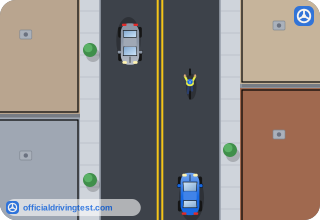
- Reduce speed or stop
- Pass on the right
- Sound your horn
- Drive onto the shoulder
Show answer
Correct answer: Reduce speed or stop
When bicyclists proceed in the center of a road too narrow to share, drivers should be ready to slow down or stop.
Source: Rhode Island Driver’s Manual (April 2024), page 55
-
When should you pass a bicyclist if oncoming traffic is near?
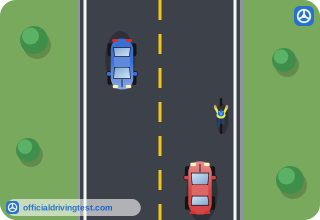
- Pass right away, before the oncoming vehicles arrive
- Pass in the bicycle lane
- Wait until there are no oncoming vehicles before you pass
- Pass on the right side
Show answer
Correct answer: Wait until there are no oncoming vehicles before you pass
The manual says not to pass bicyclists if oncoming traffic is near, but to wait until there are no oncoming vehicles.
Source: Rhode Island Driver’s Manual (April 2024), page 55
-
After you have passed a bicyclist, what should you not do?
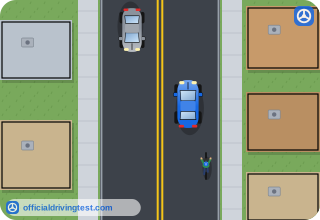
- Return to your lane after passing the bicyclist
- Reduce speed or stop abruptly in front of the bicyclist
- Signal before you move back into your lane
- Check your mirrors before moving back
Show answer
Correct answer: Reduce speed or stop abruptly in front of the bicyclist
After passing, you should not slow down or stop abruptly in front of the bicyclist.
Source: Rhode Island Driver’s Manual (April 2024), page 55
-
What should you do before opening your door into a traffic lane after parking?
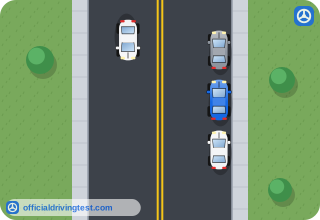
- Sound your horn to warn the traffic behind you
- Turn on your hazard lights
- Look behind you for an approaching bicyclist
- Open the door slightly and wait
Show answer
Correct answer: Look behind you for an approaching bicyclist
The manual says to look behind you for a bicyclist approaching your parked vehicle before opening the door.
Source: Rhode Island Driver’s Manual (April 2024), page 55
-
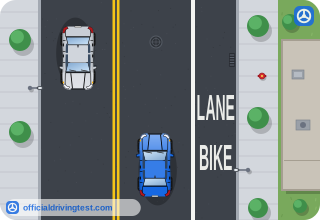
Should you drive in a bicycle lane?
- Yes, to pass a slow vehicle ahead when the lane is clear
- Yes, whenever there are no bicyclists in sight ahead of you
- No, and you may never cross it for any reason at all
- No, but you may cross it to turn a corner or enter or leave a driveway
Show answer
Correct answer: No, but you may cross it to turn a corner or enter or leave a driveway
You may not drive in a bicycle lane, but crossing is allowed when turning a corner or entering or leaving an alley, private road or driveway.
Source: Rhode Island Driver’s Manual (April 2024), page 55
-
Before you turn into a bicycle lane or sidewalk, what must you do?
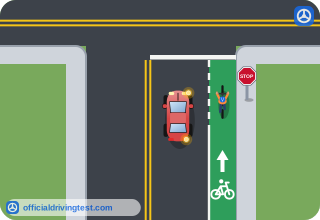
- Yield to bicyclists in the bike lane or on the sidewalk
- Sound your horn to warn them that you are turning
- Wait for a traffic officer to wave you across
- Turn on your hazard lights before crossing it
Show answer
Correct answer: Yield to bicyclists in the bike lane or on the sidewalk
The manual says to yield to bicyclists in a bicycle lane or on a sidewalk before you turn into the lane or sidewalk.
Source: Rhode Island Driver’s Manual (April 2024), page 56
-
Why can children on bicycles pose an increased safety risk for motorists?
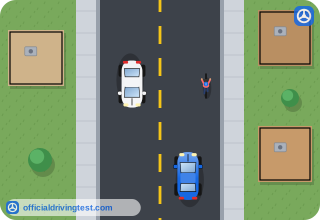
- They are not allowed to ride in the road with other kinds of traffic
- They always ride much faster than adult bicyclists do
- They may not be able to judge the speed and distance of oncoming vehicles
- They cannot hear vehicles approaching from behind them
Show answer
Correct answer: They may not be able to judge the speed and distance of oncoming vehicles
Children's visual skills and depth perception may be less developed than adults', so they may misjudge the speed and distance of oncoming vehicles.
Source: Rhode Island Driver’s Manual (April 2024), page 56
-
What is "dooring"?
- A cyclist riding between two parked vehicles and hitting a mirror
- A driver parking too close to a bicycle lane marking
- A cyclist opening a door to enter a building
- A driver or passenger carelessly opens a door and hits a passing cyclist
Show answer
Correct answer: A driver or passenger carelessly opens a door and hits a passing cyclist
Dooring is a collision between a passing cyclist and a carelessly opened vehicle door.
Source: Rhode Island Driver’s Manual (April 2024), page 56