Rhode Island: Sharing the road — Part 1 Practice Test
Questions in this part include: “Why does the Governor's message say you should be vigilant and cautious of other drivers?” · “Which of these is an example of road rage given in the manual?”
Independent educational site · not affiliated with any government agency or DMV
Ready? Test yourself
- Instant feedback with an explanation
- Every answer cites its source in the manual
- Your best score is saved on this device
- Keyboard: press 1 to 4 to answer and Enter for the next question
Questions are original and based on the official manual "Rhode Island Driver’s Manual" (April 2024), Rhode Island Division of Motor Vehicles (DMV).
All 18 questions in this practice test
Take the test above first, then use this list to study. Tap “Show answer” to see the correct answer and explanation.
Show the questions and answersHide the questions
-
Why does the Governor's message say you should be vigilant and cautious of other drivers?
- Most other drivers are overly cautious on the road
- Other drivers always signal their intentions clearly
- Not everyone is responsible, alert, or follows the rules
- Other drivers are responsible for your safety
Show answer
Correct answer: Not everyone is responsible, alert, or follows the rules
The message warns that even a safe driver cannot control others, because not everyone is responsible, alert or follows the rules.
Source: Rhode Island Driver’s Manual (April 2024), page 2
-
Aggressive driving occurs when a driver operates a vehicle in what manner?
- Slow or hesitant
- Drowsy or tired
- Inattentive or lost
- Pushy or bold
Show answer
Correct answer: Pushy or bold
The manual says aggressive driving is operating a vehicle in a pushy or bold manner.
Source: Rhode Island Driver’s Manual (April 2024), page 23
-
Which of these is an example of aggressive driving?
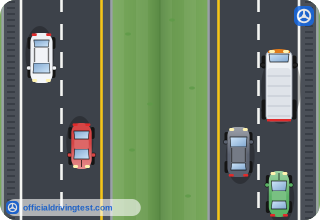
- Following too closely
- Driving slightly below the speed limit
- Signaling before a lane change
- Yielding to merging traffic
Show answer
Correct answer: Following too closely
The manual lists exceeding the speed limit, following too closely, ignoring traffic controls and improper turns as aggressive driving.
Source: Rhode Island Driver’s Manual (April 2024), page 23
-
Road rage is an escalation of emotions generally ignited by what?
- Drowsy or fatigued driving
- Driver inattention
- Aggressive driving behaviors
- Heavy traffic alone
Show answer
Correct answer: Aggressive driving behaviors
The manual says road rage is an escalation of emotions generally ignited by aggressive driving behaviors.
Source: Rhode Island Driver’s Manual (April 2024), page 23
-
Which of these is an example of road rage given in the manual?
- Tapping the horn twice
- Attempting to ram another vehicle
- Leaving plenty of room around your vehicle
- Moving out of the right-hand lane
Show answer
Correct answer: Attempting to ram another vehicle
Throwing objects at a vehicle, yelling at a specific roadway user and attempting to ram another vehicle are listed examples.
Source: Rhode Island Driver’s Manual (April 2024), page 23
-
What does the manual say about the passing lane?
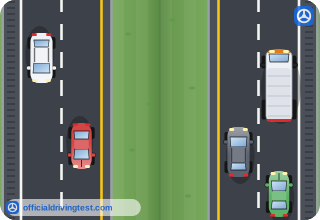
- Stay in it whenever you drive at the speed limit
- Except when passing, stay out of the far-left lane
- Use it to drive slowly so others pass on the right
- Use it whenever you are following too closely
Show answer
Correct answer: Except when passing, stay out of the far-left lane
The manual says not to block the passing lane and to stay out of the far-left lane except when passing.
Source: Rhode Island Driver’s Manual (April 2024), page 24
-
Which horn use may be perceived as less aggressive?
- One long blast
- Repeated long blasts
- Holding it until the other driver moves
- A couple of short taps
Show answer
Correct answer: A couple of short taps
The manual says to use the horn sparingly, because short taps seem less aggressive than one long blast.
Source: Rhode Island Driver’s Manual (April 2024), page 24
-
Which parking practice does the manual say helps prevent aggressive driving and road rage?
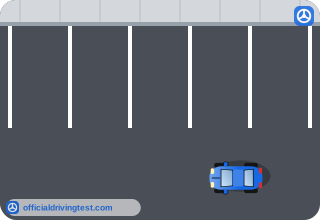
- Not parking across multiple parking spaces
- Parking across two spaces to protect your vehicle
- Parking close enough that your doors touch adjacent vehicles
- Parking in the first open space you see
Show answer
Correct answer: Not parking across multiple parking spaces
The manual says not to park across multiple spaces or touch adjacent vehicles with your car or its doors.
Source: Rhode Island Driver’s Manual (April 2024), page 24
-
When using high-beam headlights, when should you return to low beams, according to the guidelines for preventing aggressive driving?
- Once a pedestrian is ahead
- When you reach a curve
- As soon as you detect an oncoming vehicle
- When you reach a railroad crossing ahead
Show answer
Correct answer: As soon as you detect an oncoming vehicle
The manual says to switch back to low beams as soon as you detect an oncoming vehicle.
Source: Rhode Island Driver’s Manual (April 2024), page 24
-
According to the guidelines for preventing aggressive driving, what should you not do when driving close behind another vehicle?
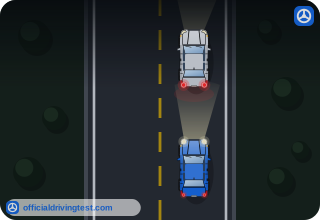
- Keep both hands on the steering wheel
- Drive with your high-beam headlights on
- Keep your low-beam headlights on
- Check your mirrors often
Show answer
Correct answer: Drive with your high-beam headlights on
The manual says not to drive behind another vehicle with your high-beam headlights on.
Source: Rhode Island Driver’s Manual (April 2024), page 24
-
Why does the manual say to move out of the right-hand lane, if safe to do so?
- To get ready to exit the roadway at the next ramp or intersection
- To pass slower vehicles
- To avoid pedestrians
- To allow vehicles entering the roadway to merge with minimal difficulty
Show answer
Correct answer: To allow vehicles entering the roadway to merge with minimal difficulty
Leaving the right-hand lane when safe makes it easier for entering vehicles to merge.
Source: Rhode Island Driver’s Manual (April 2024), page 24
-
What should you always use before changing lanes, according to the guidelines for preventing aggressive driving?
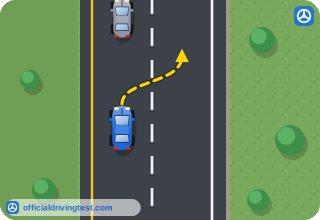
- Your turn signals
- Your horn
- Your hazard lights
- Your high beams
Show answer
Correct answer: Your turn signals
The manual says to always use turn signals before changing lanes.
Source: Rhode Island Driver’s Manual (April 2024), page 24
-
Following too closely can easily cause the driver being followed to do what?
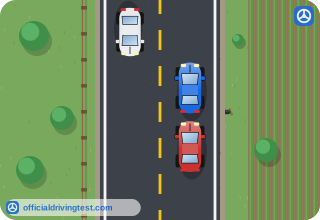
- Pull over immediately
- Speed up to leave a gap
- Become frustrated
- Turn on the hazard lights
Show answer
Correct answer: Become frustrated
The manual says following too closely can make the driver ahead frustrated.
Source: Rhode Island Driver’s Manual (April 2024), page 24
-
If confronted by a driver displaying aggressive behaviors toward you, what does the manual say about getting out of your vehicle?
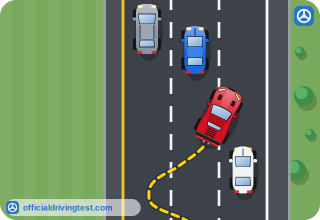
- Get out and speak calmly to the driver
- Do not get out, because your vehicle offers protection
- Get out only if the other driver stays inside
- Get out and take a photo of the license plate
Show answer
Correct answer: Do not get out, because your vehicle offers protection
The manual says your vehicle offers protection, so do not get out.
Source: Rhode Island Driver’s Manual (April 2024), page 24
-
If confronted by an aggressive driver, what does the manual say about eye contact?
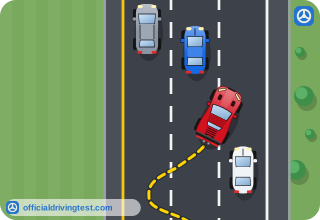
- Make steady eye contact with the driver to show you are calm
- Look at the other driver only when you speak
- Make eye contact to show you are not afraid
- Avoid eye contact with the other driver or passengers
Show answer
Correct answer: Avoid eye contact with the other driver or passengers
The manual says to avoid eye contact with the other driver or passengers.
Source: Rhode Island Driver’s Manual (April 2024), page 24
-
If a driver displays aggressive behaviors toward you, how does the manual say to respond to that driver?
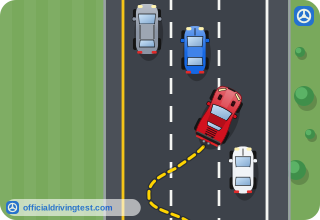
- Do not respond to the other driver
- Honk to show you are aware
- Match the other driver’s speed
- Slow down in front of the other driver
Show answer
Correct answer: Do not respond to the other driver
The manual says not to respond, to avoid escalating the conflict.
Source: Rhode Island Driver’s Manual (April 2024), page 24
-
If confronted by an aggressive driver and necessary, whom does the manual say to contact for assistance?
- The DMV
- Your insurance company
- 911
- A tow truck service
Show answer
Correct answer: 911
The manual says to contact 911 if necessary.
Source: Rhode Island Driver’s Manual (April 2024), page 24
-
If necessary, where does the manual say to drive when an aggressive driver confronts you?
- A quiet side street away from traffic where you can stop and calm down
- A busy public place with witnesses, such as a hospital or fire station
- An empty parking lot where the other driver cannot follow
- Your own home, so you can leave the vehicle quickly
Show answer
Correct answer: A busy public place with witnesses, such as a hospital or fire station
A busy public place with witnesses, such as a hospital, fire station or busy convenience store, gives you safety.
Source: Rhode Island Driver’s Manual (April 2024), page 24