Rhode Island: Sharing the road — Part 2 Practice Test
Questions in this part include: “How does the manual say to treat other road users even when they are not courteous to you?” · “At a roundabout crosswalk, what must cyclists do for pedestrians?”
Independent educational site · not affiliated with any government agency or DMV
Ready? Test yourself
- Instant feedback with an explanation
- Every answer cites its source in the manual
- Your best score is saved on this device
- Keyboard: press 1 to 4 to answer and Enter for the next question
Questions are original and based on the official manual "Rhode Island Driver’s Manual" (April 2024), Rhode Island Division of Motor Vehicles (DMV).
All 17 questions in this practice test
Take the test above first, then use this list to study. Tap “Show answer” to see the correct answer and explanation.
Show the questions and answersHide the questions
-
How does the manual say to treat other road users even when they are not courteous to you?
- Respond with the same behavior
- Follow them closely to show your displeasure
- Warn them with your horn
- Show courtesy and consideration
Show answer
Correct answer: Show courtesy and consideration
The manual says to show courtesy and consideration to other road users, even when they are not courteous to you.
Source: Rhode Island Driver’s Manual (April 2024), page 24
-
What can help you remain calm while driving, according to the guidelines for preventing aggressive driving?
- Listening to soothing music
- Listening to music at a high volume
- Making phone calls
- Listening to talk radio arguments
Show answer
Correct answer: Listening to soothing music
The manual says to always remain calm and notes that soothing music can help.
Source: Rhode Island Driver’s Manual (April 2024), page 24
-
Why does the manual say to be especially careful when buses stop?
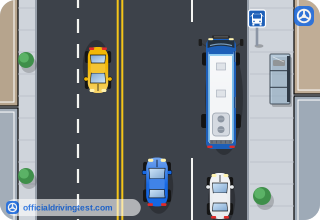
- The bus may suddenly reverse
- The bus may be carrying hazardous materials
- Passengers may be entering or leaving the bus
- The bus driver may be changing a flat tire
Show answer
Correct answer: Passengers may be entering or leaving the bus
Passengers may be getting on or off when a bus stops.
Source: Rhode Island Driver’s Manual (April 2024), page 36
-
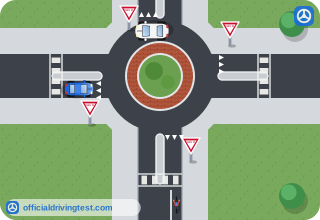
How should cyclists generally cross the pedestrian crosswalk at a roundabout?
- Ride across at full speed
- Ride across in the roadway beside vehicles
- Walk their bicycles across
- Ride across the center island
Show answer
Correct answer: Walk their bicycles across
Cyclists should generally walk their bicycles across the pedestrian crosswalk.
Source: Rhode Island Driver’s Manual (April 2024), page 41
-
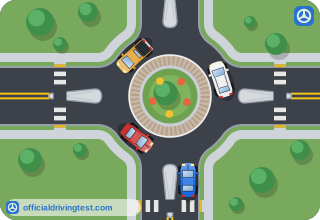
Who may navigate roundabouts like motorists?
- Inexperienced cyclists
- Experienced cyclists
- Pedestrians
- Cyclists on sidewalks
Show answer
Correct answer: Experienced cyclists
The manual says experienced cyclists may navigate roundabouts like motorists.
Source: Rhode Island Driver’s Manual (April 2024), page 41
-
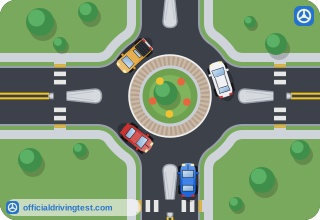
Where in the lane should a bicyclist ride in a roundabout?
- Near the curb line, out of the way of traffic
- On the center island of the roundabout
- On the splitter island
- In the middle of the lane, not near the curb line
Show answer
Correct answer: In the middle of the lane, not near the curb line
Riding in the middle of the lane keeps vehicles from passing the bicyclist.
Source: Rhode Island Driver’s Manual (April 2024), page 41
-
At a roundabout crosswalk, what must cyclists do for pedestrians?
- Yield to pedestrians in the crosswalk
- Ring a bell and keep riding through
- Ride ahead of them to clear the way
- Pass them on the right side
Show answer
Correct answer: Yield to pedestrians in the crosswalk
Like motor vehicles, cyclists must yield to pedestrians in crosswalks.
Source: Rhode Island Driver’s Manual (April 2024), page 41
-
Why may a motorcycle slow down without showing a brake light?
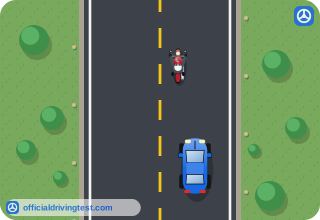
- Motorcycles do not have brake lights at all
- Motorcyclists often slow by downshifting or rolling off the throttle
- Motorcyclists never use their brakes when riding in traffic
- Motorcycle brake lights only come on at night
Show answer
Correct answer: Motorcyclists often slow by downshifting or rolling off the throttle
Slowing by downshifting or easing off the throttle does not activate the brake light, so allow more following distance.
Source: Rhode Island Driver’s Manual (April 2024), page 48
-
How much space cushion should you keep at minimum when following a motorcyclist?
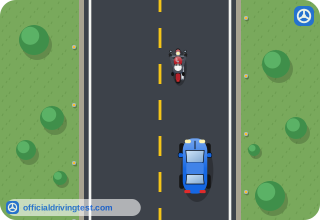
- At least two seconds
- At least one second
- At least half a second
- At least four seconds
Show answer
Correct answer: At least four seconds
The manual says to keep at least a four-second space cushion when following a motorcyclist.
Source: Rhode Island Driver’s Manual (April 2024), page 48
-
Why do motorcyclists often adjust their position within a lane?
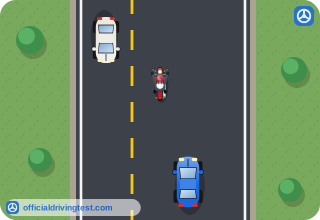
- To be seen more easily and to reduce the effects of wind and debris
- To keep other vehicles from passing them on either side of the lane
- To avoid being followed too closely by other drivers
- To make the lane markings easier for them to see
Show answer
Correct answer: To be seen more easily and to reduce the effects of wind and debris
The manual says riders move within the lane to be more visible and to minimize wind, debris and passing vehicles.
Source: Rhode Island Driver’s Manual (April 2024), page 48
-
If a motorcycle is in the left or right portion of the lane, what may the rider be doing?
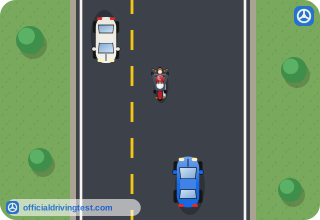
- Signaling that the rider wants to pass you
- Showing that the rider is about to leave the lane
- Selecting a safer lane position, usually with a better line of sight
- Showing that the rider can no longer control the motorcycle
Show answer
Correct answer: Selecting a safer lane position, usually with a better line of sight
The manual says the rider may be choosing a safer lane position that usually gives a better line of sight.
Source: Rhode Island Driver’s Manual (April 2024), page 48
-
Because motorcycles are less visible, how may they appear?
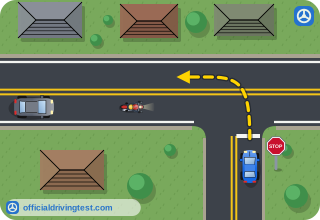
- To be moving slower than they really are
- To be larger than they really are
- To be stopped when they are moving
- To be moving faster than they really are
Show answer
Correct answer: To be moving faster than they really are
The manual says less visible motorcycles may seem to move faster than they truly do.
Source: Rhode Island Driver’s Manual (April 2024), page 48
-
When you check traffic to turn at an intersection, how should you judge the distance of a motorcycle?
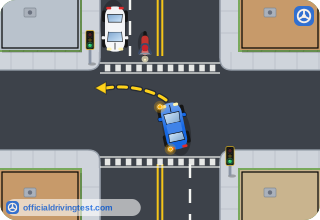
- Assume that it is farther away than it looks
- Predict that it is closer than it looks
- Assume that it is moving slower than it looks
- Judge it by the glare of its single headlight
Show answer
Correct answer: Predict that it is closer than it looks
Because of its small size a motorcycle may look farther away than it is, so predict it is closer.
Source: Rhode Island Driver’s Manual (April 2024), page 48
-
A motorcycle can be hidden by door posts, mirrors, passengers or bushes. What should you do when changing lanes or turning at intersections?
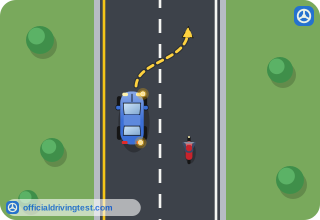
- Rely on your mirrors alone to see it
- Sound your horn before you make the move
- Take an extra moment to thoroughly check traffic
- Slow to a crawl before you change lanes
Show answer
Correct answer: Take an extra moment to thoroughly check traffic
The manual says to take an extra moment to check traffic thoroughly because a small motorcycle is easily hidden.
Source: Rhode Island Driver’s Manual (April 2024), page 48
-
How does the stopping distance of a motorcycle compare with that of a car?
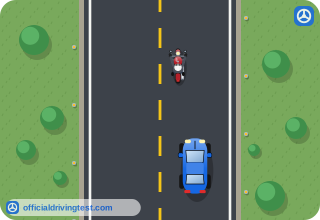
- Nearly the same, but slippery pavement makes quick stops difficult
- Much shorter, because motorcycles are lighter than cars
- Twice as long as a car on dry pavement
- Always shorter than a car on slippery pavement
Show answer
Correct answer: Nearly the same, but slippery pavement makes quick stops difficult
The manual says the stopping distances are nearly the same, but a rider has trouble stopping quickly on slippery pavement.
Source: Rhode Island Driver’s Manual (April 2024), page 48
-
Why may a motorcyclist think you are farther back than you actually are?
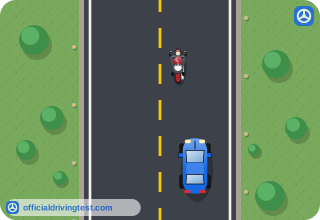
- Their mirrors are smaller and usually convex, giving a smaller image of you
- Their mirrors are flat and reflect too much glare back
- Their mirrors are mounted too high to show other vehicles behind
- Their helmets block the rider's view of the mirrors
Show answer
Correct answer: Their mirrors are smaller and usually convex, giving a smaller image of you
Small convex mirrors show a smaller image of your vehicle, so you appear farther back.
Source: Rhode Island Driver’s Manual (April 2024), page 48
-
Under what conditions is maneuverability one of a motorcycle's better characteristics?
- At every speed and on any road surface
- Only at highway speeds when the pavement is dry
- Only at slower speeds and with good road conditions
- Only on wet roads at slow speeds
Show answer
Correct answer: Only at slower speeds and with good road conditions
The manual says a motorcycle is maneuverable only at slower speeds and in good road conditions, so a rider may not be able to steer out of the way.
Source: Rhode Island Driver’s Manual (April 2024), page 48