Rhode Island: Sharing the road — Part 3 Practice Test
Questions in this part include: “How does carrying a passenger affect a motorcyclist?” · “Which motorcycle operators must always wear a certified helmet, according to the manual?”
Independent educational site · not affiliated with any government agency or DMV
Ready? Test yourself
- Instant feedback with an explanation
- Every answer cites its source in the manual
- Your best score is saved on this device
- Keyboard: press 1 to 4 to answer and Enter for the next question
Questions are original and based on the official manual "Rhode Island Driver’s Manual" (April 2024), Rhode Island Division of Motor Vehicles (DMV).
All 17 questions in this practice test
Take the test above first, then use this list to study. Tap “Show answer” to see the correct answer and explanation.
Show the questions and answersHide the questions
-
How does carrying a passenger affect a motorcyclist?
- Balance is easier, stopping distance is shorter, and maneuverability is increased
- Balance is harder, stopping distance is longer, and maneuverability is reduced
- Balance is unchanged, and maneuverability is improved
- Only the top speed of the motorcycle is reduced
Show answer
Correct answer: Balance is harder, stopping distance is longer, and maneuverability is reduced
A passenger makes balance harder, lengthens the stopping distance and lowers maneuverability.
Source: Rhode Island Driver’s Manual (April 2024), page 48
-
What does the manual say to do when checking traffic at an intersection, because some drivers may not 'see' a motorcycle?
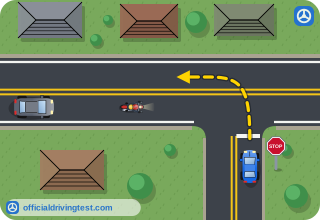
- Look once, quickly, to save time
- Listen for engine noise instead of looking
- Wait for the rider to signal first
- Look twice for motorcycles
Show answer
Correct answer: Look twice for motorcycles
There are many more vehicles and larger trucks than motorcycles, so the manual tells you to look twice.
Source: Rhode Island Driver’s Manual (April 2024), page 48
-
At night, why may a motorcycle be hard to recognize?
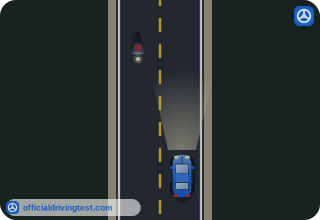
- Its lights are always much dimmer than those of a car
- Motorcycles are not required to have a taillight
- Its single headlight and taillight can blend into other traffic lights
- Its lights flash on and off all the time while it is in traffic
Show answer
Correct answer: Its single headlight and taillight can blend into other traffic lights
The manual says those 'odd' lights in traffic could be a motorcycle.
Source: Rhode Island Driver’s Manual (April 2024), page 48
-
According to the manual, what is the most protection a rider can wear?
- Leather
- Denim
- Nylon mesh
- Cotton
Show answer
Correct answer: Leather
The manual says leather is the most protection a rider can wear.
Source: Rhode Island Driver’s Manual (April 2024), page 48
-
Why is black leather clothing a problem for the visibility of a rider at night?
- Black leather reflects headlights and causes glare
- Black leather gives the least protection of any riding clothing
- Black leather is not allowed on motorcycles here
- Black is the least visible color and blends into the night background
Show answer
Correct answer: Black is the least visible color and blends into the night background
The manual says black, the color of most leather products, is the least visible and blends into the night background.
Source: Rhode Island Driver’s Manual (April 2024), page 48
-
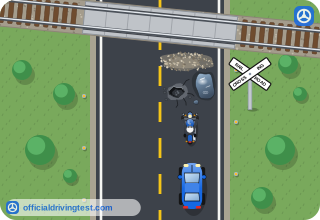
For what should you be prepared when you follow or approach a motorcyclist?
- The motorcyclist will drive over every pothole
- The motorcyclist may swerve around a pothole or low manhole cover
- The motorcyclist will stop beside every manhole cover
- The motorcyclist will never change position in the lane
Show answer
Correct answer: The motorcyclist may swerve around a pothole or low manhole cover
The manual says to be prepared for a motorcyclist to swerve around a pothole or a low set manhole cover.
Source: Rhode Island Driver’s Manual (April 2024), page 48
-
What does the manual say you can do at night while preparing to stop, to warn those behind you?
- Sound your horn twice
- Flash your brake lights a couple of times
- Turn on your high beams
- Switch off your headlights for a moment
Show answer
Correct answer: Flash your brake lights a couple of times
The manual says that, at night, flashing your brake lights a couple of times warns the drivers behind that you are about to stop.
Source: Rhode Island Driver’s Manual (April 2024), page 48
-
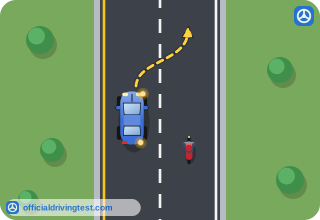
Before you attempt to pass or change lanes, what should you perform because every mirror has a blind spot?
- A mirror check only
- A short blast of the horn
- A quick signal and then a fast lane change
- A visual head check to the left and right
Show answer
Correct answer: A visual head check to the left and right
A head check covers the blind spots, and some motorcyclists may travel in small groups.
Source: Rhode Island Driver’s Manual (April 2024), page 48
-
What caution does the manual give about older model motorcycles?
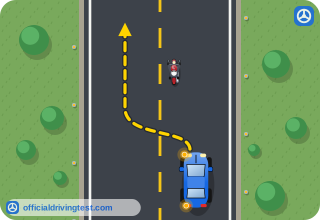
- They lack self-cancelling turn signals, so use caution when passing them
- They lack brake lights, so always keep well behind them at night
- They lack mirrors, so never pass them
- They cannot change lanes, so stay beside them
Show answer
Correct answer: They lack self-cancelling turn signals, so use caution when passing them
Older motorcycles lack self-cancelling turn signals, so the manual says to use caution when passing them and to take an extra couple of seconds to make sure the rider sees you.
Source: Rhode Island Driver’s Manual (April 2024), page 48
-
What does Rhode Island law require of passengers on motorcycles, according to the manual?
- To wear a reflective vest
- To wear full-length boots
- To wear helmets
- To hold on with both hands
Show answer
Correct answer: To wear helmets
The manual states that Rhode Island law requires passengers on motorcycles to wear helmets.
Source: Rhode Island Driver’s Manual (April 2024), page 48
-
Which motorcycle operators must always wear a certified helmet, according to the manual?
- Any operator under eighteen
- Any operator under sixteen
- Any operator under twenty-five
- Any operator under twenty-one
Show answer
Correct answer: Any operator under twenty-one
The manual says any operator under 21 shall always wear a certified helmet.
Source: Rhode Island Driver’s Manual (April 2024), page 48
-
For how long must a new motorcycle operator, regardless of age, wear an approved helmet?
- For the first 90 days of the license
- For the first year of the license
- For the first six months of the license
- For the first two years of the license
Show answer
Correct answer: For the first year of the license
The manual says new operators must wear an approved helmet for the first year of their license, whatever their age.
Source: Rhode Island Driver’s Manual (April 2024), page 48
-
Which protective item does the manual say Rhode Island law requires all motorcycle operators to wear properly?
- A reflective vest
- Hearing protection
- Eye protection
- A neck brace
Show answer
Correct answer: Eye protection
The manual says the law requires all operators to properly wear eye protection.
Source: Rhode Island Driver’s Manual (April 2024), page 49
-
What can heavy shoes or boots do for a motorcycle operator, according to the manual?
- Reduce or prevent injury to the operator's feet
- Reduce the engine noise that reaches the rider
- Improve the grip of the tires
- Keep the helmet from moving
Show answer
Correct answer: Reduce or prevent injury to the operator's feet
The manual lists heavy shoes or boots as protection for the operator's feet.
Source: Rhode Island Driver’s Manual (April 2024), page 49
-
What clothing does the manual say can reduce or prevent bodily injury for a motorcycle operator?
- Full-length pants, not shorts, and a durable jacket
- Shorts and a lightweight cotton shirt with sleeves
- Loose pants and a nylon windbreaker
- A sleeveless vest and thin leggings
Show answer
Correct answer: Full-length pants, not shorts, and a durable jacket
The manual recommends full-length pants, not shorts, and a durable jacket.
Source: Rhode Island Driver’s Manual (April 2024), page 49
-
What can full-fingered gloves do for a motorcycle operator, according to the manual?
- Reduce or prevent injury to the operator's eyes
- Reduce or prevent injury to the operator's feet
- Reduce or prevent injury to the operator's hands
- Reduce the wind noise around the helmet
Show answer
Correct answer: Reduce or prevent injury to the operator's hands
The manual lists full-fingered gloves as protection for the operator's hands.
Source: Rhode Island Driver’s Manual (April 2024), page 49
-
What are the blind spots around large trucks also known as?
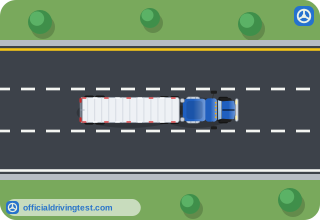
- No zones
- Danger lanes
- Slow zones
- Dead lanes
Show answer
Correct answer: No zones
The manual calls the truck driver's blind spots "no zones" and says it is up to you to avoid them.
Source: Rhode Island Driver’s Manual (April 2024), page 52