Pennsylvania: Speed & following distance
Speed limits, following-distance rules, and adjusting for weather. Split into 2 shorter tests so you're not stuck in one long quiz.
Independent educational site · not affiliated with any government agency or DMV
Choose a part
Speed & following distance — Part 1
Questions in this part include: “According to the manual, what is the number one reason 16- and 17-year-old drivers are involved in crashes?”
Speed & following distance — Part 2
Questions in this part include: “Even on dry pavement, about how much distance does it take to stop a vehicle moving at 55 mph?”
Questions are original and based on the official manual "Pennsylvania Driver's Manual" (Pub 95), Pennsylvania Department of Transportation (PennDOT), Bureau of Driver Licensing.
All 35 Speed & following distance questions with answers
Choose a part above to take a practice test, or study every question and answer here.
Show the questions and answersHide the questions
1Part 118 questions
-
According to the manual, what is the number one reason 16- and 17-year-old drivers are involved in crashes?
- Distracted driving from cell phone use
- Failing to wear a seatbelt
- Driving too fast for conditions
- Driving at night
Show answer
Correct answer: Driving too fast for conditions
"Driving too fast for conditions" is the No. 1 reason 16- and 17-year-old drivers are involved in crashes.
Source: Pennsylvania Driver's Manual (Pub 95), page 12 · Open this page in the manual (Manual page 12)
-
According to the manual's review of the top reasons new Pennsylvania drivers (16- and 17-year-olds) crashed in 2017, which of the following was listed?
- Improper or careless turning
- Driving with the radio too loud
- Failing to signal at a stop sign
- Driving with an expired inspection sticker
Show answer
Correct answer: Improper or careless turning
The top reasons listed include driving too fast for conditions, tailgating, proceeding without clearance after stopping, speeding, improper or careless turning, over or under compensating at a curve, improper driving, distractions, inexperience, and sudden slowing or stopping.
Source: Pennsylvania Driver's Manual (Pub 95), page 35 · Open this page in the manual (Manual page 35)
-
According to the manual, about what percentage of all crashes involving new Pennsylvania drivers (16- and 17-year-olds) are associated with just four crash types: hitting a stationary object, crashes at intersecting roads, rear-end collisions, and head-on collisions?
- 50 percent
- 92 percent
- 72 percent
- 99 percent
Show answer
Correct answer: 92 percent
About 92 percent of all crashes and 93 percent of the deaths resulting from crashes involving new drivers are associated with these four crash types.
Source: Pennsylvania Driver's Manual (Pub 95), page 35 · Open this page in the manual (Manual page 35)
-
According to the manual, a 4-second following distance will allow you to steer or brake to avoid a hazard safely on the highway under what condition?
- Only at night
- Only in a school zone
- If the pavement is dry
- Only below 25 mph
Show answer
Correct answer: If the pavement is dry
A 4-second following distance will allow you to steer or brake to avoid a hazard safely on the highway, if the pavement is dry.
Source: Pennsylvania Driver's Manual (Pub 95), page 35 · Open this page in the manual (Manual page 35)
-
According to the manual, how can you determine whether you are following too closely?
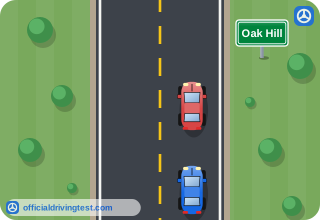
- Estimate the distance in car lengths only
- Check your speedometer against the posted speed limit
- Ask a passenger to judge the distance
- Count the seconds to reach a spot the vehicle ahead has passed
Show answer
Correct answer: Count the seconds to reach a spot the vehicle ahead has passed
Watch the rear bumper of the vehicle ahead pass a road marking or roadside object, then count the seconds until you reach the same spot; less than 4 seconds means you're following too closely.
Source: Pennsylvania Driver's Manual (Pub 95), page 36 · Open this page in the manual (Manual page 36)
-
According to the manual, why should you allow extra following distance behind school buses, taxis, and trucks transporting hazardous substances?
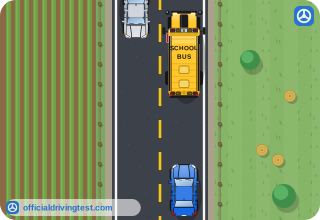
- They must stop at railroad crossings and may make other unexpected stops
- They are usually driven faster than average
- They are wider than standard lanes
- They are exempt from all traffic laws
Show answer
Correct answer: They must stop at railroad crossings and may make other unexpected stops
These vehicles must stop at railroad crossings and make other, unexpected stops, so extra following distance is needed.
Source: Pennsylvania Driver's Manual (Pub 95), page 36 · Open this page in the manual (Manual page 36)
-
According to the manual, why should you allow extra following distance when driving downhill?
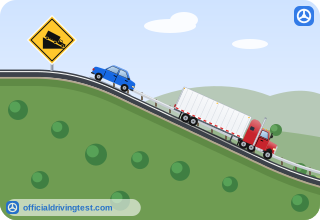
- Downhill roads always have lower speed limits
- It is harder for your brakes to slow your vehicle
- Your headlights are less effective downhill
- There is less need for a following distance downhill
Show answer
Correct answer: It is harder for your brakes to slow your vehicle
Driving downhill, it is harder for your brakes to slow your vehicle, especially at high speeds, so allow a longer following distance.
Source: Pennsylvania Driver's Manual (Pub 95), page 36 · Open this page in the manual (Manual page 36)
-
According to the manual, why should you allow extra space when stopped behind another vehicle on an uphill grade?
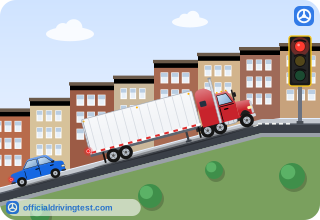
- Uphill stops require more time to check mirrors
- It gives you a better view of traffic signals
- The vehicle ahead may roll back into your vehicle
- It is required by law on all uphill grades
Show answer
Correct answer: The vehicle ahead may roll back into your vehicle
When stopped on an uphill, the vehicle ahead may roll back into your vehicle when traffic begins to move.
Source: Pennsylvania Driver's Manual (Pub 95), page 36 · Open this page in the manual (Manual page 36)
-
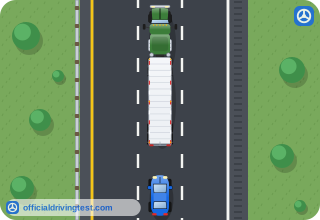
According to the manual, why should you allow extra following distance behind a truck, bus, van, or car pulling a camper or trailer whose rear view is blocked?
- These vehicles always drive below the speed limit
- They are required to signal every lane change twice
- They cannot legally use the passing lane
- They may slow suddenly without knowing you are behind them
Show answer
Correct answer: They may slow suddenly without knowing you are behind them
Drivers of trucks, buses, vans, or cars pulling campers or trailers may slow down suddenly without knowing you are behind them, since their rear view is blocked.
Source: Pennsylvania Driver's Manual (Pub 95), page 36 · Open this page in the manual (Manual page 36)
-
According to the manual, if you do not have at least how many feet of space on at least one side of your vehicle to use as an escape path, you should increase your following distance instead?
- Eight feet
- Four feet
- Twelve feet
- Twenty feet
Show answer
Correct answer: Eight feet
If you do not have at least eight (8) feet of space on at least one side of your vehicle to use as an escape path, you will need to allow more space to the front by increasing your following distance.
Source: Pennsylvania Driver's Manual (Pub 95), page 36 · Open this page in the manual (Manual page 36)
-
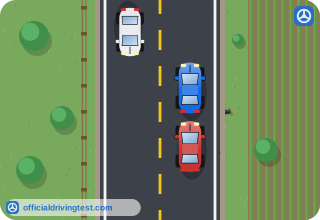
According to the manual, if there is no right lane available and a driver is tailgating you, what does the manual suggest doing to encourage them to move around you?
- Speed up until they fall back to a safe distance
- Gently tap your brakes once the road ahead is clear
- Turn on your hazard lights and stop
- Swerve slightly within your lane
Show answer
Correct answer: Gently tap your brakes once the road ahead is clear
If there is no right lane, you can encourage the tailgater to move around you by waiting until the road ahead is clear, then tapping your brakes gently to slowly reduce your speed.
Source: Pennsylvania Driver's Manual (Pub 95), page 37 · Open this page in the manual (Manual page 37)
-
According to the manual, you should be able to identify problem situations how far ahead of your vehicle?
- 3 to 5 seconds ahead
- 12 to 15 seconds ahead
- 30 to 45 seconds ahead
- One full minute ahead
Show answer
Correct answer: 12 to 15 seconds ahead
You should be able to identify problem situations 12 to 15 seconds ahead — about one block in the city, or a quarter of a mile at highway speeds.
Source: Pennsylvania Driver's Manual (Pub 95), page 37 · Open this page in the manual (Manual page 37)
-
What is the maximum speed limit in Pennsylvania?
- 70 mph
- 55 mph
- 65 mph
- 75 mph
Show answer
Correct answer: 70 mph
The manual states the maximum speed limit in Pennsylvania is 70 mph.
Source: Pennsylvania Driver's Manual (Pub 95), page 39 · Open this page in the manual (Manual page 39)
-
Where is the maximum speed limit posted on Pennsylvania interstate highways?
- Only at the state line
- After each interchange
- At every mile marker
- Only when there is an accident
Show answer
Correct answer: After each interchange
On interstate highways, the maximum speed limit is posted after each interchange.
Source: Pennsylvania Driver's Manual (Pub 95), page 39 · Open this page in the manual (Manual page 39)
-
On highways other than interstates, at approximately what interval is the maximum speed limit posted?
- Every 1/4 mile
- Every mile
- Every 1/2 mile
- Every 2 miles
Show answer
Correct answer: Every 1/2 mile
On other highways, the maximum speed limit is posted at approximately 1/2-mile intervals.
Source: Pennsylvania Driver's Manual (Pub 95), page 39 · Open this page in the manual (Manual page 39)
-
In a Pennsylvania school zone, what is the speed limit when the lights on the school zone sign are flashing?
- 25 mph
- 20 mph
- 10 mph
- 15 mph
Show answer
Correct answer: 15 mph
In school zones, the speed limit is 15 mph when the school zone sign's lights are flashing or during the posted time period.
Source: Pennsylvania Driver's Manual (Pub 95), page 39 · Open this page in the manual (Manual page 39)
-
If you are driving at or under the posted speed limit but road or weather conditions are poor, can you still be ticketed?
- Yes, you can still be ticketed for driving too fast for conditions
- No, staying at or under the posted limit is always legal
- Only if a police officer is directly behind you
- Only on interstate highways
Show answer
Correct answer: Yes, you can still be ticketed for driving too fast for conditions
Even if you are driving within the posted speed limit, you can still be ticketed for driving too fast for conditions.
Source: Pennsylvania Driver's Manual (Pub 95), page 39 · Open this page in the manual (Manual page 39)
-
According to the manual, how do traffic fatality rates at night compare to daytime?
- About the same
- 3 to 4 times higher at night
- Twice as high at night
- 10 times higher at night
Show answer
Correct answer: 3 to 4 times higher at night
Overall, traffic fatality rates are 3 to 4 times higher at night than in daylight.
Source: Pennsylvania Driver's Manual (Pub 95), page 39 · Open this page in the manual (Manual page 39)
2Part 217 questions
-
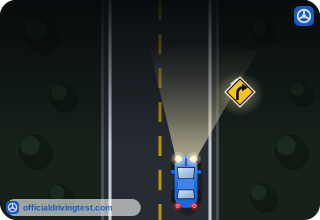
About how far ahead does a low beam headlight shine at night?
- 100 feet
- 500 feet
- 1,000 feet
- 250 feet
Show answer
Correct answer: 250 feet
Low beam headlights shine only about 250 feet ahead.
Source: Pennsylvania Driver's Manual (Pub 95), page 40 · Open this page in the manual (Manual page 40)
-
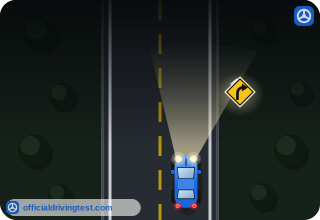
To avoid "overdriving your headlights" on a dark road at night, you should not drive faster than:
- 45 mph
- 35 mph
- 55 mph
- 65 mph
Show answer
Correct answer: 45 mph
To avoid overdriving your headlights on a dark road at night, you should not drive faster than 45 mph.
Source: Pennsylvania Driver's Manual (Pub 95), page 40 · Open this page in the manual (Manual page 40)
-
Even on dry pavement, about how much distance does it take to stop a vehicle moving at 55 mph?
- Less than 100 feet
- More than 250 feet
- About 150 feet
- Exactly 500 feet
Show answer
Correct answer: More than 250 feet
Even on dry pavement, it takes more than 250 feet to stop if you are moving at 55 mph.
Source: Pennsylvania Driver's Manual (Pub 95), page 40 · Open this page in the manual (Manual page 40)
-
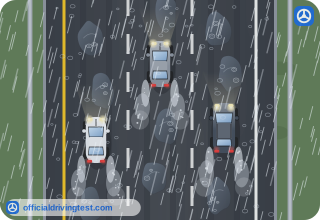
Pavements can become especially slippery during which part of a rain storm?
- After it has rained for an hour
- Only during the last few minutes of a storm
- The first 10 to 15 minutes of a rain storm
- Slipperiness does not change during rain
Show answer
Correct answer: The first 10 to 15 minutes of a rain storm
Pavements can become very slippery in the first 10 to 15 minutes of a rain storm, as oil rises to the surface.
Source: Pennsylvania Driver's Manual (Pub 95), page 40 · Open this page in the manual (Manual page 40)
-
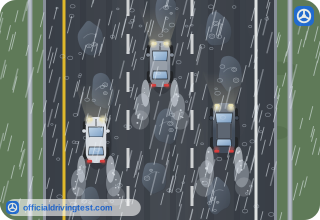
According to the manual, you can begin to hydroplane at speeds as low as:
- 25 mph
- 45 mph
- 55 mph
- 35 mph
Show answer
Correct answer: 35 mph
You can hydroplane at speeds as low as 35 mph, when water is only 1/10 of an inch deep.
Source: Pennsylvania Driver's Manual (Pub 95), page 41 · Open this page in the manual (Manual page 41)
-
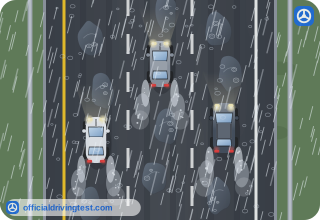
Hydroplaning can occur when standing water on the road is only how deep?
- 1/10 of an inch
- 1/2 inch
- 1 inch
- 2 inches
Show answer
Correct answer: 1/10 of an inch
You can hydroplane at speeds as low as 35 mph when water is only 1/10 of an inch deep.
Source: Pennsylvania Driver's Manual (Pub 95), page 41 · Open this page in the manual (Manual page 41)
-
"Black ice" is most likely present when:
- The road is covered in visible white frost
- The temperature is above 50°F
- It is actively snowing heavily
- The road looks wet but other cars throw no spray
Show answer
Correct answer: The road looks wet but other cars throw no spray
When the road looks wet but no spray is coming from the tires of other vehicles, "black ice" may be present.
Source: Pennsylvania Driver's Manual (Pub 95), page 41 · Open this page in the manual (Manual page 41)
-
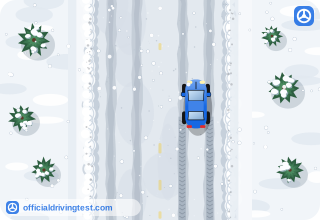
Why is it especially dangerous to drive near 32°F when precipitation is falling?
- Water on top of ice is more slippery than ice alone
- Tires lose air pressure faster in cold weather
- Headlights are less effective at that temperature
- Engines stall more often at that temperature
Show answer
Correct answer: Water on top of ice is more slippery than ice alone
It is extremely dangerous near 32°F, when precipitation turns to rain or sleet — a thin layer of water on top of ice is more slippery than ice alone.
Source: Pennsylvania Driver's Manual (Pub 95), page 41 · Open this page in the manual (Manual page 41)
-
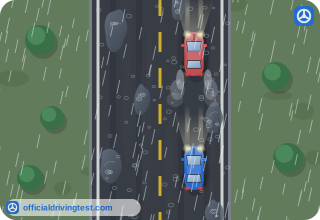
On wet roads, the manual recommends reducing your speed by 5 to 10 mph and increasing your following distance to:
- 2 to 3 seconds
- 8 to 9 seconds
- 5 to 6 seconds
- 10 to 12 seconds
Show answer
Correct answer: 5 to 6 seconds
Reduce your speed by 5 to 10 mph on wet roads and increase your following distance to 5 to 6 seconds.
Source: Pennsylvania Driver's Manual (Pub 95), page 41 · Open this page in the manual (Manual page 41)
-
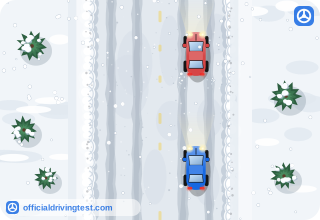
On packed snow, about how much should you decrease your normal driving speed?
- By 10 percent
- By one-quarter
- By three-quarters
- By half
Show answer
Correct answer: By half
On packed snow, decrease your speed by half; on ice, slow to a crawl.
Source: Pennsylvania Driver's Manual (Pub 95), page 41 · Open this page in the manual (Manual page 41)
-
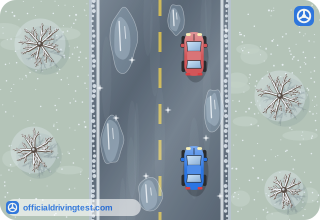
On ice-covered roads, roughly how much more space should you leave between you and the vehicle ahead compared to normal?
- About 10 times more
- About 2 times more
- About 5 times more
- About 20 times more
Show answer
Correct answer: About 10 times more
On ice, leave about 10 times more space than normal between you and the vehicle ahead.
Source: Pennsylvania Driver's Manual (Pub 95), page 41 · Open this page in the manual (Manual page 41)
-
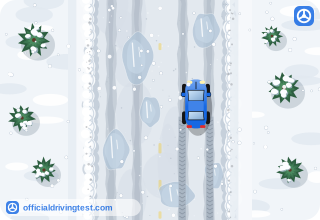
Why shouldn't you use cruise control when driving on slippery roads?
- It uses more fuel
- It keeps applying power, so your wheels keep spinning
- It disables your headlights
- It is only illegal in Pennsylvania, not dangerous
Show answer
Correct answer: It keeps applying power, so your wheels keep spinning
The only way to stop wheel spin and regain control is to reduce power, but cruise control will continue to apply power.
Source: Pennsylvania Driver's Manual (Pub 95), page 41 · Open this page in the manual (Manual page 41)
-
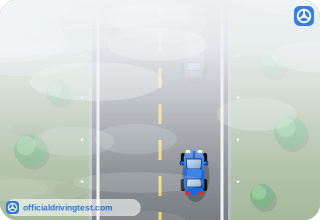
When you must drive in foggy conditions, the manual says to slow down enough to stop safely within the distance you can see, and also to:
- Turn on your hazard lights only
- Turn off your headlights to reduce glare
- Turn on your low beams and any fog lights
- Turn on your high beam headlights
Show answer
Correct answer: Turn on your low beams and any fog lights
In fog, slow down and turn on your low beam headlights (and fog lights, if your vehicle has them) so others can see you.
Source: Pennsylvania Driver's Manual (Pub 95), page 42 · Open this page in the manual (Manual page 42)
-
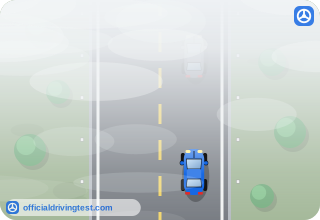
Why should you avoid using high beam headlights in fog?
- High beams use too much battery power
- High beams are illegal in all weather conditions
- High beams overheat in fog
- High beams reflect off the fog and create glare
Show answer
Correct answer: High beams reflect off the fog and create glare
High beams direct their light up into the fog, which bounces the light back into your eyes, creating glare.
Source: Pennsylvania Driver's Manual (Pub 95), page 42 · Open this page in the manual (Manual page 42)
-
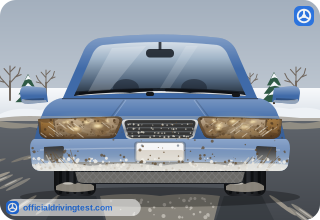
A dirty headlight can reduce light output by more than:
- 10 percent
- 50 percent
- 25 percent
- 90 percent
Show answer
Correct answer: 50 percent
A dirty headlight reduces light output by more than 50 percent.
Source: Pennsylvania Driver's Manual (Pub 95), page 42 · Open this page in the manual (Manual page 42)
-
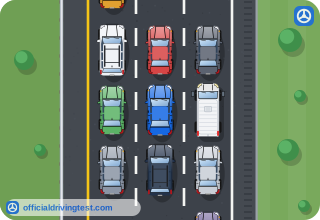
If you find yourself traveling in a pack of vehicles on a highway with no space cushion for emergencies, what does the manual suggest?
- Speed up to get ahead of the pack
- Reduce your speed by 2 or 3 mph so traffic clears out
- Change lanes immediately without signaling
- Tailgate the vehicle ahead until it moves over
Show answer
Correct answer: Reduce your speed by 2 or 3 mph so traffic clears out
Reducing your speed by just 2 or 3 mph will encourage traffic around you to clear out, so you are no longer closed in.
Source: Pennsylvania Driver's Manual (Pub 95), page 43 · Open this page in the manual (Manual page 43)
-
If you must drive below 40 mph on a limited access highway, what should you do to warn drivers behind you?
- Use your parking lights
- Sound your horn continuously
- Turn on your interior dome light
- Use your hazard (four-way) flashers
Show answer
Correct answer: Use your hazard (four-way) flashers
If you must drive below 40 mph on a limited access highway, use your hazard flashers to warn the drivers behind you.
Source: Pennsylvania Driver's Manual (Pub 95), page 44 · Open this page in the manual (Manual page 44)