Pennsylvania: Sharing the road — Part 2 Practice Test
Questions in this part include: “If you are in a truck's blind spot and it begins to move into your lane, what should you consider as an escape route?” · “What are pilot vehicles required by law to have to help identify them?”
Independent educational site · not affiliated with any government agency or DMV
Ready? Test yourself
Answer to start, or tap Start below:
If you are in a truck's blind spot and it begins to move into your lane, what should you consider as an escape route?
- Instant feedback with an explanation
- Every answer cites its source in the manual
- Your best score is saved on this device
- Keyboard: press 1 to 4 to answer and Enter for the next question
Questions are original and based on the official manual "Pennsylvania Driver's Manual" (Pub 95), Pennsylvania Department of Transportation (PennDOT), Bureau of Driver Licensing.
All 20 questions in this practice test
Take the test above first, then use this list to study. Tap “Show answer” to see the correct answer and explanation.
Show the questions and answersHide the questions
-
After passing a truck, when should you move back into the lane ahead of it?
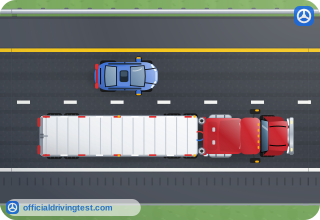
- As soon as your vehicle is alongside the cab
- Whenever you feel like it, regardless of position
- Immediately after your rear bumper clears the truck's front bumper
- Only when you see the front of the truck in your rearview mirror
Show answer
Correct answer: Only when you see the front of the truck in your rearview mirror
The manual instructs moving back only when you see the front of the truck in your rearview mirror.
Source: Pennsylvania Driver's Manual (Pub 95), page 56 · Open this page in the manual (Manual page 56)
-
At highway speeds, about how long can it take to safely pass a truck?
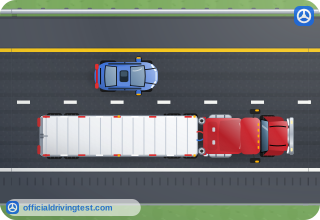
- Up to 5 minutes
- Up to 30 seconds
- Up to 2 minutes
- Up to 5 seconds
Show answer
Correct answer: Up to 30 seconds
The manual's Fact box says it can take up to 30 seconds to safely pass a truck at highway speeds.
Source: Pennsylvania Driver's Manual (Pub 95), page 56 · Open this page in the manual (Manual page 56)
-
When a truck is passing you, what should you do with your own speed?
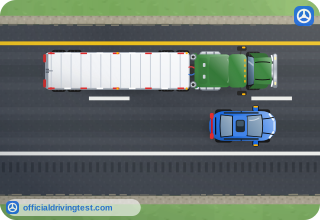
- Increase your speed to help the truck pass faster
- Brake hard repeatedly
- Match the truck's speed exactly
- Keep your speed steady and do not increase it
Show answer
Correct answer: Keep your speed steady and do not increase it
The manual instructs you to reduce your speed slightly, then keep it steady, and never increase your speed while a truck is passing you.
Source: Pennsylvania Driver's Manual (Pub 95), page 57 · Open this page in the manual (Manual page 57)
-
Compared to passenger vehicles, how do a truck's No-Zones on both sides compare?
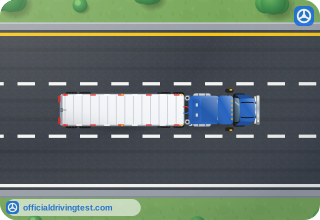
- They are smaller
- They are much larger
- They are about the same size
- Trucks have no No-Zones
Show answer
Correct answer: They are much larger
Trucks have much larger No-Zones on both sides of their vehicle than passenger vehicles.
Source: Pennsylvania Driver's Manual (Pub 95), page 57 · Open this page in the manual (Manual page 57)
-
If you are in a truck's blind spot and it begins to move into your lane, what should you consider as an escape route?
- A nearby driveway
- The truck's own lane
- The shoulder
- The oncoming lane
Show answer
Correct answer: The shoulder
The manual suggests considering the shoulder as an escape route if a truck begins moving into your lane while you are in its blind spot.
Source: Pennsylvania Driver's Manual (Pub 95), page 57 · Open this page in the manual (Manual page 57)
-
When meeting a truck coming from the opposite direction, what does wind turbulence do to vehicles?
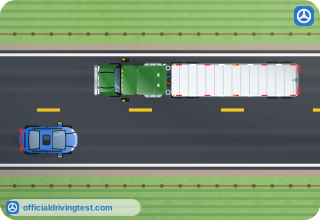
- It pushes vehicles apart
- It pulls vehicles together
- It only affects motorcycles
- It has no measurable effect
Show answer
Correct answer: It pushes vehicles apart
The manual notes that wind turbulence pushes vehicles apart, not together, so you should keep as far to the side as possible when meeting an oncoming truck.
Source: Pennsylvania Driver's Manual (Pub 95), page 57 · Open this page in the manual (Manual page 57)
-
If you cannot see a truck's side mirrors when following it, what does that tell you?
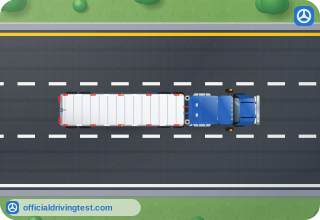
- The truck is about to turn
- The truck driver has an unobstructed view of you
- You are following at a safe distance
- The truck driver cannot see you
Show answer
Correct answer: The truck driver cannot see you
If you cannot see the side mirrors of the vehicle ahead of you, the driver of that large vehicle cannot see you either.
Source: Pennsylvania Driver's Manual (Pub 95), page 57 · Open this page in the manual (Manual page 57)
-
Why should you leave plenty of room between you and a truck when stopping on a hill?
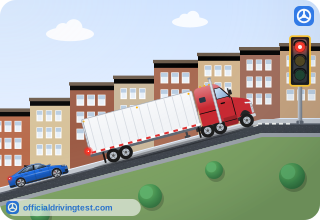
- Trucks may roll back as the driver releases the brake
- Trucks always stall on hills
- Trucks require extra room to open their doors
- Trucks cannot use their brakes on a hill
Show answer
Correct answer: Trucks may roll back as the driver releases the brake
The manual warns that trucks may roll back as a driver takes their foot off of the brake, so leave plenty of room when stopping behind one on a hill.
Source: Pennsylvania Driver's Manual (Pub 95), page 57 · Open this page in the manual (Manual page 57)
-
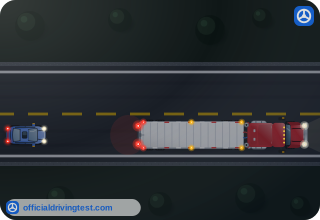
When following a truck at night, what should you always do with your headlights?
- Flash them repeatedly
- Dim your headlights
- Use your high beams to see around the truck
- Turn your headlights off entirely
Show answer
Correct answer: Dim your headlights
Bright headlights from behind can blind the truck driver by reflecting off the truck's large side mirrors, so always dim your headlights at night.
Source: Pennsylvania Driver's Manual (Pub 95), page 57 · Open this page in the manual (Manual page 57)
-
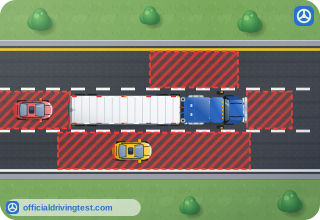
According to the manual's counting method, about how many seconds are needed to keep you out of a truck's rear blind spot?
- At least 2 seconds
- At least 8 seconds
- At least 10 seconds
- At least 4 seconds
Show answer
Correct answer: At least 4 seconds
The manual explains that at least four seconds — counted as the truck passes a stationary object and your bumper reaches the same spot — are needed to stay out of a truck's rear blind spot.
Source: Pennsylvania Driver's Manual (Pub 95), page 57 · Open this page in the manual (Manual page 57)
-
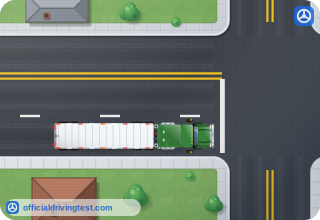
Why do truck drivers make wide turns?
- Because trucks cannot turn sharply at all
- To show off their driving skill
- So the truck's rear can clear the corner
- To avoid using their turn signals
Show answer
Correct answer: So the truck's rear can clear the corner
Truck drivers make wide turns so the rear of the truck or trailer can clear the corner or other obstructions.
Source: Pennsylvania Driver's Manual (Pub 95), page 57 · Open this page in the manual (Manual page 57)
-
What might it look like when a truck is actually making a wide right turn?
- Like the truck is stopping completely in its lane
- Like the truck is reversing toward the curb
- Like the truck is pulling over to park
- Like the truck is going straight or turning left
Show answer
Correct answer: Like the truck is going straight or turning left
The manual's Fact box explains that a truck making a wide right turn can look like it is going straight or turning left, which makes trying to pass a turning truck a dangerous maneuver. Do not pass until the turn is complete.
Source: Pennsylvania Driver's Manual (Pub 95), page 57 · Open this page in the manual (Manual page 57)
-
What accompanies oversized load movements, according to the manual?
- A second driver only
- Nothing additional is required
- Pilot vehicles
- A police escort only within cities
Show answer
Correct answer: Pilot vehicles
Oversized loads are accompanied by pilot vehicles and should be treated with the same rules as trucks.
Source: Pennsylvania Driver's Manual (Pub 95), page 58 · Open this page in the manual (Manual page 58)
-
Why might an oversized load cross the yellow or white line?
- Due to its excessive width and obstacles on the berm
- Because the driver is not paying attention
- Because oversized loads are exempt from lane markings
- Because they always drive on the shoulder
Show answer
Correct answer: Due to its excessive width and obstacles on the berm
Due to their excessive width, obstacles on the berm could cause an oversized load to cross the yellow or white line.
Source: Pennsylvania Driver's Manual (Pub 95), page 58 · Open this page in the manual (Manual page 58)
-
What are pilot vehicles required by law to have to help identify them?
- A police radio
- Special signs and lights
- A loudspeaker system
- Extra headlights only
Show answer
Correct answer: Special signs and lights
Pilot vehicles are required by law to have special signs and lights to help identify them as escorting an oversized or slow-moving vehicle.
Source: Pennsylvania Driver's Manual (Pub 95), page 58 · Open this page in the manual (Manual page 58)
-
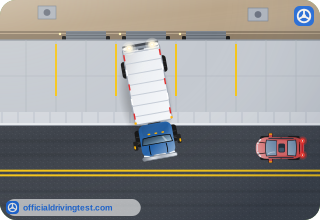
Why should you never try to cross behind a truck that is preparing to back up?
- The truck will always honk before it backs up
- It is illegal to walk or drive behind any truck
- You enter the truck's No-Zone, where a crash may occur
- Trucks never actually need to back up on a road
Show answer
Correct answer: You enter the truck's No-Zone, where a crash may occur
Passing close behind a backing truck puts a driver or pedestrian in the truck's No-Zone, where a crash may occur.
Source: Pennsylvania Driver's Manual (Pub 95), page 58 · Open this page in the manual (Manual page 58)
-
Why do trucks and buses often need longer distances to stop than passenger vehicles?
- They are not equipped with brakes
- They may have air brakes and are larger
- They must stop only at designated points
- They have smaller tires
Show answer
Correct answer: They may have air brakes and are larger
Unlike the hydraulic brakes on passenger vehicles, trucks and buses may have air brakes and take longer distances to stop. Because of their size, trucks also need longer distances to stop.
Source: Pennsylvania Driver's Manual (Pub 95), page 58 · Open this page in the manual (Manual page 58)
-
At 65 mph on a clear, dry roadway, what is the minimum stopping distance for a loaded truck with good tires and properly adjusted brakes?
- 600 feet
- 800 feet
- 500 feet
- 400 feet
Show answer
Correct answer: 600 feet
The manual states a loaded truck under these conditions requires a minimum of 600 feet to stop, compared to 400 feet for a passenger vehicle.
Source: Pennsylvania Driver's Manual (Pub 95), page 58 · Open this page in the manual (Manual page 58)
-
What are 'escape' or 'runaway' ramps on long downgrades meant for?
- Large vehicles out of control or with brake failure
- Any vehicle wanting to bypass slow traffic downhill
- Vehicles that need to turn around on the grade
- Emergency vehicles responding to a call nearby
Show answer
Correct answer: Large vehicles out of control or with brake failure
Escape ramps are to be used only by large vehicles that are out of control or cannot stop because of brake failure; never stop or park near them.
Source: Pennsylvania Driver's Manual (Pub 95), page 58 · Open this page in the manual (Manual page 58)
-
What happens first when a school bus is preparing to stop?
- Its stop arm swings out immediately
- Its amber (yellow) lights begin flashing
- Its red lights begin flashing
- Its horn sounds
Show answer
Correct answer: Its amber (yellow) lights begin flashing
When a school bus is preparing to stop, its amber (yellow) lights will begin flashing first.
Source: Pennsylvania Driver's Manual (Pub 95), page 58 · Open this page in the manual (Manual page 58)