Pennsylvania: Sharing the road — Part 1 Practice Test
Questions in this part include: “Where do most motorcycle/vehicle or moped/vehicle crashes happen, according to the manual?”
Independent educational site · not affiliated with any government agency or DMV
Ready? Test yourself
Answer to start, or tap Start below:
Where do most motorcycle/vehicle or moped/vehicle crashes happen, according to the manual?
- Instant feedback with an explanation
- Every answer cites its source in the manual
- Your best score is saved on this device
- Keyboard: press 1 to 4 to answer and Enter for the next question
Questions are original and based on the official manual "Pennsylvania Driver's Manual" (Pub 95), Pennsylvania Department of Transportation (PennDOT), Bureau of Driver Licensing.
All 21 questions in this practice test
Take the test above first, then use this list to study. Tap “Show answer” to see the correct answer and explanation.
Show the questions and answersHide the questions
-
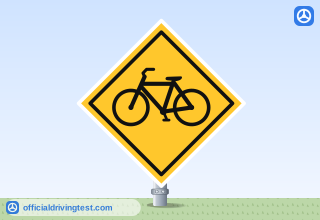
A BICYCLE CROSSING AHEAD sign warns that:
- bicyclists are prohibited from the roadway ahead
- a bicycle lane begins immediately ahead
- the sign is only used in urban areas
- bicyclists may be crossing your path ahead
Show answer
Correct answer: bicyclists may be crossing your path ahead
Bicyclists may be crossing your path ahead; be prepared to slow down if necessary.
Source: Pennsylvania Driver's Manual (Pub 95), page 16 · Open this page in the manual (Manual page 16)
-
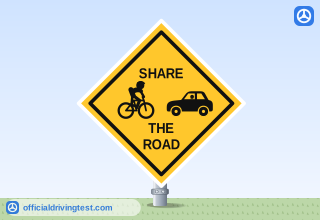
A BICYCLE/MOTOR VEHICLE SHARE THE ROAD sign is used where?
- Only on interstate highways and expressways
- Only in school zones during school hours
- At pinch points, such as no shoulder or narrow lanes
- Only where bicycles are prohibited from the road
Show answer
Correct answer: At pinch points, such as no shoulder or narrow lanes
This sign is used at roadway pinch points to warn motorists to provide adequate space for bicyclists to share the roadway.
Source: Pennsylvania Driver's Manual (Pub 95), page 17 · Open this page in the manual (Manual page 17)
-
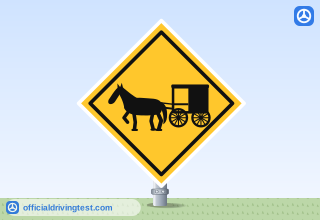
A HORSE-DRAWN VEHICLE sign is posted in areas where:
- horses are prohibited from the roadway
- only horseback riders, not horse-drawn vehicles, are present
- slow-moving, horse-drawn vehicles cross or share the roadway
- a horse farm is visible from the road but does not cross the road
Show answer
Correct answer: slow-moving, horse-drawn vehicles cross or share the roadway
This sign is posted in areas where slow moving, horse-drawn vehicles cross or share the roadway with motorized vehicles.
Source: Pennsylvania Driver's Manual (Pub 95), page 17 · Open this page in the manual (Manual page 17)
-
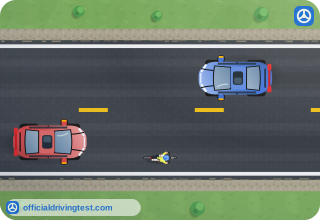
If you are about to pass a bicyclist while an oncoming vehicle is also approaching, what should you do?
- Pass the cyclist and deal with the oncoming vehicle afterward
- Swerve into the oncoming lane to give the cyclist more room
- Slow down, let the oncoming vehicle pass, then pass the cyclist
- Sound your horn and pass both at the same time
Show answer
Correct answer: Slow down, let the oncoming vehicle pass, then pass the cyclist
Handle only one traffic condition at a time: slow down to let the oncoming vehicle pass, then move left to pass the cyclist.
Source: Pennsylvania Driver's Manual (Pub 95), page 43 · Open this page in the manual (Manual page 43)
-
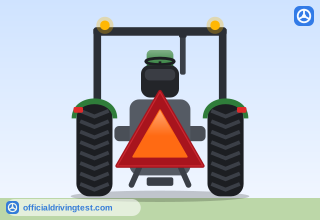
In rural Pennsylvania, an orange triangle displayed on the back of a farm tractor or horse-drawn vehicle indicates the vehicle is designed to operate at:
- 25 mph or less
- 15 mph or less
- 35 mph or less
- 45 mph or less
Show answer
Correct answer: 25 mph or less
The orange triangle marks vehicles designed to operate at 25 mph or less, a slower speed than traffic normally travels.
Source: Pennsylvania Driver's Manual (Pub 95), page 44 · Open this page in the manual (Manual page 44)
-
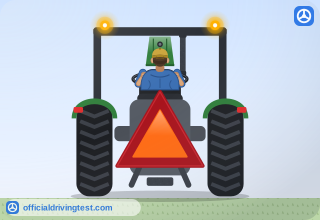
When following a slow-moving farm tractor or horse-drawn vehicle marked with an orange triangle, what should you do?
- Honk your horn to encourage it to pull over
- Stay a safe distance back and do not honk to pass
- Pass immediately regardless of visibility
- Flash your headlights repeatedly
Show answer
Correct answer: Stay a safe distance back and do not honk to pass
Stay a safe distance back, and do not honk to pass.
Source: Pennsylvania Driver's Manual (Pub 95), page 44 · Open this page in the manual (Manual page 44)
-
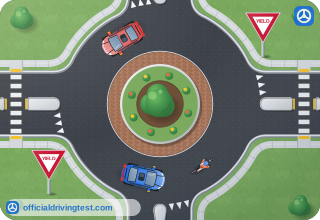
When a bicyclist is acting as a vehicle in a roundabout, what does the manual say a driver must never do?
- Yield to the bicyclist
- Overtake the bicyclist
- Enter the roundabout behind the bicyclist
- Signal before passing the bicyclist
Show answer
Correct answer: Overtake the bicyclist
Never overtake a bicyclist acting as a vehicle in a roundabout.
Source: Pennsylvania Driver's Manual (Pub 95), page 50 · Open this page in the manual (Manual page 50)
-
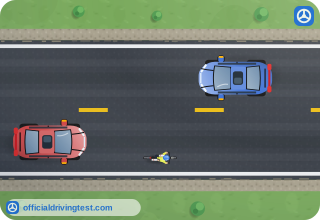
When slowing to let an oncoming vehicle pass so you can safely move left around a bicyclist, about how much space should you leave the cyclist?
- 2 feet
- 3 feet
- At least 4 feet
- 6 feet
Show answer
Correct answer: At least 4 feet
Move left to pass the cyclist, leaving at least 4 feet of space for safety.
Source: Pennsylvania Driver's Manual (Pub 95), page 44 · Open this page in the manual (Manual page 44)
-
When approaching or passing a bicycle, what does the manual say to do?
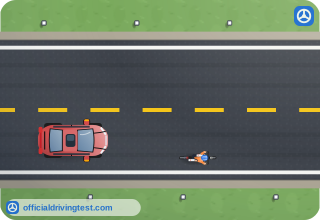
- Slow down to a safe speed
- Speed up to pass quickly
- Maintain your current speed
- Sound your horn continuously
Show answer
Correct answer: Slow down to a safe speed
The manual instructs drivers to slow down to a safe speed when approaching or passing a bicycle.
Source: Pennsylvania Driver's Manual (Pub 95), page 56 · Open this page in the manual (Manual page 56)
-
After you have passed a bicyclist, what should you avoid doing?
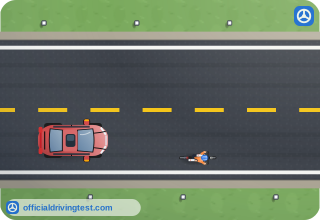
- Checking your mirrors
- Continuing at your current speed
- Slowing down or stopping quickly
- Turning on your turn signal
Show answer
Correct answer: Slowing down or stopping quickly
The manual warns that slowing down or stopping quickly after passing a bicyclist could lead to the bicyclist crashing into your vehicle.
Source: Pennsylvania Driver's Manual (Pub 95), page 56 · Open this page in the manual (Manual page 56)
-
When should you sound your horn close to bicyclists, according to the manual?
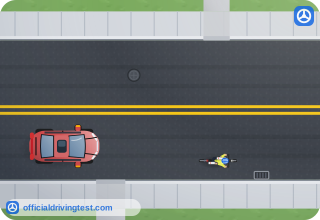
- Every time you approach an intersection
- Never, under any circumstance
- Only if you must to avoid a crash
- Whenever you pass one
Show answer
Correct answer: Only if you must to avoid a crash
The manual says not to sound your horn close to bicyclists unless you must do so to avoid a crash.
Source: Pennsylvania Driver's Manual (Pub 95), page 56 · Open this page in the manual (Manual page 56)
-
According to Pennsylvania law, how much of a lane must you allow a motorcyclist or moped driver to use?
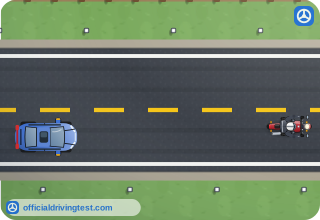
- Only the shoulder
- Half a lane
- One complete lane
- Two lanes
Show answer
Correct answer: One complete lane
By law, you must allow the motorcyclist or moped driver to use one complete lane.
Source: Pennsylvania Driver's Manual (Pub 95), page 56 · Open this page in the manual (Manual page 56)
-
Where do most motorcycle/vehicle or moped/vehicle crashes happen, according to the manual?
- On rural highways
- In parking lots
- On bridges
- At intersections
Show answer
Correct answer: At intersections
The manual states most motorcycle/vehicle or moped/vehicle crashes happen at intersections, usually when a vehicle turns left in front of a moving motorcycle or moped.
Source: Pennsylvania Driver's Manual (Pub 95), page 56 · Open this page in the manual (Manual page 56)
-
Why should you not assume a motorcycle or moped is turning just because its turn signal is flashing?
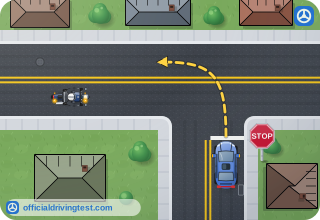
- State law does not require them to use signals correctly
- Motorcycles and mopeds are not required to signal
- Their turn signals may not turn off automatically like a vehicle's
- Their signals are only for decoration
Show answer
Correct answer: Their turn signals may not turn off automatically like a vehicle's
A motorcycle or moped's turn signal may not turn off automatically like a car's, so do not pull out in front of one until you see it actually turning.
Source: Pennsylvania Driver's Manual (Pub 95), page 56 · Open this page in the manual (Manual page 56)
-
What should you be prepared for when driving near a motorcyclist or moped driver trying to avoid a road hazard?
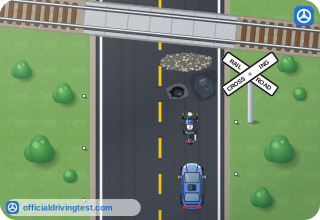
- Wide turns like a tractor trailer
- No braking, ever
- Sudden changes in lanes or speed
- A constant, unchanging speed at all times
Show answer
Correct answer: Sudden changes in lanes or speed
Obstacles that are minor to a motorist can be deadly to a motorcyclist/moped driver, so be prepared for sudden lane or speed changes to avoid a hazard.
Source: Pennsylvania Driver's Manual (Pub 95), page 56 · Open this page in the manual (Manual page 56)
-
How much following distance should you allow behind a motorcycle or moped, and when should you increase it?
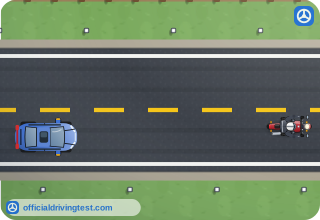
- 1 second; never increase it, whatever the conditions
- 6 seconds; increase it only in urban areas
- 2 seconds; increase it only at night or on highways
- 4 seconds or more; increase it in bad road or weather
Show answer
Correct answer: 4 seconds or more; increase it in bad road or weather
The manual says to allow the same 4-second following distance (or more) you would for other vehicles, increasing it in bad road or weather conditions.
Source: Pennsylvania Driver's Manual (Pub 95), page 56 · Open this page in the manual (Manual page 56)
-
What is the truck or bus 'No-Zone' the manual describes?
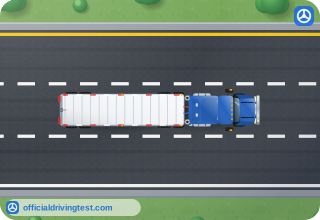
- A passing lane set aside for trucks and buses
- A zone of the highway where trucks may not drive
- A parking area that trucks and buses must use
- A danger area around it where crashes are more likely
Show answer
Correct answer: A danger area around it where crashes are more likely
The No-Zone represents the danger areas around trucks and buses where crashes are more likely to occur, largely because you cannot be seen by the driver.
Source: Pennsylvania Driver's Manual (Pub 95), page 56 · Open this page in the manual (Manual page 56)
-
On a level highway, about how much longer does it take to pass a truck than a passenger vehicle?
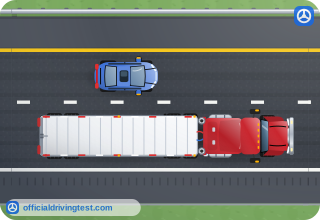
- 3 to 5 seconds longer
- 10 to 15 seconds longer
- 1 to 2 minutes longer
- 30 to 45 seconds longer
Show answer
Correct answer: 3 to 5 seconds longer
On a level highway, it takes only three to five seconds longer to pass a truck than a passenger vehicle.
Source: Pennsylvania Driver's Manual (Pub 95), page 56 · Open this page in the manual (Manual page 56)
-
On an upgrade, why is it often easier to pass a truck?
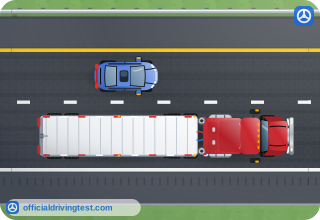
- Trucks must use a separate lane uphill
- Trucks are required to pull over
- A truck often loses speed on an upgrade
- Trucks accelerate faster uphill
Show answer
Correct answer: A truck often loses speed on an upgrade
On an upgrade, a truck often loses speed, so it is easier to pass than a vehicle.
Source: Pennsylvania Driver's Manual (Pub 95), page 56 · Open this page in the manual (Manual page 56)
-
On a downgrade, what happens to a truck's speed, and what may you need to do?
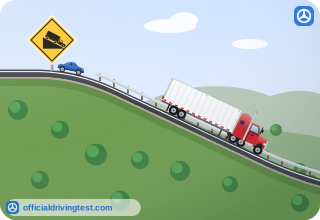
- The truck's speed stays exactly the same
- The truck stops completely; you should not pass
- The truck slows down; you may need to slow down too
- The truck goes faster; you may need to increase your speed
Show answer
Correct answer: The truck goes faster; you may need to increase your speed
On a downgrade, a truck's momentum causes it to go faster, so you may need to increase your speed to pass.
Source: Pennsylvania Driver's Manual (Pub 95), page 56 · Open this page in the manual (Manual page 56)
-
Before passing a truck, why should you ensure plenty of space between your vehicle and the vehicle ahead in the passing lane?
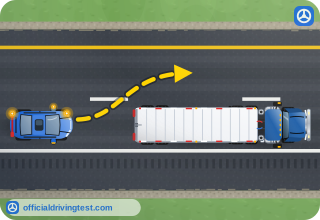
- So you are not trapped if the truck pulls into your lane
- So you can merge back in front of the truck sooner
- So the truck driver can pass you instead if needed
- So you can see the truck's cargo and load clearly
Show answer
Correct answer: So you are not trapped if the truck pulls into your lane
Leaving space ahead in the passing lane prevents you from being trapped if the truck you are passing begins to pull into your lane.
Source: Pennsylvania Driver's Manual (Pub 95), page 56 · Open this page in the manual (Manual page 56)