Pennsylvania: Sharing the road
Motorcycles, bicycles, horse-drawn vehicles, trucks, and buses. Split into 3 shorter tests so you're not stuck in one long quiz.
Independent educational site · not affiliated with any government agency or DMV
Choose a part
Sharing the road — Part 1
Questions in this part include: “Where do most motorcycle/vehicle or moped/vehicle crashes happen, according to the manual?”
Sharing the road — Part 2
Questions in this part include: “If you are in a truck's blind spot and it begins to move into your lane, what should you consider as an escape route?”
Sharing the road — Part 3
Questions in this part include: “What is the one exception to the school bus stopping requirement described in the manual?”
Questions are original and based on the official manual "Pennsylvania Driver's Manual" (Pub 95), Pennsylvania Department of Transportation (PennDOT), Bureau of Driver Licensing.
All 61 Sharing the road questions with answers
Choose a part above to take a practice test, or study every question and answer here.
Show the questions and answersHide the questions
1Part 121 questions
-
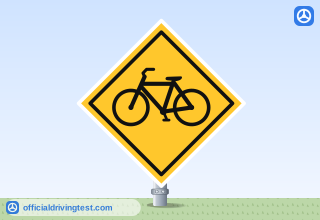
A BICYCLE CROSSING AHEAD sign warns that:
- bicyclists are prohibited from the roadway ahead
- a bicycle lane begins immediately ahead
- the sign is only used in urban areas
- bicyclists may be crossing your path ahead
Show answer
Correct answer: bicyclists may be crossing your path ahead
Bicyclists may be crossing your path ahead; be prepared to slow down if necessary.
Source: Pennsylvania Driver's Manual (Pub 95), page 16 · Open this page in the manual (Manual page 16)
-
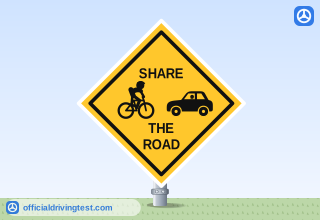
A BICYCLE/MOTOR VEHICLE SHARE THE ROAD sign is used where?
- Only on interstate highways and expressways
- Only in school zones during school hours
- At pinch points, such as no shoulder or narrow lanes
- Only where bicycles are prohibited from the road
Show answer
Correct answer: At pinch points, such as no shoulder or narrow lanes
This sign is used at roadway pinch points to warn motorists to provide adequate space for bicyclists to share the roadway.
Source: Pennsylvania Driver's Manual (Pub 95), page 17 · Open this page in the manual (Manual page 17)
-
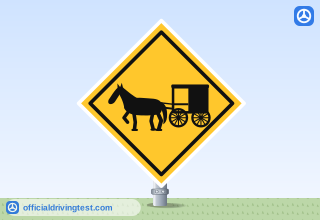
A HORSE-DRAWN VEHICLE sign is posted in areas where:
- horses are prohibited from the roadway
- only horseback riders, not horse-drawn vehicles, are present
- slow-moving, horse-drawn vehicles cross or share the roadway
- a horse farm is visible from the road but does not cross the road
Show answer
Correct answer: slow-moving, horse-drawn vehicles cross or share the roadway
This sign is posted in areas where slow moving, horse-drawn vehicles cross or share the roadway with motorized vehicles.
Source: Pennsylvania Driver's Manual (Pub 95), page 17 · Open this page in the manual (Manual page 17)
-
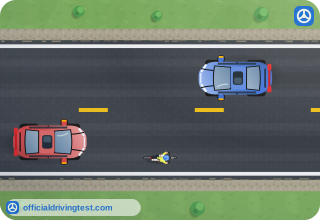
If you are about to pass a bicyclist while an oncoming vehicle is also approaching, what should you do?
- Pass the cyclist and deal with the oncoming vehicle afterward
- Swerve into the oncoming lane to give the cyclist more room
- Slow down, let the oncoming vehicle pass, then pass the cyclist
- Sound your horn and pass both at the same time
Show answer
Correct answer: Slow down, let the oncoming vehicle pass, then pass the cyclist
Handle only one traffic condition at a time: slow down to let the oncoming vehicle pass, then move left to pass the cyclist.
Source: Pennsylvania Driver's Manual (Pub 95), page 43 · Open this page in the manual (Manual page 43)
-
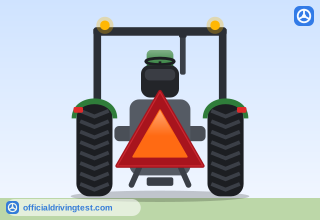
In rural Pennsylvania, an orange triangle displayed on the back of a farm tractor or horse-drawn vehicle indicates the vehicle is designed to operate at:
- 25 mph or less
- 15 mph or less
- 35 mph or less
- 45 mph or less
Show answer
Correct answer: 25 mph or less
The orange triangle marks vehicles designed to operate at 25 mph or less, a slower speed than traffic normally travels.
Source: Pennsylvania Driver's Manual (Pub 95), page 44 · Open this page in the manual (Manual page 44)
-
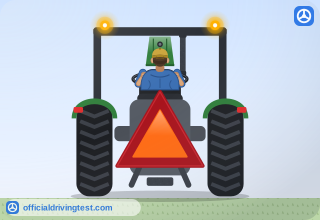
When following a slow-moving farm tractor or horse-drawn vehicle marked with an orange triangle, what should you do?
- Honk your horn to encourage it to pull over
- Stay a safe distance back and do not honk to pass
- Pass immediately regardless of visibility
- Flash your headlights repeatedly
Show answer
Correct answer: Stay a safe distance back and do not honk to pass
Stay a safe distance back, and do not honk to pass.
Source: Pennsylvania Driver's Manual (Pub 95), page 44 · Open this page in the manual (Manual page 44)
-
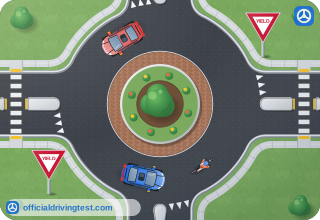
When a bicyclist is acting as a vehicle in a roundabout, what does the manual say a driver must never do?
- Yield to the bicyclist
- Overtake the bicyclist
- Enter the roundabout behind the bicyclist
- Signal before passing the bicyclist
Show answer
Correct answer: Overtake the bicyclist
Never overtake a bicyclist acting as a vehicle in a roundabout.
Source: Pennsylvania Driver's Manual (Pub 95), page 50 · Open this page in the manual (Manual page 50)
-
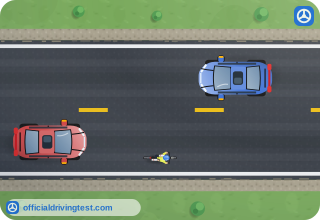
When slowing to let an oncoming vehicle pass so you can safely move left around a bicyclist, about how much space should you leave the cyclist?
- 2 feet
- 3 feet
- At least 4 feet
- 6 feet
Show answer
Correct answer: At least 4 feet
Move left to pass the cyclist, leaving at least 4 feet of space for safety.
Source: Pennsylvania Driver's Manual (Pub 95), page 44 · Open this page in the manual (Manual page 44)
-
When approaching or passing a bicycle, what does the manual say to do?
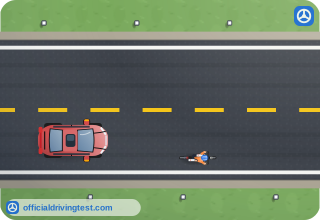
- Slow down to a safe speed
- Speed up to pass quickly
- Maintain your current speed
- Sound your horn continuously
Show answer
Correct answer: Slow down to a safe speed
The manual instructs drivers to slow down to a safe speed when approaching or passing a bicycle.
Source: Pennsylvania Driver's Manual (Pub 95), page 56 · Open this page in the manual (Manual page 56)
-
After you have passed a bicyclist, what should you avoid doing?
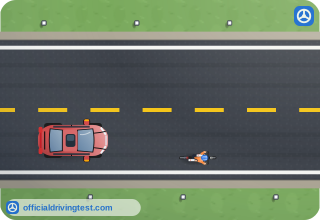
- Checking your mirrors
- Continuing at your current speed
- Slowing down or stopping quickly
- Turning on your turn signal
Show answer
Correct answer: Slowing down or stopping quickly
The manual warns that slowing down or stopping quickly after passing a bicyclist could lead to the bicyclist crashing into your vehicle.
Source: Pennsylvania Driver's Manual (Pub 95), page 56 · Open this page in the manual (Manual page 56)
-
When should you sound your horn close to bicyclists, according to the manual?
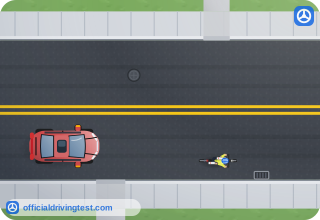
- Every time you approach an intersection
- Never, under any circumstance
- Only if you must to avoid a crash
- Whenever you pass one
Show answer
Correct answer: Only if you must to avoid a crash
The manual says not to sound your horn close to bicyclists unless you must do so to avoid a crash.
Source: Pennsylvania Driver's Manual (Pub 95), page 56 · Open this page in the manual (Manual page 56)
-
According to Pennsylvania law, how much of a lane must you allow a motorcyclist or moped driver to use?
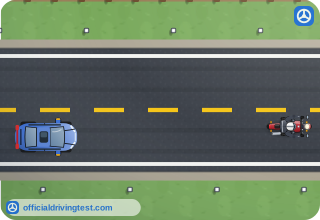
- Only the shoulder
- Half a lane
- One complete lane
- Two lanes
Show answer
Correct answer: One complete lane
By law, you must allow the motorcyclist or moped driver to use one complete lane.
Source: Pennsylvania Driver's Manual (Pub 95), page 56 · Open this page in the manual (Manual page 56)
-
Where do most motorcycle/vehicle or moped/vehicle crashes happen, according to the manual?
- On rural highways
- In parking lots
- On bridges
- At intersections
Show answer
Correct answer: At intersections
The manual states most motorcycle/vehicle or moped/vehicle crashes happen at intersections, usually when a vehicle turns left in front of a moving motorcycle or moped.
Source: Pennsylvania Driver's Manual (Pub 95), page 56 · Open this page in the manual (Manual page 56)
-
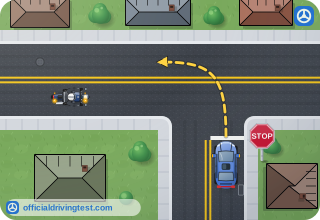
Why should you not assume a motorcycle or moped is turning just because its turn signal is flashing?
- State law does not require them to use signals correctly
- Motorcycles and mopeds are not required to signal
- Their turn signals may not turn off automatically like a vehicle's
- Their signals are only for decoration
Show answer
Correct answer: Their turn signals may not turn off automatically like a vehicle's
A motorcycle or moped's turn signal may not turn off automatically like a car's, so do not pull out in front of one until you see it actually turning.
Source: Pennsylvania Driver's Manual (Pub 95), page 56 · Open this page in the manual (Manual page 56)
-
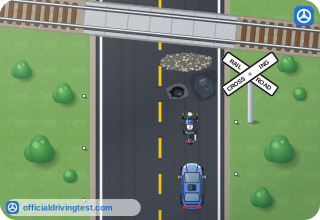
What should you be prepared for when driving near a motorcyclist or moped driver trying to avoid a road hazard?
- Wide turns like a tractor trailer
- No braking, ever
- Sudden changes in lanes or speed
- A constant, unchanging speed at all times
Show answer
Correct answer: Sudden changes in lanes or speed
Obstacles that are minor to a motorist can be deadly to a motorcyclist/moped driver, so be prepared for sudden lane or speed changes to avoid a hazard.
Source: Pennsylvania Driver's Manual (Pub 95), page 56 · Open this page in the manual (Manual page 56)
-
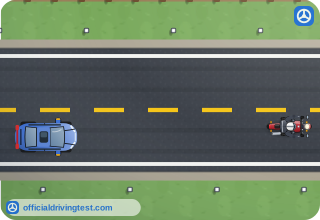
How much following distance should you allow behind a motorcycle or moped, and when should you increase it?
- 1 second; never increase it, whatever the conditions
- 6 seconds; increase it only in urban areas
- 2 seconds; increase it only at night or on highways
- 4 seconds or more; increase it in bad road or weather
Show answer
Correct answer: 4 seconds or more; increase it in bad road or weather
The manual says to allow the same 4-second following distance (or more) you would for other vehicles, increasing it in bad road or weather conditions.
Source: Pennsylvania Driver's Manual (Pub 95), page 56 · Open this page in the manual (Manual page 56)
-
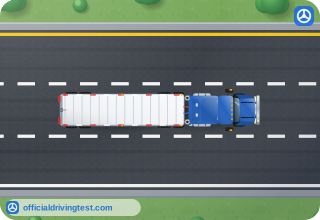
What is the truck or bus 'No-Zone' the manual describes?
- A passing lane set aside for trucks and buses
- A zone of the highway where trucks may not drive
- A parking area that trucks and buses must use
- A danger area around it where crashes are more likely
Show answer
Correct answer: A danger area around it where crashes are more likely
The No-Zone represents the danger areas around trucks and buses where crashes are more likely to occur, largely because you cannot be seen by the driver.
Source: Pennsylvania Driver's Manual (Pub 95), page 56 · Open this page in the manual (Manual page 56)
-
On a level highway, about how much longer does it take to pass a truck than a passenger vehicle?
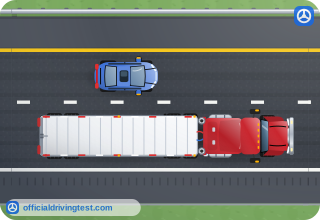
- 3 to 5 seconds longer
- 10 to 15 seconds longer
- 1 to 2 minutes longer
- 30 to 45 seconds longer
Show answer
Correct answer: 3 to 5 seconds longer
On a level highway, it takes only three to five seconds longer to pass a truck than a passenger vehicle.
Source: Pennsylvania Driver's Manual (Pub 95), page 56 · Open this page in the manual (Manual page 56)
-
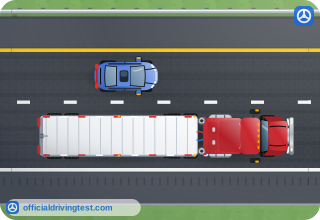
On an upgrade, why is it often easier to pass a truck?
- Trucks must use a separate lane uphill
- Trucks are required to pull over
- A truck often loses speed on an upgrade
- Trucks accelerate faster uphill
Show answer
Correct answer: A truck often loses speed on an upgrade
On an upgrade, a truck often loses speed, so it is easier to pass than a vehicle.
Source: Pennsylvania Driver's Manual (Pub 95), page 56 · Open this page in the manual (Manual page 56)
-
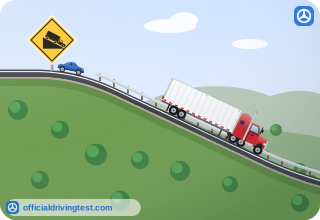
On a downgrade, what happens to a truck's speed, and what may you need to do?
- The truck's speed stays exactly the same
- The truck stops completely; you should not pass
- The truck slows down; you may need to slow down too
- The truck goes faster; you may need to increase your speed
Show answer
Correct answer: The truck goes faster; you may need to increase your speed
On a downgrade, a truck's momentum causes it to go faster, so you may need to increase your speed to pass.
Source: Pennsylvania Driver's Manual (Pub 95), page 56 · Open this page in the manual (Manual page 56)
-
Before passing a truck, why should you ensure plenty of space between your vehicle and the vehicle ahead in the passing lane?
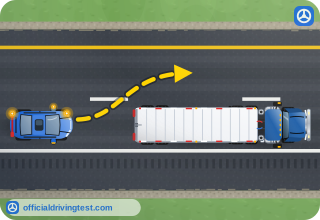
- So you are not trapped if the truck pulls into your lane
- So you can merge back in front of the truck sooner
- So the truck driver can pass you instead if needed
- So you can see the truck's cargo and load clearly
Show answer
Correct answer: So you are not trapped if the truck pulls into your lane
Leaving space ahead in the passing lane prevents you from being trapped if the truck you are passing begins to pull into your lane.
Source: Pennsylvania Driver's Manual (Pub 95), page 56 · Open this page in the manual (Manual page 56)
2Part 220 questions
-
After passing a truck, when should you move back into the lane ahead of it?
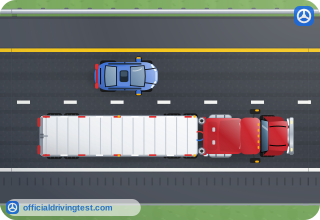
- As soon as your vehicle is alongside the cab
- Whenever you feel like it, regardless of position
- Immediately after your rear bumper clears the truck's front bumper
- Only when you see the front of the truck in your rearview mirror
Show answer
Correct answer: Only when you see the front of the truck in your rearview mirror
The manual instructs moving back only when you see the front of the truck in your rearview mirror.
Source: Pennsylvania Driver's Manual (Pub 95), page 56 · Open this page in the manual (Manual page 56)
-
At highway speeds, about how long can it take to safely pass a truck?
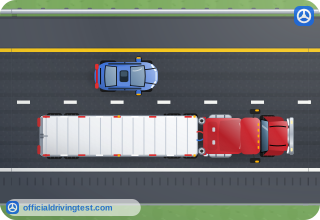
- Up to 5 minutes
- Up to 30 seconds
- Up to 2 minutes
- Up to 5 seconds
Show answer
Correct answer: Up to 30 seconds
The manual's Fact box says it can take up to 30 seconds to safely pass a truck at highway speeds.
Source: Pennsylvania Driver's Manual (Pub 95), page 56 · Open this page in the manual (Manual page 56)
-
When a truck is passing you, what should you do with your own speed?
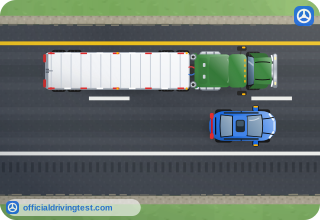
- Increase your speed to help the truck pass faster
- Brake hard repeatedly
- Match the truck's speed exactly
- Keep your speed steady and do not increase it
Show answer
Correct answer: Keep your speed steady and do not increase it
The manual instructs you to reduce your speed slightly, then keep it steady, and never increase your speed while a truck is passing you.
Source: Pennsylvania Driver's Manual (Pub 95), page 57 · Open this page in the manual (Manual page 57)
-
Compared to passenger vehicles, how do a truck's No-Zones on both sides compare?
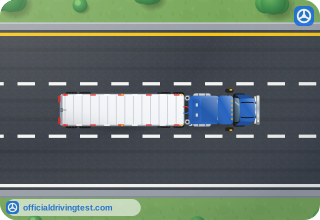
- They are smaller
- They are much larger
- They are about the same size
- Trucks have no No-Zones
Show answer
Correct answer: They are much larger
Trucks have much larger No-Zones on both sides of their vehicle than passenger vehicles.
Source: Pennsylvania Driver's Manual (Pub 95), page 57 · Open this page in the manual (Manual page 57)
-
If you are in a truck's blind spot and it begins to move into your lane, what should you consider as an escape route?
- A nearby driveway
- The truck's own lane
- The shoulder
- The oncoming lane
Show answer
Correct answer: The shoulder
The manual suggests considering the shoulder as an escape route if a truck begins moving into your lane while you are in its blind spot.
Source: Pennsylvania Driver's Manual (Pub 95), page 57 · Open this page in the manual (Manual page 57)
-
When meeting a truck coming from the opposite direction, what does wind turbulence do to vehicles?
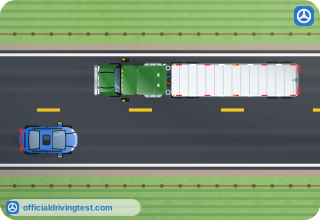
- It pushes vehicles apart
- It pulls vehicles together
- It only affects motorcycles
- It has no measurable effect
Show answer
Correct answer: It pushes vehicles apart
The manual notes that wind turbulence pushes vehicles apart, not together, so you should keep as far to the side as possible when meeting an oncoming truck.
Source: Pennsylvania Driver's Manual (Pub 95), page 57 · Open this page in the manual (Manual page 57)
-
If you cannot see a truck's side mirrors when following it, what does that tell you?
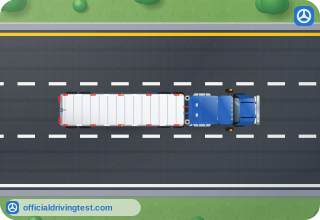
- The truck is about to turn
- The truck driver has an unobstructed view of you
- You are following at a safe distance
- The truck driver cannot see you
Show answer
Correct answer: The truck driver cannot see you
If you cannot see the side mirrors of the vehicle ahead of you, the driver of that large vehicle cannot see you either.
Source: Pennsylvania Driver's Manual (Pub 95), page 57 · Open this page in the manual (Manual page 57)
-
Why should you leave plenty of room between you and a truck when stopping on a hill?
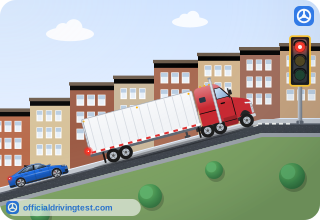
- Trucks may roll back as the driver releases the brake
- Trucks always stall on hills
- Trucks require extra room to open their doors
- Trucks cannot use their brakes on a hill
Show answer
Correct answer: Trucks may roll back as the driver releases the brake
The manual warns that trucks may roll back as a driver takes their foot off of the brake, so leave plenty of room when stopping behind one on a hill.
Source: Pennsylvania Driver's Manual (Pub 95), page 57 · Open this page in the manual (Manual page 57)
-
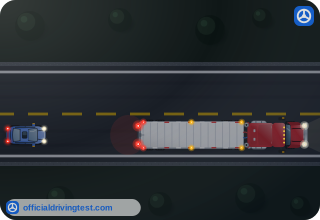
When following a truck at night, what should you always do with your headlights?
- Flash them repeatedly
- Dim your headlights
- Use your high beams to see around the truck
- Turn your headlights off entirely
Show answer
Correct answer: Dim your headlights
Bright headlights from behind can blind the truck driver by reflecting off the truck's large side mirrors, so always dim your headlights at night.
Source: Pennsylvania Driver's Manual (Pub 95), page 57 · Open this page in the manual (Manual page 57)
-
According to the manual's counting method, about how many seconds are needed to keep you out of a truck's rear blind spot?
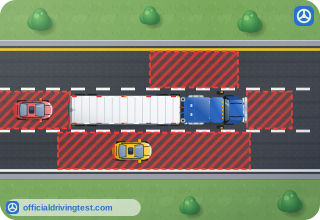
- At least 2 seconds
- At least 8 seconds
- At least 10 seconds
- At least 4 seconds
Show answer
Correct answer: At least 4 seconds
The manual explains that at least four seconds — counted as the truck passes a stationary object and your bumper reaches the same spot — are needed to stay out of a truck's rear blind spot.
Source: Pennsylvania Driver's Manual (Pub 95), page 57 · Open this page in the manual (Manual page 57)
-
Why do truck drivers make wide turns?
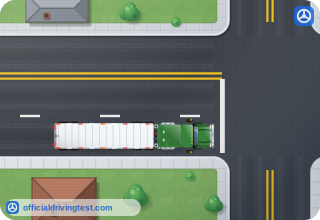
- Because trucks cannot turn sharply at all
- To show off their driving skill
- So the truck's rear can clear the corner
- To avoid using their turn signals
Show answer
Correct answer: So the truck's rear can clear the corner
Truck drivers make wide turns so the rear of the truck or trailer can clear the corner or other obstructions.
Source: Pennsylvania Driver's Manual (Pub 95), page 57 · Open this page in the manual (Manual page 57)
-
What might it look like when a truck is actually making a wide right turn?
- Like the truck is stopping completely in its lane
- Like the truck is reversing toward the curb
- Like the truck is pulling over to park
- Like the truck is going straight or turning left
Show answer
Correct answer: Like the truck is going straight or turning left
The manual's Fact box explains that a truck making a wide right turn can look like it is going straight or turning left, which makes trying to pass a turning truck a dangerous maneuver. Do not pass until the turn is complete.
Source: Pennsylvania Driver's Manual (Pub 95), page 57 · Open this page in the manual (Manual page 57)
-
What accompanies oversized load movements, according to the manual?
- A second driver only
- Nothing additional is required
- Pilot vehicles
- A police escort only within cities
Show answer
Correct answer: Pilot vehicles
Oversized loads are accompanied by pilot vehicles and should be treated with the same rules as trucks.
Source: Pennsylvania Driver's Manual (Pub 95), page 58 · Open this page in the manual (Manual page 58)
-
Why might an oversized load cross the yellow or white line?
- Due to its excessive width and obstacles on the berm
- Because the driver is not paying attention
- Because oversized loads are exempt from lane markings
- Because they always drive on the shoulder
Show answer
Correct answer: Due to its excessive width and obstacles on the berm
Due to their excessive width, obstacles on the berm could cause an oversized load to cross the yellow or white line.
Source: Pennsylvania Driver's Manual (Pub 95), page 58 · Open this page in the manual (Manual page 58)
-
What are pilot vehicles required by law to have to help identify them?
- A police radio
- Special signs and lights
- A loudspeaker system
- Extra headlights only
Show answer
Correct answer: Special signs and lights
Pilot vehicles are required by law to have special signs and lights to help identify them as escorting an oversized or slow-moving vehicle.
Source: Pennsylvania Driver's Manual (Pub 95), page 58 · Open this page in the manual (Manual page 58)
-
Why should you never try to cross behind a truck that is preparing to back up?
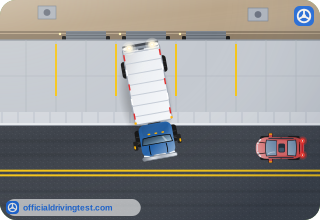
- The truck will always honk before it backs up
- It is illegal to walk or drive behind any truck
- You enter the truck's No-Zone, where a crash may occur
- Trucks never actually need to back up on a road
Show answer
Correct answer: You enter the truck's No-Zone, where a crash may occur
Passing close behind a backing truck puts a driver or pedestrian in the truck's No-Zone, where a crash may occur.
Source: Pennsylvania Driver's Manual (Pub 95), page 58 · Open this page in the manual (Manual page 58)
-
Why do trucks and buses often need longer distances to stop than passenger vehicles?
- They are not equipped with brakes
- They may have air brakes and are larger
- They must stop only at designated points
- They have smaller tires
Show answer
Correct answer: They may have air brakes and are larger
Unlike the hydraulic brakes on passenger vehicles, trucks and buses may have air brakes and take longer distances to stop. Because of their size, trucks also need longer distances to stop.
Source: Pennsylvania Driver's Manual (Pub 95), page 58 · Open this page in the manual (Manual page 58)
-
At 65 mph on a clear, dry roadway, what is the minimum stopping distance for a loaded truck with good tires and properly adjusted brakes?
- 600 feet
- 800 feet
- 500 feet
- 400 feet
Show answer
Correct answer: 600 feet
The manual states a loaded truck under these conditions requires a minimum of 600 feet to stop, compared to 400 feet for a passenger vehicle.
Source: Pennsylvania Driver's Manual (Pub 95), page 58 · Open this page in the manual (Manual page 58)
-
What are 'escape' or 'runaway' ramps on long downgrades meant for?
- Large vehicles out of control or with brake failure
- Any vehicle wanting to bypass slow traffic downhill
- Vehicles that need to turn around on the grade
- Emergency vehicles responding to a call nearby
Show answer
Correct answer: Large vehicles out of control or with brake failure
Escape ramps are to be used only by large vehicles that are out of control or cannot stop because of brake failure; never stop or park near them.
Source: Pennsylvania Driver's Manual (Pub 95), page 58 · Open this page in the manual (Manual page 58)
-
What happens first when a school bus is preparing to stop?
- Its stop arm swings out immediately
- Its amber (yellow) lights begin flashing
- Its red lights begin flashing
- Its horn sounds
Show answer
Correct answer: Its amber (yellow) lights begin flashing
When a school bus is preparing to stop, its amber (yellow) lights will begin flashing first.
Source: Pennsylvania Driver's Manual (Pub 95), page 58 · Open this page in the manual (Manual page 58)
3Part 320 questions
-
When a school bus stops with red lights flashing and its stop arm extended, how far away must you stop?
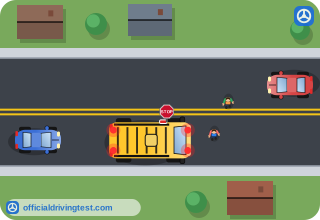
- At least 20 feet away
- At least 10 feet away
- At least 5 feet away
- At least 50 feet away
Show answer
Correct answer: At least 10 feet away
You must stop at least 10 feet away from a school bus stopped with its red lights flashing and stop arm extended.
Source: Pennsylvania Driver's Manual (Pub 95), page 58 · Open this page in the manual (Manual page 58)
-
What is the license suspension penalty for failing to stop for a school bus with a flashing red light and extended stop arm?
- A 60-day suspension
- A 6-month suspension
- A 1-year suspension
- A 30-day suspension
Show answer
Correct answer: A 60-day suspension
Failure to stop for a school bus with a flashing red light and extended stop arm results in a 60-day license suspension, in addition to points and a fine.
Source: Pennsylvania Driver's Manual (Pub 95), page 58 · Open this page in the manual (Manual page 58)
-
How many points are added to your driving record for failing to stop for a school bus with flashing red lights and an extended stop arm?
- 5 points
- 3 points
- 2 points
- 6 points
Show answer
Correct answer: 5 points
This violation carries five points on your driving record, along with a 60-day suspension and a fine.
Source: Pennsylvania Driver's Manual (Pub 95), page 58 · Open this page in the manual (Manual page 58)
-
What is the one exception to the school bus stopping requirement described in the manual?
- When driving on the opposite side of a divided highway
- When you are running late for work or school
- When it is raining and the road is slippery
- When there are no children visible near the bus
Show answer
Correct answer: When driving on the opposite side of a divided highway
The one exception is when you are driving on the opposite side of a divided highway (with a physical barrier, guide rail, or median); you must still reduce speed and drive with caution.
Source: Pennsylvania Driver's Manual (Pub 95), page 58 · Open this page in the manual (Manual page 58)
-
Why are horse-drawn vehicles often difficult to see at dawn, dusk, or night, according to the manual?
- They travel only on unlit back roads
- They are unusually small
- They are required to travel without lights
- Many are dark in color
Show answer
Correct answer: Many are dark in color
Many horse-drawn vehicles are dark in color and therefore difficult to see at dawn, dusk, or night.
Source: Pennsylvania Driver's Manual (Pub 95), page 59 · Open this page in the manual (Manual page 59)
-
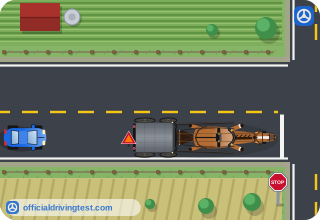
Why should you leave plenty of room when following or stopped behind a horse-drawn vehicle?
- They often roll backward after stopping
- They are required to stop every 100 feet
- They cannot use turn signals
- They travel faster than most vehicles
Show answer
Correct answer: They often roll backward after stopping
After stopping, horse-drawn vehicles often roll backward, and following too closely limits the horse-drawn vehicle driver's ability to see you. Leaving plenty of room also gives you space when you prepare to pass.
Source: Pennsylvania Driver's Manual (Pub 95), page 59 · Open this page in the manual (Manual page 59)
-
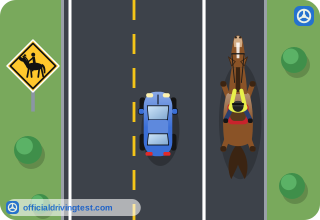
When passing a horse-drawn vehicle or horseback rider, what should you avoid doing?
- Driving too fast or blowing your horn
- Reducing your speed as you go around
- Checking your mirrors before moving back
- Signaling your lane change
Show answer
Correct answer: Driving too fast or blowing your horn
Do not drive too fast or blow your horn when passing a horse-drawn vehicle or horseback rider, as this may spook the horse.
Source: Pennsylvania Driver's Manual (Pub 95), page 59 · Open this page in the manual (Manual page 59)
-
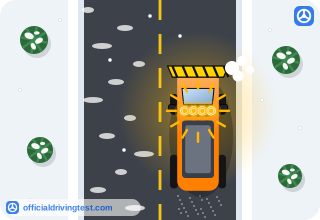
According to the manual, why should you follow a snow plow at a safe distance?
- They must often turn around and cannot see you behind them
- Their mirrors are covered by snow guards while plowing
- Snow always blocks their windshield and side windows
- Plow trucks are built without any side or rear mirrors
Show answer
Correct answer: They must often turn around and cannot see you behind them
Plow drivers have very limited visibility in their mirrors. Plows must often turn around, and their drivers cannot see you behind them, so follow at a safe distance.
Source: Pennsylvania Driver's Manual (Pub 95), page 60 · Open this page in the manual (Manual page 60)
-
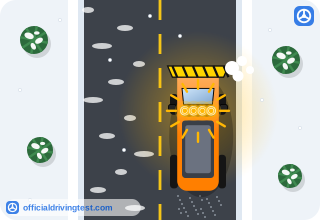
Why should you never attempt to pass a snow plow, on either side?
- Plows are required to stop for all passing vehicles
- Plows always travel faster than traffic
- It is illegal to be near any government vehicle
- Wing plows may stick out several feet and are hard to see
Show answer
Correct answer: Wing plows may stick out several feet and are hard to see
Snow plows may have wing plows that stick out several feet on either side and are difficult to see in bad weather or at night; you should not attempt to pass a plow on either side.
Source: Pennsylvania Driver's Manual (Pub 95), page 60 · Open this page in the manual (Manual page 60)
-
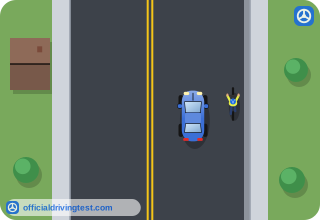
When passing a bicyclist in Pennsylvania, how much clearance must a driver allow between the vehicle and the bicycle?
- At least 2 feet
- At least 4 feet
- At least 3 feet
- At least 6 feet
Show answer
Correct answer: At least 4 feet
When passing, a driver must allow at least four feet between the vehicle and a bicycle to pass safely.
Source: Pennsylvania Driver's Manual (Pub 95), page 92 · Open this page in the manual (Manual page 92)
-
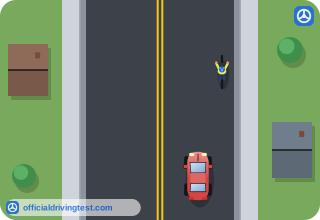
When passing a bicyclist, when is a driver permitted to cross a double yellow center line?
- Never, under any circumstances
- Only at night with headlights on
- If needed and safe, to keep 4 feet of clearance
- Only if the bicyclist signals permission
Show answer
Correct answer: If needed and safe, to keep 4 feet of clearance
If necessary and if it can be done safely, a driver is permitted to cross the center double yellow line to maintain the four feet of clearance from a bicycle.
Source: Pennsylvania Driver's Manual (Pub 95), page 92 · Open this page in the manual (Manual page 92)
-
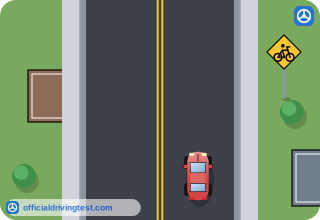
Unless making a left turn, where must a bicyclist traveling more slowly than other traffic ride, and when is this requirement waived?
- In the center of the lane at all times, never waived
- On the sidewalk, waived at intersections with traffic lights
- In the leftmost lane, waived during rush hour
- To the right, with traffic, waived on roads with one lane each way
Show answer
Correct answer: To the right, with traffic, waived on roads with one lane each way
Bicyclists traveling more slowly than passing vehicles must keep to the right and travel in the same direction as traffic, except when turning left; this is waived on roads with a single lane in each direction.
Source: Pennsylvania Driver's Manual (Pub 95), page 92 · Open this page in the manual (Manual page 92)
-
On a roadway with only one travel lane, what may a bicyclist do to avoid hazards or keep a safe distance from parked cars?
- Use any portion of the lane
- Ride only on the painted center line
- Pull completely off the paved roadway
- Dismount and walk the bicycle
Show answer
Correct answer: Use any portion of the lane
When there is only one travel lane, bicyclists may use any portion of the lane to avoid hazards, including keeping a safe distance from parked cars.
Source: Pennsylvania Driver's Manual (Pub 95), page 92 · Open this page in the manual (Manual page 92)
-
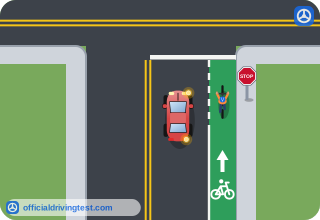
What does Pennsylvania law say about a driver turning in relation to a bicyclist riding straight ahead on a roadway or shoulder?
- Drivers may turn into the bicyclist's path if turning slowly
- Drivers cannot turn into the path of a bicyclist riding straight ahead
- Drivers may turn if they sound their horn first
- Drivers may turn only if the bicyclist is more than 50 feet away
Show answer
Correct answer: Drivers cannot turn into the path of a bicyclist riding straight ahead
Drivers cannot turn into the path of a bicyclist who is riding straight ahead on a roadway or shoulder.
Source: Pennsylvania Driver's Manual (Pub 95), page 92 · Open this page in the manual (Manual page 92)
-
What can happen to a driver who forces a bicyclist off the road in Pennsylvania?
- Nothing, since bicyclists are not protected under this law
- They receive a written warning only
- They may face criminal charges
- They must pay for the bicycle's repair only
Show answer
Correct answer: They may face criminal charges
A driver cannot force a bicyclist off the road; doing so may result in criminal charges.
Source: Pennsylvania Driver's Manual (Pub 95), page 92 · Open this page in the manual (Manual page 92)
-
How does Pennsylvania law treat bicyclists in relation to traffic laws and posted minimum speed limits?
- Bicyclists are exempt from all traffic laws
- Bicyclists must always travel at the posted minimum speed
- Bicyclists may only ride during daylight hours
- Bicyclists are considered vehicle operators who must obey traffic laws, but may travel below the posted minimum speed without being cited for impeding traffic
Show answer
Correct answer: Bicyclists are considered vehicle operators who must obey traffic laws, but may travel below the posted minimum speed without being cited for impeding traffic
Bicyclists are considered vehicle operators and must obey all traffic laws, but they may travel at less than the posted minimum speed and may not be cited for impeding traffic.
Source: Pennsylvania Driver's Manual (Pub 95), page 92 · Open this page in the manual (Manual page 92)
-
Are Pennsylvania bicyclists required to ride on a road's shoulder or berm when one is available?
- No, they may use it but are not required to
- Yes, it is always required
- Only required on freeways
- Only required when carrying a passenger
Show answer
Correct answer: No, they may use it but are not required to
Bicyclists may operate on a shoulder or berm, but are not required to do so.
Source: Pennsylvania Driver's Manual (Pub 95), page 92 · Open this page in the manual (Manual page 92)
-
What is the 'Dutch Reach' method for safely opening a vehicle door around bicyclists?
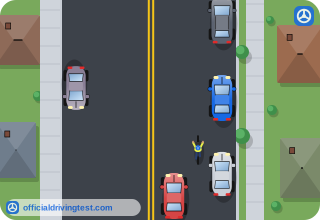
- Opening the door slowly with the hand nearer to the door
- Opening the door with your far hand, the hand farther from the door
- Opening the door only after honking the horn
- Opening the door while looking straight ahead
Show answer
Correct answer: Opening the door with your far hand, the hand farther from the door
The 'Dutch Reach' method means opening the door with your far hand, the hand farther from the door.
Source: Pennsylvania Driver's Manual (Pub 95), page 93 · Open this page in the manual (Manual page 93)
-
Why does the 'Dutch Reach' method help protect bicyclists?
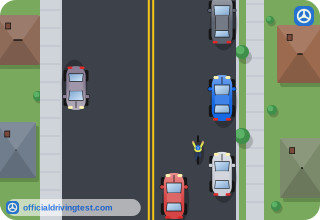
- It automatically locks the door if a bicyclist is near
- It keeps the door from opening more than one inch
- It forces your body to turn, helping you see approaching bicyclists, and prevents the door from opening too fast
- It sounds an alarm to warn cyclists
Show answer
Correct answer: It forces your body to turn, helping you see approaching bicyclists, and prevents the door from opening too fast
Using your far hand forces your body to turn, which better allows you to see approaching bicyclists, and also prevents the door from being opened too fast.
Source: Pennsylvania Driver's Manual (Pub 95), page 93 · Open this page in the manual (Manual page 93)
-
According to the manual, how far from parked cars should bicyclists ride to stay out of the 'door zone'?
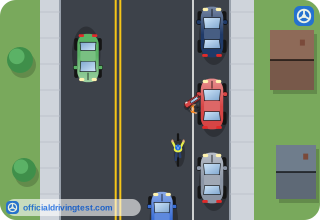
- At least 1 foot
- At least 6 feet
- At least 10 feet
- At least 3 feet
Show answer
Correct answer: At least 3 feet
Bicyclists should ride at least three feet from parked cars to avoid doors and stay outside the 'door zone.'
Source: Pennsylvania Driver's Manual (Pub 95), page 93 · Open this page in the manual (Manual page 93)