Pennsylvania: Freeway driving
Entering, exiting, and interchanges on limited-access highways. Split into 3 shorter tests so you're not stuck in one long quiz.
Independent educational site · not affiliated with any government agency or DMV
Choose a part
Freeway driving — Part 1
Questions in this part include: “In Pennsylvania, which odd-numbered interstate is in the western part of the state, while I-95 is in the eastern part?”
Freeway driving — Part 2
Questions in this part include: “Under Pennsylvania's teen crash statistics, what is the most frequent crash type for 16-year-old drivers?”
Freeway driving — Part 3
Questions in this part include: “What is the purpose of an acceleration lane at a highway entrance?”
Questions are original and based on the official manual "Pennsylvania Driver's Manual" (Pub 95), Pennsylvania Department of Transportation (PennDOT), Bureau of Driver Licensing.
All 48 Freeway driving questions with answers
Choose a part above to take a practice test, or study every question and answer here.
Show the questions and answersHide the questions
1Part 116 questions
-
On Pennsylvania highways, exit numbers correspond to:
- The mile markers on the highway
- The number of exits from the state line
- The county road index
- The order in which the exits were built
Show answer
Correct answer: The mile markers on the highway
Exit numbers correspond with the mile markers, allowing motorists to quickly calculate distances between exits.
Source: Pennsylvania Driver's Manual (Pub 95), page 19 · Open this page in the manual (Manual page 19)
-
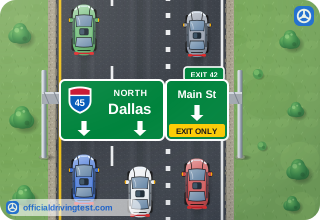
A yellow panel reading EXIT ONLY on a highway guide sign means the lane below the sign:
- Is reserved for emergency vehicles only
- Goes off the road to form a ramp
- Is only open during rush hour
- Requires an E-ZPass transponder
Show answer
Correct answer: Goes off the road to form a ramp
If a yellow EXIT ONLY panel is on a highway sign, the lane below will not continue through the interchange; instead, it will go off the road to form a ramp.
Source: Pennsylvania Driver's Manual (Pub 95), page 19 · Open this page in the manual (Manual page 19)
-
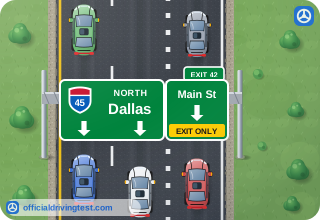
If you are driving in a lane posted with an EXIT ONLY sign, you:
- May stay in the lane and continue straight through the interchange
- Must come to a complete stop before the exit
- May change lanes, or must exit the highway if you stay in the lane
- May only exit if a police officer directs you to
Show answer
Correct answer: May change lanes, or must exit the highway if you stay in the lane
If you are in a lane posted with an EXIT ONLY sign, you may change lanes, or you must exit the highway if you stay in this lane.
Source: Pennsylvania Driver's Manual (Pub 95), page 19 · Open this page in the manual (Manual page 19)
-
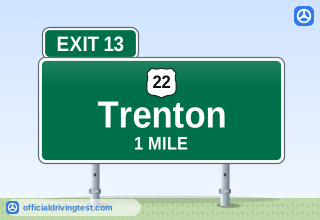
On a highway guide sign, if the small green EXIT number panel is positioned on the LEFT side of the main green rectangular sign, it tells you:
- The exit is on the right side of the highway
- The exit has been closed
- You must merge left immediately
- The exit is on the left side of the highway
Show answer
Correct answer: The exit is on the left side of the highway
The small green EXIT number sign on top of the green rectangular sign will be on the left side of the sign if the exit is on the left side of the highway.
Source: Pennsylvania Driver's Manual (Pub 95), page 20 · Open this page in the manual (Manual page 20)
-
On a highway guide sign, if the small green EXIT number panel is positioned on the RIGHT side of the main green rectangular sign, it tells you:
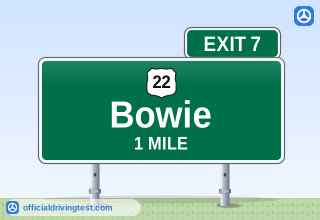
- The exit is on the right side of the highway
- The exit is two miles ahead
- The exit is on the left side of the highway
- The exit no longer exists
Show answer
Correct answer: The exit is on the right side of the highway
The small green EXIT number sign on top of the green rectangular sign will be on the right side of the sign if the exit is on the right side of the highway.
Source: Pennsylvania Driver's Manual (Pub 95), page 20 · Open this page in the manual (Manual page 20)
-
If a highway exit guide sign includes white arrows, the arrows:
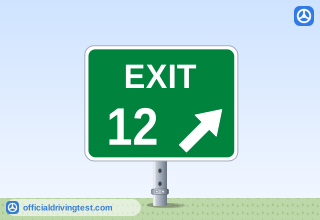
- Show the recommended cruising speed
- Point in the direction of the exit
- Indicate you should stop and wait
- Mark a detour route
Show answer
Correct answer: Point in the direction of the exit
If the sign has white arrows, the arrow will point in the direction of the exit.
Source: Pennsylvania Driver's Manual (Pub 95), page 20 · Open this page in the manual (Manual page 20)
-
A red, white and blue shield-shaped sign on a highway indicates that the highway is:
- A state-numbered truck route
- A toll road
- An interstate
- A scenic byway
Show answer
Correct answer: An interstate
The red, white and blue shield sign indicates a highway is an interstate.
Source: Pennsylvania Driver's Manual (Pub 95), page 20 · Open this page in the manual (Manual page 20)
-
One- or two-digit, even-numbered interstate highways are generally:
- North-south routes
- Toll-only routes
- Beltway loops around cities
- East-west routes
Show answer
Correct answer: East-west routes
One- or two-digit, even-numbered interstates are generally east-west routes.
Source: Pennsylvania Driver's Manual (Pub 95), page 20 · Open this page in the manual (Manual page 20)
-
Nationally, even-numbered one- or two-digit interstate route numbers generally increase:
- From I-10 in the south to I-94 in the north
- From I-94 in the north to I-10 in the south
- From east to west
- From west to east
Show answer
Correct answer: From I-10 in the south to I-94 in the north
Nationally, the numbers of even-numbered interstates increase from I-10 in the south to I-94 in the north.
Source: Pennsylvania Driver's Manual (Pub 95), page 20 · Open this page in the manual (Manual page 20)
-
In Pennsylvania, which even-numbered interstate is in the southern part of the state, while I-84 and I-80 are in the northern part?
- I-95
- I-76
- I-79
- I-81
Show answer
Correct answer: I-76
In Pennsylvania, I-76 is in the southern part of the state, and I-84 and I-80 are in the northern part.
Source: Pennsylvania Driver's Manual (Pub 95), page 20 · Open this page in the manual (Manual page 20)
-
One- or two-digit, odd-numbered interstate highways are generally:
- East-west routes
- Spur routes only
- North-south routes
- Beltways around cities
Show answer
Correct answer: North-south routes
One- or two-digit, odd-numbered interstates are generally north-south routes.
Source: Pennsylvania Driver's Manual (Pub 95), page 20 · Open this page in the manual (Manual page 20)
-
Nationally, odd-numbered one- or two-digit interstate route numbers generally increase:
- From the east coast (I-95) to the west coast (I-5)
- From north to south
- From south to north
- From the west coast (I-5) to the east coast (I-95)
Show answer
Correct answer: From the west coast (I-5) to the east coast (I-95)
Numbers of odd-numbered interstates increase from the west coast I-5 to the east coast I-95.
Source: Pennsylvania Driver's Manual (Pub 95), page 20 · Open this page in the manual (Manual page 20)
-
In Pennsylvania, which odd-numbered interstate is in the western part of the state, while I-95 is in the eastern part?
- I-79
- I-80
- I-76
- I-84
Show answer
Correct answer: I-79
In Pennsylvania, I-79 is in the western part of the state, and I-95 is in the eastern part.
Source: Pennsylvania Driver's Manual (Pub 95), page 20 · Open this page in the manual (Manual page 20)
-
A three-digit interstate route number whose first digit is EVEN, such as I-276 in Philadelphia, usually indicates:
- A spur connecting to another interstate at only one end
- A loop or beltway connecting to interstates at both ends
- A temporary construction detour
- A route reserved for commercial trucks only
Show answer
Correct answer: A loop or beltway connecting to interstates at both ends
If the first of the three digits is an even number, the highway usually connects to interstate highways at both ends, such as I-276 in Philadelphia; these are often called loops or beltways.
Source: Pennsylvania Driver's Manual (Pub 95), page 20 · Open this page in the manual (Manual page 20)
-
A three-digit interstate route number whose first digit is ODD, such as I-180 in Williamsport, usually indicates:
- A loop that connects to an interstate at both ends
- A scenic alternate route
- A spur connecting to another interstate at only one end
- A route that only exists in urban areas
Show answer
Correct answer: A spur connecting to another interstate at only one end
When the first of the three digits is odd, the highway is usually a spur route connecting with another interstate at only one end, sometimes going into a city center such as I-180 in Williamsport.
Source: Pennsylvania Driver's Manual (Pub 95), page 20 · Open this page in the manual (Manual page 20)
-
Mile markers posted along some Pennsylvania highways indicate:
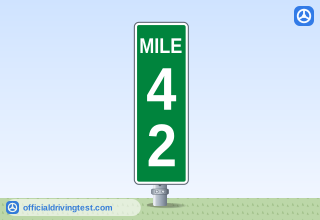
- The posted speed limit for that section of road
- The number of miles until the next rest area
- The distance to the nearest hospital
- The distance from where the route entered the state
Show answer
Correct answer: The distance from where the route entered the state
Mile markers indicate the number of miles from the point where the traffic route entered the state or from its beginning, if it does not extend to the state borders.
Source: Pennsylvania Driver's Manual (Pub 95), page 20 · Open this page in the manual (Manual page 20)
2Part 216 questions
-
On Pennsylvania highways, mile marker numbers generally:
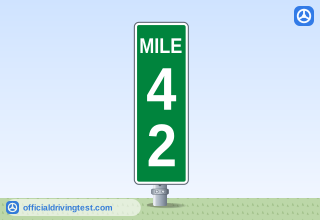
- Start at zero in the west or south and increase going east or north
- Start at 100 everywhere and count down
- Reset to zero at every county line
- Start at zero in the eastern part of the state and increase going west
Show answer
Correct answer: Start at zero in the west or south and increase going east or north
The numbers start at zero in the western part of the state for east-west roadways and in the southern part of the state for north-south roadways, increasing as you travel east or north.
Source: Pennsylvania Driver's Manual (Pub 95), page 20 · Open this page in the manual (Manual page 20)
-
If you enter Pennsylvania from the west on Interstate 80, the mile markers:
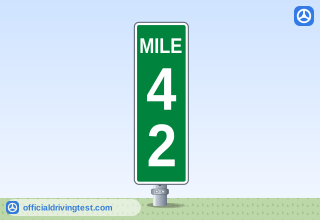
- Count down from 100 as you travel east
- Begin at Mile 1 and increase as you travel east
- Stay the same number for the entire route
- Begin at Mile 1 and decrease as you travel east
Show answer
Correct answer: Begin at Mile 1 and increase as you travel east
When you enter Pennsylvania from the west on Interstate 80, the mile markers begin at Mile 1 and increase as you travel east.
Source: Pennsylvania Driver's Manual (Pub 95), page 20 · Open this page in the manual (Manual page 20)
-
Knowing how to read highway mile markers is especially useful because it can help you:
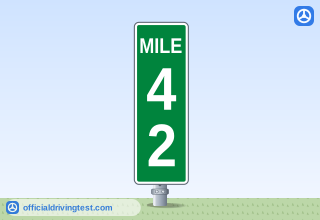
- Calculate your fuel economy
- Avoid speeding tickets
- Tell roadside assistance where you are
- Determine toll charges in advance
Show answer
Correct answer: Tell roadside assistance where you are
Knowing how to read mile markers can help you know exactly where you are and give an approximate location if you have to call for roadside assistance.
Source: Pennsylvania Driver's Manual (Pub 95), page 20 · Open this page in the manual (Manual page 20)
-
According to the PA Driver's Manual, what happens if you drive too fast on a curve?
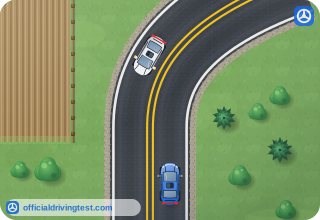
- The curve will straighten out to match your speed
- Your tires will grip the road better the faster you go
- Your vehicle will keep moving straight instead of following the curve
- Your vehicle will automatically slow itself to match the curve
Show answer
Correct answer: Your vehicle will keep moving straight instead of following the curve
Vehicles have too much inertia to instantly change direction; driving too fast on a curve makes the vehicle keep moving straight instead of following the bend.
Source: Pennsylvania Driver's Manual (Pub 95), page 51 · Open this page in the manual (Manual page 51)
-
On a left-bending curve, what is likely to happen if you take it too fast?
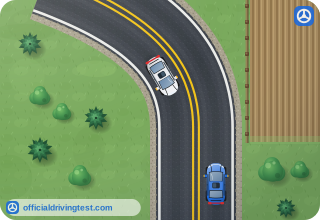
- You will go into the oncoming lane of traffic
- You will run off of the road
- You will stop automatically
- Nothing; left curves are not affected by speed
Show answer
Correct answer: You will run off of the road
The manual explains that on a left-bending curve, excess speed will carry you straight off the road instead of around the bend.
Source: Pennsylvania Driver's Manual (Pub 95), page 51 · Open this page in the manual (Manual page 51)
-
On a right-bending curve, what is likely to happen if you take it too fast?
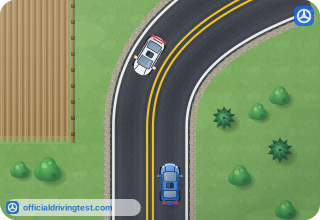
- You will stop safely at the curve's edge
- You will run off of the road to the right
- You will go into the other lane of traffic
- Your vehicle will slow itself automatically
Show answer
Correct answer: You will go into the other lane of traffic
On a right-bending curve, taking it too fast tends to carry your vehicle straight into the oncoming lane of traffic.
Source: Pennsylvania Driver's Manual (Pub 95), page 51 · Open this page in the manual (Manual page 51)
-
Under Pennsylvania's teen crash statistics, what is the most frequent crash type for 16-year-old drivers?
- A head-on collision while passing
- A rear-end collision at a traffic signal
- A single-vehicle, run-off-the-road crash
- A sideswipe collision while changing lanes
Show answer
Correct answer: A single-vehicle, run-off-the-road crash
The manual states the most frequent crash type for 16-year-old drivers in Pennsylvania is a single-vehicle, run-off-the-road crash.
Source: Pennsylvania Driver's Manual (Pub 95), page 51 · Open this page in the manual (Manual page 51)
-
From 2013 to 2017, about how many single-vehicle, run-off-the-road crashes involved 16-year-old drivers in Pennsylvania?
- 329
- 3,291
- 9,291
- 929
Show answer
Correct answer: 3,291
The manual reports 3,291 such crashes involving 16-year-old drivers in Pennsylvania from 2013 to 2017.
Source: Pennsylvania Driver's Manual (Pub 95), page 51 · Open this page in the manual (Manual page 51)
-
From 2013 to 2017, how many people were killed in Pennsylvania in run-off-the-road crashes involving 16-year-old drivers?
- 20
- 8
- 2
- 50
Show answer
Correct answer: 20
The manual states that 20 people were killed in these crashes from 2013 to 2017.
Source: Pennsylvania Driver's Manual (Pub 95), page 51 · Open this page in the manual (Manual page 51)
-
To maintain control on a curve, when should you slow down?
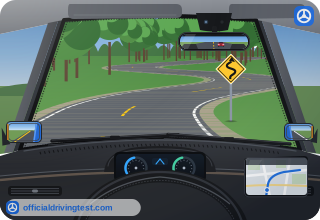
- Before you enter the curve
- While you are in the middle of the curve
- After you enter the curve
- Only if another vehicle is approaching
Show answer
Correct answer: Before you enter the curve
The manual stresses that to maintain control on curves, you must slow down before you enter the curve, not after.
Source: Pennsylvania Driver's Manual (Pub 95), page 51 · Open this page in the manual (Manual page 51)
-
What kind of warning sign will you usually see as you approach a curve?
- A blue rectangular information sign
- A red octagon sign
- A green guide sign
- A yellow diamond sign showing the bend
Show answer
Correct answer: A yellow diamond sign showing the bend
As you approach a curve you will usually see a yellow diamond warning sign showing how the road bends.
Source: Pennsylvania Driver's Manual (Pub 95), page 51 · Open this page in the manual (Manual page 51)
-
What are chevron warning signs, sometimes placed throughout a sharp curve, especially helpful for?
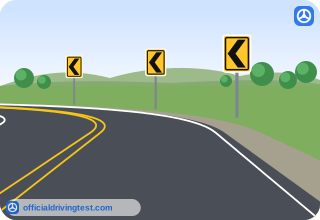
- Showing the posted speed limit
- Marking the start of a school zone
- Indicating a merging lane
- Driving at night or in poor visibility
Show answer
Correct answer: Driving at night or in poor visibility
Chevron signs on sharp curves are described as very helpful at night or in poor visibility conditions.
Source: Pennsylvania Driver's Manual (Pub 95), page 51 · Open this page in the manual (Manual page 51)
-
According to the manual's guidance for driving through curves, where should you look to steer safely, especially when there are multiple curves ahead?
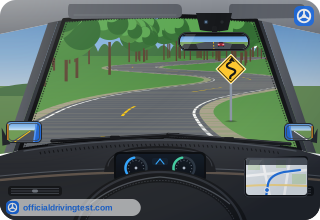
- Only at the outside edge of the curve
- Only at the centerline
- Directly at your vehicle's hood ornament
- At the inside edge of each curve ahead
Show answer
Correct answer: At the inside edge of each curve ahead
The manual advises scanning ahead and looking at the inside edge of the curve — of each curve, if there are several — as far ahead as you can see.
Source: Pennsylvania Driver's Manual (Pub 95), page 51 · Open this page in the manual (Manual page 51)
-
According to the manual, when are you at the greatest risk while driving on a highway?
- Only when driving alone
- Only when driving in the rain
- Only when driving at night
- At interchanges, when changing lanes, and when traffic unexpectedly slows or stops
Show answer
Correct answer: At interchanges, when changing lanes, and when traffic unexpectedly slows or stops
The manual identifies highway interchanges, lane changes, and unexpected slowing or stopping in traffic as the times of greatest risk.
Source: Pennsylvania Driver's Manual (Pub 95), page 52 · Open this page in the manual (Manual page 52)
-
What is your first critical decision when entering a highway?
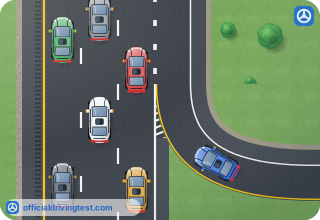
- Not turning onto the exit ramp
- Choosing your highway exit
- Adjusting your mirrors
- Checking your fuel gauge
Show answer
Correct answer: Not turning onto the exit ramp
The manual warns that your first critical decision is making sure you do not mistakenly turn onto the exit ramp and drive head-on into other traffic.
Source: Pennsylvania Driver's Manual (Pub 95), page 52 · Open this page in the manual (Manual page 52)
-
Which signs mark an exit ramp, helping you avoid entering it by mistake?
- ONE WAY, DO NOT ENTER, WRONG WAY signs
- Chevron signs
- Orange construction warning signs
- HIGHWAY ENTRANCE signs
Show answer
Correct answer: ONE WAY, DO NOT ENTER, WRONG WAY signs
Exit ramps are marked with ONE WAY signs as well as DO NOT ENTER and WRONG WAY signs.
Source: Pennsylvania Driver's Manual (Pub 95), page 52 · Open this page in the manual (Manual page 52)
3Part 316 questions
-
If you see a white line on your right and a yellow line on your left as you head onto a ramp, what does this tell you?
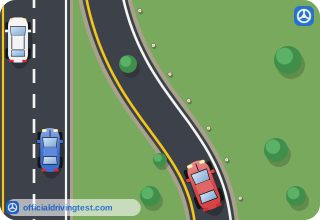
- The ramp is closed
- You are on an exit ramp
- You are headed the wrong way
- You are headed the right way
Show answer
Correct answer: You are headed the right way
A white line on the right and a yellow line on the left tell you that you are headed in the right direction onto the highway.
Source: Pennsylvania Driver's Manual (Pub 95), page 52 · Open this page in the manual (Manual page 52)
-
In a 'weaving lane' shared by traffic entering and exiting a highway, who must yield?
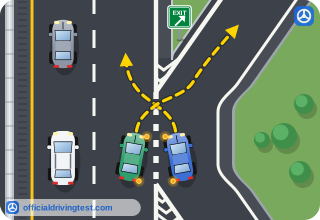
- Whichever driver is on the left
- The entering driver must yield to the exiting driver
- Both drivers may proceed at the same time
- The exiting driver must yield to the entering driver
Show answer
Correct answer: The entering driver must yield to the exiting driver
When highway entrances and exits are close together and share a weaving lane, the driver entering the highway must yield to the exiting driver.
Source: Pennsylvania Driver's Manual (Pub 95), page 52 · Open this page in the manual (Manual page 52)
-
What is the purpose of an acceleration lane at a highway entrance?
- To provide extra parking near the highway
- To let you make a U-turn safely
- To let you reach traffic speed before entering
- To allow trucks to weigh their loads
Show answer
Correct answer: To let you reach traffic speed before entering
Acceleration lanes run beside the main traffic lanes and should be long enough to let you reach the speed of traffic before entering the highway.
Source: Pennsylvania Driver's Manual (Pub 95), page 52 · Open this page in the manual (Manual page 52)
-
When looking for a gap while driving on a highway entrance ramp, what should you do?
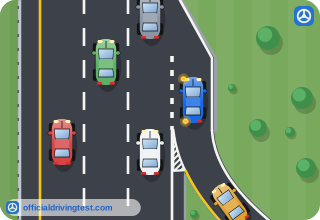
- Look only in your rearview mirror
- Look over your shoulder and in your side mirror
- Look only straight ahead
- Look only at the speedometer
Show answer
Correct answer: Look over your shoulder and in your side mirror
The manual advises looking over your shoulder and in your side mirror when looking for a gap on an entrance ramp.
Source: Pennsylvania Driver's Manual (Pub 95), page 52 · Open this page in the manual (Manual page 52)
-
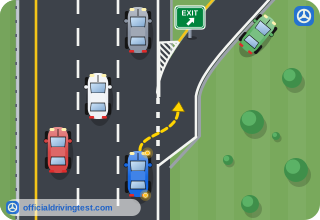
According to the manual, when should you slow down while preparing to exit a highway?
- As soon as you see the exit sign
- Only after you have moved into the exit lane
- You should never slow down until you leave the ramp
- Before you move into the exit lane
Show answer
Correct answer: Only after you have moved into the exit lane
The manual instructs drivers to get into the proper lane well in advance and not slow down until after moving into the exit lane.
Source: Pennsylvania Driver's Manual (Pub 95), page 52 · Open this page in the manual (Manual page 52)
-
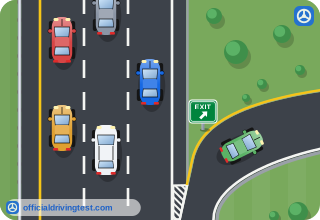
What should you do if you miss your highway exit?
- Cross the median to turn around
- Back up on the shoulder to reach it
- Take the next exit
- Stop on the highway and wait for a gap
Show answer
Correct answer: Take the next exit
The manual is clear: if you miss your exit, take the next one. Backing up, stopping, or crossing the median are described as illegal and hazardous.
Source: Pennsylvania Driver's Manual (Pub 95), page 52 · Open this page in the manual (Manual page 52)
-
What do exit ramp warning signs let you know?
- The location of the nearest gas station
- The maximum safe speed for the ramp
- The distance to the next rest stop
- The number of lanes ahead
Show answer
Correct answer: The maximum safe speed for the ramp
Exit ramps have a warning sign that lets you know the maximum safe speed for taking the ramp.
Source: Pennsylvania Driver's Manual (Pub 95), page 52 · Open this page in the manual (Manual page 52)
-
About how many feet per second does a vehicle traveling 65 mph cover?
- About 50 feet per second
- About 100 feet per second
- About 25 feet per second
- About 200 feet per second
Show answer
Correct answer: About 100 feet per second
The manual notes that 65 mph is almost 100 feet per second, meaning it takes less than one second to run off of the road.
Source: Pennsylvania Driver's Manual (Pub 95), page 52 · Open this page in the manual (Manual page 52)
-
According to the manual, about how much of the fatal crashes on highways involve vehicles that ran off the road due to speeding and/or driver fatigue?
- Nearly all
- About half
- About one tenth
- About one quarter
Show answer
Correct answer: About half
The manual states that half of the fatal crashes on highways involve vehicles that ran off the road as a result of speeding and/or driver fatigue.
Source: Pennsylvania Driver's Manual (Pub 95), page 52 · Open this page in the manual (Manual page 52)
-
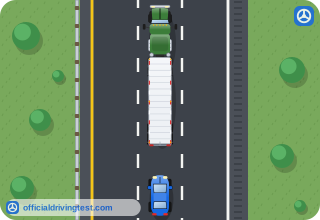
When changing lanes to pass a slower vehicle on a highway, how many lanes should you move at a time?
- As many as needed in one motion
- Three lanes at once
- Two lanes at once
- One lane at a time
Show answer
Correct answer: One lane at a time
The manual instructs drivers to change lanes only one lane at a time when passing a slower vehicle on a highway.
Source: Pennsylvania Driver's Manual (Pub 95), page 52 · Open this page in the manual (Manual page 52)
-
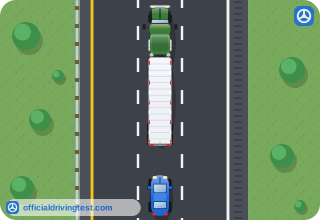
When changing lanes on a highway, when should you turn on your turn signal?
- In plenty of time for other drivers to see it
- Only if another vehicle is directly behind you
- You are not required to signal on a highway
- Only after you have completed the lane change
Show answer
Correct answer: In plenty of time for other drivers to see it
The manual says to use your turn signal every time you change lanes, turning it on in plenty of time for other drivers to see it.
Source: Pennsylvania Driver's Manual (Pub 95), page 52 · Open this page in the manual (Manual page 52)
-
As a courtesy when you see a vehicle about to enter the highway from an on-ramp, what does the manual suggest, after first checking it is clear around your vehicle?
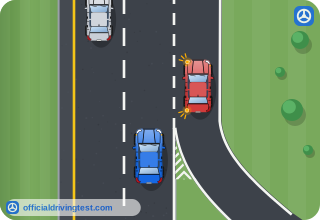
- Stop on the highway to let the driver in
- Speed up so the driver cannot merge
- Change lanes to let the driver enter easily
- Flash your high beams repeatedly
Show answer
Correct answer: Change lanes to let the driver enter easily
As a common courtesy, changing lanes (after checking it is clear) to let an entering driver merge more easily helps keep traffic moving smoothly.
Source: Pennsylvania Driver's Manual (Pub 95), page 52 · Open this page in the manual (Manual page 52)
-
Even though a courteous driver may make room for a merging vehicle, who is actually required by law to yield the right-of-way when entering a highway?
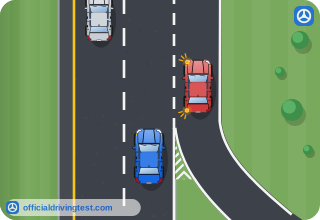
- The driver already on the highway
- The entering driver
- Neither driver
- Whichever driver arrives first
Show answer
Correct answer: The entering driver
The manual notes that the entering driver is required to yield the right-of-way to traffic already on the highway, even though other drivers may courteously make room.
Source: Pennsylvania Driver's Manual (Pub 95), page 52 · Open this page in the manual (Manual page 52)
-
What is 'highway hypnosis'?
- Inattention from staring straight ahead for long periods
- A medical condition requiring a doctor's note
- A legal requirement to stay in one highway lane
- A type of headlight glare
Show answer
Correct answer: Inattention from staring straight ahead for long periods
Highway hypnosis happens when you stare straight ahead for long periods and stop actively scanning ahead, behind, and around your vehicle.
Source: Pennsylvania Driver's Manual (Pub 95), page 52 · Open this page in the manual (Manual page 52)
-
Of fatal crashes on highways, about what percent involve rear-end collisions?
- 5 percent
- 20 percent
- 50 percent
- 80 percent
Show answer
Correct answer: 20 percent
The manual states that 20 percent of fatal highway crashes involve rear-end collisions, mostly due to driver inattention and following too closely.
Source: Pennsylvania Driver's Manual (Pub 95), page 52 · Open this page in the manual (Manual page 52)
-
What does the manual say accounts for most rear-end collision fatalities on highways?
- Poor road lighting at night
- Faulty or burned-out brake lights
- Inattention and following too closely
- Heavy rain and wet pavement
Show answer
Correct answer: Inattention and following too closely
Driver inattention and following too closely are identified as the main causes of most rear-end collisions on highways.
Source: Pennsylvania Driver's Manual (Pub 95), page 52 · Open this page in the manual (Manual page 52)